



The Importance Of Emotional Control In Trading Success


Have you ever made a trade you regretted just minutes later? The skill and knowledge to eyeball trading charts to recognize a potential shift in market sentiment is crucial to attaining trading success. But besides skill and expertise, you also need to have a firm handle on your emotions if you’re ever to become profitable.
As Warren Buffet puts it, “ The most important quality for an investor is temperament, not intellect.” You must remember that your trading performance will hinge on your ability to manage emotions and maintain discipline, especially when in a high-stakes situation. It’s important to understand that emotional control in trading is key to profitability.
Many traders tend to fall into the trap of abandoning their trading strategies when things begin to go south. Failing to stick to your strategy leads to impulsive decision making increasing your chances of incurring huge losses. Trading discipline is vital in preventing emotional reactions to negative market conditions.
Incorporating well-thought-out risk management strategies can assist you in maintaining emotional control. Join us below as we take you through why emotional control matters, common emotional traps you’re likely to face, and tips that you can use to build emotional control. We will also provide an example of a successful trader with emotional control.
Why Emotional Control Matters In Trading
Trading psychology is a study that investigates how different psychological and emotional aspects can influence a trader’s behaviour. It investigates the impact of cognitive biases, mental states, and self-control on trading outcomes. The study recognizes and understands that traders don’t always act rationally. This is because they’re emotional beings who can easily be influenced by a broad range of psychological factors. When this happens, it can lead to suboptimal decision-making, impulsive actions, and biased thinking.
The Role Of Emotions In Financial Decisions
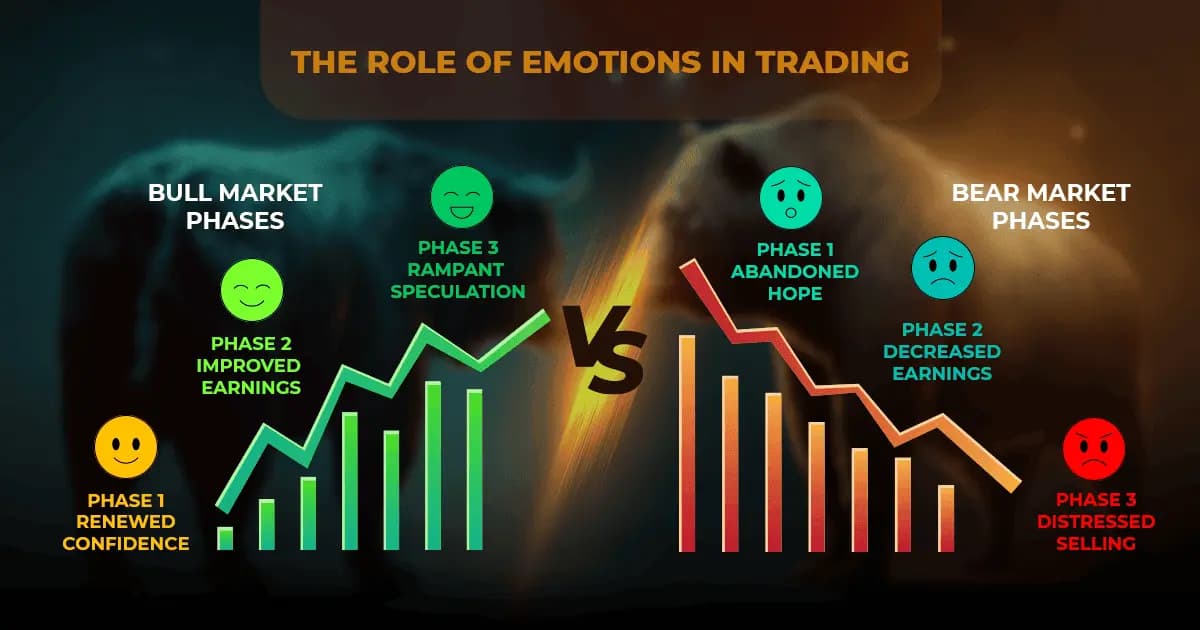
Many traders and investors consider financial decisions to be a matter of the mind rather than the heart. For example, when picking a stock or creating a budget, you’re likely to approach financial considerations as logical matters. After all, you need to be smart when it comes to how you spend your money!
Decisions related to money are an excellent example of how hard it can be to practise what you preach. It’s vital to understand that emotions have a huge influence on your decision-making processes. This is because you’ll likely feel positive or negative about a trading decision immediately, only that you’re likely to develop arguments to support your decision.
The following are some of the emotions that are likely to drive your financial decisions:
- Fear: Fear is among the most powerful emotions in trading, even among traders who have some semblance of trading discipline. Studies have shown that the fear of losing $100 in a trade tends to be significantly higher than the prospect of gaining $100. This is a concept known as loss aversion.
- Greed: Greed is an emotion that can drive you to take excessive risks in the hope of a bigger return. Compared to other emotions, such as fear, greed tends to be more calculated or rational. It can cause you to overestimate the odds by promoting a get-rich mentality. This is among the reasons you need to develop emotional control in trading.
How Emotions Can Undermine Trading Strategies
Revenge trading is a natural response when faced with significant losses. According to Brett Steenbarger –a renowned trading coach – “Revenge trading is caused by wrath as you are angry that you lost and have the lust to make it all back quickly.” When you experience a significant loss, your natural reaction will be to try and make another deal to help recoup your losses. Often, this happens without first pausing to consider whether this is the best course of action. As a result, this may lead to:
- Increased risk-taking
- Loss of objectivity
- Impulsive decision making
- Cyclical losses
Decision-making under pressure is not easy. But you must learn to master trading discipline if you’re to avoid getting sucked into revenge trading.
Common Emotional Traps And Cognitive Biases In Trading
Trading in the forex markets, whether stocks, commodities, or cryptocurrencies isn’t just about analysing charts and crunching numbers; it’s also about managing your mindset. The emotional aspect of trading can have a significant influence on your profitability. Understanding how cognitive biases and trading greed impact your trading decisions is key to developing strategies that can prevent such pitfalls.
Source: Faster Capital
The Fear Factor: How Anxiety Drives Poor Decisions
Fear is an extremely powerful emotion that can significantly influence your behaviours, thoughts, and decision-making processes. In trading, fear can manifest in various ways, such as fear of making the wrong move and the fear of missing out (FOMO). Understanding the impact of fear in trading is crucial to learning how to make informed decisions.
Some important insights you need to keep in mind related to fear include:
- It can lead to irrational decision-making.
- Fear can cause you to miss out on profitable investment opportunities.
- It can be contagious.
- You can manage it.
Greed And Overconfidence: The Silent Killers Of Profitability
Greed in forex trading refers to the overwhelming desire for more wins, more profits, and more success. When coupled with overconfidence, it leads to a lack of regard for risk, resulting in a disastrous performance. Greed and overconfidence in trading can manifest in numerous ways, such as holding on to a position for too long or trying to chase unrealistic returns.
These two silent killers can alter your decision-making processes, thus clouding your judgement. This may cause you to believe that the market will continue to behave in your favour. It’s this kind of overconfidence that may ultimately push you into abandoning your trading strategies or even taking unnecessary risks.
The Challenge Of Impatience In Trading
In this fast-paced world, emotional trading can manifest in various ways, such as impatience. For traders, patience doesn’t always seem like a virtue, as they understand all too well that stock and securities prices can rise or fall at any moment. However, there’s one thing that every successful trader understands: “A trader who can’t wait will never be a successful trader.”
Impatience can lead to costly trading mistakes. Generally, it manifests in the following ways:
- Trying to chase after the next hot stock
- Overtrading
- Panic selling
Patience is the cornerstone to success as it minimises emotional reactions, leading to well-thought-out decision-making processes.
Common Cognitive Biases In Trading
Besides your emotions, you should also be aware of cognitive biases that often affect your results.
For example, self-serving bias is the habit of attributing good results to skills, but poor results to bad luck. As such, if a trade goes wrong, you may find yourself focused on acquiring lucky charms, instead of analysing what went wrong.
Another common example is the confirmation bias where you seek out information to affirm what you already believe, instead of moving with the facts. The framing bias also makes you susceptible to false narratives because it considers how information is packaged, rather than what the package contains.
Each of these biases actively work against you and are a reminder to work using correct data and strategies, rather than what we find more appealing.
Tips For Building Emotional Control
Building emotional control when trading can prove to be the difference between profitability and loss-making. Your mental state can significantly impact your decision-making processes, especially when starting as a trader. You must remember that maintaining a calm demeanour is the key to becoming a consistent trader.
Fortunately, there is something that you can do to get into the right frame of mind.
Create A Guide For Evaluating Your Own Emotional Patterns
Mastering your emotions begins with naming them and noticing patterns actively working against your trading goals.
An emotional chart is a great tool for identifying what you feel. For example, what most people describe as fear could be humiliation, rejection, submission, insecurity, anxiety or feeling scared.
To accurately identify your feelings, look up the definition of each emotion and where you’ll feel it in the body. For example, fear causes butterflies in the stomach, sweating, difficulty breathing, hot flushes, and an elevated heart rate.
After naming the emotion, journal your feelings to establish a pattern over time
Write about your experience in detail by naming the feeling, what you felt in your body and the context around the feeling. Context helps you identify the trigger for your emotional reactions.
As you expand your record, you’ll begin to identify emotional patterns. Furthermore, as you acknowledge each emotion and trigger, you can then map out a plan for addressing them.
For instance, if you’re afraid of trading because you made significant losses, how can you choose to cope with the fear moving forward? Should you exercise to reduce the physical anxiety you feel? Do you need morning affirmations before making the trade to remind you that you can move past your mistakes? Should you add a family picture on your desk to remember what motivates you? Dig deep within to figure out what gives you peace and incorporate it into your trading practices.
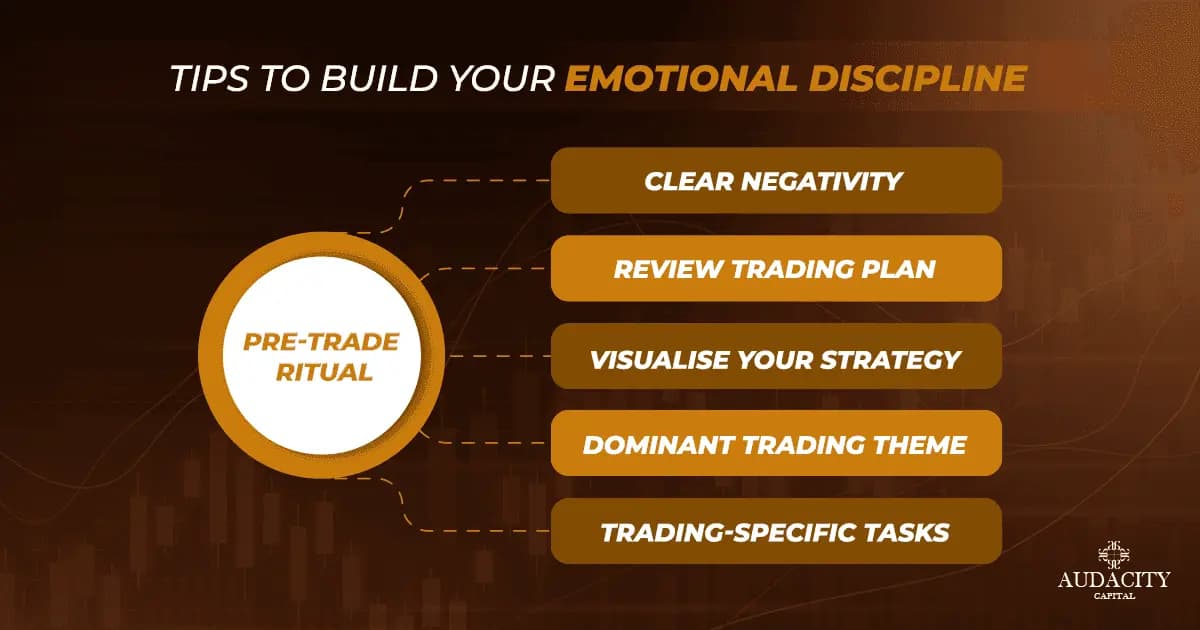
Develop A Pre-trade Ritual: Preparing Your Mind For The Market
To get into the zone for trading, it’s best to develop a pre-trade preparation routine. This is the routine you’ll use to get yourself into the right mind frame: confident, focused, alert, and ready to pounce. An ideal routine should take five to ten minutes to complete and should include some, if not all, of the following:
- Clearing Negativity: Perform a power pose and breathing exercises to regulate your body and boost your confidence and remind yourself that you’re in charge. You can do this at your desk or when making breakfast.
- Trading Plan Review: Use two minutes to go through your basic setups while also drawing out the setups you trade.
- Visualise Your Strategy: Go through your trading strategy and visualise your wins and losses. This is to ensure that you won’t be easily affected by either.
- Dominant Trading Theme: A theme can take on various forms and can include a problem that you’re actively working on fixing.
- Trading-Specific Tasks: Check news segments, open the trading platform, go through your charts, and ensure your watchlists are ready. This should always come last.
The Power Of Pausing: How Taking Breaks Boosts Control
Taking a pause from your trading routine enables you to develop trading discipline by allowing you to be present at that particular moment. A pause from your hectic schedule leaves you with time to think and reflect. Failure to reflect on your trades or decision-making processes means you risk losing out.
Self-evaluation allows you to assess your strengths and weaknesses and, perhaps, more importantly, to adjust your trading strategy. It offers you an opportunity to track the progress you have made since you started trading and to encourage you to continue assessing and analysing your charts.
Setting Limits: Using Stop-losses And Take-profits To Manage Emotions
Setting stop-losses and take-profits is an excellent way to build emotional control and manage your risk. Some of the factors that you ought to consider are support and resistance levels and market volatility. Having a well-defined stop-loss strategy will help in protecting you against excessive losses. This is how to do it:
- When it comes to setting up the stop-losses, make sure to set them up at a level that represents an acceptable loss for you. Remember to consider market volatility and the risk posed by each trade when doing so.
- For take-profits, keep the potential reward of each trade before setting the take-profit order level.
You should also be mindful of position sizing when trying to manage your risk.
Real-life Examples Of Successful Traders With Emotional Control
Warren Buffet, the son of a U.S. congressman, is the seventh richest person according to Forbes Magazine. The renowned businessman and investor attributes his success in trading to having mastered discipline in trading early on. He notes that the reason many beginner traders don’t make it in this world is that they tend to fall victim to hysteria. Often, this occurs when faced with negative market movements.
Warren famously said, “Be fearful when others are greedy and greedy when others are fearful.” This is a quote like no other as it helps in showcasing his counterintuitive approach to trading, and is a good indication of how mastering emotional control has helped him in assessing each opportunity objectively. Traders who have followed his trading style will attest that Warren isn’t your typical trader – he’ll often go on a buying spree when others are panic selling and refrain from trading when he believes that a certain asset is being overhyped.
A good example of this can be seen during the financial crisis of 2008. During this period, many investors went on a panic selling spree, but not Warren. Rather than sell, he chose to make strategic investments in companies such as Goldman Sachs, which saw him reap big rewards when the markets finally stabilised.
His emotional discipline is rooted in having a long-term mindset. This is a trader who stresses the importance of discipline and patience in trading to avoid impulsive decision-making. He stresses that traders should avoid being driven by fear or greed. By adopting such an approach, you’ll soon be on your way to developing a successful trading mindset that can guide you to long-term success.
Conclusion & Key Takeaways
As a human being, many of your actions are typically guided by your emotions. But when it comes to trading the FX markets or other financial markets, there’s a need to develop emotional control. Learning to put your emotions aside is the surest way to attain success in the world of trading. Relying on your emotions to trade will not only impact your judgement but it can also have a negative effect on your trading style.
Emotions such as fear, greed, hope, and regret can impact your trading by either making you miss out on worthy opportunities, resorting to revenge trading, or becoming impatient. None of these is good for you in the long-term as all the decisions you’ll make at these times won’t be well thought-out, increasing their likelihood of failing. If you’re to attain consistent trading success, you must learn how to keep your emotions in check.
Take your time to read through the tips provided in this guide and integrate them into your trading routines. Also, be sure to assess your emotional responses and take the first steps toward improving your trading discipline!

Bereit, diszipliniertes Risiko auf Krypto anzuwenden? Entdecken Sie die neuen Krypto-Instrumente von Audacity Capital und bringen Sie Ihre Trading-Strategie mit.
Mehr erfahrenNewsletter
Treten Sie unserem Newsletter bei, um auf dem Laufenden zu bleiben.
Treten Sie unserer sozialen Gemeinschaft bei

Beginnen Sie Ihre Reise heute Mit unserer kostenlosen Testversion
Präsentieren Sie stolz Ihre Fähigkeiten und Leistungen durch Zertifikate und erhalten Sie Anerkennung für Ihre harte Arbeit und Ihr Engagement von potenziellen Investoren und Kollegen.
Kostenlose TestversionVerwandte Artikel

The World Is Watching Punch: But Serious Traders Should Be Watching Themselves
Discover how herd mentality and emotional reactions influence trading decisions. Learn why psychological discipline matters in the markets with Audacity Capital.


Daily Habits Of Consistently Profitable Funded Traders

The Trader's Mind: Mastering Psychology For Consistent Market Success

Trading With Confidence: Structure, Discipline, and the Path to Consistency