



Financial Instruments In Day Trading


Day trading involves buying and selling a financial instrument with the sole purpose of making a quick profit. Often, the holding duration will depend on the trader and can vary from a few seconds to several hours. However, this duration shouldn’t surpass the span of one trading day.
Before we go any further, you should note that any carry-over of the position of the financial instruments in day trading to the next day doesn’t count as day trading. At its most basic, day trading calls for quick and timely action on the trader’s part.
Much of the trading occurs on margin, which enables a trader with limited capital to take a larger position, which often equals their available trading capital. Taking on a large volume helps ensure reduced transaction costs.
Several asset classes are available, as shown below:
- Forex Instruments: Forex currency exchange markets operate around the clock. As a result, forex instruments are a perfect fit for day trading as they have low transaction costs, high volatility, low capital requirements, and large liquidity. However, traders should ensure they select an appropriate currency pair matching the needs of day trading. Where possible, the trader should steer clear of exotic pairs as they tend to lack the liquidity parameter.
- Bond Futures: Bond futures have a low-risk profile that allows them to offer high leverage, high volume, low transaction costs, and high liquidity. However, as far as the financial instruments in day trading are concerned, these may not be the best for day trading due to their high capital requirements.
- Index Futures: These are highly liquid and have low transaction costs, making them a favourite with certain traders. On the other hand, they’re less volatile, which may put off other traders. Day traders who are conversant with futures trading can benefit from the high leverage provided by trading on futures indexes.
- Index-Based ETFs: Exchange-traded funds have increasingly become popular among traders who are well-versed in using the readily available trading tools. They have proven to be profitable not only for long-term investors but also for those looking to make a quick profit. This is thanks to their low cost of trading and high liquidity. Some of the best commodities in this category include gold.
- Options on Indexes: Last on our list of the financial instruments in day trading are options that act as a low-cost alternative to costly stocks. Option combinations on popular stocks and highly tracked indices with high volatility are recommended for day trading. This is partly due to their low capital requirements, high volatility, and high liquidity.
Day trading is an intense and exciting activity that typically attracts beginner traders. However, please note that it has its considerations and that you shouldn’t pick an instrument unless you have developed enough familiarity and knowledge of its characteristics.
Day Trading Stocks: How To Profit From Intraday Stock Trading
Intraday trading is a practice where a trader buys and sells the day-trading stocks listed on a stock exchange. The main goal of this approach is to take advantage of the short-range price movements that will occur in the purchased securities, hoping to generate capital gains.
Furthermore, this approach helps to reduce risks by reducing the need to hold onto a position for a prolonged duration. In doing so, stock day trading helps reduce a trader’s exposure to market fluctuations.
How To Make Money In Intraday Trading
Seasoned traders claim that this approach isn’t ideal for all traders as it requires them to maintain a realistic perspective. It’s important to note that emotional elements are some of the key drivers of intraday trading.
Additionally, traders ought to understand that there are no shortcuts to profit-making when day trading stocks. As a result, participating in intraday trading calls for one to make quick entries and departures into the markets.
For this fast-paced approach to trading stock markets to work, a trader will need patience, discipline, and an exhaustive understanding of market dynamics. The following are some quick tips to keep in mind if you’re to make money in intraday trading:
1. Start by Creating a Trading Rule Book
A rule book helps lay out all the concepts and rules that will govern your trading activities. In it, you’ll need to include your maximum allowable loss, your preferred risk-reward ratio, and the total amount you can afford to lose.
When day trading stocks, the trading rule book will serve as a detailed manual guiding all your trades. You’ll need to consult it when carrying out deals, choosing stocks, and keeping track of your picks. It’s your guide to choosing stocks that are ideal for day trading.
The goal is to ensure you abide by the rules and regulations you have outlined in the rule book. Doing this when buying large-cap stocks can help reduce emotional effects, preserve self-control, and increase your chances of making consistent and profitable trades.
2. Pick Highly Liquid Day trading stocks.
Liquidity is a significant characteristic of intraday stocks such as blue-chip stocks. It would be best if you remembered that intraday trading depends on the swift buying and selling of stocks, especially those belonging to mid-sized companies.
These are companies that typically display substantial volatility, much of which is driven by market fluctuations. For traders to make an informed decision, they need to carefully observe cyclical variations every time they make an investment.
For example, analysing the 52-week low and high values can provide a detailed indication of whether you should consider taking a short or long position.
3. Research, Research, Research
The main condition for choosing day trading stocks is conducting thorough research. You must keep in mind that there are several factors that significantly impact intraday trading. These include announcements, news, and other vital information related to stock price movements.
Analysing each of these factors will assist in establishing which stocks are ideal for intraday trading, thus helping guide your investment decisions.
4. Volatility
It’s common for intraday traders to seek stocks that have moderate to high price volatility. Whenever possible, a trader should try to steer clear of any stock that has a market value fluctuation of more than 3 percent.
Adopting such an approach will assist in mitigating the danger of extensive losses, especially if the markets were to experience a major downturn leading to market volatility.
5. Make Use of Technical Analysis
Using technical analysis when investing in day trading stocks can allow you to recognize signal patterns and trends that can lead to informed decision-making. Please be informed that this will require you to employ varied technical indicators such as moving averages and chart patterns.
By leveraging the above-mentioned tools, you can gain valuable insights into price fluctuations, leading to more informed decision-making.
What You Need To Know Before You Can Make A Profit In Intraday Trading
The following are five things every trader needs to learn to make a profit in intraday trading.
- Follow the Markets: Even experienced intraday traders using advanced tools to predict market movements often find it hard to make accurate predictions. There are instances when there may be a decline despite all technical indicators showing a looming bull run. You should, therefore, note that these factors are merely a guide and not a guarantee.
- Start Small: Although a few successful day trading stocks can help boost your self-esteem, you should be cautious about becoming too overly aggressive. Whenever possible, try to avoid taking on big risks during the early stages. In its place, shift your focus to a maximum of one to two equities and gradually increase the value and volume of your trades as you gain experience.
- Learn to Manage Your Risk: Risk management will include employing techniques such as position sizing and stop loss orders to handle your risk more efficiently. Employing these techniques will allow you to safeguard your invested capital and limit potential losses.
- Make Stop Loss Mandatory: There’s one universal factor distinguishing successful traders from unsuccessful ones – discipline. You need to foster the practice of implementing stop-loss orders frequently. This order will automatically trigger a buy or sell action of your day trading stocks once they have reached certain predetermined price levels.
- Market Entry and Exit Points: Trading in the stock exchanges means a time will come when you’ll find yourself drawn to a given stock. But you must remember that earning a profit in the FX markets calls for you to have a well-defined strategy. In the case of intraday trading, you must adhere to your guidelines if you’re to attain any success.
Forex Day Trading: Capturing Profits In The Currency Market
As suggested by its name, forex day trading involves buying and selling currency pairs all within a single day of trading. Traders practising this approach are often interested in taking advantage of the short-term price movements happening in the currency day trading markets.
Compared to long-term investments, which may require a trader to hold on to a single position for weeks, day traders seek to benefit from intraday market volatility.

Important Concepts And Terminologie
Prior to getting started on this type of trading, you’ll need first to understand some important ideas and expressions. For example:
- Leverage: In forex day trading, a broker will provide you with leverage which enables you to use a small amount of capital to control a larger position. Please note that while leverage can assist in boosting your profitability, it may also intensify the risk of getting a loss.
- Pips: When trading forex pairs, a pip refers to the small price movement that any currency pairing is likely to make. This is generally the last decimal place in the currency exchange rate.
- Currency Pairs: In FX markets, traders quote their currencies in pairs. For example, the EUR/USD pair is among the most popular currency pairs in forex day trading. The first currency, in this case, the EUR, is referred to as a base currency, while the second currency, which in our case is the USD, is called the quote currency.
Understanding The Differences Between Forex Trading And Day Trading
Forex trading comprises different types of trading, one of which is day trading. However, you should note that there is a clear difference between these two forms of trading. Their differences are as shown below:
- Day Trading: In day trading, a trader gets to open and close their positions all within a single day. They’re thus able to profit from the price movements happening during intraday trading.
- Swing Trading: A swing trader will usually try to capture intermediate-term price moves of their currency pair, e.g., the GBP/USD pair, which may require them to hold on to one position for several days or even weeks.
- Long-Term Investing: In long-term investing, the investors get to hold on to a single position for extended durations, which may last several months or even years. These are traders who are less concerned with short-range price movements.
Things You May Need To Know If You Decide To Go Into Forex Day Trading
As anyone who has traded currency pairs understands all too well, there are a few things that every trader should grasp before they get started on this journey. These are:
- Stay updated on fundamental events to help you make informed decisions: As a trader, you’ll need to update yourself on all the events happening around the world that are likely to affect forex market liquidity. Be sure to learn of events that may affect your trading decisions at the start of the day.
- Confirm you have enough time to monitor your positions: For traders who are in full-time employment, they’ll need to strike a balance between their day jobs and their trading. In short, try not to get fired from your actual job because you spend every available minute trying to look at the price movements.
The Best Forex Day Trading Strategies
As far as trading forex pairs is concerned, day trading isn’t really a trading strategy – it’s merely a trading style. If you look at its stipulations, you’ll notice that the primary rule is that you don’t leave any position open overnight.
Having said that, the following is a look at some of the most popular trading strategies:
1. Trend Trading
Trend trading is as its name suggests — traders begin by studying the direction being taken by the asset prices before buying or selling an asset. For example, if the prices have taken an upward trajectory, the ideal move is to buy the asset and take a long position.
But if, after studying the forex day trading trends, you notice that the trend has taken a downward path, the best investment decision would be to take a short position. In doing so, you get to protect your invested assets while ensuring you’ll make a profit.
It’s important to note that trend trading isn’t exclusively used by forex day traders. With this strategy, you’re at liberty to keep the position open, provided the trend continues the original path. However, in the case of an intraday trader, they would need to close their position before the end of trading hours.
2. Mean Reversion
Mean reversion works on the theory that stock prices will eventually go back to their historical mean. This forex day trading strategy uses technical analysis indicators to identify assets whose latest performance may have differed significantly from their past averages.
The trader will then attempt to benefit from the return back to normal trajectory.
3. Scalping
This is a short-range day trading strategy where the trader constantly observes the bid-ask spread margins in an attempt to take small but frequent profits. The primary focus when using this strategy is to achieve a high win rate.
Traders who use this strategy trade on the theory that it’s possible to create a large trading account by constantly taking small profits. Scalping requires that anyone taking part in forex day trading have an exit strategy, as any losses they make can easily counteract their profits.
As a result, many scalpers will choose to close their positions before the trading day closes. The reasoning behind this is that any small profit margins they may have made from their trades may get eroded by the overnight funding charges.
4. Money Flows
Finally, we have the money flows trading strategy, which involves looking at f orex volatility indicators to establish whether a digital asset is overbought or oversold. Here, you’ll need to look at both its price and trading volume instead of relying on prices alone.
This forex day trading strategy works by comparing the number of trades made on the previous day with those made on the present day. The purpose of this comparison is to establish whether the said asset recorded a negative or positive money flow.
For example, an asset that has a reading of 80+ implies it was overbought and that the trader should sell it. On the other hand, if it has a reading of 20 and below, this means the market conditions are oversold and that you should buy it.
Trading Commodities: Gold, Oil, And Other Valuable Resources
Commodities refer to naturally occurring goods or materials that are collected and processed for human use, e.g., sugar, oil, and precious metals. These items form the basis of the global economy – they’re the raw materials needed to produce energy, food, and everything else.
Often, commodities are mass-produced and standardised for quantity and quality, which means their pricing will remain the same, no matter who produces them. These commodities are purchased and sold on exchanges, just like company stock.
If you’re interested in day trading commodities, you should note that some of the most popular commodities exchanges include the London Metal Exchange, the New York Mercantile Exchange, and the Chicago Mercantile Exchange.
Choosing The Commodities You Wish To Trade
1. Hard Commodities
These refer to natural resources that have been extracted or mined from the earth. If you are interested in hard commodities, you may want to look into trading gold, copper, and oil.
2. Soft Commodities
This category includes items that have been grown and harvested, e.g., lumber, wheat, and coffee. Others include those that have been reared on farms, such as cattle and hogs.
When day trading commodities, you may also come across those that have been divided into more specific categories. This helps in accounting for the different processes used in their production, which may require you to adjust your oil trading strategies.
Examples of these categories are:
- Livestock and meat: It includes animals that have been reared specifically for food consumption and to produce items such as gelatine and leather.
- Agricultural: These are commodities grown for human consumption and include clothing and building materials as well as items such as sugar and coffee.
- Metals: Commodities under this category include palladium, gold, silver, and copper.
- Energies: It covers traditional energy sources such as heating oil, gasoline, and crude oil.
3. Commodity ETFs
Exchange-traded funds refer to investment instruments holding a basket of assets that may include stocks or commodities. Certain ETFs will generally hold the physical assets that a trader has invested in – for example, a gold ETF is likely to hold a certain number of gold coins.
However, there are others that utilize more complex investments to mimic the underlying market. As a trader, you should note that buying and selling exchange-traded funds is an excellent way to gain exposure to commodity-linked stocks.
4. Commodity Stocks
Another way to get started in day trading commodities is to buy and sell the shares of companies involved in mining, harvesting, or extraction operations. The same holds true for those involved in the growth of any commodity, including the harvesting of precious metals.
As you get started with commodity trading, remember that the relationship between a stock and a commodity is variable. You, therefore, must commit to doing your own research. There are commodity prices that tend to move in direct opposition to the stocks.
Such commodities are popular among traders looking to hedge their portfolios. For instance, let’s say that the oil supply chain has experienced some issues. What this means is that crude oil companies are likely to suffer in the short term.
However, those involved in day trading commodities will notice an increase in oil prices as the demand will surpass the available supply.
What Are The Factors That Can Impact The Price Of A Commodity?
The forces of supply and demand are the main drivers of commodity markets. What this means is that there are numerous factors that can affect them. Examples of these include:
1. Competition
The introduction of renewable or alternative goods and technologies can reduce the demand for existing commodities. For instance, the continued rise of renewable energies has significantly reduced the number of investments going into the oil and gas sectors.
New companies may also introduce a knock-on effect in the global market, more so those that have faster production lines and more efficient supply chains.
2. Weather
Natural disasters and extreme weather changes may impact natural material production, subsequently affecting day trading commodities activities. For instance, cold temperatures can compromise the goods or freeze the ground. As you know by now, anything that has a direct effect on the supply chain will also impact global demand, causing the prices to rise.
3. Politics
Political policies and events can lead to a change in prices, especially if the said policies have a likely impact on imports and exports. For example, a policy that causes the import duty to increase will drive up the prices.
4. Seasonality
Seasonality typically affects agricultural commodities, many of which are dependent on seasonal cycles. These cycles can impact the production and harvesting timeline, thus affecting the decision-making of all traders involved in day trading commodities.
Commodity prices will normally rise when harvest forecasts become positive and record a negative trend after the harvest season. This is when the market has already become flooded with agricultural products.
5. Macroeconomics
A struggling or weak economy will lower the demand for commodities. This is particularly true for those in the transport and building sectors. A strong economy, on the other hand, will lead to increased demand, contributing to higher prices.
Please be informed that there are 35+ product markets that an investor can trade, including but not limited to gold, crude oil, natural gas, and coffee. You also have the option to speculate on a wide range of commodity-linked ETFs and futures contracts.
Cryptocurrency Day Trading: A New Frontier For Traders
Cryptocurrency day trading refers to the buying and selling of crypto assets on an exchange. Most traders involved in day trading crypto typically do so by using CFDs (contracts for difference) to speculate on their price movements.
CFDs refer to leveraged derivatives. This means that a trader can trade on a given crypto asset without necessarily having to take up ownership of the underlying coin. Trading derivatives allow you to buy (go long) if you think the value of the crypto will rise or sell (go short) if you think it will decline.
The difference between buying crypto on an exchange and cryptocurrency day trading is that the former requires you to buy the said crypto asset. This means that if you’re to get involved in trading Bitcoin, you’ll need to put up the full value of the coin.

A Step-by-step Guide To Trading Cryptocurrencies
Trading crypto assets may seem challenging at first, but the process will become much simpler once you break it down into steps. Below is a guide to help you get started:
- Open a Trading Account and Fund It: The first step to getting started with trading cryptocurrency is to open a trading account. To do this, you’ll need to research reputable brokers that support cryptocurrency day trading via CFDs. Make sure to complete the setup process and credit funds into the account before you can start trading Ethereum.
- Pick the Crypto Asset You Wish to Trade: Settle on the crypto asset that you would like to trade. Some traders choose to go for well-known assets such as BTC or ETC as they’re the most widely traded and accepted. If this isn’t your cup of tea, you may wish to go for the lesser-known ones, such as XLM or LINK.
- Undertake Market Analysis: As is the case with the stock market, before you can open a trade, make sure to undertake a market analysis. When it comes to cryptocurrency day trading, you can either use sentimental analysis, technical analysis, or fundamental analysis to predict Bitcoin volatility. If possible, try to use a combination of all these methods.
- Settle on a Direction and Open a Position: Once the market analysis is complete, the next step is to decide whether you believe the crypto will increase in value (buy) or decline, and then take a position. Remember, when it comes to CFDs, you have the potential to turn a profit on your investment, whether the market is on a rise or a decline.
- Manage Risks: Make sure you have a well-defined risk management strategy in place. Your cryptocurrency day trading risk management strategy could involve implementing stop-loss orders. Such an order helps limit potential losses if the selected altcoins begin a downward trajectory.
- Continuously Monitor and Know When to Exit the Position: Immediately your trade becomes open, make it a point to monitor the markets frequently to see how the trade is performing. You have the option to close your position manually if you believe it’s the right thing to do, or you could set your trade to close automatically at a predetermined price level.
What Are The Factors That Impact Cryptocurrency Prices?
Understanding the factors that impact cryptocurrency day trading can give you an edge when it comes to making informed trading decisions. Below are some of the factors known to affect the prices of digital assets.
- Supply and Demand: This is a basic economic principle that plays a crucial role in determining crypto prices. For example, if a given asset has a high token supply but is characterised by high demand, its prices will begin to fall. On the same breadth, if its supply becomes limited and the demand increases, the prices will take on an upward course.
- Market Structure and Cycles: Cryptocurrency day trading isn’t very different from stock trading. The cryptocurrency market goes through various periods known as cycles. For instance, when a high growth period occurs, it’s followed by one or correction. Examples of factors that can influence these cycles include macroeconomic trends, market sentiment, and tech advancements.
- Inflation of Fiat Currency: Established cryptos such as BTC are, at times, considered a viable hedge against inflation. As such, when the fiat currencies become too inflated, more people opt to invest in cryptos as a way of protecting their wealth. By doing so, they get to drive its prices up.
- Availability of Exchanges: Seasoned traders engaged in cryptocurrency day trading understand all too well that the more exchanges an asset is listed on, the simpler it becomes for people to invest in it. Equally, if a said asset gets delisted from a big exchange, its prices may increase due to limited accessibility.
- Competition: There are thousands of new assets being developed on the underlying blockchain technology each day, making the cryptocurrency market one of the most competitive. Competition tends to affect pricing as the available assets compete for a share of the market. If a new asset has superior features or technology, it may affect the performance of older assets.
- Regulations: Regulatory news can have a substantial impact on crypto prices. For example, negative news, e.g., a country banning a given crypto asset, can drive its prices down, while positive news can help drive its prices up.
- Governance: The governance model adopted by a crypto asset can impact its performance in the market. Assets that have clear governance models have long proven appealing to traders and investors as they provide more stability and predictability.
- Crypto Whales: In the cryptocurrency markets, a “whale” refers to an entity or individual who holds a vast amount of crypto assets. A whale can influence cryptocurrency day trading activities by buying or offloading significant amounts of their holdings.
Ensuring you comprehend these eight factors will help you gain a deeper insight into everything happening in the crypto markets.
Tips To Help You Analyse The Cryptocurrency Markets
In the above section, we have taken you through the fundamental factors that have a direct impact on crypto prices. Allow us to now take you through technical analysis, which requires you to use statistical trends to predict future price movements.
Some of the tools you can rely on to analyse the cryptocurrency markets and create a detailed cryptocurrency day trading strategy include:
- Support and Resistance: It refers to the levels at which Bitcoin prices begin to stop and reverse. In this scenario, support is the level at which demand is high enough to prevent further price drops. Resistance is, therefore, the level at which the prices can’t rise any further.
- Chart Patterns: They’re visual representations of market psychology. You can use them to understand the different interactions happening between the buyers and sellers. By observing them keenly, you can tell which group will likely have an edge in the coming days.
- Moving Averages: Moving averages are widely used in cryptocurrency day trading to assist in smoothing out price action. They do this by filtering out any noise that may have been caused by random short-range price fluctuations of certain crypto pairs.
Futures And Options: Day Trading For Advanced Traders
Day trading futures and options involve the buying and selling of futures contracts on a single trading day. The sole objective of trading futures is to benefit from the small price movements happening in the markets.
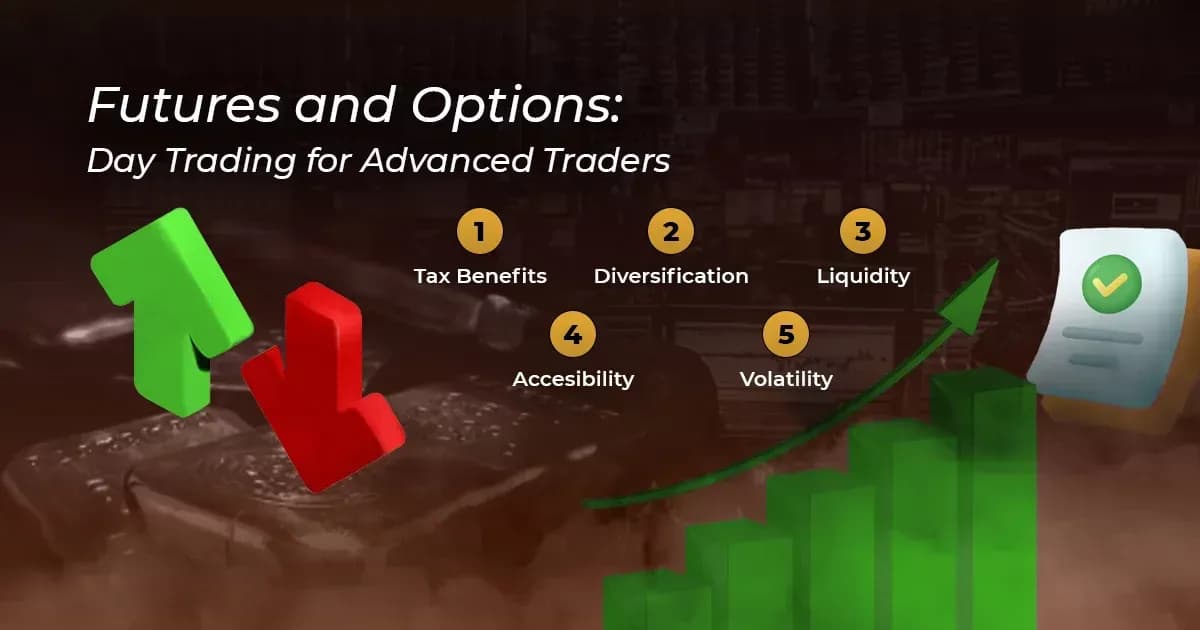
The practice of trading options appeals to beginner and seasoned traders for several reasons, such as:
- Tax Benefits: There are traders who may enjoy tax advantages that come with trading futures.
- Diversification: Futures and options cover a broad range of assets, which, in turn, helps enable more opportunities.
- Liquidity: These markets provide high liquidity, ensuring easy entry and exit.
- Accessibility: Traders have easy access to numerous futures markets
- Volatility: Intraday price fluctuations when day trading futures and options create opportunities to make quick profits.
However, any trader interested in trading this financial instrument needs to research options trading strategies thoroughly. It’s the only way to ensure that they’ll get a good understanding of the markets and develop a risk management strategy.
How Day Trading Is Applied In The Futures Market
Futures contracts refer to financial derivatives that typically involve:
- A commitment from a buyer to acquire a set quantity of an underlying asset
- A commitment from the seller to sell the asset at a predetermined price
- An agreement for this transaction to be completed on an agreed-upon future date
Therefore, day trading futures and options means purchasing and disposing of derivatives within the same trading day to benefit from small price changes. Below is a detailed step-by-step guide:
- Choose a Futures Market: As a trader, you get to choose a market based on your budget, expertise, and trading preference. Some of the popular futures markets include currencies, commodities, and stock indices.
- Engage in Technical Analysis: Having chosen your preferred market, the next step is to perform technical analysis. For this, you’ll need to analyse price charts, identify price trends, and make an informed decision on whether to buy or sell your contracts. Experienced traders engaged in day trading futures and options generally use short-range timeframes to identify trading opportunities before contract expiration.
- Gaining Leverage: In futures trading, leverage is crucial because it enables a trader to use a small amount of capital to control a bigger position. You should, however, note that while this tactic helps increase profit potential, it also does the same to your risk of losses.
- Risk Management: For traders to manage their risk when trading options, they often resort to using various strategies to limit their potential of incurring a loss. In most cases, this requires them to ensure they have implemented a stop-loss order. Implementing a stop-loss order when day trading futures and options enable you to automatically exit a position if it moves beyond a predetermined limit.
- Continuous Monitoring: Continuous monitoring and hedging are among the tactics employed by traders to mitigate against market volatility. Even with continuous monitoring, a trader should be able to make quick decisions on when to enter or exit a position as the market conditions continue to change.
Winning Strategies For Day Trading Options
Day trading options can be a rewarding experience, but as with everything else in trading, success will depend on the tools you use with regard to day trading futures and options.
Technical Analysis And Day Trading Options
Technical analysis is a winning strategy for day trading options and futures. Many traders perform technical analysis by looking at historical pricing information to help them know if or when to leverage in futures—this calls for them to study multiple chart patterns and indicators to spot potential trends.
Scalping
Scalping is a technique that involves making small trades to enable a trader to benefit from small price fluctuations. In scalping, even a small movement can be capitalised upon. This allows a trader day trading futures and options to enter or exit a position within a matter of seconds.
Scalping works well in the futures markets for the following reasons:
- Liquidity: Scalpers need liquidity to execute options premiums rapidly.
- Volatility: A scalper benefits from the small fluctuations happening in the markets.
- Tight Spreads: Scalpers know how to take advantage of narrow spreads.
News Trading
Staying updated with global macroeconomic events and news is crucial for futures traders. It would help if you remembered that the financial markets are quite sensitive to news and information flow, which means that your ability to react to emerging news can impact your profitability.
Benefits Of Day Trading Futures And Options
Once you understand the margin requirements for trading options, you stand to enjoy the following benefits:
- Potential tax benefits
- 24-hour trading cycle
- High leverage
- Liquidity
Day trading is an interesting but intense activity that typically attracts all types of traders. Its excitement aside, there’s a need to understand that it has its own considerations. This means you shouldn’t pick an instrument for trading unless you fully understand its characteristics.
The above guide should help you get started with day trading. To learn more, make sure to visit Audacity Capital today.

क्या आप क्रिप्टो पर अनुशासित जोखिम लागू करने के लिए तैयार हैं? Audacity Capital के नए क्रिप्टो उपकरणों का पता लगाएं और अपनी ट्रेडिंग रणनीति लाएं।
और जानेंन्यूज़लेटर
हमारे न्यूज़लेटर से जुड़ें।
हमारे सामाजिक समुदाय में शामिल हों

आज ही अपनी यात्रा शुरू करें हमारे नि:शुल्क परीक्षण के साथ
प्रमाणपत्रों के माध्यम से अपने कौशल और उपलब्धियों को गर्व से प्रदर्शित करें और संभावित निवेशकों और साथियों से अपनी कड़ी मेहनत और समर्पण के लिए पहचान प्राप्त करें।
नि:शुल्क परीक्षणसंबंधित लेख

Navigating Market Volatility in 2026
Learn how to navigate market volatility in 2026 with proven strategies. Manage risk, protect capital, and trade smarter with Audacity Capital.


What Is A Credit Crunch And How To Trade It? : Funded Forex Trader
Learn what a credit crunch is, why liquidity disappears during crises, and how central bank policies impact forex markets and global economies.

What Is Support and Resistance in Trading?
Learn what support and resistance are in trading, how they work, and how traders use these key price levels to identify entry and exit opportunities. A guide by Audacity Capital.

Mastering MACD Like a Funded Trader: The Complete Guide to Timing Momentum and Catching High-Probability Moves
Discover how MACD works, how to read signals, spot divergences, and apply professional trading strategies with proper risk management.