



Trading Instruments: Types, Examples, and the Best Instruments for Day Trading


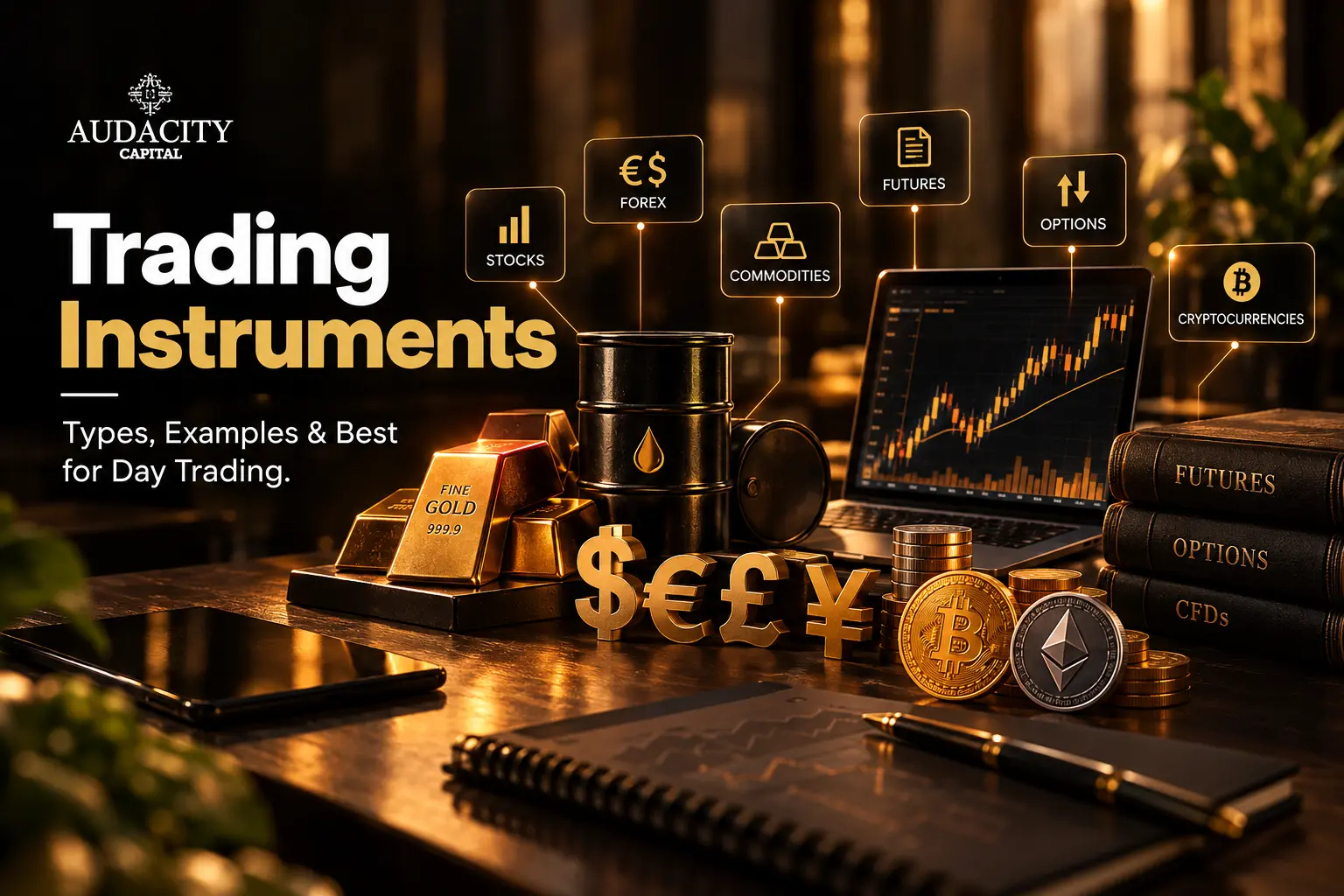
Trading instruments are the financial products that traders can buy, sell, or use to gain exposure to a market. Stocks, forex, futures, options, and cryptocurrencies are some common examples. They behave uniquely with their own levels of liquidity, leverage, cost, volatility, and trading hours. This matters most when trading intraday, because the characteristics of an instrument can directly affect execution and risk. As a result, the best instruments for day trading depend less on a single "best" market and more on how well an instrument fits a trader’s strategy, capital, and risk framework.
What Are Trading Instruments?
When traders talk about trading instruments, they mean the assets or contracts they use to take a position in a market. They include both assets that represent ownership, such as stocks, and contracts whose value depends on something else, such as options and futures. A stock, for instance, represents an ownership interest in a company, while an option derives its value from an underlying asset.
Trading instruments examples
Some common trading instruments include:
- Stocks, which represent ownership in a company.
- ETFs, which trade on exchanges and provide exposure to a basket of assets, an index or another benchmark.
- Futures, which are contracts to buy or sell an underlying commodity or financial instrument at a specified price and date.
- Options, which give the buyer the right, but not the obligation, to buy or sell an underlying asset at a specified price.
- Forex trading instruments, where traders speculate on movements between currencies.
- Bonds and other fixed-income securities.
- Commodities, either directly or through instruments such as futures and exchange-traded products.
- CFDs, where available, which allow traders to speculate on price movements without owning the underlying asset.
Why does the trading instrument matter?
The types of trading instruments matter because they affect more than the market name. They come with their own combination of liquidity, volatility, leverage, transaction costs, trading hours, margin requirements, and execution characteristics. Those differences can affect how easily a trader enters or exits a position and how much risk the position carries.
That is why the most suitable instrument depends on the strategy, timeframe, and risk framework being used.
Types of Trading Instruments
Once the main idea is clear, we will now look at what actually sits inside the broad category of trading instruments. They may all give a trader exposure to a market, but they do not behave similarly. A stock can be directly owned, an option can give a contractual right, a futures contract creates an obligation, whereas forex involves trading one currency against another.
The difference matters mostly when trades are opened and closed within a short period. Liquidity, spread, volatility, leverage, margin, contract size and trading hours can all change how a strategy behaves in live conditions. The sections below therefore focus on what each instrument means for a day trader, leaving textbook definitions behind.
1. Stocks
Stocks represent ownership interest in a company. A trader buys shares, and the position moves with the market price of those shares, thus making stocks the most straightforward instruments for short-term trading.
Day traders want stocks with enough liquidity and price movement because it makes entering and exiting worthwhile. A heavily traded stock may give tighter spreads and more reliable execution, while a thinly traded stock can become difficult to exit if the market is moving quickly.
Therefore, instead of just asking if a stock is rising or falling, the practical questions are:
- How much volume is trading?
- How wide is the bid-ask spread?
- Is there enough price movement for the strategy?
- Are there earnings, news, or other events affecting the stock?
- Can you close the position without taking excessive slippage?
For instance: A momentum trader may prefer a liquid stock that has suddenly attracted heavy volume after company news. A trader looking for small, frequent moves has a different requirement from someone trying to capture a larger intraday trend.
2. ETFs
ETFs, the exchange-traded funds, combine several investments into one single exchange-traded product. They give exposure to a broad index, industry, commodity, or other market theme, so one position can represent a wider market than a single company share. ETFs can hold stocks, bonds, commodities, currencies, and other assets depending on the fund.
That structure is useful for day traders who want exposure to a market without taking a position in one individual company. An index ETF, for instance, can allow a trader to follow broad market movement, while a sector ETF can focus the trade on a particular part of the economy.
Liquidity still deserves attention, however. Two ETFs may track very different markets and attract very different levels of trading activity. Before choosing one, a trader should look at its typical volume, spread, price movement, and the liquidity of the underlying market.
3. Futures
Futures are standardized contracts tied to an underlying commodity, financial instrument, or other market. Now, unlike buying a stock, the trader is entering a contract with defined specifications, including contract size and expiration. Standardization also helps create a common market in which many participants can trade the same contract.
Futures cover a lot more than physical commodities. Traders can find contracts linked to equity indexes, interest rates, currencies, energy products, metals, and agricultural markets. This appeal to active traders comes partly from leverage and the long trading sessions available for many contracts. Yet leverage cuts both ways. Futures traders post margin, and losses can build quickly when the market moves against the position.
Contract specifications matter just as much. A trader needs to know the contract multiplier, tick value, expiration, and margin requirement before treating a futures position as comparable to a stock position.
4. Options
Options require a different way of thinking. This is because the trader is dealing with a contract whose value depends on an underlying asset. A call gives the holder the right to buy at a specified strike price, while a put gives the right to sell. Both carry a premium and have an expiration date.
For day traders, the underlying price is only part of the story. The option’s value can also respond to time remaining and expected volatility. As expiration approaches, time decay can become increasingly important, while changes in implied volatility can alter the premium even when the underlying asset has moved very little.
That makes options more complex than simply choosing whether a stock will rise or fall. A trader must also consider:
- Strike price
- Expiration
- Premium
- Implied volatility
- Liquidity and spread
- Time decay
Options can therefore offer precise ways to express a short-term view, but their contract structure demands more careful position management.
5. Forex
Forex trading instruments allow traders to speculate on changes in the value of one currency relative to another. A currency pair such as EUR/USD expresses that relationship, with one currency quoted against another.
The market is particularly important to short-term traders because major currency pairs have substantial trading activity and the global forex market operates across major financial centres. However, forex is not one single exchange in the same way as a centralized stock exchange. Retail spot forex can trade over the counter, with the trader dealing through a broker or dealer.
Forex trading instruments also commonly involves leverage, which means a relatively small amount of capital can control a larger position. That can make small price movements meaningful, but it can also magnify losses. For this reason, the spread, position size, leverage, and timing of the trade all deserve attention.
6. Bonds and fixed-income instruments
Bonds represent debt and not ownership. Governments and companies can issue them to raise money, and traders can buy and sell them as market conditions change.
They are less closely associated with retail day trading than stocks, forex, or futures, but active trading does take place in fixed-income markets.
One relationship matters especially here: Bond prices and yields generally move in opposite directions.
When market yields rise, existing bonds with lower coupon rates generally become less attractive, putting downward pressure on their prices.
For a short-term trader, interest-rate expectations, economic data and central-bank decisions can therefore matter greatly. The US.SEC lists government and corporate bonds among the major investment products available to investors.
7. Commodities
Commodities include markets such as crude oil, natural gas, gold, silver and agricultural products. A trader does not normally need to take physical delivery of a barrel of oil or a quantity of gold because they trade derivative products.
This difference is important because traders can trade the same underlying commodity through different instruments, each with its own costs, leverage, and contract terms. Gold, for example, can be approached through a futures contract or an exchange-traded product, but those positions do not carry identical risks or mechanics.
8. CFDs and other leveraged instruments
Contracts for difference, or CFDs, allow traders to speculate on price movements without taking ownership of the underlying asset. Their availability, legal treatment and trading conditions vary by jurisdiction and provider, so a trader should check the rules that apply where the account is held.
CFDs’ main attraction is flexibility as it gives exposure to markets such as forex, indices, shares or commodities through a single trading account. Leverage, however, can make a relatively small market move produce a much larger change in account equity.
That is why the instrument itself should never be separated from the risk framework around it. Audacity Capital's approach to trading education similarly places position sizing, risk per trade and stop distance at the centre of managing leveraged exposure.
The wider lesson is simple:
There is no universally superior trading instrument. The useful question is whether the instrument’s liquidity, volatility, leverage, cost and market structure fit the trader’s strategy and risk limits. That comparison is important when deciding which markets may qualify as the best instruments for day trading.
Trading Instruments vs Asset Classes
Now that the main types of trading instruments are clear, there’s one distinction that’s worth comparing: An asset class and a trading instrument are not the same thing.
- An asset class is a broad category of assets that share similar characteristics. Some common examples are equities, fixed income, commodities, and currencies.
- A trading instrument is the specific security or contract through which a trader gains exposure to one of those markets.
Asset Class | Example Trading Instruments |
Equities | Apply Shares |
Fixed Income | U.S. Treasury bond |
Commodities | Gold futures |
Currencies | EUR/USD |
Derivatives | S&P 500 options |
The difference is important because two instruments can behave differently yet give exposure to the same underlying market. For example, a trader buying shares faces a different margin structure and execution process from someone trading an option on those shares.
How Do Trading Instruments Differ?
You know the names of different trading instruments, but it is only the beginning. The useful question is how these instruments behave once you actually put a trade on.
Liquidity
Liquidity describes how easily an instrument can be bought or sold without moving its price substantially. Higher liquidity generally means tighter spreads and easier execution, although liquidity can change quickly during volatile markets.
For a day trader, this matters because entering a position is only half the job. You also need to exit it at a reasonable price. A market that looks attractive on a chart can become difficult to trade if there is not enough volume behind the quoted price.
Volatility
Volatility determines how quickly and how far an instrument's price can move.
A highly volatile market can create more opportunities for an intraday trader, but it can also turn a small position into a large loss much faster. Volatility therefore needs to be considered alongside position size and stop distance.
Leverage and margin
Leverage allows a trader to control a larger position with less capital, but it also magnifies the effect of price movements.
This is particularly important with futures and leveraged forex trading instruments. Futures margin, for example, is a performance bond and not simply a down payment on the underlying asset, and losses can require additional funds.
The practical lesson is simple: lower capital requirements do not automatically mean lower risk.
Trading hours
Market availability can also influence an instrument's usefulness.
U.S. stocks and ETFs have defined exchange trading sessions, while many futures contracts trade for extended hours. Forex operates across global financial centres, although liquidity and activity vary by currency pair and time of day.
A trader who can only trade during a particular window should therefore consider whether the instrument is active when they are available.
Costs and execution
The quoted price is not the complete cost of trading. A trader may also face:
- Bid-ask spreads
- Commissions
- Financing or funding costs
- Exchange or contract fees
- Slippage
These costs become particularly important when a strategy generates many trades. Even a small spread can materially affect results when repeated across hundreds of transactions.
Regulation and market structure
Finally, traders need to know how the market itself works.
Stocks, ETFs, listed options, and many futures trade through organized exchanges or regulated market structures. Spot forex, by contrast, is commonly traded over the counter, meaning the trader may deal directly with a dealer.
That difference affects pricing, execution, counterparty exposure, and the protections available to the trader. It is one reason why simply comparing instruments by price movement can give an incomplete picture.
Best Instruments for Day Trading
There is no single instrument that deserves to be called the best instrument for day trading in every situation. The right choice depends on the following:
- What is the trader trying to capture?
- How much risk can be managed?
- How does the instrument behave during the trading session?
A useful comparison looks like this:
Instrument | Liquidity | Volatility | Leverage | Trading availability | Common intraday use |
Stocks | High to variable | Variable | Usually moderate | Exchange sessions | Momentum and news-driven trades |
ETFs | High to variable | Variable | Usually moderate | Exchange sessions | Index and sector exposure |
Futures | Often high | Medium to high | High | Extended for many contracts | Index and commodity trading |
Options | Varies by contract | Variable | Embedded in contract structure | Exchange sessions | Directional and volatility trades |
Forex | Very high in major pairs | Variable | Often high | Global, around the clock during the trading week | Currency trading |
Best instruments for beginners
Beginners generally benefit from trading instruments with clear pricing, strong liquidity, manageable volatility, and straightforward position sizing. That does not mean one particular market is automatically easier. Instead, a new trader should be able to understand what moves the instrument, how much it costs to trade, and how much a normal price move could affect the account.
A liquid large-cap stock or broad-market ETF may be easier for some traders to understand than a complex options position. That is a question of structure, not a guarantee of lower risk.
Best instruments for momentum traders
Momentum traders normally need movement, liquidity, and a catalyst that can attract enough market participation to produce sustained price action.
Stocks and ETFs can provide this around earnings, economic announcements or major company news. Futures can also suit traders who want exposure to broad equity indexes or commodities during extended sessions.
The important point is that volatility alone is not enough. A fast-moving market with poor liquidity can produce wider spreads and greater slippage at exactly the moment when execution matters most.
Instruments for traders who prefer longer sessions
Trading hours become especially important when a trader cannot remain in front of the market during the main U.S. session.
Many futures contracts offer extended trading, while the global nature of forex provides access across different time zones. However, longer availability does not mean equally strong liquidity throughout the session. A market can remain open while activity becomes noticeably thinner.
Why "best" depends on the trader?
The best trading instrument is ultimately the one whose characteristics match the strategy.
A trader who depends on small price movements may place greater value on tight spreads and deep liquidity. Someone trading larger directional moves may care more about volatility and catalysts. A trader using leverage must add margin requirements and potential losses to that decision.
For that reason, traders must judge the best instruments for day trading by fit and never by a universal ranking.
How to Choose the Right Trading Instrument?
After comparing the markets, the next step is to narrow the choice to instruments that actually fit the way you trade.
1. Start with your trading strategy
Your strategy should come before the instrument. A scalper looking for small intraday moves needs a different market environment from a momentum trader waiting for a major breakout. Trend-following and mean-reversion strategies can also behave differently depending on liquidity and volatility.
Skip the question, Which instrument is best? and ask, What market conditions does my strategy need to work?
The second one gives a more useful answer.
2. Check liquidity before volatility
New traders often look for the instrument that moves the most. A better starting point is to ask whether you can enter and exit efficiently.
Liquidity affects the spread, available market depth, and potential slippage. A volatile instrument with poor liquidity may therefore be less useful than a slightly quieter market with consistent execution.
3. Understand leverage and margin
Leverage deserves particular attention with futures, forex, options and CFDs. Before trading, understand how much capital is required, how the broker calculates margin, and what happens if the position moves against you. The CFTC warns that leverage can amplify both gains and losses in futures and forex markets.
4. Compare the real trading costs
Look beyond the commission. Consider the spread, exchange charges, financing costs where applicable, and the slippage you may experience during fast markets. A strategy that looks profitable before these costs are included may produce a very different result after execution costs are accounted for.
5. Match the instrument to your trading hours
There is little value in selecting a market that rarely provides your preferred setup during the hours you can trade.
Look at when the instrument is most active, when major economic or company events occur, and whether its normal liquidity matches your schedule.
6. Test one instrument before expanding
Familiarity has practical value. Learning how one market normally moves, how its spreads behave and how it reacts to news can give a trader a better working understanding than switching between ten instruments without learning any of them deeply.
That is also why professional trading environments often place emphasis on repeatable processes rather than simply increasing the number of markets available. For traders looking to develop that discipline, Audacity Capital provides trading programmes designed to support structured trading approaches.
Risks to Consider When Trading Different Instruments
Every instrument brings its own combination of opportunity and risk. Understanding that difference is more useful than treating risk as a single category.
Risk | Areas where it can particularly matter |
Leverage | Futures, forex and CFDs |
Time decay | Options |
Liquidity and slippage | Thinly traded stocks and some derivatives |
Overnight gaps | Stocks, ETFs and options |
Counterparty or dealer risk | Certain OTC markets |
Market risk
The most obvious risk is also the one traders cannot remove: the market can move against the position.
The effect depends on position size, volatility and leverage. A small percentage move can become a large account loss when a trader controls a position much larger than the capital committed.
Liquidity and slippage
An instrument may appear liquid under normal conditions and become harder to trade during a sharp market move. When available liquidity falls, spreads can widen, and orders may fill at less favourable prices.
This is particularly important for strategies that depend on precise entries and exits.
Leverage risk
Leverage changes the relationship between the capital committed and the position controlled. It can increase returns when a trade moves in the intended direction, but the same mechanism increases losses when it does not.
Complexity risk
Some instruments require more than simply predicting whether price will rise or fall. Options are affected by the underlying price, strike price, expiration, implied volatility, and time remaining. FINRA explains that time decay reduces an option's theoretical value as expiration approaches, while implied volatility affects option pricing.
Overnight and gap risk
Even traders who focus on day trading should understand what happens outside their preferred session. A stock, ETF, or option can open at a substantially different price after news or an event occurs while the market is closed.
The safest instrument is therefore not necessarily the one with the smallest price movement. It is the one whose risks the trader understands and can manage within the strategy.
FAQs
Trading instruments are financial assets or contracts that can be bought, sold, or otherwise traded, including stocks, ETFs, futures, options, forex, and bonds.
Some common trading instrument examples are stocks, ETFs, futures, options, currency pairs, bonds, commodities, and CFDs, depending on the market and jurisdiction.
The main types of trading instruments are equities, ETFs, futures, options, forex, fixed-income products, commodities, and other derivative instruments.
There is no universal winner. Liquidity, volatility, trading costs, leverage, market hours and strategy should determine which instrument fits a day trader.
Futures can offer liquidity and extended trading hours, but leverage and contract specifications make them unsuitable for traders who do not understand margin and position risk.

Ready to apply disciplined risk to crypto? Explore Audacity Capital's new crypto instruments and bring your trading strategy.
Learn MoreNewsletter
Join our newsletter to stay up to date on features and releases.
Join Our Social & Community

Start Your Journey Today With Our Free Trial
Proudly showcase your skills and accomplishments through certificates and get recognition for your hard work and dedication from potential investors and peers.
Free TrialRelated Articles
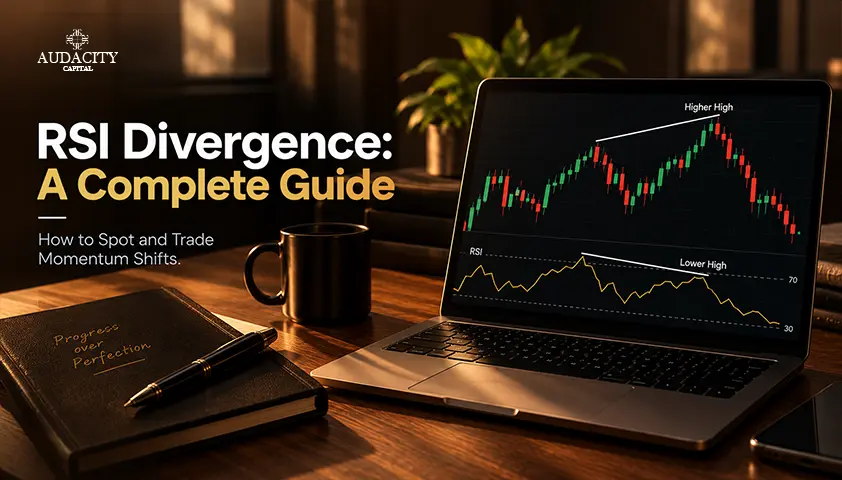
RSI Divergence: A Complete Guide to Spotting and Trading Momentum Shifts
Learn what RSI divergence is, explore bullish, bearish and hidden divergence, and discover how to identify, confirm and trade RSI divergence.

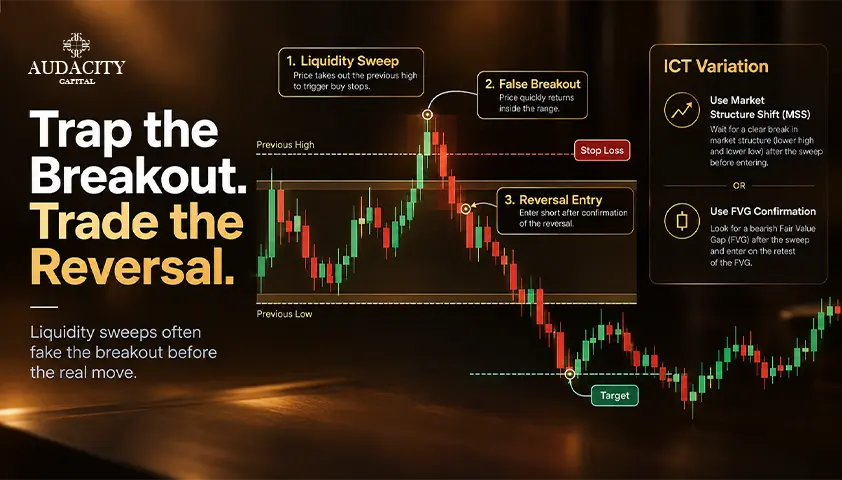
Turtle Soup Trading: Rules, Examples and ICT Variations
Learn turtle soup trading with original rules, ICT variations, bullish and bearish examples, risk controls, and a practical backtesting checklist.
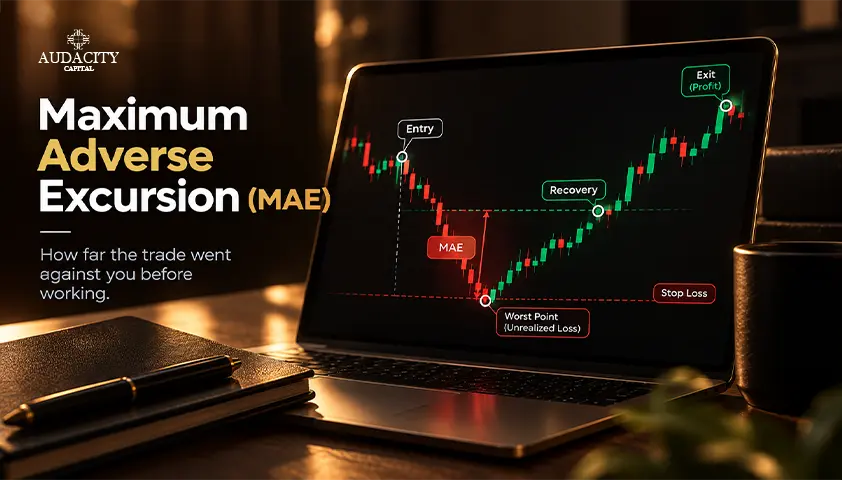
Maximum Adverse Excursion Explained for Traders
Learn how maximum adverse excursion measures a trade's worst open loss, how to calculate MAE, read charts, test stops, and avoid common errors.
Market Profile Trading: How to Read TPO Charts
Learn Market Profile Trading with TPO charts, value area, POC, initial balance, day types, practical examples, and risk controls.