


Prop Trading Challenges and Rules



Key Highlights
Prop trading firms use trading challenges to screen for disciplined traders. The evaluations, which are normally conducted on a simulated account, helps consistently profitable traders gain access to more capital.
- Traders need to pay a one-time evaluation fee to access the simulated trading environment where they get to prove their skills.
- Each challenge/evaluation will come with numerous constraints that are meant to protect the firm’s capital.
- You need to research the common pitfalls before you start the challenge to guarantee your progression to the funded account stage.
- Different firms use different challenges to screen for traders. Some offer instant funding while others have one-step and three-step challenges.
Prop Trading Challenges Explained
Prop trading challenges have increasingly become popular among skilled traders looking to gain access to a larger capital pool without having to risk their own funds. They present a unique opportunity for them to showcase their trading skills, discipline, profitability, and consistency.
During the evaluation, the traders are expected to adhere to certain rules, some of which are related to daily loss limits. Failure to do so will lead to disqualification and subsequent account termination. It’s, thus, recommended that you familiarize yourself with the rules to ensure you understand the requirements.
And as you learn the prop trading rules, remember that emotional discipline matters more than strategy. Discipline is vital as it showcases your ability to manage risk and keep your emotions in check, even in the face of adversity.
Learn more about What is Prop Trading?
What Is a Prop Trading Challenge?
A prop trading challenge refers to a structured evaluation that every trader looking to gain access to a funded account must pass through. The purpose of this challenge is to prove that you’re skilled enough to manage a prop firm’s capital and adhere to the set rules.
Prop firms use these challenges to screen potential traders, ensuring they don’t give their funds to just anyone. These challenges are generally conducted on a simulated (demo) trading account that has been designed to mimic the conditions of a Live FX market.
Read more about How Prop Trading Firms Work?
Evaluation concept
The challenge criteria in a prop firm will normally include the following:
- Profitability: In the evaluation phase, this refers to your ability to adhere to the prop firm challenge rules when attempting to hit the set profit target. Keep in mind that the firm will be looking to see whether you can remain profitable without going over the line.
- Discipline: Trading discipline is all about complying with the financial company’s trading rules and guidelines. It reflects your ability to keep your emotions in check, even when the market conditions are working against you.
- Consistency: Here, the firm is trying to see if you can remain consistent in your performance over time. A consistent prop trader is one who showcases their reliability and minimizes the likelihood of incurring large and unforeseen losses.
- Risk Management: Every skilled trader operates using a given strategy. But beyond this, you also must prove that you can adhere to the firm’s drawdown rules, including their set risk parameters. This makes effective risk management a crucial factor in deciding your fate.
Learn more about Prop Trading Business Model
Funded vs evaluation stage
Funded or instant funding programs offer a way to skip the detailed evaluation process conducted by many prop trading companies. They do this by providing you with immediate access to trading capital. This means you don’t have to worry about going through any preliminary tests.
The evaluation stage, on the other hand, provides a structured pathway for you to get into the world of trading. Here, you get to test your trading skills using a demo account before finally gaining access to a funded account.
Over the course of my trading career, I have encountered many traders who have been unable to decide on which of the two is the best for their career growth.
What I can advise you is to choose a path that aligns with your goals, trading style, and risk tolerance. If you wish to dive straight into trading, go for instant funding.
But I should point out that this path is likely to come with much higher fees and limited growth potential.
Thus, if you wish to prove your skills before unlocking a larger capital pool, I’d recommend that you follow the evaluation route. While at it, be sure to check out this guide on prop trading challenges explained.
Related Article How Traders Get Funded?
Why Prop Trading Firms Use Strict Rules

Prop firms often put in place strict funded trading challenge rules to help them manage risk while safeguarding their capital. These rules also help to ensure that their traders will exhibit discipline and consistently follow the rules in place, instead of gambling.
Below is a detailed breakdown of why prop firms enforce these rules:
- Capital Protection: The primary goal of these rules is to protect their own capital from potential human errors that may be caused by the traders and from market volatility. Since they’re the ones that provide funding, it means that they also get to bear the losses that come with a wrong trade. Their rules, therefore, serve as a safety system that forces the traders to trade in a more cautious manner.
- Trader filtering: This is also known as talent identification. Here, the prop firms {Link up to What Is Prop Trading?} use diverse rules such as consistency rules to make sure their traders have a sustainable strategy; minimum trading days requiring each trader to trade actively for a certain number of days before passing a challenge, and profit targets which serve as a benchmark to showcase that traders can generate a return on the capital advanced to them.
- Long-term consistency: As the name suggests, the goal here is to confirm that a trader can generate ongoing profits as opposed to relying on “lucky trades.” Consistency rules act as a safeguard by verifying that a trader possesses true skill and isn’t overly reliant on luck.
Core Rule Categories (Overview Section)
Drawdown Rules
These are predefined risk management limits designed to protect the prop firm by terminating funded accounts whose losses have exceeded the set limits. They include:
- Daily drawdown: Traders also call it the daily loss limit. It’s used to restrict the total amount you can lose in a single trading day. Click here to learn of its various variations. (Link down to Fixed vs Trailing Drawdown).
- Maximum drawdown: It’s the total percentage of the funded account’s equity or balance that can fall from the opening balance. Check out this detailed comparison of the daily vs max drawdown limits.
Risk & Trade Management Rules
Risk and trade management rules refer to essential strategies used to ensure long-term profitability and protect capital by limiting losses. Examples include:
- Risk per trade: It defines the maximum percentage of the available capital that you can afford to lose on a trade. For example, you could choose to only risk 1% on a trade. Be sure to read this guide on Prop Trading Risk Rules for a better picture of this!
- Trade frequency: Such rules are in place to prevent overtrading, excessive portfolio exposure, and emotional decision-making after a loss. Their focus is on ensuring long-term consistency as opposed to relying on short-term gains.
- Position sizing: They come in many forms, with the most common being the 1% rule and the risk/reward ratio. In the former, traders can risk 1% to 2% of their available capital. And in the latter, the trader must confirm that what they stand to gain is much higher than any loss they may incur.

Trader Dashboard
Get Trader Dashboard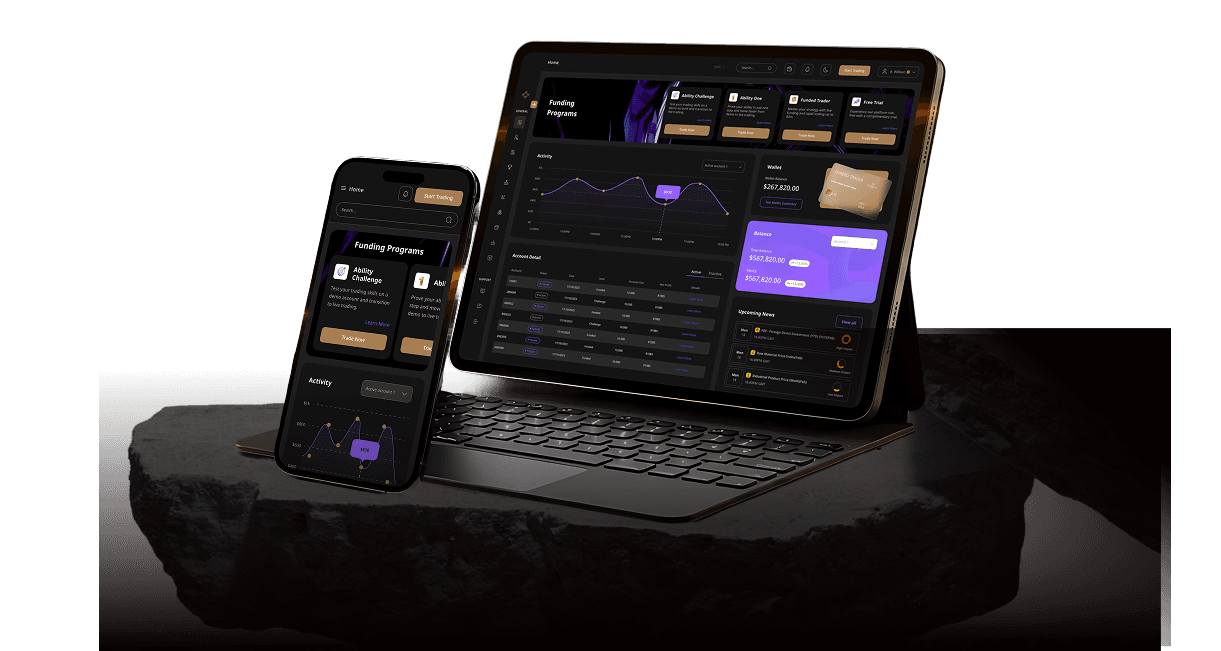
Behavioral & Discipline Rules
Prop firms often put in place behavioral and discipline rules designed to control emotional impulses and ensure consistency while managing risk.
Some of these key rules help curb:
- Overtrading: Overtrading increases your risk exposure, raises the transactional expenses, and significantly lowers your mental stamina. Disciplined traders are able to focus on quality, helping them to remain profitable. For this, a trader will need to set a daily transaction limit.
- Revenge trading: When a trade hits your predefined stop-loss target, the reasonable thing to do is to take a break. Walk away from your trading desk and take a few minutes to reset. Following the trading rules will ensure you don’t get back to trading immediately, as this may lead to more losses.
- Rule breaches: These are common among traders who approach prop trading as a game, rather than an investment. Examples of common rule violations in prop trading include overlooking the maximum daily loss violation and the trailing drawdown breach.
Why Most Traders Fail Challenges

Many traders fail prop funding challenges because of emotional trading and poor risk management. The intense pressure to hit the preset profit targets within certain limits has also been blamed for this. You should also note that there are those who fail because of overleveraging.
In a nutshell, the leading causes of failure are:
- Lack of a viable risk management plan
- Ignoring the drawdown rules
- Emotional decision-making leading to greed and revenge trading
Make sure to read our guide on Common Rule Violations to learn why you shouldn’t overlook the trading rules and regulations.
How to Approach Challenges the Right Way
Profitable traders are those who can follow a risk management plan and maintain a focused mindset even in the face of changing market conditions. To get you started, try to follow this three-step approach:
- Develop a process-focused mindset: Emotional control in prop trading can make all the difference. Remember, trading is both a mental and technical game.
- Rule-first trading: The only way to survive in prop trading is by learning to control your losses. Proper risk management is what separates profitable traders from loss-making ones.
- Consistency over profits: Adopt a consistent trading style and resist the urge to make quick profits.
As mentioned elsewhere in this guide, prop trading is much of a mental game as it is a technical one. I, therefore, recommend that you first understand the prop trading rules before starting any challenge.
FAQ
It refers to an evaluation phase where you prove that you have the skills needed to consistently generate profits, without breaching the prop firm challenge rules.
Absolutely! Prop firms charge a one-time evaluation fee that may be refunded upon getting funded or passing the challenge.
You’ll be rewarded with a funded account. Many prop trading funds are also known to refund the initial challenge fee at this point.
Many prop firms use simulated trading (demo accounts) as a risk management measure. Payouts are then made from their revenue pool.
Prop firms have traditionally put a time constraint on their challenges. This has, however, started to change, with some choosing to do away with these limits altogether.

Готовы применить дисциплинированный риск к криптовалютам? Изучите новые криптоинструменты Audacity Capital и примените свою торговую стратегию.
Узнать большеРассылка
Подпишитесь на нашу рассылку.
Присоединяйтесь к нашему сообществу

Начните свое путешествие сегодня с нашей бесплатной пробной версией
С гордостью демонстрируйте свои навыки и достижения с помощью сертификатов и получайте признание за свой тяжелый труд и преданность делу от потенциальных инвесторов и коллег.
Бесплатная пробная версияПохожие статьи

Prop Trading Risk Rules
Learn the essential prop trading risk rules every funded trader must follow. Understand drawdown limits, position sizing, and discipline with Audacity Capital.


How Traders Get Funded ?
Discover how traders get funded through prop trading firms, evaluation programs, and risk rules. Learn the path to trading firm capital with Audacity Capital.

Prop Trading Business Model
Learn how the prop trading business model works, how firms fund traders, manage risk, and share profits. Discover the structure behind modern prop firms with Audacity Capital.

How Prop Trading Firms Work?
Learn how prop trading firms work, how traders get funded, and how profit sharing works. Discover the prop trading model with Audacity Capital.