


ICT Kill Zones and Session Timing: A Practical Guide for Intraday Traders


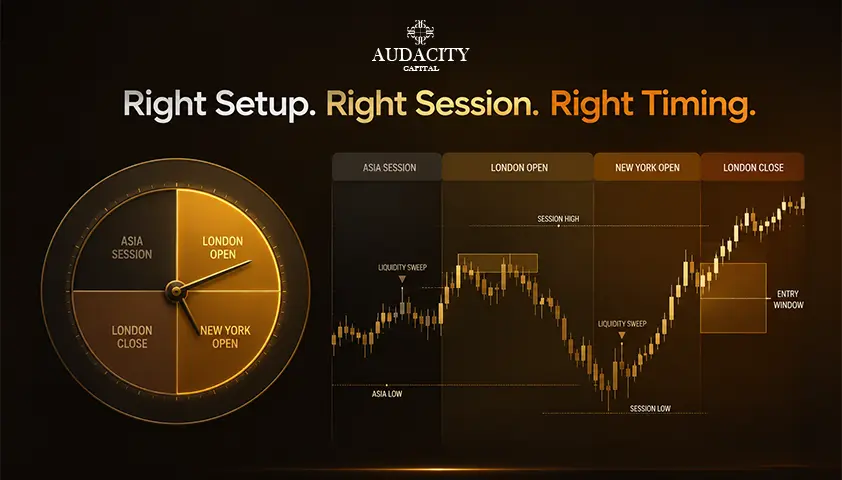
ICT kill zones are particular intraday time intervals in the framework of the Inner Circle Trader methodology to center attention on important trading-session activity.
These zones aim to reduce traders' screen time to those time frames when meaningful price action is expected to happen around session openings, closings, and overlaps.
Knowing that London or New York is active is not enough. Traders should also be aware of which New York-time window they are going to use, whether the price actually reacts to some pre-set levels, and whether there is a good setup in place.
Sometimes, different ICT sources provide different windows, and this is what usually causes confusion among traders.
In this guide, we will clarify how those differences occur and suggest a method to use them effectively.
What Are ICT Kill Zones?
ICT kill zones are time filters. They signify when the trader should be alert, but not when they should enter a trade.
In the context of ICT methodology, the kill zone denotes a portion of the trading session. It is used by traders on the grounds that the expected trading setup is likely to appear during that period.
This is unlike the forex session that takes several hours. The kill zone is a shorter window that traders derive from the longer session.
A trader who does not have direction, a setup, an invalidation, and risk rules in mind is not trading a kill zone; they are just staring at the clock.
The time window does not produce any edge. It is what happens within the time window and how the trader reacts to it that matters.
What Are the ICT Kill Zone Times?
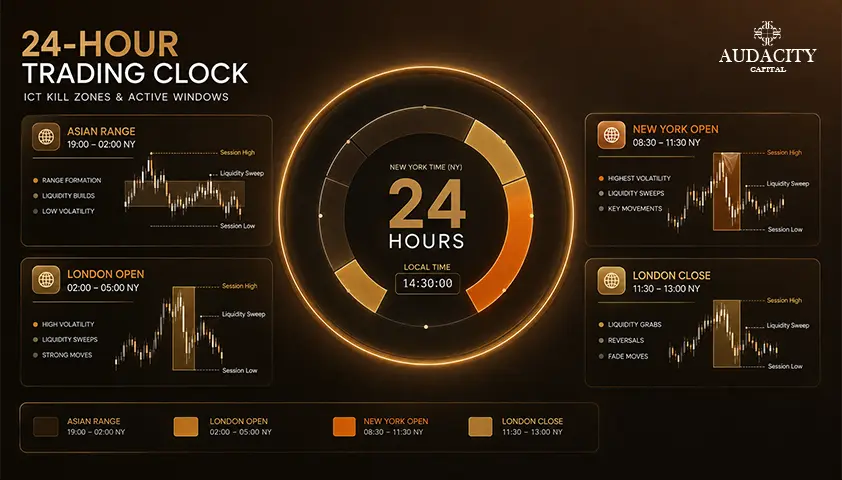
Below are the common ICT kill zone times in New York time.
Some modern ICT models have narrower or later ICT periods, particularly in the New York period, so consider these only as reference.
ICT Window | Common New York Time (ET) | What Traders Monitor |
Asian Range / Kill Zone | 8:00 PM to 12:00 AM | Overnight high and low, range development, reference levels for later sessions |
London Open | 2:00 AM to 5:00 AM | Interaction with Asian high/low, displacement, market structure shift |
New York Open | 7:00 AM to 9:00 AM (some extend to 10:00 AM) | Opening flow at US session, reaction to London range, US economic reports |
London Close | 10:00 AM to 12:00 PM | Late morning continuation, retracement, final intraday range |
Note: This article is based on New York time / ET throughout. We will explain conversion and daylight saving later.
Why Do ICT Kill Zone Times Differ Between Sources?
There are three reasons why ICT kill zone times posted on the web may vary from source to source. Different ICT courses offer different models. Some sources have a broader monitoring time, while others provide narrower execution times. Time zone and daylight saving time considerations can also change the names.
The New York time window is an obvious example.
Classic material tends to show the window as being around 7:00 to 9:00 AM New York time. More modern implementations may expand the window till 10:00 AM.
Modern ICT resources focus more on the time from 8:30 to 11:00 AM because of scheduled US data at 8:30 AM and the equity cash market opening at 9:30 AM.
None of that implies either one is right. The problem starts when a trader changes his definition each week to coincide with the indicator he has most recently added to his chart.
It is much more useful to be consistent than to spend your energy debating a 30-minute or 60-minute discrepancy without considering the trading system that you are testing.
Choose the timing definition according to the ICT system that you are analyzing, apply it in your backtest, journal against it, and stop changing it.
London Kill Zone: 2 AM to 5 AM New York Time
The widely discussed London kill zone is somewhere between 2:00 AM and 5:00 AM NY time.
This is the period around the beginning of the London session when European liquidity starts flowing into the market.
Often, traders come to this window having the Asian range already plotted on their chart, consisting of the Asian high and Asian low. These two points are sometimes used as a base for judging how the price acts once the London window becomes active.
Within the London window, traders may be watching for:
- interaction between the price and Asian high or Asian low
- testing of previous day high or previous day low
- displacement in one way or another, a shift in the market structure on a lower timeframe
- the formation of a fair value gap
- continuation or rejection of the price at the pre-planned level
None of this is a must. London doesn’t have to clear out both sides of the Asian range.
Traders observe the behavior, they don't assume it.
New York Kill Zone: Understanding the Timing Variations
For new ICT traders, the NY kill zone is typically the most confusing because that's when the various sources can be most apparent.
The classic window is from 7:00 AM to 9:00 AM (New York time). This window has been expanded to 7:00 to 10:00 AM in a broader definition. Some newer ICT related resources have adjusted the window to be closer to 8:30AM to 11:00AM.
There are logical explanations behind why this particular timeframe is of interest. London is active while US involvement becomes more pronounced. Some key US economic releases are out at 8:30 AM, and some other major releases are out by 10:00 AM ET.
The US equity market also opens up at 9:30 AM. Such a combination might generate additional action, but "can" is not "will."
In this guide, we use the 7:00 to 9:00 AM time frame as the traditional start, and the 8:30 to 11:00 AM time frame as an alternative for traders whose strategies rely on post-data action.
Pick one, document it, and stick with it long enough to draw useful conclusions.
Asian Kill Zone and the Asian Range
The ICT trader will typically look at the Asian kill zone period for daily highs and lows, which can be used as reference levels at a later stage during the day. A commonly used reference places this period around 8:00 PM to 12:00 AM NY, but there are narrower Asian kill zones too.
The distinction between trading the Asian session actively or just using their range as a reference point for London is important. There are many ICT traders who choose the latter option.
They wait for Asia to set its range, note the high and low levels and then trade on these levels when Europeans join.
Instrument selection becomes relevant in this case. A trader dealing with JPY, AUD, or NZD could have a different attitude towards Asia in comparison to a trader who trades EUR/USD. In the case of EUR/USD, the Asian session may be more of an informative one than an execution one.
The Asian session is not necessarily a quiet or a range market. Its behavior depends on the pair, the day, and scheduled regional data.
What Is the London Close Kill Zone?
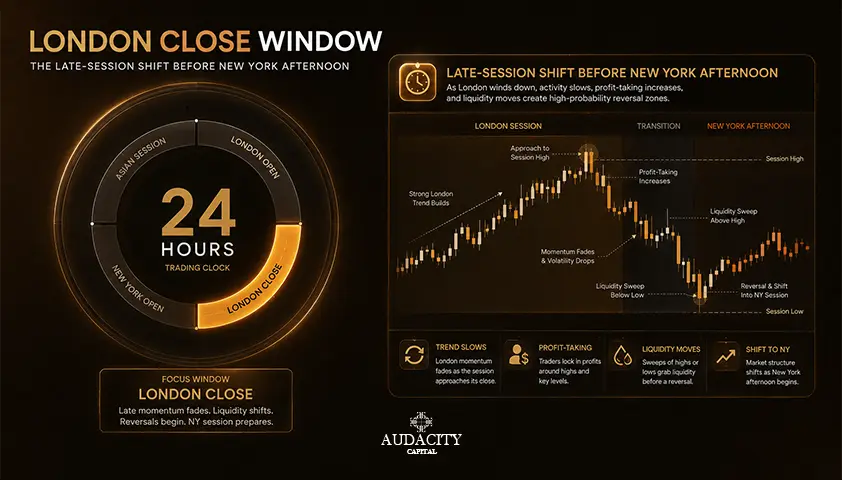
The London close kill zone usually refers to the period between 10:00 AM and 12:00 PM New York time. It happens as the London trading day comes to an end, but New York is still trading.
Traders may watch this period for the morning move to slow or for profit-taking to emerge. They may also look for a retracement into an earlier imbalance, continuation toward another liquidity objective, or completion of the intraday range.
Some traders use it to manage existing positions rather than open new ones. That choice depends entirely on the model being followed.
This window is not an automatic reversal period. Nothing in the clock alone forces the morning move to reverse. If a valid setup appears against the morning direction, the trader assesses it against their model. If it does not, there is no trade.
ICT Kill Zones vs Forex Trading Sessions
A forex session describes a broad market period defined by which regional financial center is active. An ICT kill zone is a narrower timing window used within the ICT methodology for focused observation. A trader can be inside the London session but outside their chosen London kill zone.
Feature | Forex Session | ICT Kill Zone |
Meaning | Broad regional market activity period | Narrower ICT time filter inside a session |
Duration | Roughly 8 to 9 hours | Typically 2 to 4 hours |
Purpose | Describe when a regional market is open | Narrow the observation window for setups |
Entry signal? | No | No, still requires a valid setup |
Example | London session, approx. 3:00 AM to 11:00 AM ET | London kill zone, approx. 2:00 AM to 5:00 AM ET |
EST, EDT and Daylight Saving: Which Time Should You Use?
Use New York local time, preferably written as Eastern Time or ET, as your anchor. That single decision removes most of the confusion caused by different ICT session times shown across websites.
EST equals UTC-5 and applies during the winter months. EDT equals UTC-4 and applies during daylight saving time, which in the United States currently runs from the second Sunday of March through the first Sunday of November.
If a source publishes ICT kill zone times in EST as fixed year-round values, those times can be off by an hour during daylight saving time. Check whether the source adjusts its times for EDT.
If you live in a timezone with different DST rules, or one that does not observe DST at all, your local equivalent of a New York kill zone will shift during the year even though the ET window has not moved. Your broker server time may also differ from New York time, so a broker clock reading 9:00 does not automatically mean 9:00 ET.
A simple conversion workflow:
- Check the current time in New York.
- Determine the kill zone window in ET time.
- Match that against your trading platform clock.
- If necessary, convert into your local time.
- Reconfirm everything around the March and November DST changes.
Avoid creating any permanent GMT conversions in your mind without mentioning whether New York is on EST or EDT time.
How to Use ICT Kill Zones Step by Step
Use one repeatable sequence. The details of the setup can vary with your ICT model, but the process should not.
- Establish higher-timeframe context before the session. Determine your daily bias and note the broader structure.
- Mark important liquidity references. These may include the previous day's high and low, prior session highs and lows, and obvious buy-side or sell-side liquidity pools.
- Identify the exact kill-zone window you are using. Write down the ET start and end. Do not switch mid-week.
- Wait for price to interact with a planned area during that window. No interaction with a planned level, no trade.
- Look for the setup required by your model. That might be displacement, a market structure shift, or an FVG forming inside the killzone.
- Define invalidation, risk and target before entering. Position size according to your risk plan, not according to how confident the window makes you feel.
The rule that ties this together: if the kill zone begins but the setup never appears, there is no trade. The clock does not create the entry.
Example: London Kill Zone Setup
Consider a hypothetical EUR/USD scenario:
During the Asian session, price forms a defined range with a clear high and low. Your higher-timeframe read is bearish, and the previous day high sits just above the Asian high.
The London kill zone begins at 2:00 AM ET. Shortly after, price trades above the Asian high, tags into the previous day high, and fails to continue.
A candle closes back inside the range with visible displacement to the downside.
On the lower timeframe, a bearish fair value gap forms during the drop. Price retraces toward the FVG, and you assess whether the setup matches your predefined model, invalidation level, and risk parameters.
What matters most is what did not happen: the trade was not taken because the clock reached 2:00 AM. The timing simply narrowed the period in which you were watching for the setup to appear.
If the sweep, displacement, and FVG had not formed, there would be no position, regardless of the window being open.
How Kill Zones Work With Liquidity, FVGs and Market Structure
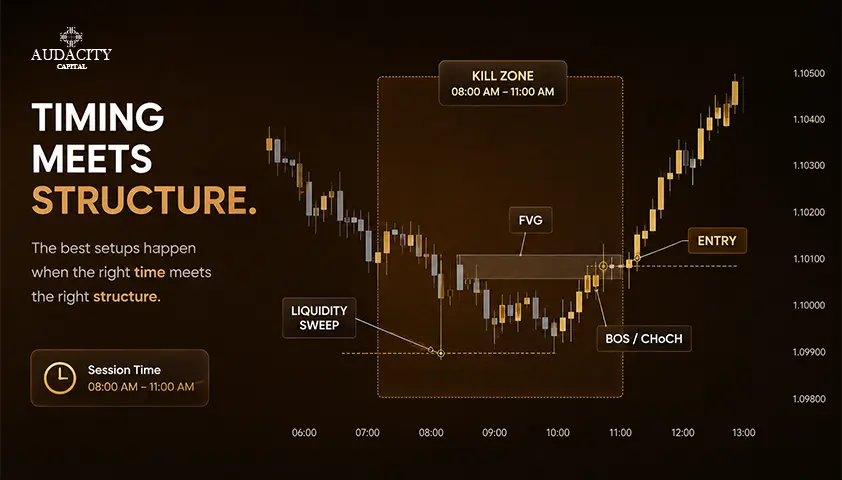
Kill zones do not stand alone. A useful way to keep the pieces separate:
- Kill zone = when to look
- Liquidity = which level matters, whether that is a liquidity sweep target, buy-side pool, or sell-side pool
- Market structure and displacement = how price is reacting to that level
- FVG or entry model = where an entry may be considered
None of these should be interpreted in isolation. An FVG during a session overlap does not automatically create a setup. It is different from a clean sweep of the previous day's high followed by displacement into an FVG during the New York kill zone.
For a deeper walkthrough, see Audacity Capital's ICT Trading Strategy guide and the Fair Value Gap explainer.
Common ICT Kill Zone Mistakes
- Treating the opening time as an automatic trade signal. The window opens, but the market does not owe you a setup.
- Using EST all year without accounting for EDT. Half the year, your published times are off by an hour.
- Confusing the full London or New York session with the narrower kill zone. Being inside the session is not the same as being inside the window.
- Switching between 7 to 9 AM, 7 to 10 AM and 8:30 to 11 AM New York windows without knowing which model you are testing.
- Assuming every Asian high or low break is a liquidity sweep that must reverse. Some are, some are not.
- Trying to trade every kill zone in the same day. Screen fatigue erodes discipline faster than any single loss.
- Ignoring scheduled economic events. A kill zone that coincides with high-impact data behaves differently.
- Taking every FVG that forms during a kill zone. Location, context and confluence still matter.
- Using broker server time without checking its relationship to New York time. Verify once, do not assume.
- Lowering setup standards because the window is about to end. A rushed entry near the close of a kill zone is still a rushed entry.
Which ICT Kill Zone Should You Focus On?
There is no universal best kill zone. Anyone claiming one window is objectively the most profitable is skipping over the variables that actually matter.
- London may be relevant for traders focused on EUR and GBP pairs, where European liquidity dominates the morning.
- New York may suit traders focused on USD pairs, US indices, or US morning activity around cash-market open and scheduled data.
- Asian session study can be particularly relevant for JPY, AUD, and NZD markets, or for traders who use the Asian range as pure context for later sessions.
- London Close may fit traders active in the late US morning who work with continuation or reversion setups.
The correct choice depends on your instrument, your local timezone, your trading model, and what your backtesting actually shows. Not on what someone else called their favorite window.
Conclusion
The workflow is simple and worth repeating. Use New York time as your anchor. Choose the kill-zone definition used by your trading model. Mark relevant session levels before the window opens. Then wait for price to confirm interaction with those levels and apply your normal risk rules on every entry.
Kill zones organize when a trader pays attention. They do not, on their own, determine direction, entry, or outcome. Timing narrows the field of view. Price action, context, and disciplined execution do the rest. Treat the clock as a filter, not a signal, and the rest of your ICT process will do more of the work it was designed to do.
Frequently Asked Questions
ICT kill zones are specific intraday time windows within the Inner Circle Trader methodology where traders focus on session-driven price behavior. They act as a time filter for observation, not as an automatic entry signal. A valid setup, defined risk, and directional context are still required.
The common windows, in New York time, are roughly 8:00 PM to 12:00 AM for the Asian range, 2:00 AM to 5:00 AM for the London open, 7:00 AM to 9:00 AM (some extend to 10:00 AM) for the New York open, and 10:00 AM to 12:00 PM for the London close. Different ICT models use slightly different windows, so pick one and use it consistently.
The London ICT kill zone is commonly referenced as 2:00 AM to 5:00 AM New York time. It covers the period when European liquidity enters the market and often coincides with interaction against the Asian range. Traders monitor it for displacement, structure shifts, and FVG formation, not for guaranteed direction.
The classic New York ICT kill zone is 7:00 AM to 9:00 AM New York time. Broader implementations extend it to 10:00 AM, and some newer resources emphasize the 8:30 to 11:00 AM window around US data and the equity open. The right choice depends on the model you are trading.
They differ for several reasons. Different ICT courses teach different models, while some resources use broader monitoring windows and others use narrower execution windows. Timezone conversion can also shift the labels. The answer is not to keep switching. Choose the version that matches the model you are studying and remain consistent.
The Asian kill zone is commonly placed at approximately 8:00 PM to 12:00 AM New York time. Many ICT traders use it primarily to identify the overnight high and low, which then become reference levels during London and New York. Actively trading Asia is a separate decision from using its range as context.
The ET windows themselves do not change, but the offset between ET and other timezones does. When New York shifts between EST (UTC-5) and EDT (UTC-4), traders in other regions may see their local kill zone times move by an hour. Always verify around March and November DST changes.
No. Forex sessions describe broad regional market hours, while ICT kill zones are narrower timing windows within those sessions used specifically inside the ICT methodology. You can be inside the London session but outside your chosen London kill zone, and the two should not be used interchangeably.

Handa nang maglapat ng disiplinadong panganib sa crypto? Galugarin ang mga bagong instrumento ng crypto ng Audacity Capital at dalhin ang iyong diskarte sa pangangalakal.
Matuto PaNewsletter
Sumali sa aming newsletter.
Sumali sa Aming Social Community

Simulan ang Iyong Paglalakbay Ngayon Gamit ang Aming Libreng Pagsubok
Ipagmalaki ang iyong mga kasanayan at tagumpay sa pamamagitan ng mga sertipiko at makakuha ng pagkilala para sa iyong pagsusumikap at dedikasyon mula sa mga potensyal na mamumuhunan at kasamahan.
Libreng PagsubokMga Kaugnay na Artikulo
Supertrend Indicator: Explained
Stop getting whipsawed. Learn the best Supertrend indicator settings, formula, and step-by-step trading strategies to capture trends and manage risk.

%20Indicator__webp__orig.webp)
On-Balance Volume (OBV) Indicator: Explained
What is the OBV indicator? Discover how On-Balance Volume tracks buying and selling pressure to validate breakouts, spot bullish/bearish divergence, and predict market reversals.
Parabolic SAR: A Complete Guide
The stop-and-reverse dots show trend direction and trailing-stop levels, but they whipsaw in ranges. See how to calculate, read, and use them well.
Breaker Blocks in Trading: Explained
Getting stopped out by fake breakout lines? Discover how breaker block logic confirms real market structure shifts so you stop trading standard S/R lines that get swept.