




Prop Trading Risk Rules



Key Highlights
Passing your prop firm evaluation and keeping your funded account profitable requires both consistency and discipline. With regards to discipline, these are the two forms to practice:
- Psychological Discipline: Avoid self-sabotage by trading with your emotions. Emotional trading will lead to losses caused by overleveraging and overtrading.
- Mathematical Discipline: This is where factors such as adherence to drawdown limits, daily/weekly limits, and position sizing will come into effect.
Prop Trading Risk Rules
Risk management is the basis of success and profitability in prop trading. No matter whether trading to complete a challenge or using a funded account, how well you manage risk will determine how far you go in this industry.
Prop trading provides skilled and ambitious traders with an opportunity to scale up fast, and with the added benefit of not having to risk their own funds. But this opening is not without conditions. For starters, it requires that you avoid breaching certain prop trading risk rules.
If you have just started learning about prop trading, I suggest you start by going through our very first article in this series,
Below, we will look at the risk control measures you ought to deploy when trading!
Common Risk Rules Across Prop Firms

The ability to control losses is the single most important skill that every prop trader ought to develop. With this skill, you’ll quickly learn the following:
- FX markets are unpredictable, and no single trading system can guarantee 100% accuracy.
- Without discipline and a prop trading risk management plan, even high-win rate strategies will soon blow up.
- The prop traders who last long enough to become profitable are those who respect trade sizing, loss limits, and the art of capital preservation.
Now, let’s look at some of the rules instituted by prop firms to help you achieve these!
- Daily and Maximum Drawdown Limits: All prop trading firms have two sets of primary limits: daily drawdown (the maximum amount you can lose on any trading day) and the maximum drawdown (how much your trading account can afford to lose overall). If you’re to become a profitable trader, make sure to know both rules like the back of your hand. It would also be a good idea to take a closer look at the differences between these two rules. Read More About latest Guide Drawdown in Prop Trading
- Apply a stop loss order: Failure to apply a stop loss in your prop trading sessions will expose you to untold losses. It’s recommended that before you execute any trade, you ensure that you have a defined exit point. Furthermore, this exit point should always be informed by your trading style/strategy, and not your emotions.
- Regular risk assessments: Performing regular assessments helps confirm that you’re staying within the firm’s limits. Use these evaluations to fine-tune your trading strategies, and where need be, adjust your position. These assessments are key in determining the placement of stop-loss orders.
- Keep emotions in check: Managing your emotions is vital to attaining success in prop trading. While technical skills and market knowledge are a plus, your mindset when trading influences the moves you’ll make. Consistently profitable traders are those who have learned how to keep their emotions in check.
Related Guides
Let me put it this way: if regular trading were a zero-sum game, then prop trading would be a sport where discipline and consistency were much-needed traits.
You need these two traits to avoid breaching the rules set by the prop firms, as this would lead to account closure. Having a sound risk management plan helps you remain consistent when trading.
Therefore, if you’re to remain funded, I suggest you find ways to manage your downside in the same way you’re trying to chase the upside!
It’s only by doing this that you can be able to scale up and begin trading with an even larger capital allocation.
Read More About Ultimate Guide Prop Trading Challenges & Rules


Audacity Capital Empowering Traders Since 2012
Join the Prop FirmPosition Sizing
Setting up a stop loss order is the first step towards responsible risk management. The next step is to align your trade positions with the risk management strategy in use. This move is called position sizing, and it helps protect your funded account from large losses.
When properly executed, it also makes it easier to achieve your profit targets, which is one of the requirements imposed in prop evaluation challenges. Now, before you rush off to calculate your position sizes, there are a few factors you should keep in mind:
- Current market conditions
- Your account balances
- How much of the available capital would you be willing to risk per trade?
- The distance that exists between your start and close positions (stop-loss limit)
During periods when the markets are undergoing volatile conditions, it will be a good idea to cut your position size by 50% as a capital preservation measure. You can then, gradually, regain your normal risk levels as the markets begin to stabilize.
Daily Loss Limits

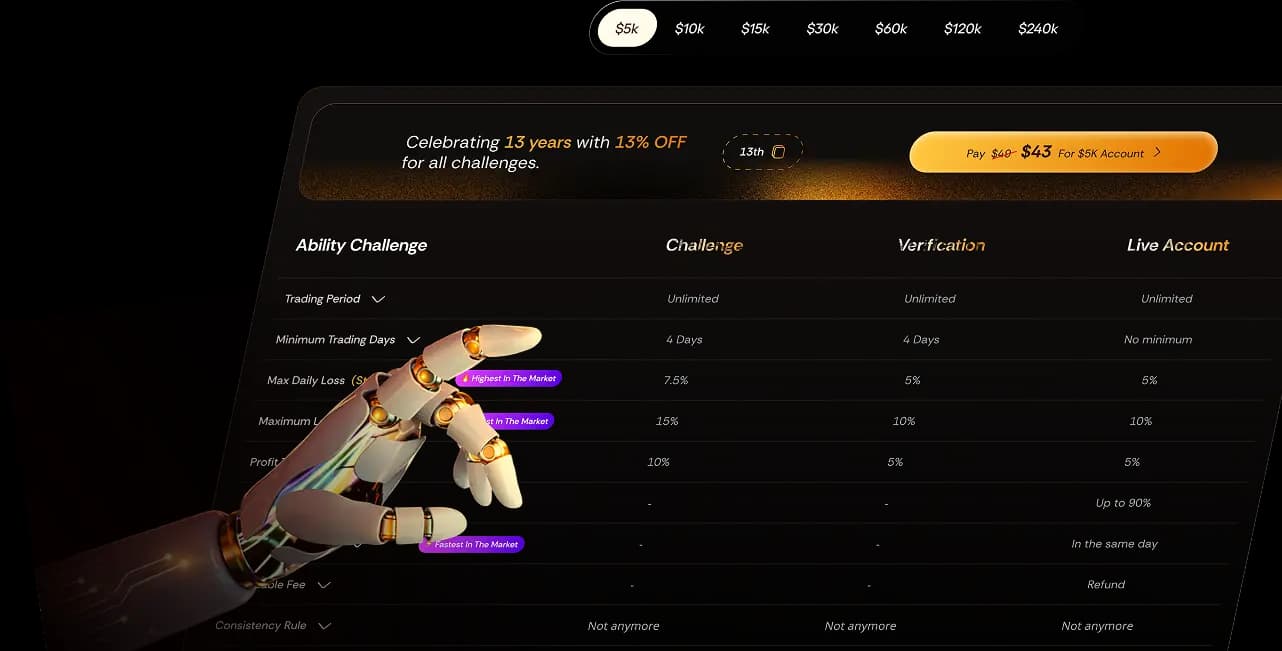
The daily loss limits are an objective of your funded trading account. If you happen to break them for any reason, the prop firm will not see this as a breach of their rules. On the other hand, if your loss exceeds this limit on a trading day, your account will be auto-liquidated.
What this means is that all open positions will be flattened, pending orders canceled, and the funded account will be prevented from opening any new positions until the next trading day. Often, this limit is factored based on your trading day’s Net profit and loss. And this will include:
- Fees
- Simulated commissions
- Both realized and unrealized trade profit and loss values
The daily loss limit matters because it helps instill trading discipline and proper risk management practices in a trader. It’s what enables you to live another trading day, because, like it or not, bad days do exist.
Trader Dashboard
Trade NowWhy Rules Exist
Prop trading rules are there to help manage risk and ensure that the firm’s capital will remain protected. Through these rules, the firm also gets to identify traders who are consistently disciplined, thus helping them weed out gamblers.
Because these firms allow you to trade large amounts of capital, they have no option but to enforce strict, non-negotiable rules. Let’s take a closer look at why proper risk management in trading rules exist:
- Protect firm capital: The trading rules have been designed as a safety net to prevent a bad trade from blowing up the entire funded account. Some of the rules that help protect firm capital include drawdown limits. Through them, traders get to prioritize capital preservation, thereby resisting the urge to execute high-risk strategies.
- Foster discipline and proper trading habits: The rules against overtrading and over-leveraging are meant to curb impulsive actions. Many of these actions, such as revenge trading, tend to happen after a trader has made a significant loss. They are, therefore, present to enforce professional risk management practices.
- Filter for consistent talent: The challenge phase is designed to check whether a trader can make money and, at the same time, adhere to strict rules. Some of the rules you need to observe during this phase will include consistency rules and the time-constraint.

Audacity's Prop Trading Challenges
Free Prop Firm Challenge- Business model sustainability: Rules do much more than check the consistency of prop traders; they also ensure the sustainability of the firm. Prop firms use these rules to predict their payout obligations while predicting future cash flows. It’s how they get to remain profitable, even when multiple traders fail.
Simply put, the prop trading risk rules aren’t there to make your life difficult: they’re the framework that helps transform speculative trading into a professional undertaking. Consequently, familiarize yourself with them and learn how to avoid rule violations.
Read more about our latest guide Static Drawdown Vs Trailing Drawdown
Learn about Daily vs Intraday Drawdown
Conclusion
Managing risk effectively is vital for anyone participating in the Audacity Capital trader funded challenge. The rules discussed above help provide a structured approach to protecting capital and balancing profitability. Applying these principals will enable you to build disciplined trading habits, which are key to becoming consistently profitable.
FAQ
To help prop firms predict their payout obligations. Without them, passing rates can become erratic, making it impossible to forecast cash flows.
Breaching a prop trading rule, e.g., a maximum daily limit rule, will lead to an automatic termination of your evaluation. And if you’re already using a funded account, this will result in its closure.
No! You can’t request this kind of adjustment. You must learn to trade within the set limits.
Prop trading challenges require consistency and disciplined risk management. If you’re to succeed, you should only risk between 1% and 5% of your available capital.
You don’t have to worry about this, as every account participating in a funded account evaluation will come with a fixed daily loss limit.
Of course! Many modern prop firms have strict rules against high-frequency trading, gap trading, and, in certain cases, even news trading.
This will vary from one prop firm to the next. There are those who allow their traders to hold their positions, while others require you to close them by the end of the day. For the latter, this is used as a precautionary measure to help mitigate against gap risk.
Prop trading is a double-edged sword that comes with both risks and opportunities. Its risks include the pressure to perform consistently and the threat of account termination.

Handa nang maglapat ng disiplinadong panganib sa crypto? Galugarin ang mga bagong instrumento ng crypto ng Audacity Capital at dalhin ang iyong diskarte sa pangangalakal.
Matuto PaNewsletter
Sumali sa aming newsletter.
Sumali sa Aming Social Community

Simulan ang Iyong Paglalakbay Ngayon Gamit ang Aming Libreng Pagsubok
Ipagmalaki ang iyong mga kasanayan at tagumpay sa pamamagitan ng mga sertipiko at makakuha ng pagkilala para sa iyong pagsusumikap at dedikasyon mula sa mga potensyal na mamumuhunan at kasamahan.
Libreng PagsubokMga Kaugnay na Artikulo

Best Prop Firm to Trade With in 2026: Why Audacity Capital Leads the Market
Discover why Audacity Capital is considered one of the best prop firms in 2026, offering funded accounts, fast payouts, and flexible trading rules.


Prop Trading Vs Flow Trading
Learn the difference between prop trading and flow trading, including strategies, risk exposure, client interaction, and which path suits your trading career.

Prop Trading Vs Quant Trading
Learn the difference between prop trading and quant trading, including strategies, technology, risk management, and which approach suits your trading style.

Prop Trading Vs Investment Banks
Explore how prop trading differs from investment banks in strategy, capital, and risk management with insights from Audacity Capital.