


Spread Betting vs CFD Trading


Both spread betting and CFD trading give a UK trader the same exposure to the same markets, with leverage and no ownership of the underlying instrument.
At first glance, the option of choosing one or the other seems cosmetic. You will have the same access to shares, indices, forex and commodities, whether you choose the wrapper or not, so what is the importance?
It matters because the difference most people think they already understand is the one they understand least. This article is for educational purposes only and is not a tax or investment recommendation; both are leveraged products with significant risk of loss.
Who This Comparison Applies To
Before proceeding, confirm that this comparison is yours to make. For the majority of the world, it is not.
Spread betting is a UK and Ireland product only. CFDs can be availed almost everywhere except for retail traders in the United States.
If you are in the United States, this comparison does not apply to you. Instead, you need to focus on the derivatives available to you as a trader in the market.
In India and in most markets you'll be choosing between CFDs and something completely different, not between these two. The only traders who really have a choice between Spread Betting and CFDs are UK or Irish traders.
If it's not you, then the rest of this page will not help much, so you'd better spend your time elsewhere.
What the Two Have in Common

Begin with the common core as it sets the stage for all that comes next. Both spread betting and CFD trading are leveraged derivatives, traded over the counter with a provider. Neither instrument gives you ownership of the asset underlying the trade.
Both offer short and long positions. Both trade on markets such as stocks, indices, forex, and commodities and in some cases even cryptos.
Both are subject to overnight funding when positions are not traded during trading hours. Both are equally FCA regulated and subject to the retail protections for UK retail clients.
Your economic exposure is almost the same. Comparing the two will not change your exposure or potential losses.
That is, all the difference is at the wrapper-level: the size of the position, its taxation, its expiration and the currency in which it settles. Everything else about the two products is the same.
How Each One Is Sized, Priced and Settled
There are three distinct mechanics which differentiate between them and you will find them in a very predictable order.
Sizing
The spread bet is placed at a rate per point of movement. Your profit or loss is the number of points the market moves multiplied by your stake.
A CFD is placed at the number of contracts, each of which represents a specific amount of the underlying. The profit or loss here will be made through the price difference multiplied by the contract quantity.
Neither is necessarily easier in concept than the other.
The per-point format feels more intuitive for someone coming from outside markets, while the contract format maps directly onto the underlying for anyone coming from share dealing.
Currency
Spread bets are settled in sterling, irrespective of the market traded. This eliminates direct currency risk from a position in a US/Euro instrument.
For CFDs, settlement is usually done using the currency of the instrument itself. Therefore, currency exposure can be included in the position.
This is not a complete win for spread betting because while stripping an exposure out is an example of simplification, it is still a conversion taking place somewhere at the price provided by the spread betting firm.
Cost
The cost of spread betting is contained in the spread alone.
CFD firms will often have a lower spread for certain markets while having a commission fee that applies to share CFDs.
There is no reliable difference in cost. The comparison of commission and spread is dependent on the market, the provider and the holding period, so the right answer is: compare the total cost when it comes to the specific instrument you will be trading.
Spread betting | CFD trading | |
How a position is sized | A stake per point of movement | A number of contracts |
Settlement currency | Sterling, whatever the market | The instrument's own currency |
Where the cost sits | Entirely in the spread | Spread, plus commission on some markets |
Expiry | Fixed date, usually rollable | Generally none, futures-based excepted |
Where it is available | UK and Ireland only | Most markets, not US retail |
Account types | Usually individual only | Individual and corporate |
The Tax Difference, and the Condition Nobody Mentions
This is why most people find their way to this page, so let’s start off with the mechanics, followed by the part that never gets mentioned.
HMRC considers spread betting to be a form of gambling and not investment. For most of the UK residents, that translates to profits not being subject to capital gains tax, no stamp duty and no need to record on a self-assessment return.
CFD profits are subject to capital gains tax above the annual exempt amount, at the prevailing rates. Again, CFDs are exempt from stamp duty as there is no ownership of the underlying.
Here is what ranking pages don't mention. Profit exemptions are meaningless to a trader who does not make any profits. The flipside of the spread betting exemption is that losses from the spread betting cannot be offset against other capital gains.
CFD losses can be offset in the same year, or carried forward to future years.
So this is not a tax benefit comparison of the two products. It's a decision concerning the outcome that you would like to achieve with the tax support.
You're making that choice without knowing what you will receive. The spread betting exemption is useful in case you have profits, and the CFD loss offset will help if you do not.
Follow that through. Providers have to disclose the percentage of losing retail accounts, and this percentage in the industry is usually a majority.
If the majority of retail accounts lose, then the loss offset might be more relevant than the profit exemption for some traders. And this is a rather unpleasant thing to mention, but it should be mentioned during the comparison.
On the accuracy note. Your tax treatment depends on your specific situation, and can change. Consult HMRC or a professional advisor on your position, and check the annual exempt amount and the relevant rates, since they have been changed recently.
Expiry, and the Cost of Staying In
This is the factor which most people only discover when it becomes a cost to them, and it is the one that is most significant for anyone holding positions beyond a few days.
Spread bets have a set expiry. A position can be rolled to keep it open, but rolling is a transaction and there is a cost involved. CFDs do not have any expiry and are theoretically able to be held indefinitely, except for those based on futures contracts, where the underlying contract sets the expiry.
For the day trader and short swing trader, the expiry and rollover issue will barely register. Most comparisons treat them as a footnote.
For anyone who is holding positions over weeks or months, however, the rollover becomes a cost on top of the overnight interest. Those costs can accumulate in the background.
The practical point is this: the longer your intended holding period, the more the expiry difference outweighs the tax difference in the actual arithmetic.
Rollover costs and financing rates both vary by provider and instrument, so check your own provider's schedule rather than work from a generic figure.
Which One Fits Which Situation
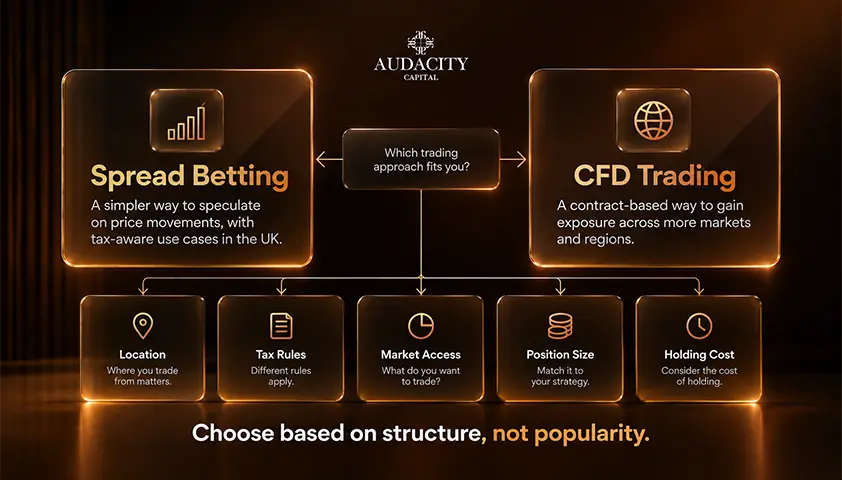
Here is the recommendation the rest of the results avoid, sorted by your circumstances rather than by product. Treat each as a lean, not a rule, because the answer is genuinely conditional. But a lean is still an answer.
Where spread betting leans stronger
You are a UK resident trading short-term positions. You trade non-sterling markets where avoiding direct currency exposure is useful. You are not looking to offset losses against gains elsewhere, and you are trading as an individual rather than through a company.
Where CFDs lean stronger
You hold positions for weeks or months and would otherwise be paying to roll them. You have capital gains elsewhere and would benefit from loss offset.
You are hedging an existing share portfolio. You are trading through a corporate account. Or you are outside the UK and Ireland, in which case the question does not arise at all.
One closing note on proportion. This decision is smaller than the search volume behind it suggests. Both products deliver the same exposure and the same risk, and no wrapper choice compensates for a method that does not work.
A trader choosing between them is optimising the last few percent of a result that has not been produced yet.
If this describes you | Leans toward | Because |
Short-term positions, UK resident | Spread betting | No expiry cost at that horizon, and the exemption applies if profitable |
Holding for weeks or months | CFDs | No expiry means no recurring cost to stay in |
Capital gains elsewhere to offset | CFDs | Losses can be set against other gains |
Hedging an existing share portfolio | CFDs | Loss treatment is what makes the hedge work on paper |
Trading through a company | CFDs | Spread betting is usually individual accounts only |
Outside the UK and Ireland | CFDs by default | Spread betting is not offered to you |
Conclusion
The two products give you the same exposure. The choice between them is a choice about tax treatment, expiry and settlement currency, not about how you will perform.
The tax headline that drives this entire search is real, and it is also conditional in a way that rarely gets stated plainly: the exemption helps the profitable, and the loss offset helps everyone else.
Get the choice right, but do not agonise over it. The wrapper does not change the outcome it is wrapping. A short-term UK trader who is confident in their edge leans one way. A longer-term trader, or someone with gains to offset, leans the other. That is most of what there is to decide.
Frequently Asked Questions
Yes, many UK providers let you hold both. The practical point worth knowing is that positions in the two accounts are treated separately and cannot be netted against each other. A profit in one and a loss in the other do not combine for tax or margin purposes, so you manage them as two distinct sets of positions.
It depends on which classification you mean, and the two do not match. HMRC treats spread betting as gambling for tax purposes, which is precisely why the exemption exists. But the activity is regulated by the Financial Conduct Authority as a financial product, not by the Gambling Commission. So the tax classification and the regulatory classification point in different directions, and both are correct.
The general position is that spread betting profits are not taxed for most UK residents, whether or not it is your only income. Be careful here, though. Situations where trading is conducted as a business have been treated differently, and this is a genuinely contested area. If your circumstances might fall into that category, take professional advice rather than rely on a general answer.
No, neither product gives you ownership, so neither pays an actual dividend. Both typically apply a dividend adjustment to open positions on individual shares. That adjustment is credited on long positions and debited on short ones, which mirrors the economic effect of a dividend without the underlying holding.
Generally no. Spread betting is usually offered through a provider's own platform rather than through MetaTrader, though availability varies by firm. If platform choice matters to you, check with the specific provider before opening an account rather than assuming MT4 or MT5 support.

Handa nang maglapat ng disiplinadong panganib sa crypto? Galugarin ang mga bagong instrumento ng crypto ng Audacity Capital at dalhin ang iyong diskarte sa pangangalakal.
Matuto PaNewsletter
Sumali sa aming newsletter.
Sumali sa Aming Social Community

Simulan ang Iyong Paglalakbay Ngayon Gamit ang Aming Libreng Pagsubok
Ipagmalaki ang iyong mga kasanayan at tagumpay sa pamamagitan ng mga sertipiko at makakuha ng pagkilala para sa iyong pagsusumikap at dedikasyon mula sa mga potensyal na mamumuhunan at kasamahan.
Libreng PagsubokMga Kaugnay na Artikulo

PnL in Trading - What is PnL in Trading?
Learn what P&L in trading means, how to calculate it, the difference between realized and unrealized P&L, and how prop firms use P&L.


What Is a Breaker Block in Trading? A Complete Guide for 2026
Learn what a breaker block is in trading, how bullish and bearish breaker blocks form, how to identify them, and how traders use them in SMC and ICT.

Averaging Down: Explained
What averaging down does to your breakeven and your exposure, the one question that settles whether to do it, and why leverage changes the answer entirely.

Trailing Stop Loss: How to Use It
How a trailing stop loss works, three ways to set the distance, the MetaTrader setting most traders get wrong, and what the trail costs you in return.