


Trading Burnout: Signs and Recovery


You still access your trading platform as usual. Everything is in order — the chart opens normally and your watchlist is right where you left it. But the work has gone flat.
The reviews that you have been giving are now few and far between or nonexistent. You are making trades which you can no longer justify and you stop asking yourself why.
This article helps you work out what is actually happening, since several different problems can produce the same fortnight, and they don't react to the same thing. It is purely educational and not medical, psychological, or investment advice.
What Burnout Is, and What It Is Not
The World Health Organization lists burnout as an occupational phenomenon and not a medical condition in ICD-11. It specifies the state in three aspects: first, energy depletion or exhaustion; second, mental distance or cynicism towards work; and third, loss of professional efficacy.
This definition should be applied as a model, which is more accurate than the lists of unorganized symptoms that dominate most websites on the topic.
Below is the element that increases its value. Tiredness in itself is simply exhaustion and exhaustion can be overcome by sleeping. The difference in the case of trading burnout is the combination of both elements.
A person who is depleted, who has become cold towards tasks they were once passionate about, and no longer believes they can execute the task has an entirely structurally different problem than someone who had a difficult week.
One thing to keep in mind, and no other competing page mentions this caveat. Burnout was developed and researched as a concept for the workplace where there are employers, coworkers, workloads, and fixed hours. The trader who trades independently has none of those.
The three dimensions apply directly to trading, but the framework itself was created for a different environment. Take this into consideration as you read it.
Dimension | What it looks like at the desk | What it is not |
Exhaustion | Depleted before the session starts, not after it begins | One poor night's sleep or a hectic week |
Mental distance or cynicism | Dispassionate about results, no longer reviewing and dreading the open | Calm detachment, which is a good sign, not a bad one |
Reduced sense of efficacy | No longer believing you can execute a plan you still trust | Losing faith in the plan itself, which is another problem |
The Signs, and Which Ones Are Worth Trusting
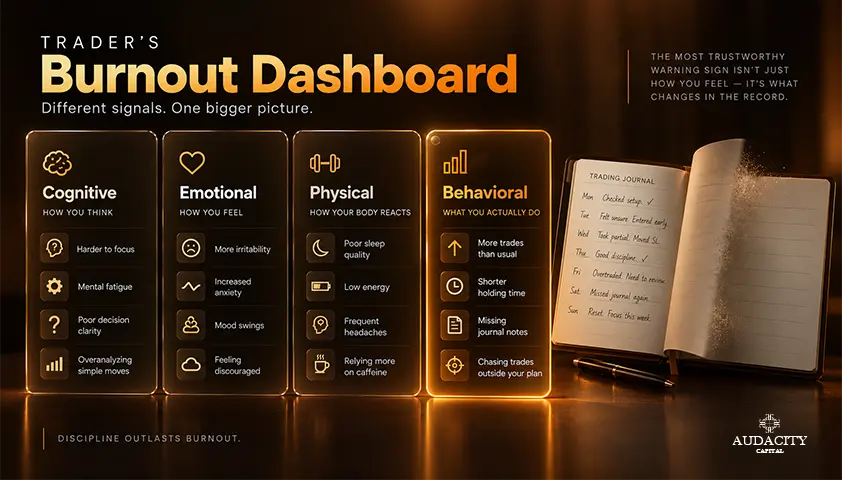
It would be easier to identify trading burnout signs that should be taken into account if they were grouped according to their nature instead of just being listed as flat text.
1. Cognitive signs may include hesitation in setups you are familiar with and have traded many times, followed by a late chase on a familiar move once it is executed.
2. Emotional signs include irritability, dullness, and fear prior to the start of the session.
3. Physical signs include disrupted sleep, constant tension, and changes in appetite.
4. Behavioral signs are the drifts which can be quantitatively measured such as increased frequency of trade, shortened holding period, and absence of journaling.
The behavioral symptoms are the only ones that can be evaluated instead of experienced.
The trader experiencing burnout during trading will tend to underestimate the severity of his condition because acknowledging this condition would imply accepting defeat.
A trading journal that has changed from sentences into blanks is an indicator which doesn't rely on your current mood and usually comes before the feeling does.
Therefore, take your journal and evaluate your recent successes as compared to your last two weeks of trading. Look for their length, frequency, and how many trades had any reasoning behind them at all. It is a view of the record, not a quiz with a grade.
There is no threshold here, and no count. The number of signs isn't a hint, neither is the increased frequency of trades. Pages that publish figures like those invented them.
Four Things That Look Like Burnout and Are Not
This part is most important. The same lousy, unproductive fortnight can be four different problems and if you treat it as one of them, it's even worse.
One, a regular losing streak.
You still buy into the idea, you are still implementing it exactly as planned, and you are still getting bad results. This is simply variance at work.
A losing period may arise even when the strategy is properly executed, and changing the strategy due to variance only worsens the issue. What's important is whether you have executed as you intended.
Two, lost faith in the method.
This often occurs after a losing streak, or after a rule violation turns out to be winning. You have stopped trusting the plan rather than having the inability to implement it.
This is a matter of testing and review, not one of exhaustion, and cannot be solved by resting. The defining question is: do you still believe in your process?
Third, something that goes beyond trading.
When depression, lack of interest, hopelessness, and disruptions in sleeping patterns carry on beyond the market, then there is likely an issue that goes beyond trading burnout.
This goes beyond the scope of what a trading article can diagnose or help with. Get professional help. It’s not something that can be talked your way out of behind your trading desk.
Fourth, compulsive behavior patterns.
Chasing losses, trading with funds that should be elsewhere, concealing losses from people that are close to you, the inability to stop once you have made the decision to.
This is a completely separate issue from exhaustion, as this will not get better through resting, but requires support designed for it.
Contact problem gambling assistance programs available in your country. If you identified with that paragraph, it's the most helpful thing on this page.
Reading this cannot rule any of these in or out. The idea is to make the difference clear and in that way you know which way to look.
Why Trading Produces This So Reliably
Trader burnout is not a symptom of your failure to do well at something others excel at. There are certain aspects of the task that could lead to burnout, and it is useful to understand why.
The market never closes. An open market eliminates the end-of-day signal that exists in most other tasks, and therefore the only way to know when your day is done is to realize it yourself.
Feedback is instant, monetary, and unpredictable. This can hold your attention far too long after the service or session ends, and the uncertain reward makes it even harder to quit.
Retail trading is largely solitary, so there is nobody around to recognize the shift in you, or assess your interpretation of your condition. The task is also extremely decision dense relative to the amount of time spent doing it.
Four hours of decision-making in a stressful environment is different from four hours of regular work. Not only do the number of hours matter but so do the number of decisions made.
When a trader is going through evaluation, there is another factor. A fee paid for, a goal to achieve, and a rule set that could close down your trading account.
The combination of the two puts a time limit on an activity that may not have one, and a deadline plus variance is a surefire recipe for the state described here. It's better to identify that pressure than to try to ignore it.
What Recovery Actually Involves

If this is genuine trading fatigue rather than one of the other four problems, recovery is a sequence, not a schedule. Three stages, in order, each with a reason behind it.
Stage one, stop properly.
A real break means positions closed and charts off, and that includes checking prices for no reason, which keeps the same loop running. The objection almost everyone raises is that they will trade smaller instead.
That usually fails, because you are still inside the environment that produced the state. Trading smaller reduces the stake, not the exposure.
Stage two, rebuild the rest of it.
Burnout in a solo occupation is usually accompanied by that occupation having quietly become the only thing in the week. Sleep, movement, other people, and time that is not contingent on a result.
This is not a wellness aside tacked onto the end. It is the part that decides whether the break does anything, and a break spent reading about markets is not a break.
Stage three, re-enter the process.
Come back small and judge the return on whether you did what you intended, not on whether it made money. The reason matters.
Measuring yourself on P&L the moment you return reinstalls the exact pressure the break was meant to interrupt. Compliance with your own plan is the thing you can actually control, which makes process goals the only fair measure of a re-entry.
A break followed by a return to the identical schedule, the same screen time, and the same expectations produces the identical outcome. If nothing about the working pattern changes, the rest was a pause, not a recovery.
There is no fixed timeline for any of this. Anyone offering you a day count, a position size percentage, or a trade cap for trading burnout recovery is guessing, and the precise protocols you will find elsewhere have nothing behind them.
Stage | What it involves | Why it is usually skipped |
Stop | Positions closed, charts off, no price checking | Feels like quitting, so traders trade smaller instead |
Rebuild | Sleep, movement, people, time not tied to an outcome | Feels unrelated to trading, so it gets treated as optional |
Re-enter | Small size, judged on doing what you intended | P&L is easier to measure than process, so it takes over again |
When This Needs Someone Who Is Not a Trader
Some grounds are clear enough that no trading article should be your reference point.
Rest and time away have not shifted it. What is happening away from the charts matters as much as what is happening in front of them, particularly your mood, your sleep, and your interest in things that have nothing to do with markets. Or you recognised yourself in the compulsive pattern described earlier.
For the first two, speak to a qualified professional. For the third, reach out to problem gambling support services in your own country. Because this readership is global, look for the services available where you live rather than any single national line, which would be wrong for most people reading this.
This is what the situation calls for. Nothing more dramatic than that, and knowing how to recover from trading burnout sometimes means accepting that recovery is not the trader's job to run alone.
Conclusion
The useful question was never whether you are burned out. It is which of several different problems you actually have, because the responses pull in completely different directions. A losing stretch needs patience.
A broken belief in the method needs review and testing. Genuine exhaustion needs a real stop and a change to the pattern that caused it. And two of the possibilities need someone qualified, not a trading article.
Hold onto that last point. Whatever you conclude, the thing that produced this state will still be there when you come back, unless something about how you work actually changes.
Frequently Asked Questions
Yes. The exhaustion comes from sustained decision-making, screen hours, and the pressure of being evaluated, and none of that requires the money to be real. An evaluation with a target and a rule set can carry as much load as a live account. The absence of real capital does not remove the decision density that drives the state.
No. Tilt is usually a more acute reaction to a trading event, such as a loss, missed trade, or rule violation. Burnout develops more gradually and reflects a broader deterioration in energy, attitude, and sense of effectiveness.
Do not make that decision from inside the state. Everything looks worse from there, and a conclusion reached while depleted is not a reliable one. This is a question to revisit after a genuine break, not during one.
This is the main reason traders refuse to stop, so it is worth answering plainly. A documented process is what survives a break. An undocumented feel is what does not. If you are worried about losing your edge over time away, that is a reason to write your process down, not a reason to keep trading through the fatigue.
Yes, and it is the least intuitive case. The pressure comes from sustained decision load and the absence of a natural stopping point, not from losing. Good results can extend both of those rather than relieve them, because success often means longer hours and more time in front of the screen.

Handa nang maglapat ng disiplinadong panganib sa crypto? Galugarin ang mga bagong instrumento ng crypto ng Audacity Capital at dalhin ang iyong diskarte sa pangangalakal.
Matuto PaNewsletter
Sumali sa aming newsletter.
Sumali sa Aming Social Community

Simulan ang Iyong Paglalakbay Ngayon Gamit ang Aming Libreng Pagsubok
Ipagmalaki ang iyong mga kasanayan at tagumpay sa pamamagitan ng mga sertipiko at makakuha ng pagkilala para sa iyong pagsusumikap at dedikasyon mula sa mga potensyal na mamumuhunan at kasamahan.
Libreng PagsubokMga Kaugnay na Artikulo
What Is BOS in Trading? A Complete Guide to Break of Structure (2026)
Learn what BOS in trading means, how Break of Structure works, how to identify bullish and bearish BOS, and how traders use it in market analysis.

Prop Firms With No Consistency Rule in 2026
Compare prop firms with no consistency rule. Find firms offering flexible profit requirements, trading conditions, and payout policies for traders.
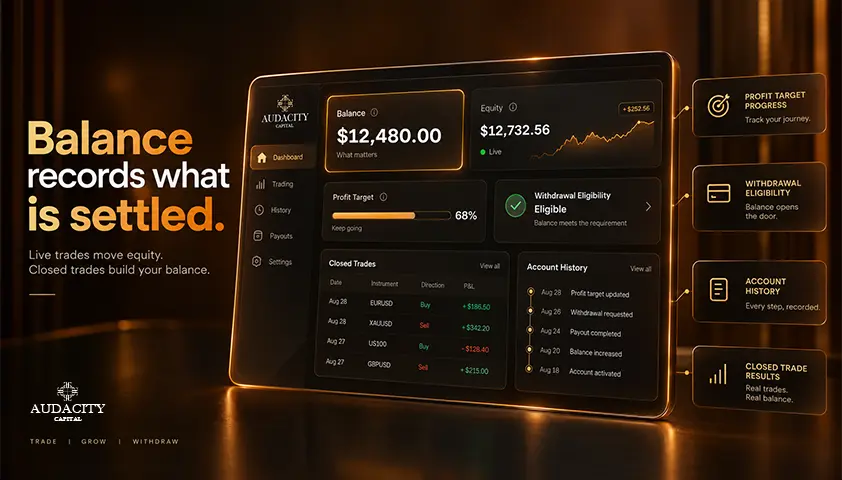
Equity vs Balance in Trading: Which Number Matters
Equity vs balance explained: what each number includes, why margin calls and prop firm rules run on equity, and where your balance still decides things.

PnL in Trading - What is PnL in Trading?
Learn what P&L in trading means, how to calculate it, the difference between realized and unrealized P&L, and how prop firms use P&L.