





How To Use Multiple Timeframe Analysis For Better Trade Entries


Have you ever opened a long position only to see the market moving in a downtrend almost immediately? Most traders have experienced this, and it can be very frustrating, especially when you are starting Forex trading. Many traders who lose in the market in this manner overlook the importance of multiple time frame analysis, which is key in ensuring you take accurate entries.
Traders must always have an in-depth and complete view of the market to identify short-term and long-term trading opportunities easily. Relying only on one time frame might not give you the results you want, but comparing all time frames allows you to spot better trade entries, ensuring you remain profitable.
Keep reading this article to understand why multiple time frame analysis is important and how you can implement this strategy in your trading.
What Is Multiple Time Frame Analysis?
MTA or multiple time frame analysis refers to a technique whereby traders examine a particular asset using different time frames to come up with a clear trading perspective. The main aim is to align their trading strategy with long-term and short-term trends to boost the overall success rate. Different time frames allow a trader to quickly pinpoint potential trades and know the right moments to open a position.
Understanding Time Frames In Trading
In Forex, traders can use different trading time frames. These time frames are specific periods that allow you to identify the direction of the market. They can range from 1 second, 1 minute, daily, to weeks and even months.
Each time frame has its unique purpose, allowing traders to choose a time frame depending on their trading style. For example, longer time frames are ideal for swing traders and long-term investors, while shorter time frames are suitable for scalpers and intra-day traders.
The Concept Of Multiple Time Frame Analysis
Multiple time frame analysis creates a more strategic approach to tackling the market. This is because time frame strategy allows traders to gain clarity on the direction of the price. By understanding the overall direction of the market, traders can easily spot short-term or immediate opportunities that will help them boost their account balance. This is exactly how traders take advantage of multiple time frames analysis;
Traders use the top-down approach to enter the market. They simply start with higher time frames, that is, the weekly or daily chart. Higher time frames are mostly used to know the overall trend of the market. It can either be bullish, bearish, or ranging. Traders will then start zooming in to lower time frames, either the 4-hour or 1-hour chart, to spot optimal trade entry and exit points. Some traders will go further down to 15 min or 5 min for a more accurate entry.
By zooming in more and more, traders eliminate the chances of taking wrong trades. For example, if the daily time frame is bullish and the 1-hour chart is bearish, the odds of winning the trade decrease. Ignoring higher time frames may cause you to take trades in the wrong direction, which may lead to significant losses. Traders are mostly encouraged to take trades only in the direction of the trend. Doing the opposite may delay your progress.
Why Use Multiple Time Frame Analysis?
Traders are always advised to take advantage of multiple time frame analysis or MTA to become profitable in the market. Here is why:
Aligning With The Bigger Picture
Aligning your trades with the broader market is one key benefit of relying on Forex time frame analysis. By identifying the direction of price in higher time frames, you can know where to open and close your trades. Aligning trading strategies with the overall trend of the market also reduces risks, ensuring you enjoy long-term profitability.
Avoiding False Signals
It is easy for Forex traders to encounter pitfalls when trading using only one time frame, especially the lower time frames like the 1-minute or 5-minute charts. What may appear to be a perfect setup in the 5-minute chart may lead to a trade that reverses or continues if it’s not in line with the higher time frame market trend. Forex time frame analysis helps you avoid false signals, ensuring you take A+ setups only.
Improving Risk-to-reward Ratios
This is another key advantage of the time frame analysis strategy. It provides an opportunity to manage your account better, ensuring you last long in the market. By using different time frames and sticking to the overall trend of the market, you are more likely to take precise entry and exit points. Market analysis also allows you to place tight stop-loss and take profit orders more accurately. This, in turn, boosts your risk-to-reward ratio.
Example
Using one time frame to trade in the market may not be as effective as combining different time frames. One time frame analysis increases market noise and may give false signals, leading to losses. Here is how that may happen;
Imagine a trader spots a bearish breakout in the 15-minute time frame while trading GBP/USD. The market has just moved past the support level, and the trader immediately takes a sell trade, assuming that a strong downward trend has started without checking a higher time frame. This makes him lose the trade.
If the trader had checked the 4-hour time frame, he would have noticed a strong upward trend, and the market was just retracing or seeking liquidity before it moves in the intended direction. Once the market touches the discount level in the 4-hour chart, it begins to move upwards.
When you use the 15-minute chart without a higher time frame, you may think that the market is trending downward and you will be stopped out if you take a sell trade.
How To Implement Multiple Time Frame Analysis
Grasping the concept of multiple time frame analysis may appear to be daunting for most beginner traders, but the process is actually simple. To implement MTA in your trading successfully, here is a step-by-step process of how you should do it;
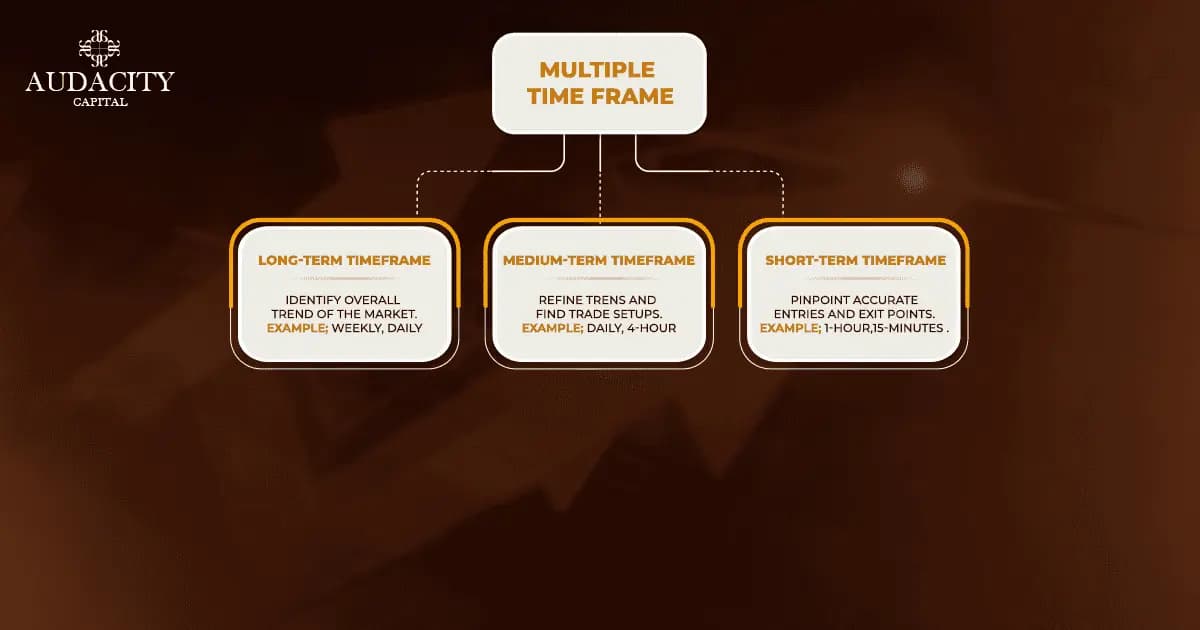
Choosing Your Time Frames: Long-term, Medium-term, And Short-term
The first thing is to select time frames that align with your trading goal and style. Many traders sabotage their trading progress by using multiple time frames to analyze the market. This usually causes analysis paralysis, making it difficult for a trader to make an informed decision.
Successful traders usually frame their trades on at least three time frames to avoid confusion. These time frames are;
- Long-term time frame: The longer time frames are mainly used to identify the overall direction of the market. It could be a monthly, weekly, or daily chart.
- Medium-term time frame: Traders mostly focus on this to know where the price is moving next. Is it making a higher high or higher low? Medium-term time frames allow traders to find potential setups. These may range from daily, 4-hour to 1-hour charts.
- Short-term time frame: The shorter time frames are used for accurate entry and exit points. Traders use them to enhance timing and accuracy. Traders may use a 1-hour, 15-minute, or 5-minute chart.
For example, swing traders use the weekly/daily chart for market direction, a 4-hour chart for setups, and a 1-hour chart to identify accurate entry and exit points.
The Top-down Approach: Start With The Higher Time Frame, Move To The Lower Time Frame.
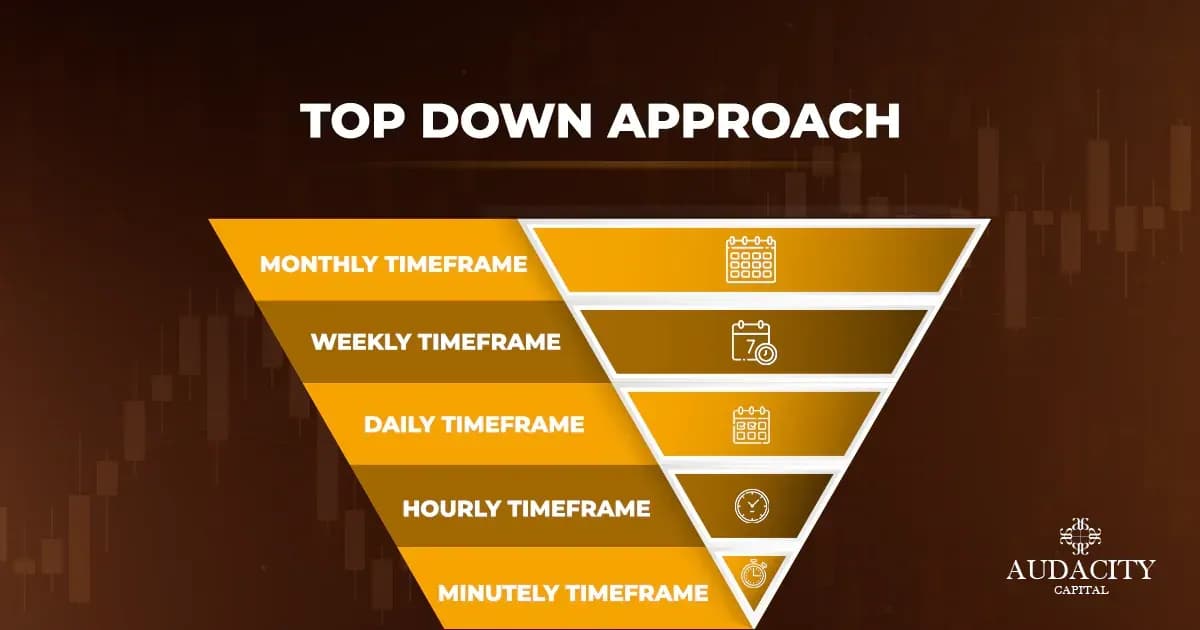
After understanding how different time frames are used, pick three time frames that will help you apply the top-down trading approach. Top-down is the backbone of MTA, and it will help you improve your trading if used correctly.
For example, if the daily chart indicates a downtrend, focus on identifying selling opportunities in the 4-hour chart, then zoom in further to refine entry and exit points. By using three time frames to analyze the market, you are sure the market won’t reverse suddenly. This also allows you to have better stop-loss positions as compared to using only one time frame to trade.
Identifying Key Levels And Patterns Across Time Frames
It doesn’t matter whether you are a swing trader, day trader, or scalper. So long as you know what key levels to look for in the market, you will always get a setup. Key levels in the market mostly depend on the strategy you are using. Some traders pay attention to support and resistance levels or use trendlines. Others use supply and demand zones, while some pay close attention to areas of imbalances in the market, commonly referred to as Fair Value Gaps.
All these are points of interest for traders. Once the price touches these levels, traders begin to look for confirmation to take buy or sell trades depending on the direction of the market. Apart from key levels, some traders rely on patterns such as head and shoulders, triangle or double tops, and bottoms to open trades.
Confirming Entry Signals On The Lower Time Frame
The last step in the time frame strategy is to confirm entry signals. As a trader, you should not be quick to take a trade without getting a good confirmation on the lower time frame. Even when everything aligns together, you should first wait for confirmation before opening a trade. When confirming entry, most traders use candlestick patterns, such as engulfing patterns or pin bars. Others use technical indicators like RSI, while others rely solely on reversal patterns to buy and sell.
Common Mistakes In Multiple Time Frame Analysis
Multiple time frame analysis can reduce unnecessary risks while ensuring you improve your trading performance. But to achieve the results you want, you must be aware of the common pitfalls you may encounter when using a time frame analysis strategy. These mistakes include;
Overcomplicating With Too Many Time Frames
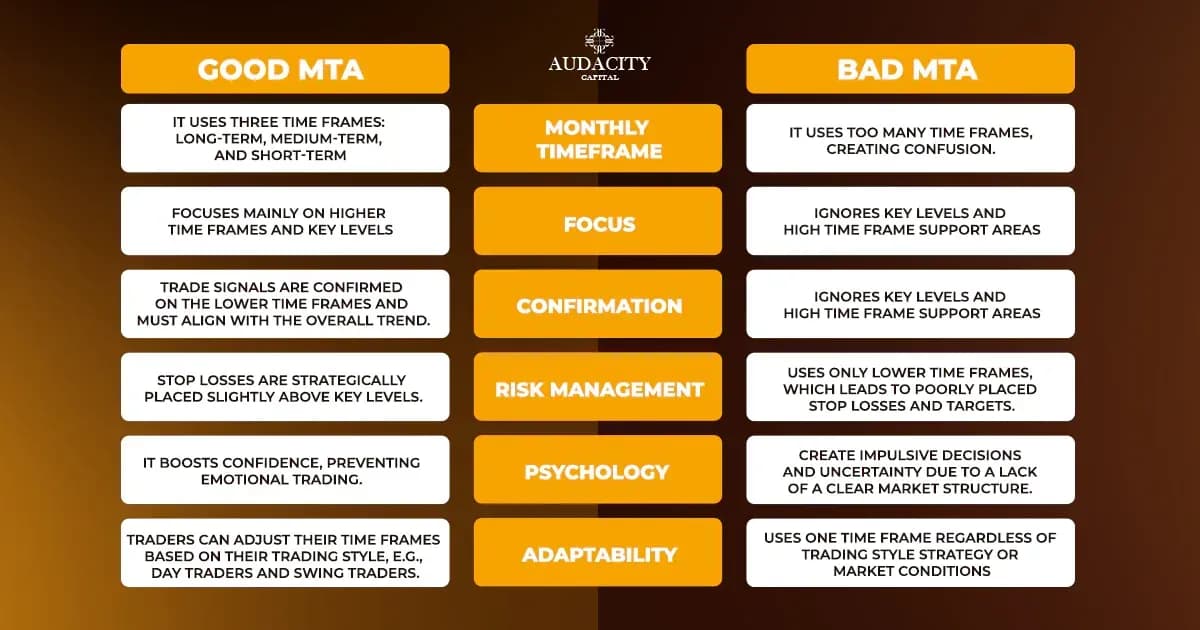
Do not overcomplicate your trade with too many time frames. You only need three time frames to become a successful trader. The use of several time frames brings confusion, making it hard for you to trade confidently. Sticking to only three time frames, long-term, medium-term, and short-term trading, will help you avoid this time frame mistake.
Ignoring The Higher Time Frame Context
This is another common trading analysis error that prevents new traders from making good profits in the market. Most beginner traders overlook the importance of using a higher time frame to check market trends. Failing to look at the bigger picture increases losses, and at times, traders may lose their accounts. It is advisable for traders to stick to a higher time frame trend, especially when taking trades using the lower time frame.
Start your analysis from the higher time frame and indicate the trend of the market. Then zoom in and mark your area of interest, and finally, wait for a confirmation to take the trade.
Chasing Signals On Lower Time Frames
you to open trades every time you spot a signal. The rapid movements in the lower time frame chart can lead to impatience and overtrading, which increases your risk of exposure.
The best way to avoid chasing price is to treat lower time frames as tools for confirming entries rather than for making major decisions in the market. Ensure you have higher or medium time frame support before opening any trades on the lower time frame.
By knowing these time frame mistakes and how to avoid them, you will be unstoppable in the market. Spotting potential and accurate entries will be easy for you since you already know what to look for. Multiple time frame analysis allows you to make your trading decisions based on higher time frame market trends. This means that your chances of losing will be much lower compared to when you are using one time frame or lower time frames for analysis.
Good Mta Vs. Bad Mta
Case Study: Mta In Action

Case Study: Identifying A High-probability Trade With Mta
Here is one of the real-world trading examples that clearly demonstrates how MTA can increase success rate;
Imagine a Forex trader, Josh, analyzing the GBP/USD pair. Josh begins analyzing the market from the daily time frame, going down to a 15-minute time frame. He notices a clear uptrend in the daily time frame characterized by higher highs and higher lows. He drops down to the 4-hour time frame and sees that the market is in a bearish trend.
As he proceeds further down, Josh also sees that the 1-hour time frame is in a bearish trend. Since he wants to stick to the overall trend of the market Josh decides to be patient in order to take a much better setup.
He marks his point of interest (POI) in the 4-hour chart and sets alerts. After a few hours, the price finally reaches his POI. Instead of entering the trade immediately, Josh decides to zoom in further to 1-hour for confirmation. He then sees a double bottom, confirming that the price wants to start going up. All these signals tell him that this is an excellent setup that may play out successfully.
Outcome: The trade smashes take profit as it aligned perfectly with the higher time frame trend. There was also a higher time frame support level and a confirmation in the lower time frame, indicating that the price was ready to reverse.
This multiple time frame case study simply reveals how different time frames can help enhance your trading skills while ensuring you remain a profitable trader throughout your trading career.
Conclusion And Next Steps
Using the multiple time frame analysis method in your trading will enhance your confidence and outcomes in the market. MTA improves trade entries by allowing you to see the bigger picture before taking any trades. By having a broader view of the market, you are more likely to make decisions based on what’s happening in the higher time frames.
However, before using the time frame analysis strategy on your live account, use a demo account to practice. This will help you build confidence and discipline and reduce emotional trading. Evaluate the outcome of this trading style and find out which top-down approach is suitable for you.
By combining MTA and other practical trading strategies, you’ll manage to boost your trading game, making the journey easy and worthwhile. Now is the time to get started. Click here to try the top-down approach using three time frames for better entries.

Ready to apply disciplined risk to crypto? Explore Audacity Capital's new crypto instruments and bring your trading strategy.
Learn MoreNewsletter
Join our newsletter to stay up to date on features and releases.
Join Our Social & Community

Start Your Journey Today With Our Free Trial
Proudly showcase your skills and accomplishments through certificates and get recognition for your hard work and dedication from potential investors and peers.
Free TrialRelated Articles

What Economic Indicators Impact Forex Trading?
Learn which economic indicators impact forex trading, including inflation, GDP, interest rates, and employment data. Trade smarter.


Is Crypto Less Risky?
How To Use Technical Indicators To Trade Forex?
Uncover the secrets of successful Forex trading with technical indicators. Enhance your strategies and improve your trading results.
Candlestick Patterns Explained: How Traders Read Price Action
Learn to read price action with proven candlestick strategies and improve trading consistency now with Audacity