



The Impact Of Leverage In Forex Trading: How To Use It Wisely.



The Impact Of Leverage In Forex Trading: How To Use It Wisely.
Is leverage boosting your trading outcome, or is it putting your account at risk? Leverage in forex trading is a significant tool that can improve your returns and also increase your losses. With just a small amount of capital, traders can control large positions, amplifying their profits or losses. This explains why leverage is usually described as a double-edged sword. Without careful risk management and proper use of leverage, traders can quickly blow up their accounts.
Understanding how leverage impacts your account and the risks involved will help you know the importance of using leverage wisely for long-term success in your trading career. This article will walk you through the benefits of leverage, how to use it wisely and how to avoid the common pitfalls associated with leverage that might drag you behind.
What Is Leverage In Forex Trading?
Beginner and intermediate traders need to grasp the concept of leverage in forex trading to maintain profitability in the market. Without the right information, traders may be trapped in a circle of doom. Understanding leverage allows you to manage risk properly and choose the appropriate leverage levels that will safeguard your trading capital.
Leverage Explained: Borrowing Power To Amplify Trades
The Relationship Between Leverage And Margin
Leverage and margin are closely intertwined but have different purposes in forex trading. Leverage allows a trader to control a huge amount of a security or asset, while margin is the amount of money a trader is expected to put forward before opening a trade. Brokers normally set a margin requirement, which determines how much money a trader must deposit to trade in the platform.
For example, if the broker requires a 1% margin, this means that you must have at least 1% of the total trade size in your account. If the amount in your account falls below the margin requirement, a margin call is triggered, which simply means you must deposit more funds to continue trading.
This is why choosing the right leverage in margin trading is crucial, as it will help protect your account from significant losses, which may trigger a margin call. Excessive leverage on margin accounts allows traders to boost their profits quickly, but one wrong move can quickly wipe out your account within minutes.
The Pros And Cons Of Using Leverage
Traders starting forex trading with small capital can take advantage of leverage to boost their account size. But as much as leverage allows traders to maximize profits, this financial tool also increases risks. Understanding forex leverage risks as well as its benefits will allow you to improve your trading performance. Here, we explore the pros and cons of using leverage in trading.
The Upside: Amplifying Profits With Small Capital
Increasing forex trading profits is one of the best and most recognized benefits of leverage. Beginner traders who have a small investment can make huge returns within a few months, thanks to leverage. Leverage enables these trades to open trades without breaking the bank. It also provides flexibility by allowing traders to make the most of short-term movements in the market so long as they maintain the margin requirement.
The Downside: Increased Exposure And Potential For Large Losses
As mentioned above, leverage is a double-edged sword. As a beginner trader, do not let the profits fool you because the losses can triple the profits if leverage is not utilized correctly. Excessive or high leverage can expose you to market fluctuations, putting your capital at risk.
With high leverage, losses can quickly add up, triggering margin calls or may even call for account liquidation. This is why, as a trader, you need to understand risk management if you are going to use leverage. Knowing how it works will help you protect your account from huge losses.
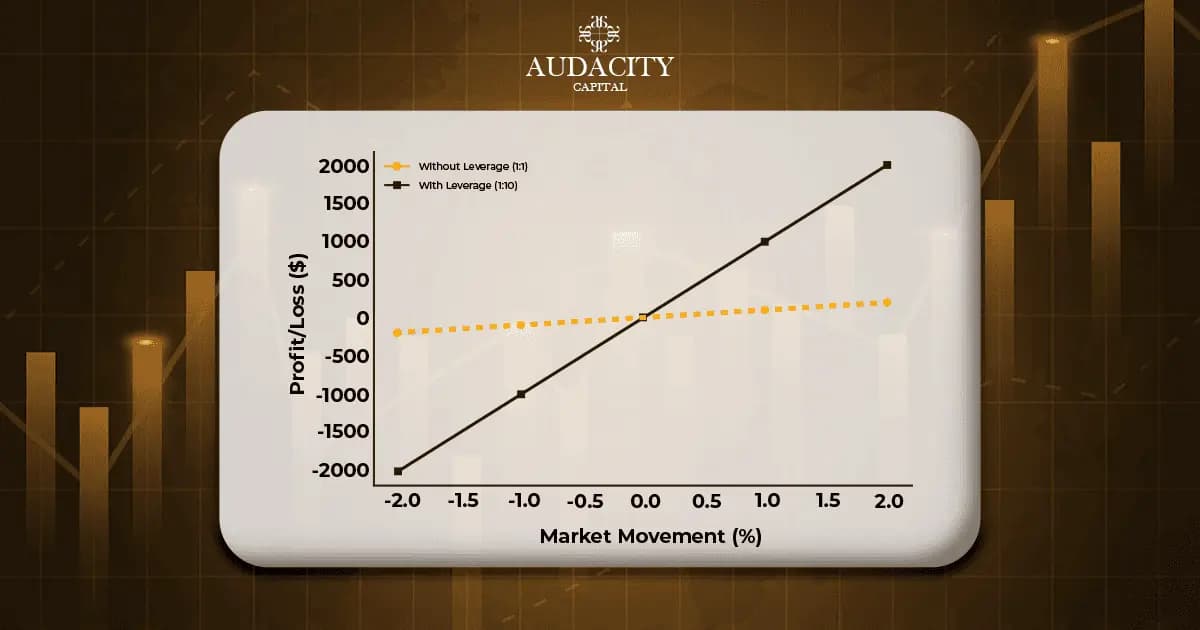
The graph above illustrates the impact of leverage on profit and loss on a leveraged and a non-leveraged account. As you can see, leverage amplifies both gains and losses on a leveraged account as the market moves. A trader using no leverage experiences profits and losses proportional to an asset’s percentage change. A 1% gain means a $100 profit, and a 1% loss means a $100 loss.
On the other hand, a trader using leverage experiences more gains and losses. The graph shows that a 1% price change causes a $1000 profit or loss. This demonstrates the risk and power of using leverage. As much as it boosts potential profits, it also exposes a trader to more significant losses, which is why leverage needs to be used wisely.
How To Use Leverage Wisely
Beginner traders may quickly fall into the trap of using high leverage ratios without considering the risks it presents. While it can offer massive amounts of profits, it’s also crucial to understand that it can wipe out your account. Using leverage properly can help protect your account from margin calls, ensuring you trade effectively and remain profitable. Here are a few key steps that will help you minimize leverage risks and maximize your overall returns:
Start Small: Using Low Leverage Ratios To Minimize Risk
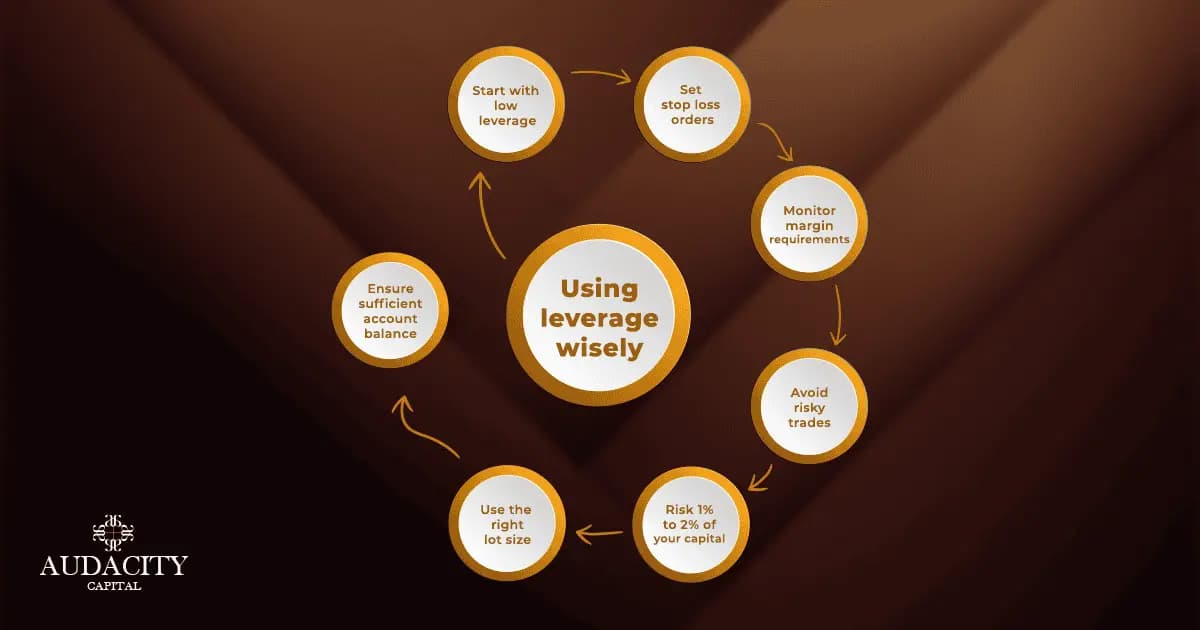
When starting forex trading, it is important to control your greed. Greed in traders usually manifests itself in many ways, one of which is taking excessive risks. Traders do this by overleveraging their accounts to gain more profits. To overcome this psychological problem, accept that growing gradually is the best way to achieve your trading goals.
Starting small allows you to learn from so many mistakes that could have otherwise dragged you behind in the future. Instead of using high-risk leverage ratios like 1:5000 or 1:1000, start with 1:10 or 1:50. A Low leverage ratio allows you to minimize your losses, giving you more control over your trading capital. Many experienced traders prefer a more conservative leverage ratio as it enables them to prevent huge drawdowns.
Always Use Stop-loss Orders
Another effective way of managing leverage risks is by using a stop-loss order. This is a tool that allows you to automatically close all your orders in case the market moves against you. Traders who do not set stop-loss orders risk blowing their accounts if the market suddenly moves against them due to economic changes.
By setting a stop-loss order, you are telling your broker to close your opened positions if the price hits a certain price level in the market. This helps protect your account from excessive losses. Even if you are using leverage, you will not lose all your money as long as you have calculated your risk.
Monitoring Margin Requirements To Avoid Margin Calls
One thing most traders fail to do is to monitor margin requirements. Sometimes, beginner traders may be overcome by psychological emotions like overconfidence, fear, and greed. This may lead them to open multiple positions without considering margin requirements. Before they know it, they have already received a margin call, which basically means they must add more money or close their running positions.
The lack of awareness in the market can sometimes lead to a never-ending circle of losses, causing some traders to give up. As an intermediate or beginner trader, you must understand that monitoring the available margin is a fundamental part of using leverage wisely. Traders who know this are less likely to blow their accounts no matter how bad their trading day looks.
Above is a flowchart showing key steps traders can use to manage leverage wisely. It illustrates a structured approach to proper risk management, from starting small to ensuring you always have sufficient funds in your account.
Common Mistakes Traders Make With Leverage
If leverage is not used properly, it can lead to costly mistakes. This is because it can expose your account to unnecessary losses and risks. Here are some of the common trading mistakes with leverage that can help you avoid errors and sharpen your trading strategy for consistent profits:
Overleveraging: The Fast Track To Blowing Up An Account
Overleveraging in forex is one sure way to wipe out all your investment in the market. High leverage ratios allow you to open large contract sizes, but this may come at a cost. You may make huge returns in a few trades, but losses may double quickly, especially in a highly volatile market.
Experienced traders avoid overleveraging their accounts because they know it may blow their accounts within a short time. For this reason, they stick to conservative leverage ratios like 1:20, 1:10, or 1:50 and never risk more than 1% or 2% of their trading capital on a trade. By sticking to these rules, these traders achieve profitability within a few months.
Ignoring Market Volatility When Using Leverage
Market volatility varies in different pairs and assets. A highly volatile market can quickly wipe out your trading capital if proper risk management is ignored. This is why market volatility should never be overlooked, especially when using a high leverage ratio. If the market suddenly moves against you due to economic events, profits can quickly turn to losses. To cushion this risk, traders should always use stop-loss orders, monitor economic news, and adjust leverage ratios depending on the market’s volatility.
Failing To Adjust Leverage Based On Market Conditions
This is yet another common leverage mistake among many forex traders. Using the same leverage ratio in all market conditions might be the reason you are becoming profitable. This is because risk management approaches may vary in different trading environments.
For example, in stable market conditions, traders can comfortably adjust their leverage ratios to increase returns, but during high-impact news, it is advisable to reduce leverage to prevent unexpected losses due to rapid price movements during that time. By adjusting leverage ratios in different market conditions and managing your trades carefully, you can protect your account and improve profitability over time.
Case Study: Smart Vs. Risky Leverage Use
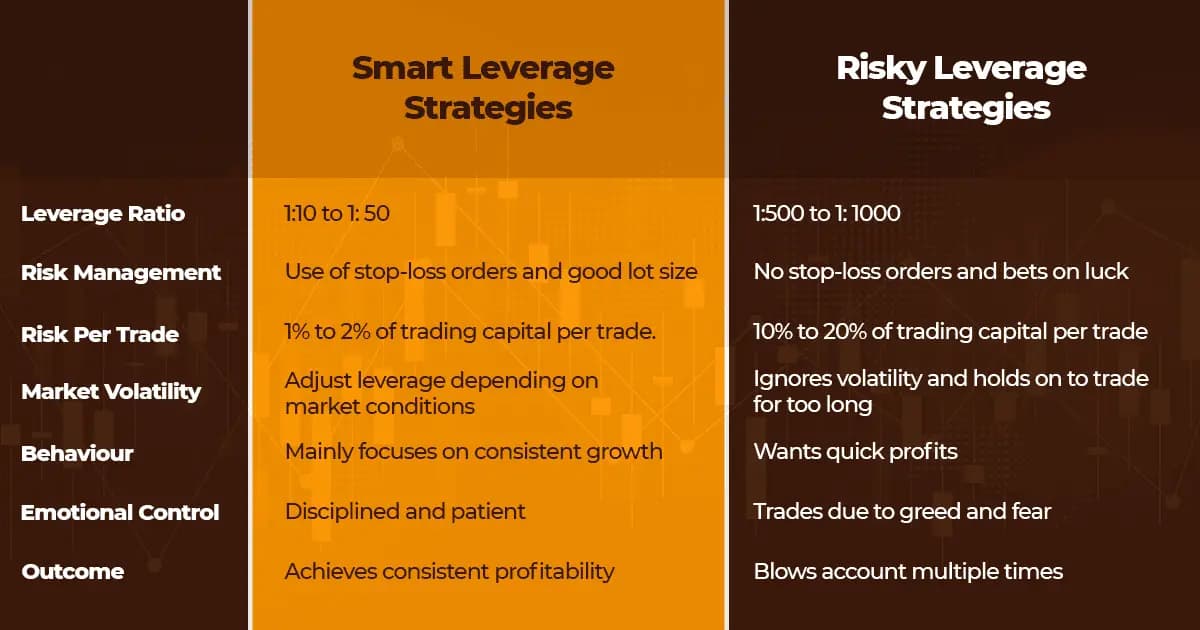
The way forex traders apply leverage can determine their trading results over a specific period. Traders who achieve long-term success understand that the key to sustainable leveraged trading is risk management and discipline. Traders who chase quick profits by overleveraging expose themselves to potential losses, which can wipe out all their investments. Here is a simple forex leverage case study that compares two traders: the one who uses leverage wisely and the one who gambles with high leverage:
The Responsible Trader Vs. The Overleveraged Gambler
The Responsible Trader
Peter is an experienced trader who never risks more than 2% on a single trade and uses a leverage ratio of 1:10. He has his risk management plan in place and never goes against it whenever he gets into the market.
Peter also uses stop-loss orders to prevent excessive losses, keeps track of margin requirements, and is keen on market conditions, ensuring his leverage is adjusted when necessary. Over time, Peter sees that his account is gradually increasing, and he can even withdraw profits to invest in other projects.
Peter’s leverage success story emphasizes the need for patience, discipline and smart risk management techniques in the market.
The Overleveraged Gambler
On the other hand, Sam is a trader who strongly believes that you cannot be profitable without high leverage. He trades with a leverage of 1:500 and opens random trades, hoping to catch small price movements. Some other mistakes Sam makes when trading include trading on highly volatile markets without adjusting his leverage, ignoring proper risk management, holding losing trades for too long, not using stop-loss orders and revenge trades when he experiences losses.
Sam realizes that as much as he can make huge profits at times, his losses sometimes double or triple his profits. He also notes that he has funded his account multiple times to meet the margin requirements in only 2 months. Sam will eventually learn from his mistakes and improve his psychological game to become profitable like Peter.
This short leverage case study intends to help you understand that success in forex trading does not depend on how big your leverage is. With discipline and well-structured risk management, you can gradually grow your account size and eventually achieve your trading goals.
Comparison Of Smart Vs. Risky Leverage Strategies
Conclusion & Next Steps
Forex leverage is a double-edged sword, meaning it can significantly increase your profits and also accelerate your losses. It allows traders to control large positions with minimal capital, but if not used wisely, it can lead to financial setbacks. Proper use of risk management, discipline and patience can help traders achieve success in the long run with leveraged trading.
The use of low leverage, stop loss orders and monitoring margin requirements are some of the mentioned approaches that can help traders minimize leverage risks. Traders can refine all these risk management strategies by testing their trading approach on a demo account. A demo account allows you to assess your risk tolerance and develop a working trading plan, ensuring you create a solid foundation that will enable you to achieve consistency.

Ready to apply disciplined risk to crypto? Explore Audacity Capital's new crypto instruments and bring your trading strategy.
Learn MoreNewsletter
Join our newsletter to stay up to date on features and releases.
Join Our Social & Community

Start Your Journey Today With Our Free Trial
Proudly showcase your skills and accomplishments through certificates and get recognition for your hard work and dedication from potential investors and peers.
Free TrialRelated Articles

Gold Hits Record Highs Then Crashes: The Full Fundamental Breakdown
Gold hit record highs before falling sharply. Why is gold crashing and will gold crash further? Discover the real reasons behind the gold price crash with insights from Audacity Capital.

From Strategy To Structure: How Professional Traders Turn Market Knowledge Into Consistent Profitability

The Human + Machine Equation: Why The Best Traders Think Like Algorithms (And Feel Like Humans)

How to Trade Gold (XAUUSD): The Complete Guide
Learn how to trade Gold (XAUUSD) like a professional trader with Audacity Capital. Discover proven strategies, risk management techniques, session timing, and expert tips for consistent gold trading success.