



What Is Forex Fundamental Analysis and How Can Traders Use It?


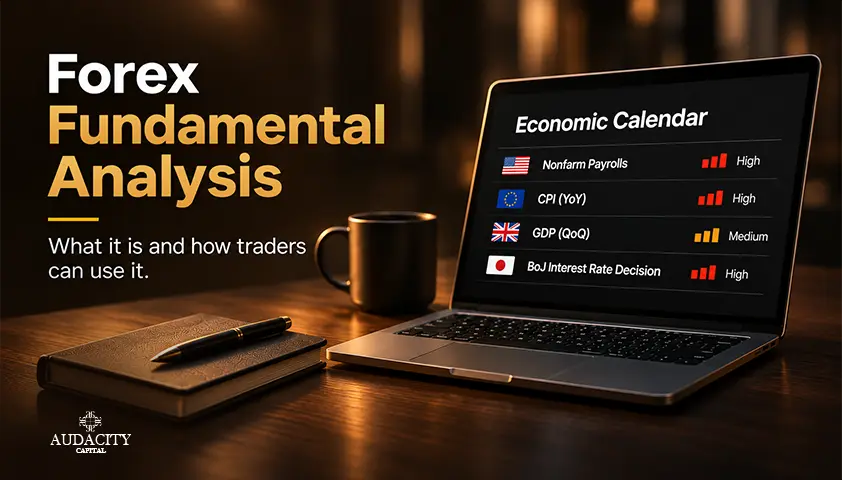
A currency's value is interrelated with the economic conditions of the country it belongs to. The market starts reassessing that currency if inflation remains high, employment weakens or a central bank changes its policy. These changes and what they mean for an exchange rate are exactly what we know as Forex fundamental analysis.
If we consider EUR/USD – a change in the economic outlook of the United States may influence the dollar, but the Euro's own economic conditions also matter when assessing the pair. This is why looking at one country's economic performance rarely gives a complete picture. Traders need to understand what is happening on both sides of the exchange rate.
In this guide, we will look at the information they follow, how they interpret economic announcements and where fundamental analysis fits into a trading approach.
What Is Fundamental Analysis in Forex Trading?
Studying currency involves much more than the current exchange rate. As a trader, you need to understand what is happening in the economy that supports its value.
Now, let’s come to what is fundamental analysis in forex trading? It is the process of examining economic information and policy developments to assess how they may influence a currency's value relative to another.
If we look at the pair USD/JPY – a monetary policy shift in the Bank of Japan may affect expectations for the Yen, while decisions at the Federal Reserve may influence the US dollar.
Traders analysing this pair will have to consider both currencies as the exchange rate reflects the relationship between the two currencies.
In short, the purpose of forex fundamental analysis is to build this economic understanding before making a trading decision. Traders may go through economic figures, central bank statements, and changes in borrowing cost outlook. They then think about whether it supports their view of the currency pair.
Which Factors Influence Forex Prices?
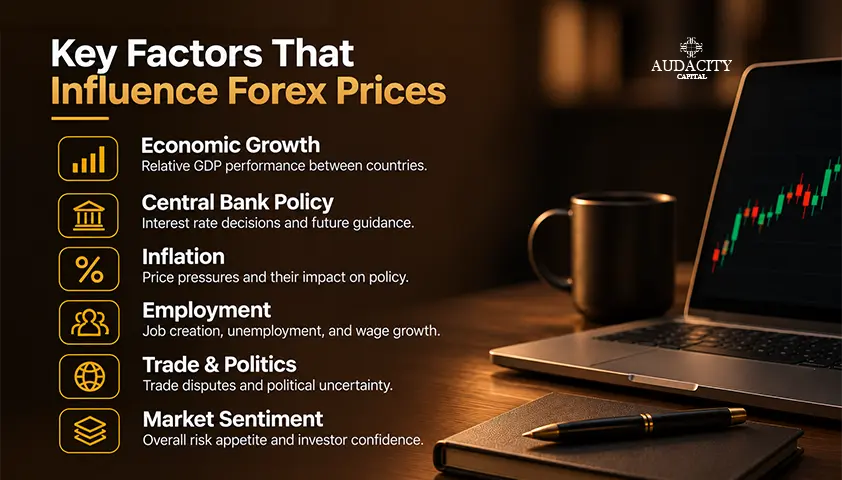
Because an economy is doing well or is going through a difficult period, it is not necessary that its currency will move. What matters is how its economic position compares with that of the country on the other side of the currency pair. This is something traders need to understand when carrying out forex fundamental analysis.
In a EUR/USD pair, when the US economy grows more than the Eurozone, the US dollar is automatically more attractive to investors. But this attractiveness also comes from the Federal Reserve's interest-rate outlook and what is happening with inflation. If the market already expected stronger US growth, the announcement may not produce much of a change.
Employment figures can also influence this outlook. If there are slower job creations in a country, it does raise questions about the strength of its economy, mainly if wage growth is also losing its momentum. Similarly, major trade disputes and political uncertainty impact investors’ confidence despite reasonable latest economic figures.
Data is not always the main driver. Sometimes the overall mood in the market takes over. If investors get nervous, they dump currencies they think are risky and run to stable ones. That is why fundamentals in forex are not black and white. The same news can move market differently depending on what people were expecting.
Which Economic Indicators Should Forex Traders Follow?
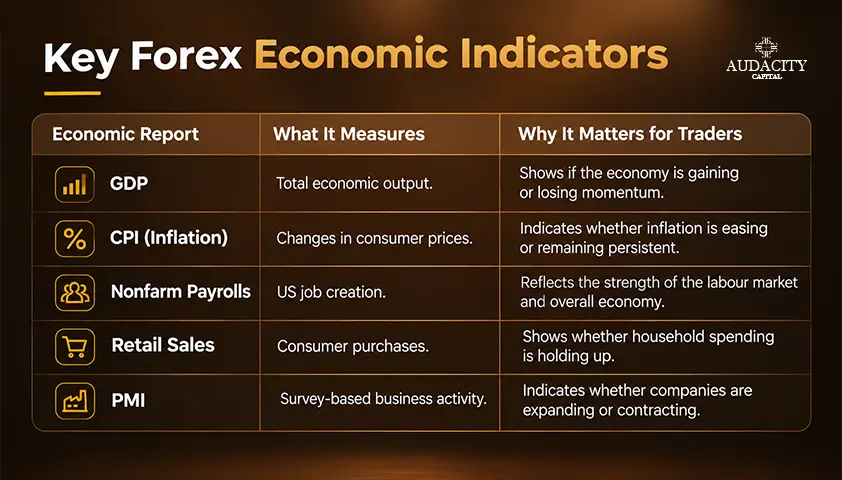
There is quite a lot of economic information available to Forex traders, but following every announcement is not necessary. Some reports have a greater influence on currency prices because they help investors understand what a central bank may do next. This is where fundamental analysis forex becomes more practical because, when collecting economic figures, a trader must know what those figures are telling them.
Gross Domestic Product (GDP)
GDP is basically a snapshot of economic activity. If it is increasing, the economy is growing because businesses and consumers are doing more. If it is weak, it signals a possible slowdown. Traders also focus on expected vs actual.
Consumer Price Index (CPI) and Inflation
You have to watch inflation because it is driving central bank thinking. CPI is about consumer prices, while core CPI is consumer prices without food and energy in the US measure. If inflation is sticky, investors are thinking rates are staying higher for longer.
Employment Reports and Unemployment
For forex, US Nonfarm Payrolls is a major release. It shows how many jobs were created or cut outside the excluded categories. Traders also look at wages, because stronger wage growth can mean more inflation.
Retail Sales and Purchasing Managers' Index (PMI)
Retail sales = are consumers spending more or less?
PMI = are businesses expanding or contracting according to purchasing managers? Traders use them to get an early read on the economy before GDP.
Always compare actual vs previous vs expected. A decent report can still be seen as negative if it missed big expectations.
A Quick Reference to Major Forex Economic Reports
Economic report | What the report measures | What traders want to understand |
GDP | Total economic output | Whether the economy is gaining or losing momentum |
CPI | Consumer price changes | Whether inflation is easing or remaining persistent |
Nonfarm Payrolls | US job creation | Whether employment conditions support the economic outlook |
Unemployment rate | Share of the labour force without work but seeking employment | Whether the labour market is becoming weaker |
Retail sales | Consumer purchases | Whether household spending is holding up |
PMI | Survey-based business activity | Whether companies are reporting expansion or contraction |
PPI | Prices received by domestic producers | Whether businesses are facing increasing price pressures |
How Do Central Banks Influence Currency Prices?
As soon as a central bank changes its view of the economy, traders quickly notice it. Monetary policy sets the cost of borrowing, which decides what currency pays, so in forex fundamentals, central banks carry heavy weight.
Interest Rate Decisions
Persistent inflation pushes a central bank toward higher rates, and softer inflation or a weak economy toward cuts. Traders watch the gap between two countries. When one bank raises while the other cuts, money automatically chases the higher yield, which supports the currency.
Monetary Policy Statements and Forward Guidance
Read both the statement and the number. Wording that stresses inflation risk marks a hawkish bank, one leaning toward tighter policy, while a dovish bank sounds open to easing. A hint about the next meeting, called forward guidance, can move a currency even when today’s rate stays the same.
Central Bank Speeches and Meetings
All major central banks like the Fed, ECB, and BoE have scheduled meetings, and traders track press conferences and minutes as well. A governor’s comment or one line in minutes can shift expectations, which rate number alone will not reveal. Do not think a rate hike automatically strengthens currency. If it was already expected, the market priced it, and a hint of a pause can send currency lower.
Insight: Move comes from expectation vs announcement gap, so explanation matters more than decision. That is the basis of fundamental analysis in forex.
How Do Forex Traders Use Economic News and Data Releases?
Until you know what the market expected, a headline number says very little. That habit sits at the heart of fundamental analysis in Forex trading, and it counts most for reports that can shift interest-rate expectations. Check four things on every release.
- Previous: The last reported figure, including any revisions.
- Forecast: What economists and market participants expected.
- Actual: The figure released by the relevant authority.
- Reaction: How the currency moves once traders digest it.
How to Read an Economic Announcement?
Information | What to examine | Why it matters |
Previous | The last reported figure and any revision to it | Shows whether the earlier picture of the economy has changed |
Forecast | The consensus expectation before release | Tells you what is already priced in |
Actual | The newly published figure | The raw result, before any interpretation |
Difference | The gap between forecast and actual | Measures how big the surprise was |
Wider context | Related data and recent central bank comments | A beat can mean little if the central bank is already signalling a different path |
Currency reaction | Price movement in the minutes and hours after release | Shows whether the market accepts or rejects your first reading |
Suppose US inflation is expected to stay at 3% and the release shows 3.4%. Traders may conclude that the Federal Reserve will keep policy restrictive for longer, and the dollar can pick up support, although other information still matters. The same figure can land differently on another day. If traders had already braced for 3.4%, the number adds little fresh buying, because the surprise is missing.
Pro tip: Before data comes, write what the market expects and what would really change your thinking. That way you don't trade a number only because it looks good or bad. Fundamental forex rewards that prep.
How Do Political Events and Market Sentiment Affect Currency Prices?
A currency can lose value even when its latest economic data hasn’t changed much. Investors also worry about things outside the economy, and an election result, a policy shift or a dispute with a trading partner can make them rethink the risk of holding that currency. That’s why forex fundamental analysis has to follow politics as well as data, most of all when something unexpected happens.
Political and Geopolitical Developments
An election matters when investors are unsure about what a new government will do. If there are trade restrictions and sanctions, the businesses that import or export get hit, which can change the expectations for growth further down the line. A conflict adds the worry about supply disruptions and about what the fighting will cost the countries involved. None of this shows up in the usual reports on the day, but the prices often move first.
Risk-On and Risk-Off Market Sentiment
Sentiment changes how investors treat currencies.
Investors are comfortable holding currencies tied to stronger growth in a risk-on mood. But many of them pull back and look for safer currencies when uncertainty rises. The US dollar is the usual first stop, and the Japanese yen and Swiss franc often join it, although they don’t always move together. The IMF has discussed how rising uncertainty can push up demand for safe-haven assets while straining foreign exchange liquidity and adding to volatility.
So a currency can weaken even when its home economy looks steady, because the wider market mood sometimes counts for more than the latest report. A trader may have a sound view of a pair’s economic outlook, and a political surprise can still change the picture within hours.
How to Apply Fundamental Analysis in Forex Trading?
Knowing the economic data is one thing, and turning it into a trading view takes a bit more work. You have to tie what’s happening in two economies to the one pair you follow, and that is where fundamental analysis in Forex Trading earns its keep. It also doesn’t mean chasing every announcement.
Start With One Pair and Its Two Currencies
Pick a pair you understand. With EUR/USD, you have to watch the United States and the Eurozone, because looking at the dollar alone gives half the picture.
See What Has Changed
Take two outlooks and compare where they stood a few weeks or months ago. For example:
- Has the Federal Reserve changed its thinking on interest rates?
- Are expectations for the European Central Bank moving the other way?
These are potentially major shifts and matter more than a single release.
Build a View and Say What Would Support It
Now take the report from the comparison and decide if you lean towards bullish or bearish. Note it all down from what backs the view and what would weaken it.
Having this report in writing doesn’t mean you can enter a trade right away, but now you have a reason to watch a pair, and you are not vaguely hoping that one currency will rise.
Keep Checking Whether the Idea Still Holds
Market conditions change, so your analysis must change too. If you are trading EUR/USD because the Fed is holding its stance, and Fed changes guidance, you need to review. Before trading, note what would make you rethink. That note stops you from clinging to the idea after you already committed.
Fundamental Analysis vs Technical Analysis: Which One Should Forex Traders Use?
As a Forex trader, you should use a combination of both. Some spend their morning hours reading economic reports, whereas some traders read price charts, avoiding every news – this is basically a fundamental-against-technical split.
Starting from different places, both types of analysis study currency markets. Fundamental analysis forex asks what is happening in the economies behind a pair. Whereas what the price is doing right now falls under technical analysis. However, neither of them predicts the market with certainty.
Fundamental analysis | Technical analysis | |
Main focus | Economic conditions | Price behaviour |
Information used | Economic reports and central bank policy | Price charts and trading indicators |
Common tools | GDP, CPI and interest-rate expectations | Moving averages, RSI and support/resistance |
Main purpose | Understand what may influence a currency | Study possible price direction and trade timing |
Typical application | Assessing the wider currency outlook | Examining potential entries and exits |
Can Traders Combine Both Approaches?
Plenty of traders do, since the two answer different questions. Say you study EUR/USD and build a view from shifting Federal Reserve expectations. Then you open the chart to see whether price action supports that view, instead of entering the moment an announcement lands. Expectedly, the two sometimes disagree. Price can keep moving the other way, or the market may have already priced in the news. Don’t force them to agree, as a disagreement is also information. The context is what you gain from using both, where fundamentals explain the background whereas charts show how the price behaves around it.
What Are the Limitations of Forex Fundamental Analysis?
Knowing what is happening in an economy doesn’t make it easy to say where its currency goes next. That’s the catch with forex trading fundamental analysis. The data gives you a reason to form an opinion, but the market can answer differently. A country can publish encouraging figures and its currency can still fail to gain. A few reasons explain this.
- The market wanted an even better result.
- Earlier figures were revised, so the new one looks different.
- Investors had already adjusted their positions before the announcement.
- A political or international development changed the wider outlook.
Timing is the other problem. You can see correctly that one economy is doing better than another and still be early, because markets take time to adjust to new information.

Audacity Capital's Instant Trading Program
Funded Trader ProgramWhy Can a Currency Fall Despite Positive Economic News?
Imagine the US reports stronger employment growth than expected. At first it looks good for the dollar. But if wage growth has slowed and the Federal Reserve has hinted at cutting interest rates, investors may see no reason to buy. The headline figure is only part of the story, so read it together with wage growth, revisions and the wider outlook. One positive report can’t always outweigh a change in monetary policy expectations or in market mood. That’s why a fundamental view needs a review whenever new information arrives, and getting the economic background right doesn’t mean every trade moves the expected way.
Can You Ignore Fundamental Analysis When Trading Forex?
Can a trader work with charts alone? Some do, especially on short-term strategies with a clearly defined technical approach. Even then, the economy behind a currency pair deserves a little attention. For instance, a trader is holding EUR/USD into a Federal Reserve announcement. The chart shows a decent setup, but the decision can change market expectations and cause a sudden swing, and the conditions the trade was planned under may no longer exist.
You don’t have to become an expert in economic policy or spend hours on financial news. But knowing the schedule of major announcements for your preferred currency pairs and what they mean for your position is important. You may not make Forex fundamental analysis your main trading method but it can sit alongside a technical strategy. Leaving it out completely only means missing information that can affect a trade you already hold.
Audacity Capital Empowering Traders Since 2012
Trade with Audacity CapitalFinal Thoughts on Forex Fundamental Analysis
A currency pair shows how two currencies compare, and working out why that relationship changes takes a bit more effort. Following economic developments and central bank expectations gives you a better understanding of the market you are trading. Fundamental analysis in Forex trading won’t make every decision correct, but your trading view then rests on a stronger economic base.
Forex Trading Strategies In Depth
- Best Forex strategy for consistent profits
- Trading Forex Without Leverage
- Forex Leverage Trading Strategies
- Forex Swing Trading Strategies
- Forex Crossover Moving Average Strategies
- Hedging Forex Trading Strategies
- Forex Scalping Trading Strategies
Frequently Asked Questions
In Fundamental analysis in Forex, you study the economic factors affecting the Forex market. In this, you track interest rates, inflation, jobs, growth, and news to understand the economy behind the currency.
Fundamental analysis in Forex trading is about cause and effect, where economic news is the cause and currency movement is the effect. If the economy is strong, people will invest, and the currency will rise. But if the economy is weak, traders will shift and the currency will drop.
The most important indicators to watch are central bank interest rates, inflation, employment numbers, GDP, and trade balance. Apart from these, PMI and consumer confidence also matter.
No one is better, as both have strengths and weaknesses. Fundamental Forex analysis covers economic reasons, whereas technical analysis covers price patterns. A good trader will not choose one; they combine both for best results.
Technically yes. You can buy a currency of a strong economy and sell a weak one, but timing can cause the real problem. Fundamental analysis does not tell you when price will move. That is why even fundamental traders use some chart levels for entry.
Almost daily or at least before you start trading. If you are a day trader, check it multiple times a day, but if you are a swing trader, check at least once. You should be aware of major news like inflation data and interest rates.
Yes, in the long term and to some extent but it cannot make a perfect prediction. Fundamental analysis can help in currency forecasting, but 100% prediction is not possible.

Bereit, diszipliniertes Risiko auf Krypto anzuwenden? Entdecken Sie die neuen Krypto-Instrumente von Audacity Capital und bringen Sie Ihre Trading-Strategie mit.
Mehr erfahrenNewsletter
Treten Sie unserem Newsletter bei, um auf dem Laufenden zu bleiben.
Treten Sie unserer sozialen Gemeinschaft bei

Beginnen Sie Ihre Reise heute Mit unserer kostenlosen Testversion
Präsentieren Sie stolz Ihre Fähigkeiten und Leistungen durch Zertifikate und erhalten Sie Anerkennung für Ihre harte Arbeit und Ihr Engagement von potenziellen Investoren und Kollegen.
Kostenlose TestversionVerwandte Artikel
Which Book Is The Best For Technical Analysis In Forex?
Find the perfect book for technical analysis in currency trading. Learn from experts and gain a competitive edge in the forex market.

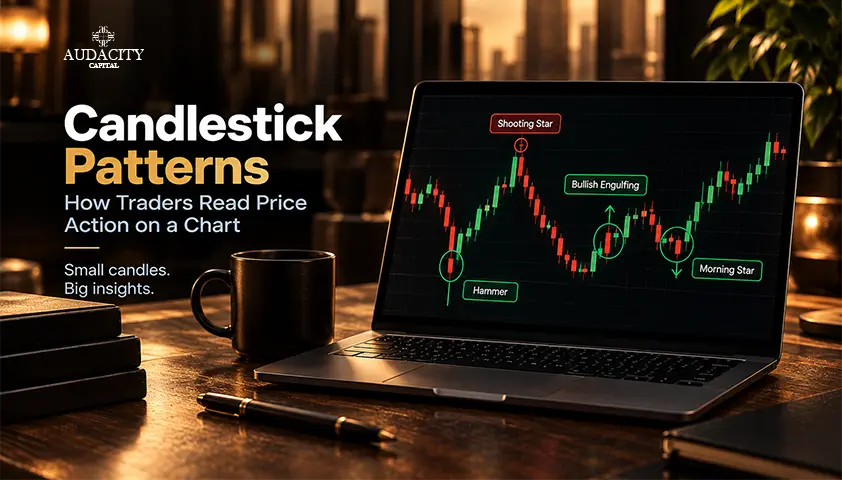
Candlestick Patterns: How Traders Read Price Action on a Chart
Learn to read price action with proven candlestick strategies and improve trading consistency now with Audacity

Is Crypto Less Risky?

Weekly Economic Calendar: How Smart Traders Turn Volatility Into Opportunity
Learn how to use the weekly economic calendar to trade market volatility. Discover strategies to manage risk and capitalize on high-impact news events.