


Trailing Stop Loss: How to Use It


A static stop loss helps secure a trade, but it does not help when the trade begins moving in your favor. When you have guessed right, you have to know when to exit and, most often, you will make that decision based on your emotions.
A trailing stop loss eliminates this decision process. It follows the market movement for you and adjusts your stop loss automatically as your profit grows.
This automation works, and it comes at a cost, too, which most explanations fail to mention. This article is purely educational, and leveraged trading involves considerable risks.
What a Trailing Stop Loss Does That a Fixed Stop Does Not
Trailing stop loss is a stop which follows price with a fixed gap when the trade moves in your favor and holds still when the price moves in the opposite direction.
It moves only in one direction. This single property of trailing stop loss makes it a powerful trading tool, and everything else here follows from it.
This is how it really works. Most traders don’t mention this detail, but the trail is defined from the highest level achieved by the trade, rather than from its entry point or the current price level.
On a long position, the stop is pulled up behind each new high; in the case of a short position, it moves below each new low. If the price retreats, then the stop doesn't retract. It waits.
Here is one more that competitive pages often fail to mention. The trail does not start when you open up the trade. The trail starts after the trade has been in profit by the distance of the trail.
Until that time, the only thing that will be protecting your trade is the original stop. Stop losses limit the amount of loss that can occur on a trade, and trailing stops are simply an extension of this principle.
Watch the Trail Move Through One Trade
The numbers make it even more clearer.
Assume one long position opened at 1.1000 with a trail distance of 20 points, and observe where the stop lies as prices develop. No fancy moves here; it's just one position and round numbers to keep the mechanic in sight.
Pay attention to two rows in particular. The first is where the trail is triggered, hence the lack of action at the beginning. The second one is where the price turns around and the stop remains in place.
The second row is where the mechanism works and also where the trade is most likely to be closed.
Price moves to | Best price so far | Trailing stop sits at | What is happening |
1.1000 (entry) | 1.1000 | Original stop, unmoved | Trail is not active yet |
1.1015 | 1.1015 | Original stop, unmoved | Not yet 20 points in profit, nothing to trail from |
1.1020 | 1.1020 | 1.1000 | Trail activates at the set distance behind the high |
1.1050 | 1.1050 | 1.1030 | Stop follows the new high, still 20 points behind |
1.1035 (retracement) | 1.1050 | 1.1030 | Stop holds. It never moves backward |
1.1030 touched | 1.1050 | Triggered | Position closes at market, above the entry |
Once the stop has been moved above your initial entry, then there is no chance for the trade to close as a losing one at that level. It is important to note this.
The level is protected. The execution is a separate question; we’ll discuss that later in this article.
Three Ways to Set the Distance, and What Each Gives Up
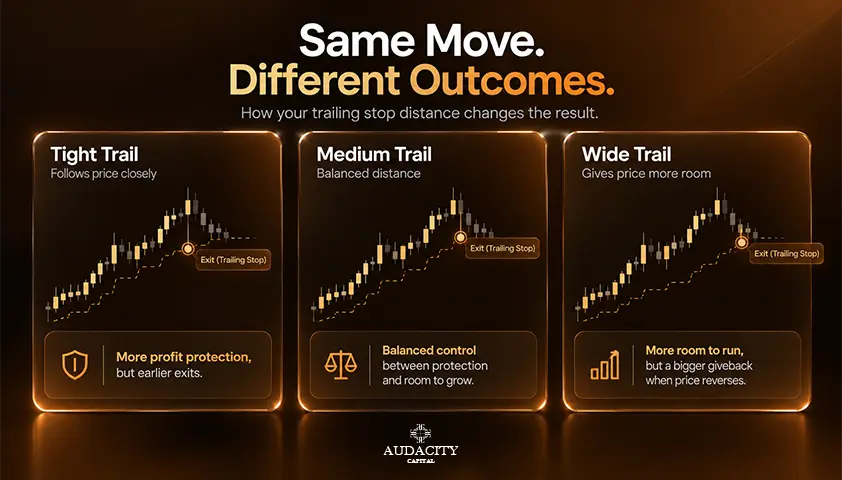
This is what traders are here for. There is no distance that can withstand retracements while still protecting profits. Each of the settings is a point on that trade-off. The three methods below are three different ways of deciding where to sit on it.
Method one: fixed distance
A fixed number of points or a fixed percentage. It is simple, consistent, and the only type of distance supported by default by most platforms. The downside of it is that it ignores the instrument itself.
The fixed distance will be overly wide when applied to a calm pair and overly narrow when applied to gold or an index. Try the same distance on several assets, and you’ll get stopped out all the time on some of them and barely protected on others.
Method two: volatility based
A distance that is based on a volatility indicator like Average True Range (ATR), so the trail opens out when the instrument is most volatile and narrows when it is calm. This overcomes the portability drawback of the fixed method.
The weakness of it is that it's not usually native. It may require an indicator, script, or manual adjustment. It can also expand at the wrong time during a spike in volatility.
Method three: structure based
Following the stop after subsequent swing lows for a long trade or swing highs for a short trade, instead of a fixed distance from them. This approach takes into consideration what the market is doing. This is also the way that many professional discretionary traders talk about it.
The disadvantage of this approach is that it is manual. It takes a judgment call of what is considered a valid swing and there is no platform setting for it.
Treat all of them as approaches that require further testing in your trading instrument. There is no recommended number, percentage, or multiple of risk in each of the cases and none of these methods is the best in all cases.
The Setting Most MetaTrader Traders Get Wrong
There are four behaviors that confuse traders, and they all account for the vast majority of "my trailing stop doesn't work" claims.
This is precisely where the trader who finds trailing stops in the right-click menu encounters trouble.
One, it runs on your machine.
MetaTrader's native trailing stop is handled by the terminal, not by the broker's server. This is the difference between client-side and server-side execution. If the platform closes or the connection drops, the trail stops updating. The stop is not cancelled.
The last level the trail reached stays on the server as an ordinary fixed stop. It simply stops following. Some providers implement a server-side version, so confirm which one you have.
Two, points are not pips.
The trailing stop distance is entered in points. On a five-digit quote, ten points is one pip. Type a number you meant as pips and you set a trail a tenth of the intended width, which gets you stopped out almost immediately.
Three, there is a minimum distance.
Each instrument carries a minimum stop distance, sometimes called the stops level, set by the provider. A trail set inside it is rejected. That is the usual cause of an invalid level error, and the figure sits in the instrument specification.
Four, spread is on the other side.
The trail follows one side of the quote while the position closes on the other. A tight trail triggers slightly earlier than the chart alone suggests, because the spread sits between the two.
A VPS is the standard answer to the first problem, since it keeps the terminal running when your own machine is not. That is the whole mention it needs here.
Symptom the trader sees | What is actually happening | Where to check |
Trail stopped moving overnight | Terminal was closed, so the trail stopped updating | Whether the platform ran continuously |
Stopped out almost instantly | Distance entered as pips but read as points | The digit count on the quote |
Invalid level, setting rejected | Trail is inside the instrument minimum | The instrument specification |
Triggered slightly before the level on the chart | The closing side of the quote includes spread | The live spread on that instrument |
Cannot set it before entering | The trail attaches to an open position, not a pending order | The order ticket versus the position list |
What a Trailing Stop Actually Costs You
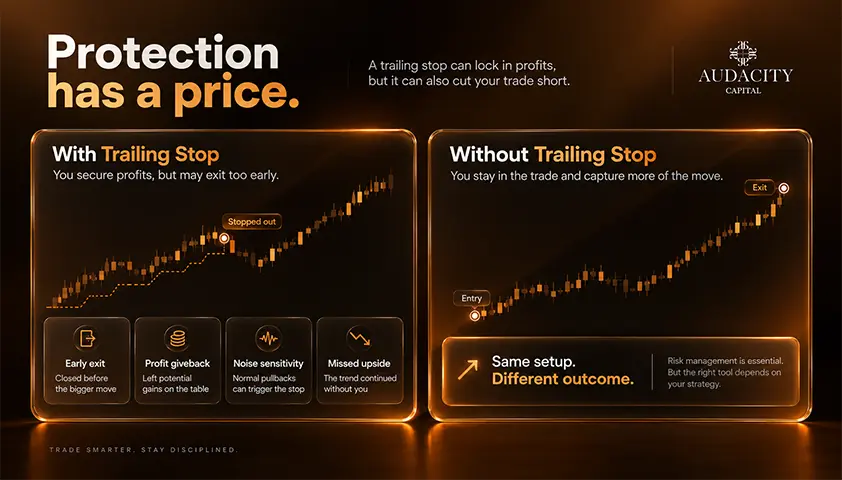
A trailing stop loss has a real price, and you should pay it knowingly rather than assume it is free protection.
The main cost is simple. A trailing stop cannot tell a normal retracement apart from a reversal. It only measures distance. If a trade pulls back through the trail and then continues in the original direction, the tool has ended that trade early.
On trending instruments, that is a common outcome, not an unlucky one. Tighten the trail to protect more of the gain and you simply increase how often it happens.
Then there is the execution cost. When the level is reached, the trailing stop becomes a market order and fills at the best available price. In a fast move, over a weekend gap, or around a news release, that fill can sit meaningfully below the level. Slippage and gap risk both live here.
The trail protects a price on the chart, not a price in the account. This is why the phrase "locks in profit" needs a qualifier every time. It locks in a level. The fill can still differ from that level.
So the honest summary is this. A trailing stop does not maximize a winning trade. It converts an open-ended judgment call into a mechanical rule, and it pays for that with some of the upside.
For a trader who exits too early on emotion, that is usually a good trade to make. For a trader already holding winners well, it may not be.
A Trailing Stop Is Not a Trailing Drawdown
If you arrived from an evaluation context, the word "trailing" appears in two completely unrelated places, and they get confused constantly. Worth separating them cleanly.
A trailing stop loss is an order you choose, attached to one position, that closes that position. A trailing drawdown is an account-level rule set by the firm, applied to the whole account, that ends the account.
One is a tool. The other is a limit. They share a word and nothing else, and a trailing stop does not protect against a trailing drawdown in any way.
They interact in one direction only. Using tight trailing stops produces more frequent small exits, which is a trading-style question, not a rule-compliance one.
The account-level limit is unaffected by which stop type you use. If you want the full account rule explained, that lives in the dedicated drawdown guide, not here.
Conclusion
A trailing stop loss is a way of deciding in advance how much of an open gain you are willing to give back in exchange for not having to make the exit decision live.
That is a genuine trade, and it is worth making for many traders. But it is a trade. The people disappointed by the tool are almost always the ones who thought it came free.
Do one thing before you rely on it. Set a trail on a single position and watch it through one full session. Check that the distance units are what you intended, and check that the trail keeps updating when you step away from the desk.
That is a single session of observation, and it is exactly where all four of the platform problems above reveal themselves.
Audacity Capital's simulated evaluation accounts run on MT5 and DXTrade. You can use them to watch how a trailing stop behaves on your own instruments before putting your own capital at risk. The free trial also lets you run that check without paying for a challenge first.
Frequently Asked Questions
Generally no. A trail attaches to an open position rather than to an order still waiting to fill, so the sequence is enter first, then apply it. Platforms differ on whether any equivalent exists at the pending-order stage, so check your own order ticket.
A trailing stop becomes a market order and prioritizes execution. A trailing stop limit becomes a limit order and prioritizes price. That difference matters, because a limit can leave you holding the position during exactly the fast move you wanted out of. MetaTrader supports only the market version.
Not as an order, though traders use it like one. Its dots advance behind price and never move backward within a leg, which mimics a trailing exit. It is an indicator, not an order type, so it does not close anything by itself.
They do different jobs. Moving to a breakeven stop is a single one-time adjustment that removes risk, while a trail is a continuous rule that also gives back a defined amount of gain. Many traders use both in sequence rather than choosing between them.
Yes. The two coexist on the same position, and whichever level is reached first closes it, so the take profit caps the upside the trail would otherwise keep following.
Usually, since a trailing stop is an ordinary order type and is not typically restricted. The tools used to automate one, such as expert advisors, scripts, or a VPS, are sometimes limited, so check your specific program rules rather than assuming.

Bereit, diszipliniertes Risiko auf Krypto anzuwenden? Entdecken Sie die neuen Krypto-Instrumente von Audacity Capital und bringen Sie Ihre Trading-Strategie mit.
Mehr erfahrenNewsletter
Treten Sie unserem Newsletter bei, um auf dem Laufenden zu bleiben.
Treten Sie unserer sozialen Gemeinschaft bei

Beginnen Sie Ihre Reise heute Mit unserer kostenlosen Testversion
Präsentieren Sie stolz Ihre Fähigkeiten und Leistungen durch Zertifikate und erhalten Sie Anerkennung für Ihre harte Arbeit und Ihr Engagement von potenziellen Investoren und Kollegen.
Kostenlose TestversionVerwandte Artikel
What Is BOS in Trading? A Complete Guide to Break of Structure (2026)
Learn what BOS in trading means, how Break of Structure works, how to identify bullish and bearish BOS, and how traders use it in market analysis.


What Is a Breaker Block in Trading? A Complete Guide for 2026
Learn what a breaker block is in trading, how bullish and bearish breaker blocks form, how to identify them, and how traders use them in SMC and ICT.

Averaging Down: Explained
What averaging down does to your breakeven and your exposure, the one question that settles whether to do it, and why leverage changes the answer entirely.

PnL in Trading - What is PnL in Trading?
Learn what P&L in trading means, how to calculate it, the difference between realized and unrealized P&L, and how prop firms use P&L.