


How Prop Firm Payouts Work: Profit Splits, Withdrawals and Your First Payout



Getting funded is only half the job. Getting paid is the point, and it is the part traders understand least.
How prop firm payouts work is not "your profit minus a percentage." A payout is a sequence of gates your profit passes through before any money moves, and the split is the last gate, not the first.
That is why your withdrawal can be far smaller than the green on your screen, even when you broke no rule.
This guide walks the whole thing: splits, the gates that shrink a payout, the first-payout process, methods and timing, a short tax note, and the number one test of whether a firm actually pays.
What is a prop firm payout?
A prop firm payout is the cash a funded trader withdraws after the firm applies its profit split, and the other gates we will cover, to profit from closed trades.
Closed trades means positions you have already exited and booked. Open or unrealized profit on running positions does not count until you close it.
One honest point most guides skip: most funded accounts are simulated, yet the payout is real money paid from the firm's own treasury.
How profit splits work
The prop firm profit split is the percentage of profit you keep. The firm keeps the rest.
Typical splits look like this, and remember these figures vary by firm and change fast:
- 70 to 80% is common. You keep the majority, the firm keeps 20 to 30%.
- Up to 90% appears at many firms, sometimes paired with stricter rules.
- Progressive or tiered splits often start around 80%, rise to 90% at milestones, and can reach 95 to 100% for consistent or elite traders.
- Some instant-funding and futures models pay 100% on a first tranche (for example the first $25,000), then move to a 90/10 arrangement.
The split applies to your net closed profit.
For example: on $2,000 of net profit at an 80% split, $1,600 is yours and $400 stays with the firm.
Warning Note:. Watch for withdrawal or admin fees that eat into your net take-home. A headline 90% split with fees attached can leave you worse off than a clean 80% split with none. Always read the fee line, not just the percentage.
The Payout Gates: Why your withdrawal is smaller than your profit

This is the part almost nobody explains upfront, and it is where all the confusion comes from. Before the split even applies, several gates decide how much of your profit is actually eligible to withdraw. Your profit passes through the gates first. The split comes last.
Let us walk each gate, then run the math.
Gate 1: The safety-net buffer
Some firms require you to keep a drawdown buffer in the account, for example the drawdown amount plus a small cushion, especially for your first few payouts.
This buffer protects the account from immediately breaching after you pull money out, and it caps how much of your profit is eligible to withdraw.
Gate 2: The starting-balance reset
You withdraw profit above the initial balance. After a payout, the account resets to its starting balance. That means the cushion resets each cycle, and you do not compound indefinitely between withdrawals. Your profit is banked, and the account starts fresh.
Gate 3: Minimum trading days
Most firms require a minimum trading days count, often a set number of active or profitable days, before profit becomes payout-eligible. You cannot bank one big day and cash out the next morning. This rewards consistency over a single lucky move.
Gate 4: Per-request caps and consistency gates
Some firms cap how much you can withdraw per request. Others gate the payout on a consistency rule, for example no single trading day making up more than 30% of your total profit at payout time. Both can shrink or delay your eligible amount.
After the gates: An example
Here is the breakdown that explains everything. Figures are illustrative and typical, not firm-specific.
From $4,500 profit to roughly $1,500 approved
- Starting balance: $50,000
- Account grows to: $54,500 (a $4,500 gain)
- You request a withdrawal.
- Gate 1, the buffer: the firm requires a cushion above the drawdown line, holding back part of your gain.
- Gate 2, minimum trading days and eligibility: only profit that clears the eligibility window counts.
- Gate 3, per-request cap: the firm limits the size of this withdrawal.
- Result: about $1,500 is approved this cycle, and about $3,000 stays in the account.
Nothing went wrong. No rule was broken. The remaining profit is not lost, it simply stays in the account or rolls into the reset, depending on the firm's model.
This is the mechanic that surprises new traders most, and it is why the split alone never tells the full story.
Your first payout, step by step
Here is the sequence, in order. Timings are typical and vary by firm, so verify yours.
1. Pass the evaluation and reach funded status: You cannot withdraw until you are trading a live funded account.
2. Meet the minimum trading days: Commonly 5 to 10 profitable days, though some firms require around 30 calendar days from your first trade for the very first withdrawal, then loosen afterward.
3. Complete KYC verification: KYC stands for Know Your Customer, an identity check the firm must complete before any payout is sent. Do this early so it does not delay you.
4. Reach the minimum withdrawal threshold: Often $250 to $500, or a set profit percentage.
5. Request the payout through your dashboard.
6. The firm reviews and approves: Commonly 24 to 72 hours, checking for rule violations.
7. Funds are sent via your chosen method, typically 1 to 4 days.
The real timeline math. Add it up honestly: evaluation days, plus minimum funded days, plus processing time.
A firm advertising "instant payouts" that still requires 30 funded days before your first withdrawal is not actually fast. Do the addition yourself before you believe the headline.
Withdrawal Methods and Timing
How you actually receive the money matters as much as how much you receive. A prop firm withdrawal usually arrives through one of a few channels.
Common methods:
- Bank wire
- Crypto, often USDT
- Contractor-payment platforms like Deel or Rise, used to process trader payouts legally and quickly
- PayPal or Wise at some firms
Stage | Typical timing |
Review and approval | 24 to 72 hours |
Funds processed | 1 to 4 days |
Received end to end | Often around 8 days |
Two cautions to check here:
1/ Check for withdrawal fees that eat into your take.
2/ Confirm your chosen method is actually available in your country before you rely on it. Availability differs by region.
Payout Frequency and What Happens After
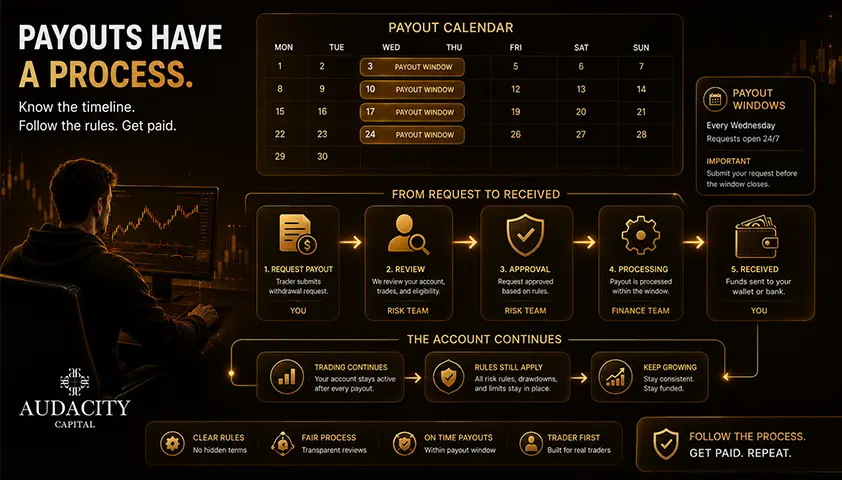
The payout cycle varies. Modern firms often run bi-weekly, weekly, or on-demand withdrawals, where older models were monthly.
After a payout, the account resets to its starting balance and the next cycle begins. The profit cushion resets, so each period starts clean.
A common perk: the challenge or activation fee is often refunded with your first payout. This is not universal, so verify it in your firm's terms before assuming it.
Consistent payouts also unlock scaling, where your account size grows over time, sometimes toward $1M, $2M, or beyond, and at some firms your split increases as you scale. This is the reward for proving you can trade the capital responsibly, not a shortcut.
A Quick Word on Taxes
Prop firm payouts are usually treated as self-employment or contractor income, since you are often paid as a contractor through platforms like Deel or Rise, rather than as an employee.
The rules vary widely by country. Set money aside for tax, keep clean records of your payouts, and consult a qualified tax professional.
Note: This is general information, not tax advice.
How to spot a firm that actually pays (the red and green flags)
This is the trust test. The single most important thing about any firm is whether it pays, on time, without moving the goalposts.
Green flags
- A transparent split with the gates explained upfront
- A public, verifiable payout history or payout proof
- Consistent terms that do not change after you are funded
- A reasonable, clearly stated first-payout timeline
- Clear withdrawal methods
- No surprise fees
Red flags
- Delayed or denied payouts
- Hidden rules invoked only at payout time, for example "your trading violated X" when X was never disclosed
- A manual-review black hole with no timeline
- Instant-payout marketing that actually requires 30 or more funded days
- Withdrawal fees that quietly eat your take
- Terms that change after you are funded
- No payout proof anywhere
Payouts at Audacity Capital
Audacity Capital sits firmly in the transparent camp, and we can explain our payout model openly.
The structure is straightforward: up to 90% profit split, bi-weekly payouts, and a clear first-payout timeline of 14 days after activation.
There is no consistency rule gating payouts. Scaling runs toward $2M for traders who trade the capital responsibly, with the withdrawal methods and gates laid out clearly rather than hidden until payout day.
Remember, a funded account is capital and structure, not an edge in itself and the discipline is still yours to build.
Related Articles
How to Get Your First Payout as a Funded Trader (Step-by-Step Guide)
$250 Million Paid Out. 14 Years In. We're Just Getting Started
Frequently Asked Questions
Add your evaluation days, your minimum funded days (often 5 to 10 profitable days, or around 30 calendar days at some firms for the first withdrawal), and processing of 1 to 4 days. That total is your real timeline. An "instant payout" claim that still requires many funded days first is not actually fast.
Because of the gates. The buffer, the starting-balance reset, and per-request caps can leave only part of your profit eligible to withdraw, even when you broke no rule. The split is applied last, after those gates have already reduced the eligible amount.
It is a percentage of your net closed-trade profit, not open or unrealized profit, with the firm keeping the rest. Tiered or progressive plans raise your share as you hit milestones, so a trader on 80% today might reach 90% or higher over time.
Commonly bank wire, crypto such as USDT, and contractor-payment platforms like Deel or Rise, with PayPal or Wise available at some firms. Processing is usually 1 to 4 days once your request is approved. Check which methods are available in your country.
Legitimate ones do, reliably, and they show payout proof. A consistent, on-time payout history without moving the goalposts is the single best test of a firm you can trust.
Many firms refund it with your first payout as a perk, but not all do. Check the terms before you buy so you know exactly what to expect.
It usually resets to the starting balance and a new cycle begins. The profit cushion resets each payout period, so you build a fresh cushion before your next withdrawal.
Usually yes, and it is often treated as contractor income, though the rules vary by country. Set money aside, keep records, and consult a tax professional. This is general information, not tax advice.

Prêt à appliquer un risque discipliné aux cryptos ? Explorez les nouveaux instruments crypto d'Audacity Capital et apportez votre stratégie de trading.
En savoir plusNewsletter
Rejoignez notre newsletter pour rester informé.
Rejoignez Notre Communauté Sociale

Commencez Votre Voyage Aujourd'hui Avec Notre Essai Gratuit
Affichez fièrement vos compétences et réalisations grâce à des certificats et obtenez la reconnaissance de votre travail acharné et de votre dévouement auprès d'investisseurs potentiels et de pairs.
Essai Gratuit