


Scalping vs Swing Trading: Which Strategy Is Right for You? (2026 Guide)



Scalping vs Swing Trading: Quick Answer Scalping and swing trading are two popular trading strategies that differ in holding time, trade frequency, and risk exposure. Scalping involves making multiple trades within seconds or minutes to capture small price movements, while swing trading focuses on holding positions for several days or weeks to profit from larger market trends. Scalping suits active traders who can monitor the markets continuously, whereas swing trading is better for traders seeking a more flexible and less time-intensive approach. |
|---|
Key Takeaways
- Scalping focuses on quick trades lasting seconds to minutes.
- Swing trading aims to capture larger price moves over days or weeks.
- Scalping requires constant market monitoring and rapid decision-making.
- Swing trading involves fewer trades and more patience.
- Neither strategy is inherently better—the right choice depends on your trading style, experience, available time, and risk tolerance.
Choosing between scalping and swing trading is one of the most important decisions you will make as a trader. Get it right and you will find a strategy that fits your lifestyle, personality, and goals. Get it wrong and you will spend months — or years — fighting a style that was never built for you.
This guide gives you an honest, side-by-side breakdown of both strategies so you can make that decision based on clarity, not guesswork.
What Is Scalping?
Scalping is a short-term trading strategy where traders enter and exit positions within seconds to a few minutes, targeting small price movements — typically 2–10 pips or a fraction of a percent per trade. The goal is to stack many small wins throughout a session rather than waiting for a single large move.
A scalper might execute 20–100+ trades in a single session. Each individual profit is small, but the cumulative total — when risk is managed correctly — can be significant.
Key characteristics of scalping:
- Holds positions for seconds to a few minutes
- Targets 2–10 pips or 0.1–0.5% per trade
- Executes 20–100+ trades per day
- Uses 1-minute, 3-minute, and 5-minute charts primarily
- Requires constant screen attention during trading hours
- Relies almost entirely on technical analysis and real-time price action
- Profits are realised daily — no overnight exposure
Scalping is often described as the most intense form of active trading. It demands fast reflexes, ironclad discipline, and the ability to make clean decisions under continuous pressure. There is no time to second-guess an entry when a 1-minute candle closes in 60 seconds.
What Is Swing Trading?
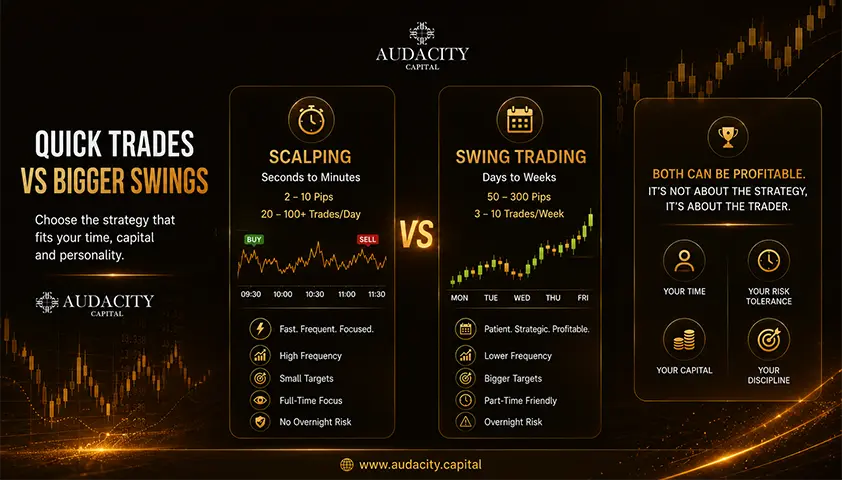
Swing trading is a medium-term strategy where traders hold positions for several days to a few weeks, capturing "swings" — meaningful directional moves in price that develop over time. Instead of targeting tiny intraday fluctuations, swing traders wait for high-probability setups and then let the trade breathe.
A swing trader might place 3–10 trades per week. Each trade targets a larger move — typically 50–300 pips in forex or 3–10% in stocks and crypto. This lower trade frequency means lower transaction costs, less screen time, and a fundamentally different daily routine.
Key characteristics of swing trading:
- Holds positions for 2 days to several weeks
- Targets 50–300 pips or 3–10% price moves
- Executes 3–10 trades per week
- Uses 4-hour, daily, and weekly charts primarily
- Requires chart review once or twice per day (30–60 minutes)
- Uses both technical and fundamental analysis
- Carries overnight and weekend risk
Swing trading is often called the most accessible active trading strategy for one reason: it fits around real life. You do not need to sit at a desk for 8 hours. You do not need millisecond execution. You do need patience, discipline, and the ability to hold a position through normal market noise without panicking.
Scalping vs Swing Trading: Key Differences at a Glance
Factor | Scalping | Swing Trading |
|---|---|---|
Holding Period | Seconds to minutes | Days to weeks |
Trade Frequency | 20–100+ per day | 3–10 per week |
Profit Target Per Trade | 2–10 pips / 0.1–0.5% | 50–300 pips / 3–10% |
Charts Used | 1-min, 3-min, 5-min | 4-hour, Daily, Weekly |
Screen Time Required | 4–8 hours/day | 30–60 minutes/day |
Overnight Risk | None | Yes |
Transaction Costs | High (many trades) | Low (few trades) |
Capital Required | Higher ($10,000+) | Moderate ($2,000–$5,000+) |
Stress Level | Very High | Moderate |
Best For | Full-time traders | Part-time traders |
Analysis Type | Technical only | Technical + Fundamental |
Skill Level Required | Advanced | Beginner–Intermediate |
Time Commitment: How Much of Your Day Does Each Require?
This is often the deciding factor — and the one most articles gloss over.
Scalping demands your full attention. During active trading hours, there is no checking emails, no phone calls, no interruptions. A scalper sitting in front of EUR/USD during the London–New York overlap needs to be completely present. A single distraction at the wrong moment means a missed exit, a widened stop, or an impulsive re-entry. Realistically, active scalping requires 4–8 hours of unbroken focus per day.
Swing trading is compatible with a full-time job. This is not a minor detail — it fundamentally changes who can use each strategy. A swing trader's daily routine looks like this: 20–30 minutes in the morning reviewing charts and checking for new setups, placing orders with predefined stops and targets, and 20–30 minutes in the evening reviewing any active positions. The market does the work while you get on with your day.
Bottom line on time: If you have a job, a business, or significant other commitments, swing trading is the only realistic option between the two. Scalping as a side activity alongside a full-time role is not a strategy — it is a recipe for burnt-out, distracted trading that costs money.
Capital Requirements
Neither strategy is free to learn, but they have different capital thresholds for being practical.
Scalping generally requires a larger starting account for two reasons. First, spread costs eat into profits on small moves — a 1.5-pip spread on a trade targeting 5 pips is already 30% of your target gone in transaction costs. You need a large enough account to make the remaining 3.5 pips meaningful. Second, scalping in stocks (particularly in the US) is subject to the Pattern Day Trader (PDT) rule, which requires a minimum $25,000 account for traders who execute more than 3 day trades per week. Forex and crypto scalping have no PDT rule but still benefit from larger account sizes. Practical minimum: $10,000+.
Swing trading is more accessible to traders starting with smaller capital. Because you are targeting larger moves with fewer trades, spread costs represent a much smaller percentage of your profit target. A 1.5-pip spread on a trade targeting 100 pips is 1.5% of your target — far more manageable. Swing trading is also unaffected by the PDT rule since positions are held for multiple days. Practical minimum: $2,000–$5,000 for forex and crypto; $10,000+ for stocks due to the overnight margin requirements at most brokers.
Risk and Reward: Which Strategy Is More Profitable?
This is the question every trader wants answered — and the honest answer is: both can be highly profitable, and both can be highly destructive. Strategy choice determines your risk profile, not your profitability ceiling.
Here is how the math differs in practice:
Scalping example (Forex):
- Account: $20,000
- Risk per trade: 0.5% ($100)
- Target: 1:1.5 risk-to-reward
- Profit per winning trade: $150
- Win rate needed to profit: 60%
- Trades per day: 30
- Daily P&L at 60% win rate: ~+$900 gross, minus spread costs across 30 trades
Swing trading example (Forex):
- Account: $10,000
- Risk per trade: 1% ($100)
- Target: 1:3 risk-to-reward
- Profit per winning trade: $300
- Win rate needed to profit: 35%
- Trades per week: 5
- Weekly P&L at 45% win rate: ~+$450 gross, with minimal spread impact
Swing trading's 1:3 risk-to-reward ratio means you can be wrong more often and still profit. A swing trader winning just 40% of trades with a 1:3 ratio is still profitable. A scalper with a 1:1.5 ratio needs to win 60%+ consistently — a much higher execution bar, especially across 30+ trades per day where emotional fatigue accumulates.
Transaction costs are the hidden killer of scalping. At high trade frequencies, spread costs, commissions, and slippage erode a meaningful portion of gross profits. Swing traders pay a fraction of these costs because they trade far less frequently.
Trading Psychology: Which Is Harder to Master?
Both strategies make serious psychological demands — they just do it in completely different ways.
Scalping's psychological challenge is speed and volume. Every decision has to be clean, fast, and unemotional. There is no time to deliberate. Over the course of a session with 30+ trades, mental fatigue accumulates. Research on cognitive performance shows measurable decision-quality degradation after sustained periods of high-frequency decision-making. The difference between a disciplined scalper and a reckless one often comes down to knowing when to stop — not just when to trade.
Revenge trading is a critical risk for scalpers. A losing streak of 5 trades in a row can trigger the urge to "make it back" with a larger position on trade number 6. That single impulsive trade can erase an entire session's gains. Scalpers must develop an almost mechanical indifference to individual trade outcomes, which takes years to build.
Swing trading's psychological challenge is patience and conviction. You enter a trade on Monday. Tuesday does nothing. Wednesday moves slightly against you. Thursday recovers. Friday closes flat. You are still in position. This kind of waiting — combined with the uncertainty of holding overnight risk — tests a completely different type of psychological resilience. Swing traders battle the urge to exit early when a trade is just consolidating, or the impulse to add to a losing position because "the setup still looks good."
For beginners, swing trading is significantly more forgiving. Mistakes happen slower. You have time to think, review, and correct. A bad scalping decision can hit your stop in 30 seconds. A bad swing trade can take 3 days to play out — giving you far more time to recognise the error and manage it.
Tools and Setup Required
Scalping requires:
- High-speed internet connection (latency matters — milliseconds count on 1-minute charts)
- A broker with tight spreads and fast execution (raw/ECN accounts preferred)
- A platform with one-click execution (MT4/MT5, cTrader, or equivalent)
- Multiple monitors (most scalpers run 2–4 screens)
- Real-time Level II data or order flow tools for advanced scalpers
- A quiet, distraction-free trading environment
Swing trading requires:
- Standard internet connection
- A charting platform (TradingView, MT4/MT5)
- Access to an economic calendar
- A reliable broker with reasonable overnight swap rates
- A trading journal for tracking setups and outcomes
The infrastructure gap between the two is significant. A beginner can swing trade profitably with a laptop, a TradingView account, and a reliable broker. A beginner trying to scalp without professional-grade tools and execution is starting at a serious disadvantage.
Scalping vs Swing Trading for Forex
Scalping in Forex works best during high-liquidity session windows — primarily the London open (8:00–9:30 AM GMT) and the London–New York overlap (1:00–5:00 PM GMT). These windows provide the tight spreads and directional momentum that scalping depends on. The best pairs for scalping are EUR/USD, GBP/USD, and USD/JPY — they have the tightest spreads and deepest liquidity.
Swing trading in Forex is session-agnostic because setups are identified on the daily chart and entries are placed via limit orders. A swing trader can analyse charts at 8 PM, set their orders, and not need to look at the screen again until the following evening. Forex's 24/5 nature and absence of overnight gaps (unlike stocks) actually makes it well-suited to swing trading.
Verdict for Forex: Both strategies work well. Beginners should start with swing trading. Experienced traders with full availability should explore scalping during the London–New York overlap only.
Scalping vs Swing Trading for Crypto
Scalping crypto is popular because the market runs 24/7 and volatility is higher than most asset classes. Bitcoin and Ethereum are the best scalping candidates due to liquidity depth. However, crypto spreads on certain exchanges can be wider than forex, and market manipulation on smaller coins can invalidate scalp setups instantly. Peak scalping hours for crypto align with US market hours (9:30 AM–4:00 PM EST) when institutional volume is highest.
Swing trading crypto is powerful because crypto's volatility creates larger swings than most other markets. A swing trader can target 10–30% moves on major coins within a 2–3 week holding period during trending markets. The daily chart on Bitcoin and Ethereum is remarkably technical — key levels and patterns are well-respected because so many traders watch the same charts.
Verdict for Crypto: Swing trading is more forgiving and better suited to crypto's extreme volatility. Scalping works but requires choosing high-liquidity coins and peak-volume hours carefully.
Scalping vs Swing Trading for Stocks
Scalping stocks is primarily an opening-hour strategy. The first 30–90 minutes after the NYSE open (9:30–11:00 AM EST) produce the highest volume and most reliable momentum moves. Scalpers focus on high-volume stocks with tight bid-ask spreads. The PDT rule ($25,000 minimum account) is a significant barrier for new traders.
Swing trading stocks avoids the PDT rule entirely. Swing traders look for stocks in strong uptrends pulling back to key moving averages, or stocks breaking out of multi-week consolidation patterns. Earnings risk is the primary danger — always check earnings dates before entering a swing position in a stock.
Verdict for Stocks: Swing trading is more accessible for the majority of retail traders due to the PDT rule and the lower capital requirements.
Pros and Cons of Each Strategy
Scalping
Pros:
- No overnight risk — all positions closed at session end
- Daily income potential — profits are realised every session
- Works in any market direction (up, down, or sideways)
- High trade frequency provides more data for rapid skill development
Cons:
- Extremely high time commitment — not compatible with a day job
- High transaction costs erode profits
- Cognitive fatigue is a real and consistent performance risk
- Requires expensive infrastructure (fast internet, professional platforms)
- Takes years to develop the required execution speed and discipline
Swing Trading
Pros:
- Compatible with a full-time job or business
- Lower transaction costs — fewer trades mean lower fees
- Better risk-to-reward ratios (1:3 is standard vs 1:1.5 for scalping)
- Lower psychological pressure — more time to think between decisions
- Accessible to beginners on modest starting capital
Cons:
- Overnight and weekend gap risk
- Capital is tied up in open positions
- Requires patience — trades can take days or weeks to resolve
- Missed setups can mean waiting days for the next comparable opportunity
Which Strategy Is Right for You? (Self-Assessment)
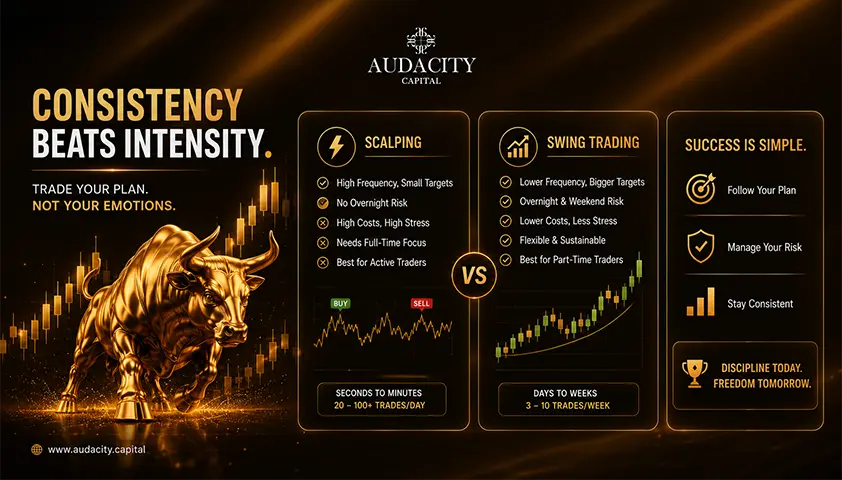
Answer these five questions honestly:
1. How much time can you dedicate to trading per day?
- Less than 2 hours → Swing trading
- 4–8 uninterrupted hours → Scalping is viable
2. Do you have a full-time job or business?
- Yes → Swing trading (non-negotiable)
- No / flexible hours → Either, based on preference
3. What is your starting capital?
- Under $5,000 → Swing trading (forex/crypto)
- $10,000+ → Either strategy is viable
4. How do you handle stress and fast decisions?
- I need time to think → Swing trading
- I thrive under pressure → Scalping may suit you
5. What kind of feedback do you prefer?
- Immediate results / daily closure → Scalping
- Patience is fine / long-term process → Swing trading
Scoring:
- Mostly swing trading answers → Start with swing trading
- Mostly scalping answers → Explore scalping after building a solid foundation
- Mixed → Start with swing trading and add scalping elements after 6+ months of consistency
Can You Do Both?
Yes — and many experienced traders do. The most common hybrid approach is:
- Swing trade as the primary strategy (set-and-forget trades on the daily chart)
- Scalp selectively during peak hours (London open or London–New York overlap) when a high-quality short-term setup appears
However, this hybrid should only be attempted once you are consistently profitable in at least one of the two styles. Trying to learn both simultaneously is one of the most common mistakes new traders make — the strategies require different mindsets, different charts, and different emotional states. Mastering one first before adding the other is always the smarter path.
Final Verdict: Scalping vs Swing Trading
There is no universally "better" strategy. There is only the strategy that is right for you — and that comes down to your schedule, capital, temperament, and goals.
Choose scalping if you are an experienced trader with full-time market access, professional infrastructure, and the psychological makeup to make clean, rapid decisions under sustained pressure without emotional interference.
Choose swing trading if you have a job or other commitments, you are building your trading career alongside other responsibilities, or you are still developing your market reading skills. It is the more accessible, more forgiving, and statistically more achievable path for the majority of traders.
Most successful traders who scalp today started as swing traders. The patience, discipline, and market understanding that swing trading builds are the same qualities that eventually make a scalper elite. The fastest path to profitable scalping often runs through swing trading first.
Ready to Put Your Trading Style into Practice?
Whether you choose scalping or swing trading, long-term success depends on disciplined execution, effective risk management, and access to the right trading capital.
Explore our Instant Funding program and start trading with professional capital without going through a traditional evaluation challenge.
Related Articles
For a deeper breakdown, read: Is Day Trading Easier Than Swing Trading?
Frequently Asked Questions
It depends on your time, experience, and trading style.
Scalping has higher execution risk, while swing trading has overnight risk.
Yes, it is generally easier and less stressful.
Yes, some traders combine both depending on market conditions.
Both can be highly profitable. Scalping depends on high win rates across many trades; swing trading depends on strong risk-to-reward ratios across fewer trades. Swing trading's 1:3 risk-to-reward means a 40% win rate is profitable. Scalping's 1:1.5 ratio requires 60%+ win rates — a harder consistency bar to clear, especially at high trade volumes.
No. Swing trading is significantly more suitable for beginners. It allows more time to analyse, make decisions, and learn from mistakes. Scalping's pace makes it very unforgiving for those still developing their skills.
Neither is inherently lower risk — risk is determined by position sizing, not strategy. However, swing trading carries overnight and weekend gap risk that scalping does not. Scalping carries higher cumulative transaction costs and cognitive fatigue risk. They carry different types of risk.
Yes, but only after building consistent profitability in one strategy first. Trying to learn both simultaneously usually results in mediocrity in both. Master one, then consider adding elements of the other.
Scalping: $10,000+ (forex/crypto), $25,000+ for US stocks (PDT rule). Swing trading: $2,000–$5,000 (forex/crypto), $10,000+ for stocks.
Both work well in forex. Scalping is optimal during the London–New York overlap with EUR/USD, GBP/USD, or USD/JPY. Swing trading works throughout the week using daily charts. Beginners should start with forex swing trading.
Swing trading is better suited to most crypto traders because the 24/7 market and high volatility create large swings that daily-chart swing setups can capture. Scalping crypto requires peak-volume hours and high-liquidity coins to avoid spread and slippage issues.

Prêt à appliquer un risque discipliné aux cryptos ? Explorez les nouveaux instruments crypto d'Audacity Capital et apportez votre stratégie de trading.
En savoir plusNewsletter
Rejoignez notre newsletter pour rester informé.
Rejoignez Notre Communauté Sociale

Commencez Votre Voyage Aujourd'hui Avec Notre Essai Gratuit
Affichez fièrement vos compétences et réalisations grâce à des certificats et obtenez la reconnaissance de votre travail acharné et de votre dévouement auprès d'investisseurs potentiels et de pairs.
Essai GratuitArticles Connexes
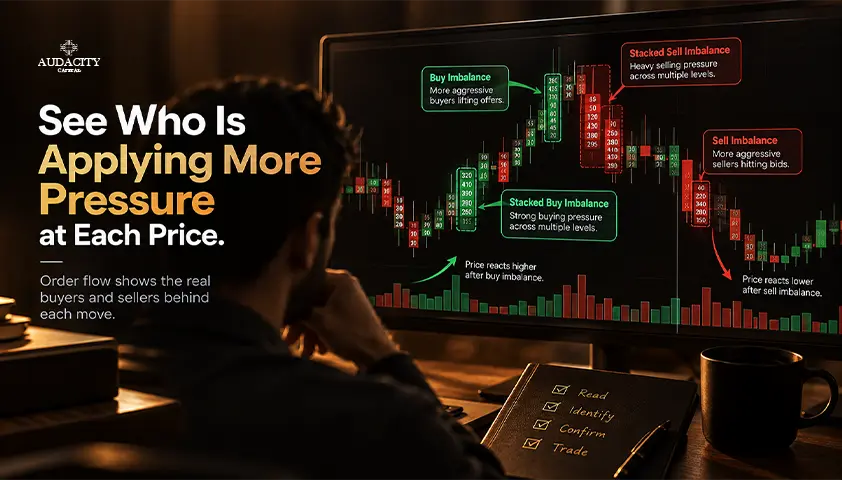
Order Flow Imbalance: How to Read Buy and Sell Pressure
Learn what order flow imbalance means, how footprint and order book readings differ, and how traders assess buy and sell pressure with context.

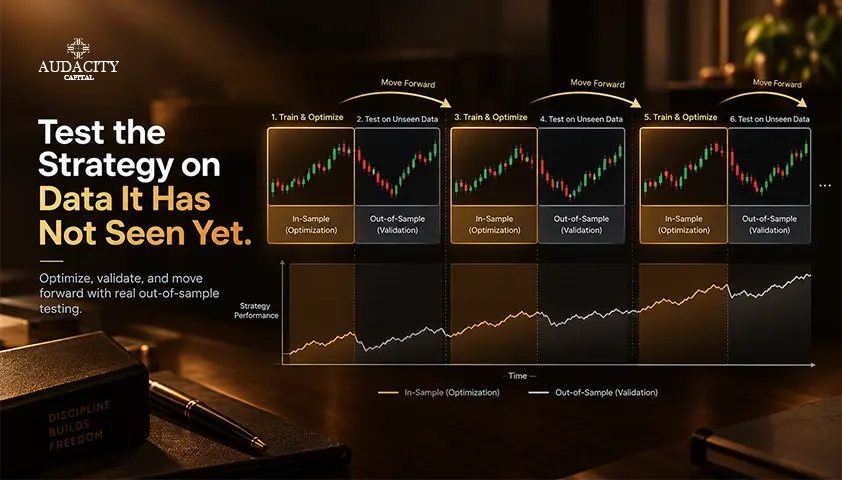
Walk-Forward Analysis in Trading: A Practical Guide
Learn how walk-forward analysis works in trading: in-sample and out-of-sample windows, rolling vs anchored designs, a worked example, and how to read results.
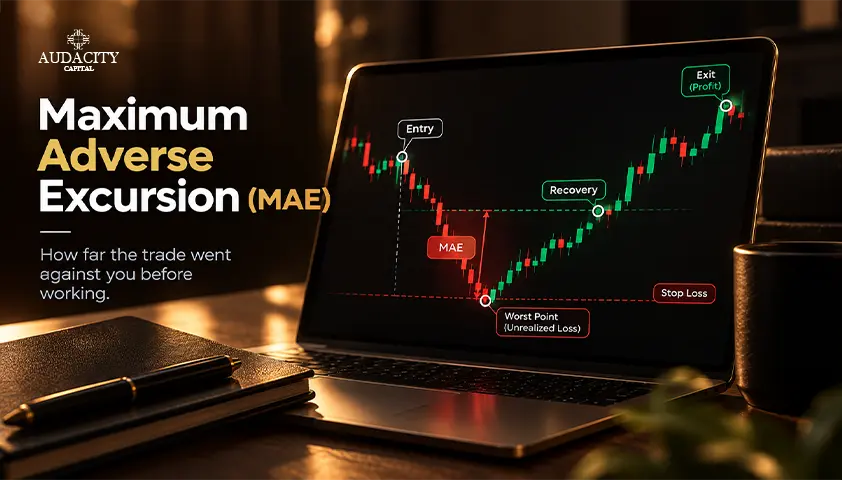
Maximum Adverse Excursion Explained for Traders
Learn how maximum adverse excursion measures a trade's worst open loss, how to calculate MAE, read charts, test stops, and avoid common errors.
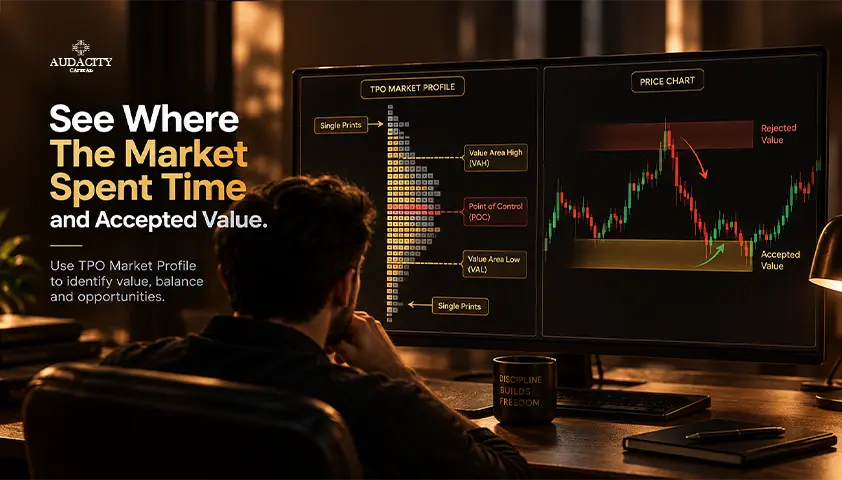
Market Profile Trading: How to Read TPO Charts
Learn Market Profile Trading with TPO charts, value area, POC, initial balance, day types, practical examples, and risk controls.