



Candlestick Patterns Explained: How Traders Read Price Action


Key takeaways
- Candlesticks reflect buyer and seller behavior, not predictions
- Candle structure matters more than pattern names
- Context determines the reliability of candlestick signals
- Indecision candles warn rather than signal entries
- Candlesticks should confirm setups, not define them alone
- Risk management is essential for long-term success
Candlesticks are one of the most widely used tools in technical analysis. They do not predict the future; instead, they communicate what is happening in the market right now. Every candlestick reflects the interaction between buyers and sellers and reveals valuable insight into market psychology.
At Audacity Capital, candlestick analysis is viewed as a confirmation tool that helps traders improve timing, manage risk effectively, and trade with clarity rather than emotion.
This guide covers candlesticks from the ground up, explaining not just what patterns look like, but why they form and how professional traders use them.
What Are Candlesticks?
Candlesticks are a method of displaying price data on a chart. Each candlestick represents price movement over a specific period and shows four key data points:
- Open price
- High price
- Low price
- Close price
Unlike line charts, candlesticks provide depth and detail, allowing traders to see how price behaved within that timeframe, not just where it ended.
The Psychology Behind Candlesticks

Every candlestick tells a story of market sentiment.
- Long bullish candles indicate strong buying pressure
- Long bearish candles indicate strong selling pressure
- Small bodies suggest balance or hesitation
Candlestick patterns work because markets are driven by human behavior. Fear, greed, confidence, and uncertainty are all reflected visually through candle formation.
Anatomy of a Candlestick
Each candlestick consists of two main parts:
- Body: the distance between the open and close
- Wicks (or shadows): the highs and lows reached during the period
How traders interpret them:
- Large bodies show strong conviction
- Long wicks show rejection of price
- Small bodies suggest indecision
Understanding this structure is more important than memorising pattern names.
Bullish Candlestick Patterns
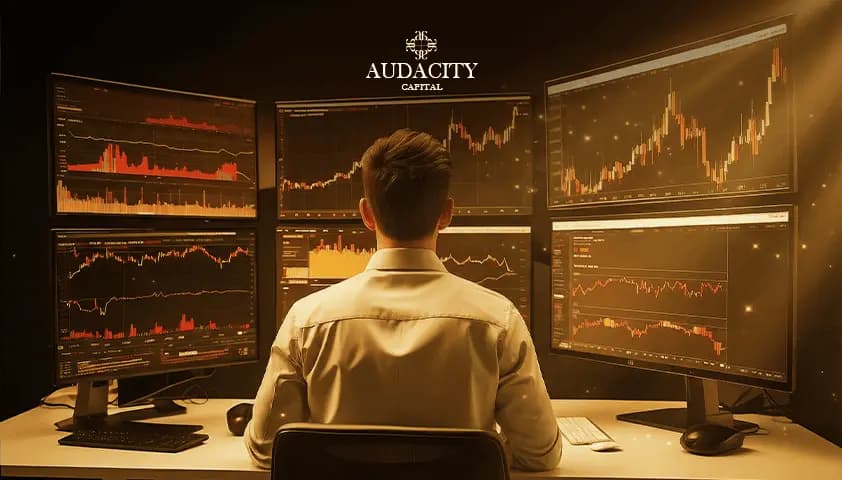
Bullish candlestick patterns suggest that buyers may be gaining control of the market.
Common bullish patterns include:
- Bullish Engulfing, where buyers completely overpower sellers
- Hammer, showing strong rejection of lower prices
- Morning Star, indicating a shift from selling pressure to buying pressure
These patterns are most effective when they appear at key demand zones, support levels, or after extended market declines.
Bearish Candlestick Patterns
Bearish candlestick patterns indicate that selling pressure may be increasing.
Common bearish patterns include:
- Bearish Engulfing, where sellers dominate buyers
- Shooting Star, showing rejection of higher prices
- Evening Star, signaling a potential shift from buying to selling
Like bullish patterns, bearish candlesticks must always be evaluated in context.
Indecision Candlesticks
Not all candlesticks represent dominance. Some show uncertainty in the market.
Common indecision candles include:
- Doji, where the open and close are nearly the same
- Spinning Top, which has a small body and wicks on both sides
These candles often appear before reversals, continuations, or consolidation phases. They act as warnings rather than direct trading signals.
Using Candlesticks in Context

One of the biggest mistakes traders make is using candlestick patterns in isolation.
Professional traders combine candlestick analysis with:
- Market structure
- Trend direction
- Supply and demand zones
- Higher timeframe bias
A bullish candle in the middle of nowhere has little meaning.
A bullish candle at a strong demand zone within an uptrend carries much more weight.
Common Candlestick Mistakes
Many traders struggle with candlesticks because they:
- Memorise patterns without understanding them
- Ignore higher-timeframe context
- Enter trades based on a single candle
- Overlook risk management
Candlesticks are confirmation tools, not complete trading systems.
Risk Management with Candlesticks
No candlestick pattern is guaranteed to work.
Effective risk management includes:
- Stop-loss placement beyond structure
- Consistent position sizing
- Accepting losses as part of the process
At Audacity Capital, discipline and consistency matter more than individual trade outcomes.
Candlestick patterns are a visual language of the markets. When used correctly, they help traders trade with clarity, confidence, and discipline rather than emotion.
Frequently Asked Questions
No. Candlestick patterns should not be traded in isolation. They work best when combined with market structure, trend direction, and key price zones.
Candlesticks work on all timeframes, but higher timeframes such as the 4-hour and daily charts generally provide more reliable signals. Lower timeframes are better suited for entry refinement.
Yes. Candlestick analysis works across forex, indices, stocks, commodities, and cryptocurrencies because all markets are driven by buyer and seller interaction.
There is no single most powerful pattern. A simple candle at the right location is often more effective than a complex pattern in the wrong context.
No. Beginners should focus on understanding candle anatomy, rejection wicks, strong closes, and market context rather than memorising pattern names.
Yes. Candlestick behavior can help identify momentum shifts, potential reversals, and profit-taking opportunities, making them useful for managing open trades.
They often fail when traders ignore context, manage risk poorly, trade emotionally, or during high-impact news events that disrupt normal price behavior.
Candlesticks are viewed as a decision-making aid that helps traders refine entries and manage risk within a structured, rule-based trading framework.

क्या आप क्रिप्टो पर अनुशासित जोखिम लागू करने के लिए तैयार हैं? Audacity Capital के नए क्रिप्टो उपकरणों का पता लगाएं और अपनी ट्रेडिंग रणनीति लाएं।
और जानेंन्यूज़लेटर
हमारे न्यूज़लेटर से जुड़ें।
हमारे सामाजिक समुदाय में शामिल हों

आज ही अपनी यात्रा शुरू करें हमारे नि:शुल्क परीक्षण के साथ
प्रमाणपत्रों के माध्यम से अपने कौशल और उपलब्धियों को गर्व से प्रदर्शित करें और संभावित निवेशकों और साथियों से अपनी कड़ी मेहनत और समर्पण के लिए पहचान प्राप्त करें।
नि:शुल्क परीक्षणसंबंधित लेख

What Economic Indicators Impact Forex Trading?
Learn which economic indicators impact forex trading, including inflation, GDP, interest rates, and employment data. Trade smarter.


Is Crypto Less Risky?
Which Book Is The Best For Technical Analysis In Forex?
Find the perfect book for technical analysis in currency trading. Learn from experts and gain a competitive edge in the forex market.

Why Ex Military Are Good Traders?
Discover the new career opportunity for ex-military: trading. Banks and trading firms are hiring veterans for the trading floor.