



GTC in Trading: What Good Till Cancelled Orders Mean and How to Use Them Properly


Introduction
Every order you send to the market carries two instructions. The first is obvious: buy or sell, at what price, and in what size. The second is easy to overlook, yet it quietly shapes how your trade plays out. It tells your broker how long the order should stay alive if it isn't filled straight away.
That second instruction is called "time in force", and the most common setting you'll come across is GTC, short for Good Till Cancelled.
On the surface, GTC sounds simple. You place an order, and it waits patiently until price reaches your level or until you remove it yourself. For traders who can't sit in front of the charts all day, that patience is incredibly useful. A trader in Lagos, Sydney or Singapore can set up an entry for the New York session and go to bed. A swing trader can mark a weekly level and let the market come to them.
But the same feature that makes GTC convenient also makes it dangerous when it's misunderstood. An order that never expires will keep waiting even after the reason you placed it has disappeared. It will trigger during a news spike you forgot about. It can fill at a far worse price after a weekend gap.
This guide covers what GTC means, how it compares with other time in force options, where it fits in different trading styles, the risks most traders only discover the hard way, and a practical framework for managing GTC orders with discipline.
What Does GTC Mean in Trading?
GTC stands for Good Till Cancelled (you'll sometimes see it written as "Good 'Til Canceled" on American platforms). It's a time in force instruction that keeps an order active until one of two things happens:
- The order is filled because price reaches your specified level, or
- You cancel the order manually.
Compare that with a standard day order, which automatically expires at the end of the trading session if it hasn't been filled. A GTC order carries over from one session to the next, and from one week to the next, sitting on the broker's server until something happens to it.
It's worth being clear on one point from the start. GTC only matters for orders that don't fill immediately. A market order executes at the best available price almost instantly, so its time in force is largely irrelevant. GTC comes into play with pending orders, such as limit and stop orders, where you're waiting for price to reach a level that hasn't printed yet.
"Until cancelled" isn't always forever
In practice, "good till cancelled" doesn't always mean indefinitely. Many brokers, particularly in equities, apply a maximum lifespan to GTC orders, often somewhere in the range of weeks to a few months. Once that limit is reached, the order is automatically cancelled even though you never touched it. Some brokers also cancel or adjust open orders around corporate events such as stock splits.
In forex and CFD trading, pending orders on most platforms can genuinely remain open with no expiry. The rules vary by broker and by asset class, so it's always worth checking your provider's order policy rather than assuming.
How Does a GTC Order Work?, Step by Step
The lifecycle of a GTC order is straightforward once you break it down:
- You define the order. You choose the instrument, direction, order type (for example a buy limit), trigger price, position size and, ideally, a stop loss and take profit.
- You set the time in force to GTC. On many platforms this is the default, which is exactly why so many traders don't realise they've chosen it.
- The order sits on the broker's server. It isn't part of your open positions yet. On most platforms, no margin is used and no overnight financing is charged while the order is pending.
- Price either reaches your level or it doesn't. If it does, the order triggers and becomes a live position. If it doesn't, the order just keeps waiting.
- The order ends in one of three ways. It fills, you cancel it, or the broker's own maximum duration (if there is one) cancels it for you.
The key thing to notice is step four. A GTC order has no opinion about whether the market still looks the way it did when you placed it. It is purely mechanical. That's both its strength and its weakness.
GTC vs Other Time in Force Instructions
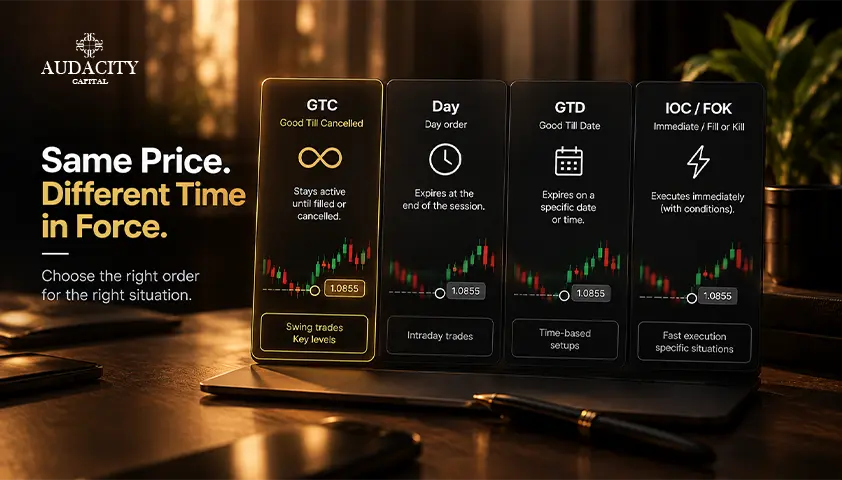
GTC is one of several time in force settings. Understanding the alternatives helps you choose the right one for each setup rather than defaulting to GTC out of habit.
Instruction | Full name | How long the order lasts | Typical use |
GTC | Good Till Cancelled | Until filled or cancelled (subject to any broker limit) | Swing entries, key levels, stop losses and targets |
Day | Day order | Until the end of the current trading session | Intraday setups that only make sense today |
GTD | Good Till Date (or Good Till Time) | Until a specific date or time you choose | Setups with a known shelf life, such as before a data release |
IOC | Immediate or Cancel | Fills whatever it can immediately, cancels the rest | Getting partial size quickly in thin markets |
FOK | Fill or Kill | Must fill completely and immediately, or it's cancelled | Large orders where partial fills aren't acceptable |
GTC vs Day orders
A day order is the cautious option. If your analysis is based on today's price action, such as a London session range or an intraday liquidity sweep, there's little reason for the order to survive into tomorrow when the context will be different. A day order cleans itself up automatically.
A GTC order suits ideas built on higher timeframe structure, where a level may remain relevant for days or weeks.
GTC vs GTD
GTD is the most underrated alternative to GTC. It lets you say, "I want this order live until Thursday at 12:00 London time, and not a minute longer." That's useful when you know an event is coming, such as a Bank of England rate decision or a US inflation release, and you'd rather not have an entry trigger during the volatility.
Many experienced traders use GTD as their default and reserve GTC for protective orders like stop losses and take profits.
Which Order Types Can Be Set as GTC?
Most pending order types can carry a GTC instruction. The main ones are:
Buy limit. An order to buy below the current price. Traders use it to buy into a pullback, for example at a demand zone, an order block or a previous support level.
Sell limit. An order to sell above the current price, typically at resistance, a supply zone or a premium area of a range.
Buy stop. An order to buy above the current price, often used for breakout entries once price clears a key high.
Sell stop. An order to sell below the current price, used for breakdowns below support or a previous low.
Stop limit orders. A two-part order where a stop price triggers a limit order. Available on some platforms, these give more price control but carry a risk of not being filled at all in fast markets.
Stop loss and take profit. Protective orders attached to an open position. On most platforms these are effectively GTC by default, which is exactly what you want. A stop loss that expired overnight would leave a position unprotected.
How GTC Works on Popular Trading Platforms
Different platforms present time in force in different ways, so it's worth knowing where to look.
MetaTrader 5. When placing a pending order, MT5 offers an expiration setting with options such as GTC, Today, Specified (a date and time) and Specified Day. Choosing GTC keeps the order live until it fills or you remove it.
MetaTrader 4. MT4 doesn't label the option "GTC". Instead, there's an expiry field on the pending order window. If you leave expiry unticked, the order has no expiration, which behaves as GTC.
cTrader. Pending orders can be left without an expiry (GTC) or given a specific expiry date and time.
Equity and multi-asset brokers. Stock trading platforms usually show a time in force dropdown next to the order ticket, with Day often set as the default and GTC as an option. This is where maximum lifespans on GTC orders are most common.
Whatever platform you use, make a habit of checking the default setting. Many traders run pending orders as GTC for months without ever realising it was a choice.
Why Do Traders Use GTC Orders?
Used deliberately, GTC orders solve some very real problems.
1. You don't have to watch the screen
This is the big one. Markets move around the clock, and your best setups won't always appear at convenient times. A trader in Nairobi or Johannesburg analysing the New York session, or a trader in Sydney waiting for a London open move, can place a GTC order and let execution happen without them.
2. It enforces your plan
A pending order placed after calm analysis removes a lot of in-the-moment emotion. You decided on the entry, stop and target when you were thinking clearly, not while watching a candle surge towards your level.
3. It suits higher timeframe trading
Swing and position traders often work from daily and weekly levels that can take days to reach. Re-entering the same order every morning is tedious and invites mistakes. GTC keeps the order in place across sessions.
4. It keeps protective orders alive
Stop losses and take profits need to stay active for as long as the position is open. GTC is the natural setting for them.
5. It helps you trade patiently
Some of the cleanest entries come from letting price come to you. A resting limit order at a well-chosen level encourages exactly that behaviour, instead of chasing moves that have already happened.
What Are the Risks of GTC Orders?
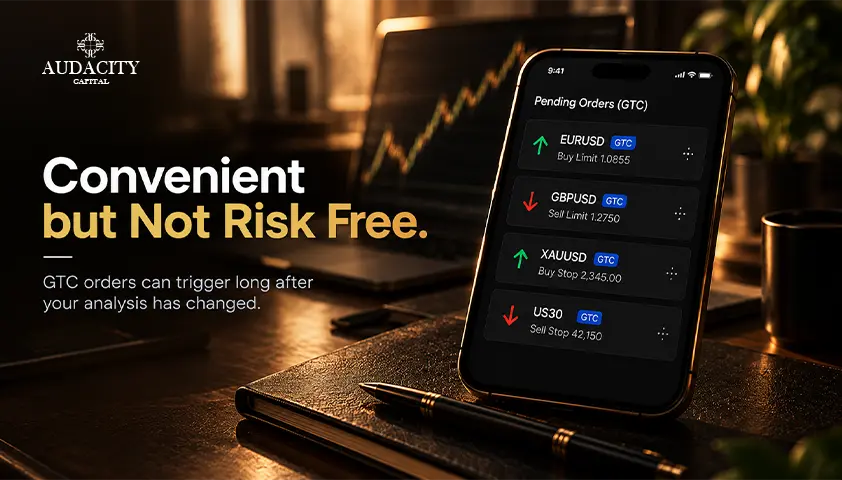
For every advantage, there's a matching risk. These are the ones that catch traders out most often.
1. Your analysis goes stale, but the order doesn't
This is the most important risk to understand. You place a buy limit at a demand zone on Monday because the higher timeframe trend is bullish. By Thursday, price has broken structure to the downside and the bullish case has fallen apart. Your buy limit, however, is still sitting there, ready to buy into a market that is now bearish.
A GTC order remembers your price. It doesn't remember your reasons.
2. Forgotten orders
Traders with several instruments on the go can easily lose track of pending orders. An order placed weeks ago on a pair you've stopped watching can trigger unexpectedly, opening a position you didn't plan for, in a size that may no longer fit your risk.
3. Position sizing that no longer fits
Your lot size was calculated against your account balance and stop distance on the day you placed the order. If your balance has changed meaningfully since then, whether through wins or losses, that old order may now risk more or less than intended.
4. Conflicts with trading rules
If you trade under a set of rules, whether your own trading plan or the terms of a funded account, some restrictions can apply to pending orders as well as open positions. For example, some programmes have rules about holding trades over weekends or through news events. A GTC order that fills at the wrong time can create a breach you didn't intend. Always read the specific rules that apply to your account.
5. Margin surprises
On most platforms, a pending order doesn't reserve margin until it triggers. If several GTC orders fill at once, for instance during a sharp correlated move, your available margin could be tighter than you expected. Some orders may even be rejected at the moment of triggering if there isn't enough free margin.
GTC Orders, Gaps and Slippage
Gaps deserve their own section because they turn a well-placed order into a painful one.
A gap happens when price jumps from one level to another with no trading in between. In forex, the most common gaps appear between the Friday close and the Monday open, when weekend news gets priced in all at once. In stocks and indices, gaps can happen at every session open.
How a GTC order behaves in a gap depends on its type:
Stop orders (including stop losses) become market orders once triggered. If price gaps straight through your stop level, the order fills at the next available price, which can be significantly worse. This is slippage, and it's the reason a planned 20 pip loss can become a 50 pip loss.
Limit orders only fill at your price or better. If price gaps through a buy limit, you'll typically be filled at the better opening price. The catch is that a gap through your limit may be the market telling you something has fundamentally changed, and you're now entering on the wrong side of that news.
A simple gap illustration
Suppose you're long GBP/USD and your GTC stop loss sits at 1.2680. The market closes on Friday at 1.2710, so you're 30 pips from your stop. Over the weekend, unexpected political news breaks in the UK. On Monday, GBP/USD opens at 1.2630.
Your stop was triggered because price is now below 1.2680, but the first available price is 1.2630. Your loss is 80 pips instead of the 30 you planned for. The GTC stop did its job of closing the trade, but it couldn't guarantee the price.
Some brokers offer guaranteed stop losses on certain products, usually for an extra fee. Otherwise, the main defences against gap risk are position sizing, reducing exposure before weekends, and avoiding holding pending orders through known risk events.
GTC Orders and High-Impact News
News releases are where resting GTC orders do the most unexpected damage.
Around major releases, such as US non-farm payrolls, eurozone inflation data, or rate decisions from the Federal Reserve, European Central Bank, Bank of England or Bank of Japan, spreads can widen sharply and liquidity can thin out for a few seconds. During those moments:
- Pending orders can trigger on a brief spike that reverses almost instantly.
- Stop orders can suffer heavy slippage.
- Widened spreads can trigger orders even when the chart's bid price never touched your level, because buy orders trigger on the ask price and sell orders on the bid.
That last point surprises many traders. If you have a sell limit at 1.0950 and the chart shows the high at 1.0947, you might assume it didn't come close enough. But charts often display the bid price. When spreads widen during news, the ask can reach levels the bid chart never shows, and buy stops or sell-side stop losses can be triggered as a result.
The practical fix is simple. Check the economic calendar before placing any GTC order, and either use GTD to expire the order before a major release or remove it manually ahead of time.
Best Practices for Managing GTC Orders
GTC orders are a tool. The difference between using them well and badly comes down to routine.
1. Treat every pending order as a live trade
If you wouldn't be comfortable with the position being open right now, you shouldn't be comfortable with the order waiting to open it.
2. Always attach a stop loss and take profit
A pending order without protective orders can trigger into a position with unlimited downside. Set both before the order goes live.
3. Review open orders daily
Build a short routine into your session prep. For each pending order, ask three questions: Is the original reason still valid? Is the position size still correct for my current balance? Is there high-impact news before it's likely to fill?
4. Define an invalidation point
Decide in advance what would make the setup invalid, such as a close below a certain level or a break of structure on your execution timeframe. If that happens before your entry triggers, cancel the order.
5. Prefer GTD when the setup has a shelf life
If your idea is only valid for the next two sessions, set the order to expire after two sessions. Let the platform do the housekeeping.
6. Be deliberate about weekends
Before the Friday close, look at every pending order and open position. Decide which ones you genuinely want exposed to weekend gap risk.
7. Keep a record
Log pending orders in your trading journal along with the reasoning behind them. When an order triggers days later, you'll know exactly why it was there.
8. Limit how many orders you leave running
The more GTC orders you have open, the harder they are to manage and the greater the chance of unintended correlated exposure. Fewer, higher quality orders are easier to keep under control.
Worked Example: A GTC Buy Limit on EUR/USD
Here's how a disciplined trader might use a GTC order from start to finish. The figures are illustrative.
The setup
On a Monday, the trader is analysing EUR/USD. The daily chart shows a clear bullish structure, with a series of higher highs and higher lows. Price is currently trading at 1.0940 after a strong push higher, and the trader has identified a daily demand zone between 1.0845 and 1.0865, the origin of the most recent bullish leg.
Rather than buying at the current price and chasing the move, the trader wants to wait for a pullback into that zone. Price might take several days to get there, so a GTC order makes sense.
The order
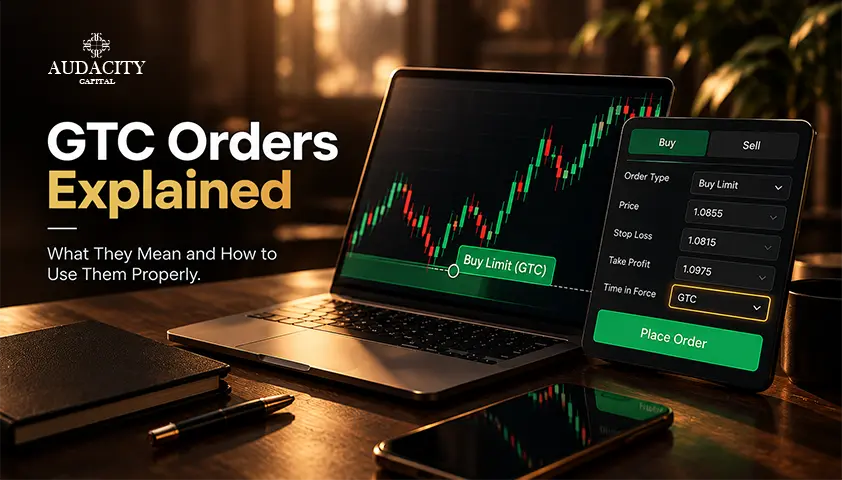
- Order type: Buy limit
- Entry: 1.0855
- Stop loss: 1.0815 (40 pips, below the demand zone)
- Take profit: 1.0975 (120 pips, just below the recent high)
- Risk to reward: 1:3
- Time in force: GTC
Position sizing
The trader's account balance is 100,000 USD and they risk 1% per trade, which is 1,000 USD. On EUR/USD, one standard lot is worth roughly 10 USD per pip. With a 40 pip stop:
1,000 ÷ (40 × 10) = 2.5 lots
The review routine
The trader also writes down two cancellation rules. First, if the 4-hour chart breaks structure to the downside before price reaches the zone, the bullish idea is weakening and the order gets cancelled. Second, if a high-impact release is due and the order still hasn't filled, it comes off beforehand.
On Tuesday morning, the trader checks the economic calendar and sees eurozone inflation data due on Wednesday and a US data release on Thursday afternoon, London time. Both could move the pair sharply.
Scenario A: The plan works
On Wednesday, price drifts lower into the zone during the London session and fills the buy limit at 1.0855, before the afternoon volatility. The stop loss and take profit are already attached. By the following Monday, price rallies to 1.0975 and the take profit is hit for a gain of 120 pips, or 3,000 USD.
Scenario B: The news risk is managed
Instead, price hovers around 1.0900 for Monday and Tuesday without reaching the zone. With the eurozone inflation data due on Wednesday morning and the order still unfilled, the trader follows the second rule and cancels the buy limit before the release.
The data surprises to the downside. EUR/USD drops more than 100 pips in minutes, slicing through the demand zone and trading as low as 1.0790 before settling. Had the order stayed live, it would have filled at 1.0855 and the stop at 1.0815 would likely have been hit moments later, possibly with slippage. By stepping aside, the trader avoided a loss and can reassess the chart once the dust settles.
Scenario C: The forgotten order
Now picture the same setup without a review routine. The trader places the GTC order on Monday, gets busy with other pairs, and forgets about it. Three weeks later, after the trend has turned bearish and the account balance has dropped to 92,000 USD, price rallies back to 1.0855 and triggers the order.
The position opens at 2.5 lots, which now represents roughly 1.09% risk rather than 1%, on a setup whose reasons disappeared weeks ago. Price continues lower and the stop is hit.
The order worked exactly as instructed. The problem was the lack of management around it.
Key Takeaways
- GTC means Good Till Cancelled. The order stays active until it's filled or you cancel it, subject to any maximum duration your broker applies.
- GTC only matters for pending orders. Market orders fill immediately, so time in force mainly affects limit and stop orders.
- It's often the default. Many platforms set pending orders to GTC automatically, so check your settings.
- GTC is ideal for protective orders. Stop losses and take profits should stay active for as long as the position is open.
- Alternatives exist for a reason. Day orders suit intraday setups, and GTD orders suit ideas with a known shelf life or an upcoming news event.
- The biggest risk is stale analysis. A GTC order remembers your price but not your reasoning.
- Gaps and news can cause slippage. Stop orders can fill well beyond your level when price jumps.
- Management is everything. Review orders daily, define invalidation points, recheck position sizes and plan for weekends.
FAQ
GTC stands for Good Till Cancelled. It's a time in force instruction that keeps an order active until it's filled or manually cancelled.
In principle, indefinitely. In practice, some brokers, especially equity brokers, cancel GTC orders after a set period, which can range from weeks to a few months. Forex and CFD platforms often allow pending orders to stay open with no expiry. Check your broker's policy.
Neither is better in every situation. GTC suits setups based on higher timeframe levels that may take days to reach. Day orders suit intraday ideas that lose relevance once the session ends.
On most platforms, no. Overnight financing (swap) is usually only charged on open positions, and margin is typically only used once the order triggers. Once filled, normal costs apply.
Limit orders fill at your price or better. Stop orders become market orders once triggered, so they can fill at a worse price during gaps or fast markets. This is known as slippage.
On most platforms, stop losses and take profits attached to an open position remain active until the position closes, which effectively makes them GTC.
It depends on your plan and your risk tolerance. Weekend gaps can cause pending orders to trigger at unexpected prices and stops to slip. Many traders review or remove pending orders before the Friday close. If you trade under a funded account or any set of trading rules, check whether weekend exposure is restricted.
Yes. On most platforms you can modify the entry price, stop loss, take profit or expiry of a pending order, or cancel it entirely, at any time before it triggers.
A GTC order stays active until it fills or you cancel it. A GTD (Good Till Date) order automatically expires at a date and time you choose, which makes it useful for setups with a limited window.

क्या आप क्रिप्टो पर अनुशासित जोखिम लागू करने के लिए तैयार हैं? Audacity Capital के नए क्रिप्टो उपकरणों का पता लगाएं और अपनी ट्रेडिंग रणनीति लाएं।
और जानेंन्यूज़लेटर
हमारे न्यूज़लेटर से जुड़ें।
हमारे सामाजिक समुदाय में शामिल हों

आज ही अपनी यात्रा शुरू करें हमारे नि:शुल्क परीक्षण के साथ
प्रमाणपत्रों के माध्यम से अपने कौशल और उपलब्धियों को गर्व से प्रदर्शित करें और संभावित निवेशकों और साथियों से अपनी कड़ी मेहनत और समर्पण के लिए पहचान प्राप्त करें।
नि:शुल्क परीक्षणसंबंधित लेख
How Many Trading Days in a Year?
How many trading days are there in a year? See the number of U.S. stock market trading days in 2026, monthly totals, holidays and how markets differ.

Inside Bar Pattern: Meaning, Examples and Trading Rules
Learn how to identify the inside bar pattern, compare entry and stop rules, and assess false breakouts before testing a trading strategy.

Spinning Top Candlestick Pattern: Meaning, Formation & How to Trade
Learn what the spinning top candlestick pattern means, how it forms, bullish and bearish setups, confirmation signals, trading strategies, examples, and risks.
How to Draw Trend Lines
How to draw trend lines step by step, whether to use wicks or bodies, when a line is valid, and when to redraw versus accept a break.