


Prop Trading Vs Quant Trading



Key Highlights
Prop trading and quantitative trading are both capital-intensive, high-performance trading strategies that are often confused to mean the same thing, but which differ in approach, personnel, and tech reliance.
In a nutshell, this is what you need to know about prop trading vs quant trading:
- Proprietary trading focuses on the “how” in trading and places strong emphasis on speed and execution quality. Traders practicing prop trading don’t get to hold poSome prop trading strategies focus on short-term trades, while others may hold positions overnight depending on the firm and strategy.
- Quant trading looks at the “why” in trading and mainly focuses on building robust algorithms and finding patterns in data. Its goal is to identify high-probability trading opportunities.
- A prop trader career path is one that can best be described as a high-risk, high-reward profession. It is often considered a high-risk, high-reward career path. If you lose, you get your account terminated.
- Becoming a quant trader is an intellectually rigorous process, but it is a path that offers more stability and versatility. Its skills, such as data science and coding, are easily transferable.
Prop Trading Vs Quant Trading
Prop trading involves traders using a prop firm’s capital to trade, in return for a share of the profits. The strategies used by prop traders can be automated or discretionary and will focus on capitalizing on short-term price movements/fluctuations.
Quant trading, on the other hand, relies on algorithms, data analysis, and mathematical models to make automated trading decisions. Looking at these two types of trading, it’s clear that quant trading is specialized and tech-driven, while prop trading is broader and trader-driven.
Read on to learn about how to compare prop trading vs quant trading.
Check here and learn more about our latest guide about Prop Trading Vs Other trading models
What Is Prop Trading?

I have spent the better part of the last decade working as a prop trader, and whenever an aspiring trader asks me what it is that I do, or rather what prop trading is, I try to give them the simplest definition.
In our world, prop trading is where you receive funding from a prop firm to take on larger positions in the financial markets, and then split any profits you make with the company.
If you look at this model, you’ll notice that it’s different from other approaches used by investment banks and hedge funds. This is because these two use client cash to trade, and not their own funds.
Now, I’d like to note that firms in the prop trading industry use different models. For instance, I have come across those who hire employees and fund their trading accounts.
In this example, the employee will be placed on a monthly retainer and will be entitled to a share of the profits they generate.
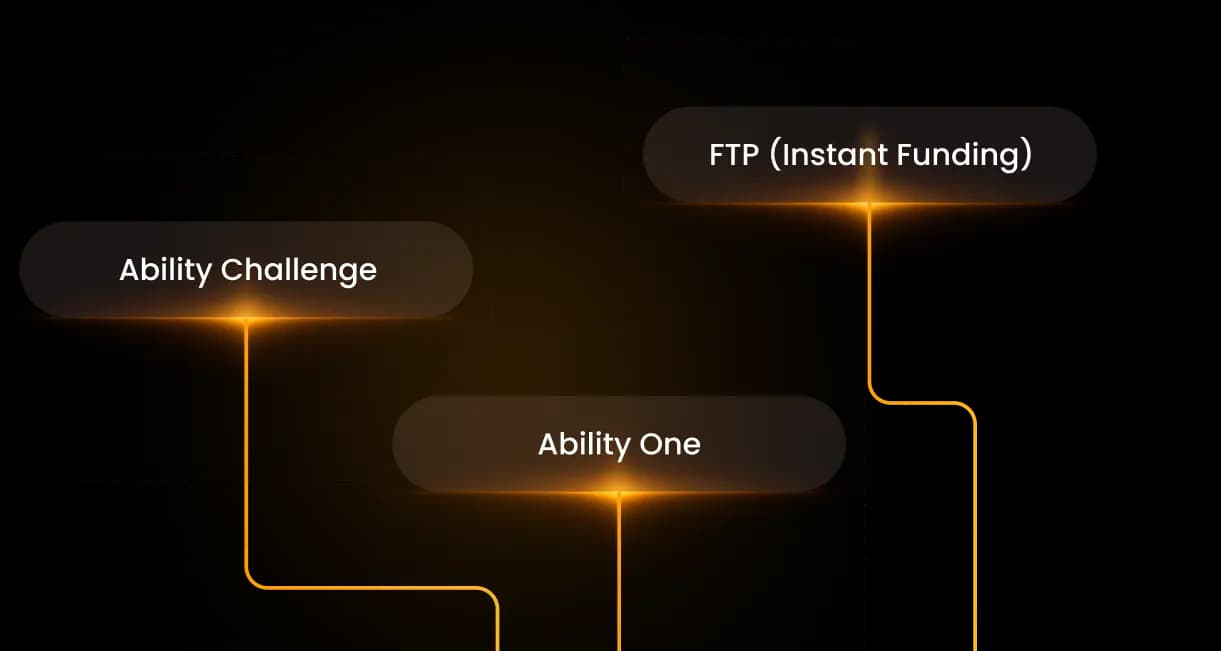
And there’s also my preferred model: where a prop trading firm recruits traders from around the world, trains and tests them, and if they pass the evaluation challenge, they get funded.
The chances of scaling in the last model are higher, and so are your chances of earning more! Read more about our latest guide What Is Prop Trading?
What Is Quant Trading?
Quant trading is a trading approach where traders rely on mathematical models and algorithms to make trading-related decisions. The models used in this strategy are often based on the financial assets' price and will include technical analysis models.
And as has been the case with other trading approaches, quant trading is evolving at a fast pace, a fact that has seen it incorporate other popular models in the trading space. Examples of these include artificial intelligence (AI) and fundamental analysis.
The thinking behind quantitative trading is quite straightforward: its goal is to take the manual approaches that we typically use when trading and automate each and every one of them. For example, you could find a trading model that’s entirely based on moving average crossovers!
Prop Trading vs Quant Trading: The Similarities
Prop trading and quant trading share several similarities, e.g., they both use the prop trading’s capital to generate profits, instead of pooling or using client money for the same. Let’s look at a few more similarities:

Are You Looking For A Funded Trader Program?
Funded Trader Program- Risk Management Emphasis: Both models place a lot of importance on risk management and are known to use tools like stop loss orders and strict drawdown limits to safeguard capital.
- Source of Capital: Their traders rely on proprietary capital to execute trades, meaning that the prop firm funds their account, enabling them to take on larger positions.
- Technology Driven: Quant trading is often automated but can also involve semi-automated or hybrid approaches, and trading in modern prop firms has become increasingly dependent on algos, necessitating the use of high-speed tech.
- Data Driven Strategies: Both prop trading and quant trading strategies are heavily data reliant and aim to take advantage of statistical arbitrage and market inefficiencies to generate profits. Neither relies on "gut feeling" or watching the news. Prop traders often use technical indicators and order flow, while Quants use statistical arbitrage and stochastic modeling. Both require quantitative validation before a trade is placed.
- Autonomy: Because neither entity is managing a client’s pension fund," they aren't bound by the same strict regulatory oversight or conservative mandates as retail banks. This allows both to take on higher-leverage positions and more aggressive risk profiles.
- The "Zero-Sum" Mindset: Both typically operate in highly liquid markets (Forex, Futures, Equities) seeking to extract "Alpha" (excess return). They aren't looking for long-term dividends; they are looking for market inefficiencies to exploit.
- Profit Sharing Structure: In both worlds, the "talent" (the trader or the researcher) is usually compensated via a percentage of the PnL (Profit and Loss) they generate, rather than just a flat salary.
Let’s use a table to compare the two:
Feature | Prop Trading | Quant Trading |
|---|---|---|
Primary Goal | Direct profit from market moves | Finding statistical edges via models |
Capital Source | Firm's internal balance sheet | Internal (Prop) OR External (Fund) |
Human Element | Can be "discretionary" (human clicks) | Almost entirely automated |
Skillset | Market intuition, risk management | Math, Physics, CS, Statistics |
Prop Trading vs Quant Trading: The Differences
Proprietary trading is where a firm provides traders with access to its capital to trade larger and more diverse financial instruments. While the strategies used by prop traders are discretionary, quant traders tend to rely on data analysis, algorithms, and mathematical modeling to automate their decision-making.
The following is a look at their main differences:
- Use Different Approaches: To an outsider, prop trading and quant trading are one and the same. But at the basic level, you’ll find that prop traders use different discretionary strategies to make money, while quant traders use different models to find trading opportunities.
- Decision Making: Both approaches use technology when trading, but the level to which they depend on it varies. For example, quant technology is solely dependent on technology. Some complex models even use emerging technologies like sentiment analysis, machine learning, and artificial intelligence. Prop trading uses a broader approach where a trader can use a variety of methods to make their decisions.
- Psychology: The psychology of emotions is another important difference you need to understand. Quant trading is usually referred to as an autopilot method of making money. This is because the model is designed to identify opportunities and execute trades automatically and execute orders. On the other hand, prop traders have to learn how to manage their emotions. Without proper emotional management, prop traders may be at risk of engaging in revenge trading.
- Time Horizon: Prop trading revolves around the idea of capitalizing on the short-term movements happening in the financial markets. Because of this, many prop traders have no option but to rely on scalping strategies instead of holding positions overnight. Quant trading works differently in that it has a varied timeline. Some traders use it to trade short-term positions while others use it for long-term investing.
- Regulations: Lastly, there exists a regulatory difference between quant trading and prop trading. For instance, quant trading is nothing more than a trading strategy and is thus not regulated by industry bodies. Prop trading, however, is regulated, especially in the U.S, where banks are restricted by the Volcker Rule on the kind of speculative activities that they can participate in.

Free Prop Firm Trading Competition
Start the Free ChallengeConclusion
Prop trading and quant trading have their similarities, but it’s their differences that help traders tell them apart. For example, prop traders rely on their instincts, self-discipline, and technical analysis to make investment decisions. In contrast, a quant trader can rely on an algorithm to handle all the heavy lifting on their behalf. And this is not the only difference, as prop traders focus on market feel and tools, while their counterparts in quantitative trading focus on code and data. If you wish to learn more about the differences between prop trading and quant trading, make sure to visit the Audacity Capital official website. And while here, take a look at the funded trader program to learn how you can become a prop trader today.
FAQs
Prop trading is basically defined by whose money is being used by the trader, while quant trading is defined by how a trade will be made. A prop trader can use discretionary methods to make decisions, whereas the quant trader relies on algorithms and rule-based systems.
Yes. More and more traders are becoming open to the idea of using technology to trade, and have learned how to juggle manual decision-making with automated execution of orders.
Becoming a prop trader will enable you to use a prop firm’s capital to boost your earning potential. The major benefit of working as a quant trader is that the field is intellectually stimulating and comes with a high earning potential in the form of a salary plus bonuses pegged on performance.
Rapid decision-making, strong emotional control, and technical skills are what you need to become a prop trader. For quant traders, you’ll need a background in data science and statistics.
Both models are profitable. It all depends on your risk tolerance and ability to manage the capital at your disposal.

क्या आप क्रिप्टो पर अनुशासित जोखिम लागू करने के लिए तैयार हैं? Audacity Capital के नए क्रिप्टो उपकरणों का पता लगाएं और अपनी ट्रेडिंग रणनीति लाएं।
और जानेंन्यूज़लेटर
हमारे न्यूज़लेटर से जुड़ें।
हमारे सामाजिक समुदाय में शामिल हों

आज ही अपनी यात्रा शुरू करें हमारे नि:शुल्क परीक्षण के साथ
प्रमाणपत्रों के माध्यम से अपने कौशल और उपलब्धियों को गर्व से प्रदर्शित करें और संभावित निवेशकों और साथियों से अपनी कड़ी मेहनत और समर्पण के लिए पहचान प्राप्त करें।
नि:शुल्क परीक्षणसंबंधित लेख

Prop Trading Vs Institutional Trading
Learn the difference between prop trading and institutional trading, including capital sources, strategies, risk management, and career opportunities.


What Is Max Drawdown?
Learn what max drawdown means in trading, how to calculate it, and the max drawdown formula traders use to measure risk and account performance.

Prop Trading Vs Trading Your Own Capital
Compare prop trading and trading your own capital with insights from Audacity Capital. Learn the key differences, risks, and which option suits your trading goals.

Prop Trading Vs Flow Trading
Learn the difference between prop trading and flow trading, including strategies, risk exposure, client interaction, and which path suits your trading career.