


Mastering The Psychology Of Trading: A Comprehensive Guide For Consistent Profits



Source: TradeProAcademy
Trading in the money markets can be an exciting yet intimidating experience. With its huge potential for considerable profits, it’s no wonder that many people have become drawn to forex trading. Typically, there’s a lot of focus on technical analysis, indicators, and trading strategies as you get started on your trading career.
But while this is needed, as your career kicks off, you’ll soon come to note that strategy and analysis will eventually take care of themselves as you settle on a niche. Trading psychology, on the other hand, will require that you put in a considerable amount of work, especially during the early days.
Mastering trading psychology is vital to developing a profitable trading mindset in the currency markets . To fully master trading, it will be important to understand the following four things:
- Knowledge
- Skill
- Process
- Mindset
Understanding trading psychology is crucial to becoming a profitable trader, but this is usually the last step in a long journey. The reality is that it takes time and energy to get a good grasp of the psychological principles of trading. This understanding and their eventual application come from honing skills, accumulating knowledge, and gaining experience across various markets.
Experience is key. The more hours you spend trading, the better you become at building a subconscious understanding of the FX market. As you become well-versed with the shifts and patterns in market sentiment, you become better at capitalizing on emerging opportunities in these markets.
In this comprehensive guide to developing a profitable trading mindset, we will take you through the importance of reflecting on your trading mentalities and more. Get ready to receive practice advice on the role of psychology in forex trading and what you can do to develop emotional control and discipline in your trading career.
The Role Of Psychology In Trading Success
At its core, forex trading is a battle of intellect and emotions. The latter drives decision-making, thus significantly impacting trading performance. For you to master trading psychology, you must be prepared to recognize how emotions impact your trading outcomes. This means being prepared to learn how to harness such emotions efficiently.
What Is Trading Psychology?
It refers to the emotional factors that influence your behaviour and decisions when trading in the financial markets. It includes a variety of feelings, such as impatience, fear, overconfidence, and greed. All these are feelings that can substantially affect your decision-making and lead to either success or failure.
Learning trading psychology is vital to developing a trader mindset – a mindset where you’re able to make rational decisions, adhere to your trading plan, and, in the end, achieve consistent profits. Every successful investor tries to maintain a level-headed approach to trading, which means ensuring you don’t get swayed by short-term emotions.
Why Mental Resilience Is More Important Than Technical Skill
Forex trading has attracted countless beginner and intermediate traders seeking financial success. While most of them tend to focus on mastering technical analysis, there are those who are slowly realizing that psychology is critical to attaining consistent profitability in the FX markets. Below is a look at why resilience is more important than technical skill.
Emotions And Their Impact On Decision-making
One major reason why psychology trumps technical analysis in the money markets is the impact emotions have on your decision-making processes. Forex trading is typically accompanied by a rollercoaster of emotions, which are normal with every win or loss you record. Developing a trader mindset means not letting emotions such as fear or greed impact your decision-making.
Technical analysis offers valuable insights into price patterns and trends. Unfortunately, it doesn’t address all the aspects of forex trading. If you fail to manage your emotions, the chances are that you’ll end up making irrational decisions. In such a case, you may find yourself engaging in revenge trading, overtrading, or even taking excessive risks.
Examples Of Psychological Pitfalls In Trading
There’s more to becoming profitable in the money markets than merely learning how to read charts and set up trades. You must understand that there are various factors that can affect your success. The following is a look at some of these pitfalls:
- The Impulse to Overtrade: Overconfidence and impatience are two psychological patterns that can lead to overtrading. Impatience causes you to trade based on predictions, while overconfidence can cause you to misread trading data.
- Loss Aversion: Trying to avoid losses by being overly cautious will make you move your stop losses in a bid to try and break even too quickly. The problem with this approach is that you’re likely to give up on your gains in a bid to avoid making a loss.
- Emotional Trading: Making trading decisions based on your emotions can lead to irrational decision-making. Emotions can cause you to act against what you believe to be true or even against your best interests.
Understanding Your Trading Emotions
The human brain is a very complicated organ. It’s responsible for controlling everything you do, from the slight movement of your limbs to the blinking of your eyes. Your brain plays an important role in how your experiences transform into trading emotions from the basic mechanisms driven by hormone production.
However, there are instances when these emotions may begin to act against you and could even push you into engaging in unintended or irrational trades.
Fear, Greed, And The Trader’s Dilemma
Forex trading can generate a variation of emotional responses, such as fear, greed, and excitement. And a lack of emotional control in trading can significantly impact your trading outcomes. Using emotional impulses to trade instead of relying on objective market analysis may contribute to the following:
- Cognitive Biases: Underconfidence, excessive risk-taking, and overconfidence are some of the emotions that can be triggered by emotional trading, thus leading to uncertainty.
- Loss Aversion : It causes you to become overly focused on immediate losses, a fact that may cause you not to trade.
- Fear: It’s likely to arise in trading due to unforeseen market volatility. In turn, this can lead to impulsive decision-making motivated by anxiety instead of rational analysis.
How Emotions Can Derail Your Trading Plan
Similar to how you go about your everyday life, the journey to financial success in forex trading also has several common behavioural patterns. Here, fear and greed in trading are the two emotions that tend to directly and indirectly drive investment decisions. The following is a look at how emotions can derail your trading plan.
- Fear of Missing Out: It refers to the feelings you experience when you think or see other investors making money from a hot trade. These are some of the feelings that traders experienced when they began chasing “meme stocks”, only for them to get slammed because of a late market entry or exit.
- Hope: In the currency markets, hope can be an obstacle to attaining profitability if it’s accompanied by fear or greed, as these two emotions can lead to risky decision-making.
- Fear: It’s among the most common feelings in this world, and it can show up in diverse ways, leading to behavioral biases, such as the urge to “double down.”
- Greed: While it can be a motivating force that pushes you to try out new trading strategies, it can also lead to risky decisions that are downright dangerous to your portfolio.
Emotional Triggers Every Trader Faces
Source: capital.com
The image above depicts some of the emotions that you’re likely to face when trading. Below is a look at the psychology-related examples you’ll have to deal with during your trading journey.
- Failing to execute a well-defined trade setup due to fear that you may incur a loss if the trade goes against your position.
- Holding on to a winning position for too long because of greed, even though your analysis shows that it may be time to book your profits.
- Exiting a profitable trade because you’re anxious that the markets may reverse course instead of continuing a positive trajectory.
Ignoring the rules you defined on your trading plan and instead getting carried away by the prevailing flow in the market.
Developing Emotional Control And Discipline
Emotional control is a must-have skill in the fast-paced world of forex trading. It’s what separates successful currency traders from the rest of the herd. Feelings can cloud your judgment, leading to impulsive decision-making. Therefore, you need to develop trading discipline to achieve consistent profitability. But how do you go about doing so?
The Power Of Discipline In Consistent Trading

Emotional control in trading is the ability to maintain a consistent approach and manage emotions when trading, no matter the market conditions. It acts as a critical component of trading success for the following reasons:
- Enhances Risk Management: When you develop trading discipline, you become better equipped to follow your risk management rules. Through it, you learn the importance of setting stop-loss orders as well as adhering to your predefined position strategies. This is the kind of discipline that’s needed to help protect capital by minimizing losses.
- Maintains Objectivity: Emotional discipline helps you remain objective at all times, ensuring you don’t get tempted to deviate from your trading plan. By controlling your emotional responses, it means you get to avoid impulsive decision making which may lead to significant losses.
- Sustains Long-Term Success: Consistency is crucial to long-term trading success. Emotional control in trading ensures that you stick to your strategies and continue to make adjustments informed by performance metrics as opposed to relying on emotional reactions.
- Improves Decision Making: A trader who has emotional discipline is more likely to make their decisions based on strategy and analysis rather than on emotions such as hope, fear, or greed. This, in turn, leads to more calculated decisions.
- Reduces Stress: Forex trading can be a stressful undertaking, especially when the market is experiencing volatile conditions. Developing a trading discipline will help you manage stress more efficiently, allowing you to maintain a clear mind.
Tips For Building Emotional Control
Source: SimplyPsychology
Most traders understand all too well that emotions can influence their trading decisions. To stay calm and motivated throughout a trading session, you need to use well-organized techniques to enable you to make decisions based on reason, not your gut feeling. Some of the tips you can use to manage your feelings include:
- Don’t act on anger
- Follow each trade session with a break
- Don’t marry your positions
- Set a fixed point at which to walk away
- Keep your mind on the plan
- Manage your stops carefully
Setting Boundaries: When To Walk Away From The Trade
Source: Medium.com
Many beginner traders trade under the general assumption that “ a real trader must continue trading, no matter what .” However, seasoned traders understand that it’s vital for you to know when to walk away from the markets for your own survival. Not only can the market conditions change, but your psychological outlook may also become affected.
During such times, it may be ill-informed to continue trading. Even experienced traders will need to take frequent breaks to help them re-evaluate their trading strategies. Having emotional control in trading requires that you don’t be afraid to acknowledge your limitations. Schedule breaks between sessions and only enter the markets when you’re mentally ready.
There exist several psychological reasons for staying away from the forex markets. For example, there are days when you may be feeling down or tired. During such times, the chances are that you won’t be able to maintain a positive mindset. Opting to trade during such occasions means you’ll be disposed to impulsive trading.
Some traders could be tempted to trade through such slumps, leading them to put on bad trades. Attempting to trade when you’re in a poor mental state means your account will likely take a hit, as well as your ego. For the most part, it’s best to stand down when your spirits have taken a hit and only resume trading when you’re feeling refreshed.
The Trader’s Mindset: Shifting From Survival To Growth
A trading mindset is not only a necessity in this world; it’s a must-have. The forex markets are a battleground of all types of human emotions and are characterized by fear, hope, greed, and regret. In this type of environment, possessing a trader mindset will prove to be beneficial in that it allows you to remain profitable.
Fixed Vs. Growth Mindset In Trading
Dr Carol Dweck , a renowned psychology professor at Stanford University, is credited with introducing the concepts of fixed and growth mindsets. The growth mindset denotes the belief that intelligence and beliefs can be developed through strategy, effort, and help from others. A fixed mindset, on the other hand, is the belief that intelligence and abilities are fixed.
Here are their differences:
Fixed Mindset
- Threatened by the profitability of other traders
- Fear of failure causing you to avoid challenges
- Sees criticism as a threat
- Believes that their abilities are fixed
Growth Mindset
- See other traders as inspiration
- Not afraid of failure
- Sees challenges as learning opportunities
- Appreciate feedback and criticism for self-improvement
A profitable trading mindset requires that you have the right strategy and that you develop mental resilience. It’s the reason why you should learn to develop a growth mindset when trading different currencies. Some of the notable benefits of applying a growth mindset in your trades include:
- Resilience when faced with losses
- Continuous learning
- Flexibility and adaptability
- Better risk management
- Motivation and perseverance
How To Learn From Losses Without Emotional Fallout
Developing a growth mindset in trading requires that you learn how to deal with losses. Dealing with trade-related losses involves much more than learning from your mistakes; you need to know how to handle them emotionally. For a beginner trade, this can prove challenging, as it calls for you to be in tune with your reactions.
For example, if you’re one of those people who needs immediate closure after experiencing a significant loss, you’ll need to evaluate and learn from it immediately. On the other hand, if you tend to be easily disappointed by such things, you may want to walk away from the trading session until you have had enough time to process the loss.
Therefore, while its crucial to work hard to enhance your trading skills, it will also be important to strike a good work-life balance. This is the only way to ensure that losses won’t consume your life.
When faced with a trading loss, there are numerous things that you may want to avoid. Examples of these include adopting a carefree attitude or even ignoring the losses. Although it’s crucial to evaluate all the information provided to you, you must also be ready to take responsibility for your trading actions.
When trying to learn from a trading-related loss, the key will be to use this experience positively. This is something that will require you to examine the cause of the said loss and then take preventive action to ensure it won’t recur in the future.
Turning Mistakes Into Opportunities For Growth
Mistakes are generally seen as negative experiences in the world of trading. In any case, such a point of view tends to dismiss the compelling truth: analyzing such slips and learning from them can turn out to be the key needed to open your potential as a forex trading pro. By turning mistakes into opportunities for growth, you not only get to develop a growth mindset in trading but you also get started on your journey to profitability.
So, how can you turn your mistakes into opportunities for growth?
- Adopt a Positive Mindset: A positive mindset enables you to embrace your mistakes and failures as part of your trading journey instead of viewing them as the end of the road.
- Apply a Systematic Process: This is where you begin following a clear and consistent method to analyse, understand, and resolve your trading failures.
- Leverage Feedback and Support: Feedback and support are two resources that can help you improve your trading performance and expand your perspectives.
- Celebrate Your Successes: These help you acknowledge your efforts, achievements, and any improvements you have made in your trading journey.
- Learn from Others: Learning from other traders is an excellent way of benefiting from their knowledge, experiences, and wisdom.
Overcoming Common Psychological Barriers To Trading
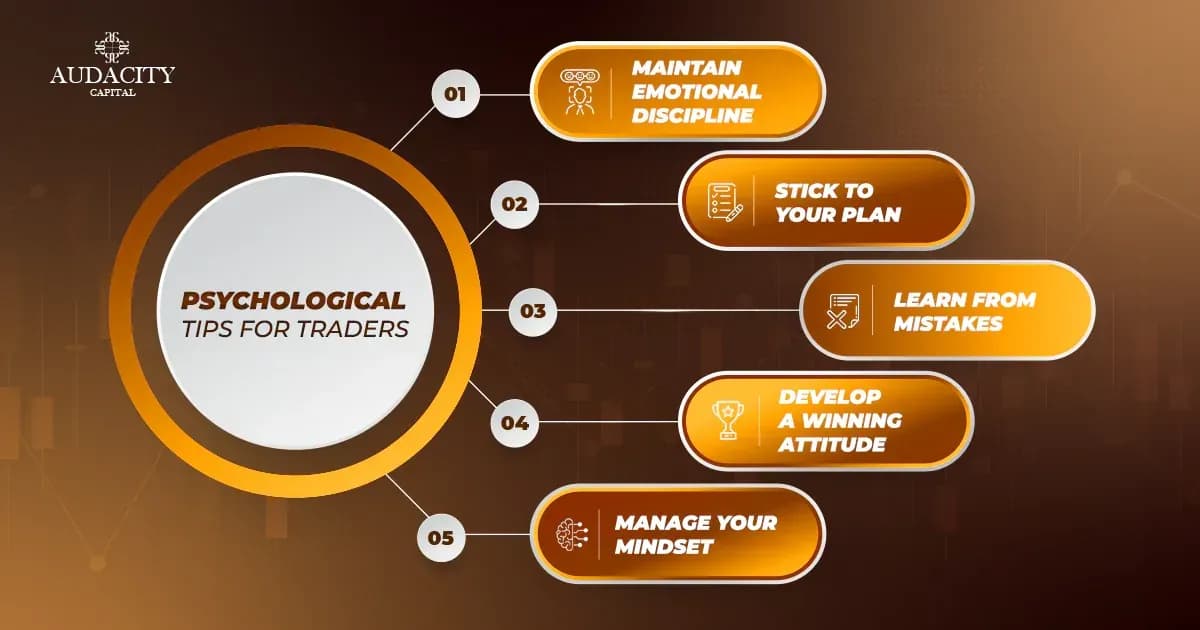
Getting a basic understanding of the most common psychological barriers in trading is the first step to learning how you can overcome them.
Overconfidence: The Silent Account Killer
Overconfidence in trading is a bias that can cause you to overestimate your knowledge, skills, and abilities. It can also cause you to dismiss or ignore important signals, feedback, or information. To overcome this challenge, you need to monitor your performance and evaluate your trading decisions based on factual and objective data. Be sure to track your win rate, drawdowns, risk-reward ratio and returns over time. Try to keep a trading journey and use it to review your wins and losses. This will help in maintaining discipline and humility. While at it, make it a point to continuously educate yourself on what’s happening in the money markets.
How To Avoid Revenge Trading After A Loss
Revenge trading involves trying to recoup your losses by making hurried, emotional trades. You can avoid this practice by:
- Taking a Break: If you experience a devastating loss, take a break from the trading session and use this time to clear your mind. Taking a break will enable you to regain emotional control and gain a better perspective.
- Implement the Two Strikes Rule: The 2-strikes rule can help prevent you from risking too much as well as overtrading. It’s a rule that allows you to set a limit on the number of losses you can take in a day or in a row before you walk away from a trading session.
- Develop More Awareness: Make sure you’re aware of your thoughts, emotions, and behaviors while trading currencies. Notice when you’re ego-driven, frustrated, or angry and how these emotions affect your decision-making processes.
Loss Aversion And The Fear Of Letting Go
Loss aversion and the fear of letting go refer to a cognitive bias that refers to the tendency of traders to experience psychological distress and negative emotions when they suffer a loss. In the world of trading, loss aversion is the tendency to focus on avoiding losses as opposed to making equivalent gains.
Fortunately, there are a few strategies that you can employ to help you mitigate its cost. Examples of these include:
- Creating a well-defined exit strategy
- Using stop-loss orders
- Automating your trading
Creating A Mental Checklist For Every Trade
Currency trading is a complex undertaking that requires a thorough understanding of market conditions, financial instruments, risk management, patterns, and charts. For you to become a profitable trader, you’ll need to have more than technical know-how; you’ll need to create a trader mindset checklist.
Pre-trade Mental Check: Are You Ready?
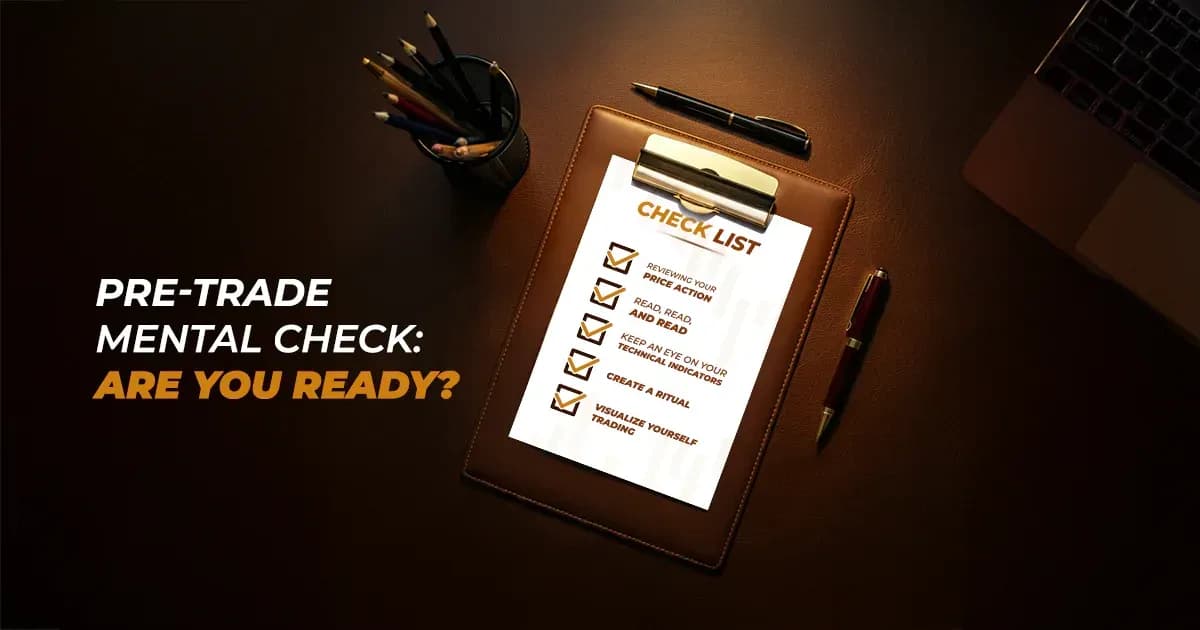
Pre-trade preparation is the surest way to avoid mistakes when trading forex. While great traders and investors will tell you that mistakes play an important role in creating a successful trader out of you, the goal should be to minimize them. Failure to do that will cause your account to explode, leading to a loss of capital.
Some of the habits that can assist in improving your pre-trading routine include:
- Reviewing your price action
- Read, read, and read
- Keep an eye on your technical indicators
- Create a ritual
- Visualize yourself trading
Managing Your Stress Levels Pre- And Post-trade
Encourage better stress management pre- and post-trading by understanding how you can handle elevated stress levels. Self-awareness and ongoing reflection are recommended ways to gain control over any worries or stress that you may have as a trader. By paying more attention to your mind and body, you’ll know when to take a break and what you need to do.
To reach your full trading potential and achieve optimal wellness, you’ll need to
- Learn your stressors
- Know what you need to do and the things that work for you
- Know when to stop
- Understand your boundaries
Make sure to follow these four steps to help you in your journey to overcoming trading anxiety.
How To Stay Grounded During Market Volatility
Mental resilience for traders is often defined by how well a trader recovers when the market is experiencing volatility. Typically, volatility can be caused by various factors such as natural disasters, geopolitical conflicts, inflation, and economic uncertainty. When it occurs, it may lead to sudden decreases or increases in value.
During such times, your focus should be on things that you can control, e.g.,
- Maintaining a long-term perspective
- Adjusting spending and saving
- Remaining flexible and ready for possible market movements
- Creating a cash contingency
- Reassessing asset allocation to reduce risk
Quick Recap
Mastering the psychology of trading requires that you:
- Maintain emotional discipline
- Stick to your trading plan
- Learn from your mistakes
- Develop a winning attitude
- Learn to overcome your greed
- Keep a trading log
- Manage your mindset
Conclusion & Final Thoughts
Understanding trading psychology is crucial to attaining consistent trading success. By learning and managing emotional biases, building a winning mindset, and implementing the tips in this guide, you can begin to navigate the challenges of the trading world with discipline and confidence. Remember, profitability in this world is not just about being able to predict market movements; it also requires you to master your own psychology.

Pronto ad applicare un rischio disciplinato alle criptovalute? Esplora i nuovi strumenti crypto di Audacity Capital e porta la tua strategia di trading.
Scopri di PiùNewsletter
Iscriviti alla newsletter per restare aggiornato.
Unisciti Alla Nostra Community Social

Inizia Il Tuo Viaggio Oggi Con La Nostra Prova Gratuita
Mostra con orgoglio le tue abilità e i tuoi risultati attraverso certificati e ottieni riconoscimenti per il tuo duro lavoro e dedizione da potenziali investitori e colleghi.
Prova Gratuita