


What Is Scalping Trading? A Beginner's Guide



A trader brought an asset, held it for weeks or months while waiting for a major trend to play out. Then entered a few other traders who exited a position in just a few minutes or even seconds with the aim to pocket tiny price movements before the market shifts. This quick, rapid-fire approach is known as Scalping Trading, where rather than waiting for a major market move, scalpers take advantage of small price changes by entering and exiting trades quickly. Here's a lot more to learn.
What is Scalping Trading?
Scalping trading is an ultra-short-term trading strategy that aims for small profits from frequent trades. This involves a scalper holding a position briefly, often ranging from a few seconds to several minutes.
The core idea is simple:
Don't capture a large price movement -> look for small opportunities in the market -> ultimately, attempt to profit from them repeatedly.
A typical scalping approach involves:
- Short holding periods: Positions closes quickly instead of being held for hours, days, or weeks.
- Small profit targets: Scalpers try to capture relatively small price movements on each trade.
- High trade frequency: A scalper may enter and exit multiple positions during a single trading session.
- Quick decision-making: Market conditions can change rapidly, so trades often require timely entries and exits.
- Strict risk management: Controlling losses on individual positions is an important part of the strategy as multiple trades are placed.
The goal of scalping in trading is that scalpers focus on capturing small, short-term price movements and repeat this process throughout the trading session.
Since it is a quick and frequent trading activity, scalping requires a disciplined approach. Traders must manage entries, exits, position sizes, and risk carefully and not focus on a single large winning trade.
The mechanics of Scalping in Trading are easier to understand with a simple example. Consider an equity quoted at:
- Bid: $100.00
- Offer: $100.01
A trader reviewing Level 2 market depth notices a temporary buildup of buy orders, suggesting short-term buying support.
Further, the scalping trade follows a simple sequence:
Buy 2,000 shares at $100.01
↓
Buying activity increases
↓
Quote moves to $100.08 bid / $100.09 offer
↓
Sell 2,000 shares at $100.08
↓
Gross profit: $0.07 × 2,000 = $140
It took roughly 12 seconds for this entire scalping trade.
The purpose of this example is simple: enter when a short-term opportunity appears, capture a small price movement, and exit quickly. A successful scalper will repeat this process across multiple trades during a single session.
How Does Scalping Trading Work?
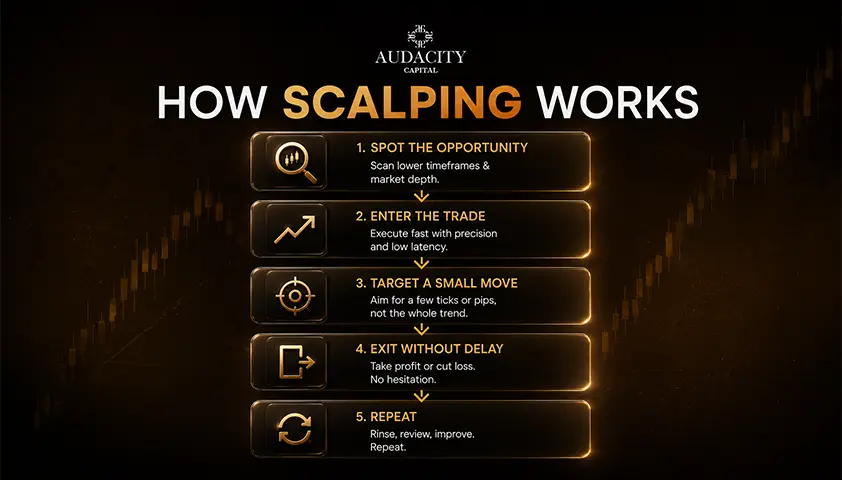
To execute scalping in trading, it is important to have a systematic process that converts technical triggers into fast market execution. The mechanics of trading scalping depends on low latency, precise entries, and clear exit criteria, as the position duration is measured in seconds or minutes.
- Spot the Opportunity → The trader watches short-term charts and market data for a potential setup, such as an EMA pullback, VWAP bounce, or temporary order book imbalance.
- Enter the Trade → When the setup meets the trader’s criteria, they enter quickly using a trading platform with fast order execution and, where appropriate, hotkeys or DMA.
- Target a Small Price Move → Rather than waiting for a major market move, the trader aims to capture a small gain of a few ticks or pips.
- Exit Without Delay → Once the target is reached, or the setup no longer looks favorable, the position is closed according to the trader’s predefined exit rules.
- Repeat → The process can be repeated several times during active trading hours, with the trader managing each scalping trade within strict risk limits.
Key Characteristics of Scalping Trading
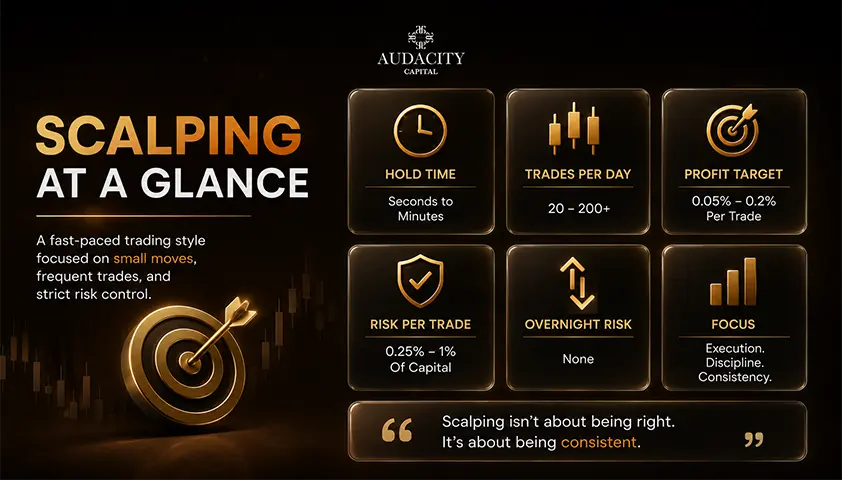
So, what is a scalper trader really like in practice? It's not just another trader who holds positions for a short time. Scalping also means frequent decision-making, precise entries and exits, controlled risk, and the ability to respond quickly as market conditions change.
When looking at What Is Scalping in Trading, here are a few of many characteristics that stands out:
Very Short Holding Periods → Scalpers keep positions open for only seconds or minutes. This limited exposure reduces the risk of being caught in a sudden market reversal or unexpected news event.
Frequent Trading → A scalper may execute numerous orders throughout the session. Depending on the strategy and market conditions, active traders can make dozens of trades in a single day.
Small Profit Targets → Scalpers don't sit back for a major price movement, but they capture relatively small gains from short-term fluctuations. The strategy depends on repeating these opportunities rather than relying on a single large winning trade.
Tight Risk Management → Small profit targets also mean that losses need to be carefully controlled. A large loss on one trade can offset the gains from several successful trades, making predefined stop-loss levels and position sizing particularly important.
Speed-Focused Execution → Fast execution can be an important part of active scalping. In professional setups it may include direct market access, low-latency connections, and trading hotkeys so that orders are placed and managed quickly.
Preference for Liquid Markets → Scalpers prefer instruments with high trading volume, tight bid-ask spreads, and sufficient market depth. These conditions can make it easier to enter and exit positions without excessive execution costs.
Scalping vs Other Trading Styles
When considering what does scalping mean in trading alongside day trading, swing trading, and position trading, the main distinctions relate to holding periods, trade frequency, profit targets, and the intensity of execution. Unlike strategies that depend on capturing broader market trends, Scalping in Trading prioritizes brief periods of market exposure and rapid responses to short-term price movements.
Feature | Scalping | Day Trading | Swing Trading | Position Trading |
Holding Duration | Seconds to Minutes | Minutes to Hours | Days to Weeks | Weeks to Months |
Trades Per Session | High (20–200+) | Moderate (1–5) | Low (1–3 per week) | Very Low (1–2 per month) |
Target Profit Per Trade | Micro (0.05%–0.2%) | Moderate (1%–3%) | Large (5%–15%) | Largest (20%+) |
Typical Risk-to-Reward | 1:1 to 1:1.5 | 1:2 to 1:3 | 1:2 to 1:5 | 1:3 or higher |
Time Commitment | Full focus during active session | High intraday focus | Moderate (1–2 hours daily) | Low (Periodic monitoring) |
Overnight Risk Exposure | None (Zero overnight holding) | None (Positions closed daily) | Substantial (Gapping risk) | Maximum (Macroeconomic risk) |
Primary Execution Tools | Level 2, Tick/1m charts, DMA hotkeys | 5m–1h charts, intraday trends | Daily charts, structural levels | Weekly charts, macro fundamentals |
This structural comparison also highlights the key risk-reward trade-offs across different trading styles. While swing and position traders may seek favorable risk-to-reward ratios, such as 1:3 or higher, to compensate for lower win rates and overnight exposure, Scalping Trading typically operates with lower ratios, often around 1:1 to 1.5:1. Scalpers seek to offset these tighter profit margins through higher win rates, frequent scalping trades, and execution in high-volume, liquid markets, while avoiding overnight exposure.
Which Markets Are Best for Scalping?
Not every market is equally beneficial to scalping. If a trader wants advantage of small price movement they need an asset that can be entered and exited quickly, without trading costs or price gaps eating into the potential profit. And this is the reason why what is a scalper trader looking for often comes down to two key factors: Strong liquidity and tight bid-ask spreads.
Here are some considerably suitable markets for traders interested in trading scalping:
- Foreign Exchange (Forex): Major currency pairs such as EUR/USD, GBP/USD, and USD/JPY offer deep liquidity. They can have bid-ask spreads as low as 0.0 to 0.8 pips, supporting frequent short-term trades.
- Stock Market Indices: Index futures and highly liquid index ETFs, including the S&P 500 E-mini, Nasdaq 100, and Nifty 50, offer high trading volume and frequent price movements during core market hours.
- Precious Metals (Gold): Spot Gold (XAU/USD) mixes strong liquidity with short-term volatility. This creates opportunities for lower-timeframe traders, particularly during overlapping global market sessions.
- Large-Cap Equities: High-volume blue-chip stocks that trade tens of millions of shares per day can provide the market depth needed for efficient scalping trades.
- Cryptocurrency Markets: Major digital assets such as Bitcoin and Ethereum trade around the clock and can offer frequent price movements. However, traders need to account for exchange commissions and other trading costs.
Finally, market liquidity and the bid-ask spread can have a direct impact on scalping performance. High liquidity allows orders to be executed efficiently without significantly moving the market, while tight spreads reduce the transaction costs that can quickly eat into the small profit targets of a scalper.
Common Timeframes Used by Scalpers
Scalpers use lower-timeframe charts to track order flow and price action in real time:
- Tick and Volume Charts: Generate new price bars based on transaction volume or tick counts rather than elapsed time, offering an unfiltered view of market activity.
- 1-Minute Chart: The standard primary timeframe used by manual scalpers to identify short-term setups, breakout levels, and immediate momentum shifts.
- 3-Minute and 5-Minute Charts: Used to confirm micro-trend direction and locate entry triggers during intraday pullbacks.
If you are a trader taking a scalping trade on a 1-minute chart, also check the 15-minute or 1-hour chart. Slightly longer timeframes will give you a better view of the overall trend. Remember, if the short-term setup aligns with the larger market direction, the trade may have a better chance of working.
Common Indicators Used by Scalpers
For short-term trading, technical indicators can make it easier to spot potential opportunities. Scalpers generally keep their charts simple, using a few responsive indicators to confirm entries and filter out unnecessary market noise.
- Exponential Moving Averages (EMAs): Short-period EMAs (such as the 5, 9, 20, and 21 EMAs) track short-term momentum and act as dynamic support and resistance levels.
- Volume Weighted Average Price (VWAP): A key institutional benchmark that helps confirm intraday value and identify mean-reversion pullbacks.
- Relative Strength Index (RSI): Identifies short-term overbought or oversold conditions on lower timeframes.
- Moving Average Convergence Divergence (MACD): Confirms momentum shifts and signal line crossovers during trend accelerations.
- Bollinger Bands: Measures lower-timeframe volatility spikes and mean-reversion extremes relative to standard deviation bands.
- Volume and Level 2 Market Depth: Analyzes real-time order stacks and time & sales data to track institutional buying and selling pressure.
Technical analysis for trading scalping relies heavily on these tools to validate lower-timeframe setups. Confirming an entry for a scalping trade via VWAP or short-term EMA pullbacks helps ensure entries align with active market momentum.
(For detailed indicator parameters, customized settings, and strategy configurations, refer to our dedicated technical indicator guides.)
Advantages of Scalping Trading
- Frequent Trade Setups: Rapid price oscillations occur throughout active sessions, generating regular entry setups regardless of overall market direction.
- No Overnight Risk Exposure: Closing all open positions before the session close protects capital from overnight gaps, geopolitical headlines, and unexpected earnings reports.
- Accelerated Quantitative Feedback: Completing multiple execution cycles daily allows scalpers to accumulate performance data and refine strategies faster than longer-term traders.
- Effective in Range-Bound Markets: Scalping strategies can generate steady returns during sideways consolidation periods where trend-following strategies stagnate.
- Compounding Micro-Gains: Defining what is a scalping trade in practice involves capturing minor tick moves consistently, allowing disciplined execution to build steady account equity over time.
Consider an index is moving within a narrow 10-point range for three hours. While trend-following traders wait for direction, a scalper buys near support and sells near resistance, repeating these short trades to capture small gains while keeping stop-losses tight.
Disadvantages of Scalping Trading
- High Psychological Strain: Managing tick-by-tick price changes and executing rapid orders requires intense concentration that can lead to mental fatigue.
- Transaction Fee Friction: High execution frequency leads to cumulative brokerage commissions, regulatory fees, and bid-ask spread costs that reduce net returns.
- Execution Slippage: Rapid market movements during news releases can lead to order fills at worse prices than expected, expanding average loss sizes.
- Asymmetric Risk Risks: Letting a single losing scalping trade run past predefined stops can quickly erase the accumulated gains of multiple successful trades.
- Infrastructure Dependence: Success requires stable direct market access, low-latency internet connections, and professional charting platforms, creating capital and tech requirements for retail traders.
A key part of understanding what does scalping mean in trading is recognizing the impact of costs and discipline. Suppose 30 trades produce $300 in gross gains. After $90 in commissions and two $110 losses from hesitation, the trader ends the session in the red, despite winning 85% of the time.
Skills Every Scalper Needs
Developing consistent performance in Scalping Trading requires a specialized set of psychological, technical, and operational skills:
- Uncompromising Execution Discipline: Cutting losing positions immediately at predefined technical stop levels without hesitation or emotional bias.
- Dynamic Patience: Waiting patiently for valid strategy setups to form, avoiding low-quality trades driven by boredom or overactivity.
- Rapid Information Processing: Evaluating Level 2 order books, tick flow, and lower-timeframe charts quickly to make sub-second entry and exit decisions.
- Strict Risk Control: Sizing positions consistently so that capital risk per trade remains capped at a small percentage of total account equity.
- Emotional Composure: Maintaining operational focus and following strategy rules after taking back-to-back losses, avoiding impulsive revenge trading.
- Market Microstructure Literacy: Understanding how order routing, depth queues, bid-ask spreads, and liquidity pools affect order fill quality.
So, what is a scalper trader in terms of mindset? A scalper stays focused and disciplined, adapting quickly to changing market conditions while sticking closely to predefined risk and trading rules.
Is Scalping Trading Suitable for Beginners?
The answer to this can’t be a direct Yes or No. Whether scalping will suit you as a beginner can only come down once you weight both its advantages and disadvantages. The section directly below will help you:
Advantages for Beginners
- Fast Execution Experience: Completing a high volume of trades helps beginners master platform navigation, order entry types, and hotkey execution.
- Immediate Feedback: Trades resolve quickly, giving new traders immediate insight into entry timing and exit discipline.
Key Challenges
- High Operational Pressure: Fast price movement can trigger emotional mistakes, leading novice traders to chase extended moves or hold losing positions.
- Execution Disadvantages: Retail beginners using basic trading software often face execution delays and slippage compared to institutional order flow.
- Overtrading Risk: High order activity can lead to compulsive trading, where transaction fees gradually erode account equity.
If you are new to what is scalping in trading, it is important to learn the strategy before putting real money at risk. A demo account provides a safe way to practice what is a scalping trade, improve execution, and become comfortable with fast market decisions.
Common Scalping Mistakes
- Overtrading Outside Peak Hours: Executing orders during low-volume sessions when wide bid-ask spreads and slow order flow reduce entry setups.
- Chasing Extended Price Spikes: Entering positions after a rapid price move has already occurred, buying directly into short-term momentum exhaustion.
- Ignoring Bid-Ask Spread Costs: Trading illiquid instruments where spread costs consume most of the gross profit margin.
- Trading Thin Liquidity Books: Entering positions in illiquid equities or currency pairs, leading to unexpected slippage on exit orders.
- Operating Without a Defined Plan: Placing orders based on gut feel rather than pre-defined technical rules and order book setups.
- Moving Stop-Loss Orders: Holding onto a failed scalping trade and turning it into an unmanaged day trade in the hope of breaking even.
A major oversight when learning what is scalping in trading is underestimating how transaction fees compound across high trade counts. Forcing inappropriate scalping trades during periods of low volume hands an advantage to market makers through wider spreads and reduced fill quality.
How to Get Started with Scalping Trading
If you want to start with “what is scalping in trading” it successfully demands a structured approach to strategy development, platform infrastructure, and risk control.
- Master Market Mechanics: Learn how bid-ask spreads, Level 2 market depth queues, tick charts, and order flow dynamics function in real time.
- Select Liquid Target Instruments: Focus on major Forex pairs, index futures, or high-cap equities with low spread costs and deep order volume.
- Build Execution Infrastructure: Select a direct market access (DMA) brokerage platform equipped with direct order routing, sub-50ms execution speeds, and custom hotkeys.
- Practice on a Demo Account: Test platform hotkeys, order execution speeds, and technical setups in a risk-free simulated environment.
- Establish Strict Risk Limits: Set fixed position sizing rules and enforce a firm daily loss limit (such as stopping after three consecutive losing trades).
- Maintain a Detailed Journal: Log order execution speeds, fill quality, spread costs, and technical performance to continuously evaluate performance metrics.
Building an environment for trading scalping requires combining disciplined execution rules with low-latency terminal tools. (For a complete step-by-step tutorial on configuring hotkeys, setting platform order entry rules, and managing real-time trade setups, refer to our comprehensive guide: How to Do Scalping Trading.)
Conclusion
So, what is scalping trading? It is a short-term strategy focused on capturing small price movements through quick, frequent trades rather than waiting for major market moves.
Successful scalping depends on:
- Strict risk management
- Fast, disciplined execution
- Controlled trading costs
- Clear entry and exit rules
Ultimately, what does scalping mean in trading? It means finding repeatable short-term opportunities and acting on them with discipline. More scalping trades do not automatically mean more profits; consistency and risk control matter most.
For traders who can follow a clear plan, Scalping in Trading can provide frequent intraday opportunities without overnight exposure.
Related Blogs
10 Scalping Trading Strategies That Actually Work
Frequently Asked Questions
The minimum capital requirements vary by asset class and local financial regulations. Like, U.S. equity day trading regulations require pattern day traders to maintain a minimum account balance of $25,000. But Forex, micro-index futures, and cryptocurrency markets let traders start scalping with lower initial capital allocations.
Yes, algorithmic and automated systems are widely utilized in modern Scalping Trading setups. Automated algorithms monitor real-time tick feeds, identify technical entries, and execute orders within milliseconds, eliminating human execution delay and emotional bias.
Because scalping strategies often target smaller risk-to-reward ratios (typically between 1:1 and 1.5:1), achieving long-term profitability usually requires a win rate between 60% and 70%.
The optimal times for scalping occur during periods of high liquidity and price volatility, particularly when major global financial exchanges open or overlap. For equities and index futures, the first hour of cash market trading (such as 9:30 AM to 10:30 AM EST) offers peak intraday order volume and price movement. In Forex markets, the overlap between the London and New York trading sessions provides high liquidity and minimal bid-ask spread friction.
Scalping trading removes overnight holding risk and protects capital from price gaps and news events that occur while markets are closed. But it also introduces significant intraday execution risks, including slippage, high fee drag, rapid mental fatigue, and asymmetric losses if stop levels are ignored.

Готовы применить дисциплинированный риск к криптовалютам? Изучите новые криптоинструменты Audacity Capital и примените свою торговую стратегию.
Узнать большеРассылка
Подпишитесь на нашу рассылку.
Присоединяйтесь к нашему сообществу

Начните свое путешествие сегодня с нашей бесплатной пробной версией
С гордостью демонстрируйте свои навыки и достижения с помощью сертификатов и получайте признание за свой тяжелый труд и преданность делу от потенциальных инвесторов и коллег.
Бесплатная пробная версия