


Are Funded Accounts Legit? An Honest, Balanced Answer



Yes, funded accounts are legit as a model. Real firms run them, you trade the firm's capital (usually simulated), and you are not personally liable for trading losses beyond the fee you paid.
But, the reality is more complex than "yes". The industry is truly diverse. There are some that are established and are reliable and there are some who are scammers and legit doesn't mean easy or guaranteed.
If the offers sound too good to be true or if you've heard about companies going out of business or even denying payments, your suspicion is fair. This guide will provide you with a fair judgment and a clear method to distinguish between a genuine firm and a ripoff.
The honest answer: are funded accounts legit?
The funded-account model comes from proprietary trading, where a firm (often called a prop firm) provides its own capital for traders to trade in exchange for a share of the profits. The practice of institutional prop trading dates back many years.
Retail companies simply brought it within reach of regular traders for a small fee.
Thus, when people ask are funded accounts legit, this type of system is a legitimate business model and not some sort of scam created to cheat people.
A legal proprietary trading company operates a well-organized system. You take an evaluation; it is a test to help prove your ability and discipline to the firm before they give you capital.
There are tight risk and drawdown limits; drawdown refers to the maximum loss which a trading account can take, without getting breached. And there is a profit split, which is the agreed percentage of profits that you get versus the company.
The seemingly favorable conditions of “trade large capital, keep most of the profit” are balanced by these safety measures that allow the firm to survive.
Now comes the disclaimer. All companies are not alike.
Quality, transparency, and reliability can differ tremendously, and there are misconceptions about the model.
The best test to apply is the following: the difference between a legitimate operation and a scam is not whether the account is simulated. It is if the trading conditions are fair, and if profits are made.
Why funded accounts feel too good to be true
Let us be clear about the skepticism.
The selling point is this: “Trade $100,000 in capital, keep 80 to 90% of the profits, and risk just a small fee.”
To a careful reader, that may sound exactly as a scam, and critics are right to question how any company can afford to give away that much money.
In the majority of instances, you don’t trade an actual six-figure capital. You trade a simulated trading capital that reflects all market conditions exactly.
The firm's revenue comes mainly from evaluation and challenge fees, which is profitable exactly because the vast majority of the traders don’t pass the evaluation. On top of that, the firm takes a cut of the traders who do succeed and withdraw profits.
So this is not about getting free money out of thin air. It is an organised enterprise model that has a definite revenue logic.
Your financial risk in actual terms is the fee that you have to pay, not the large simulated capital that appears on the screen. And this is what makes the whole thing work.
In this article, the point of legitimacy is sufficient: there is a real business behind the offer.
Are funded accounts legal? The regulatory reality
This is where honesty is crucial, so here we should be precise.
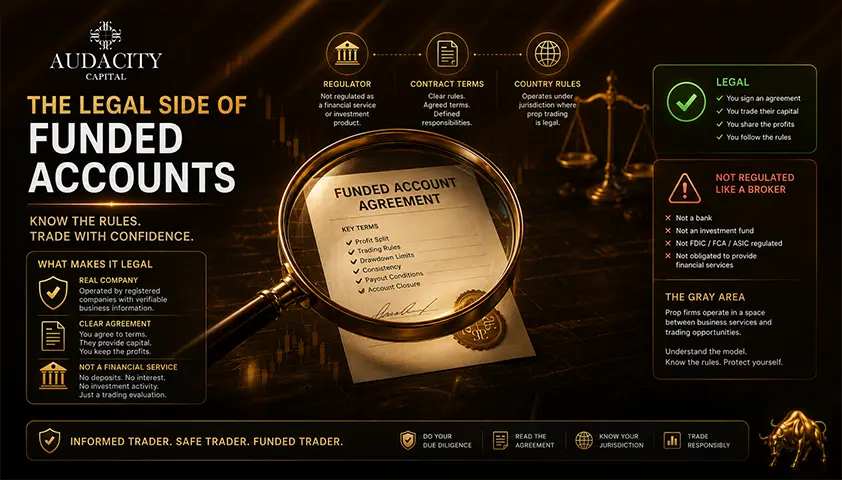
Are prop firms legal? Yes. Prop trading is legal, legitimate prop firms work based on contracts, and they are governed by contract law as opposed to trading regulation.
The simulated-account model is legal if it is transparent. Therefore, the issue of legality of the prop trading is quite simple – it is a legitimate activity.
Now, the key point.
The majority of retail prop firms are not regulated as financial institutions. They are not the middlemen, nor do they keep clients' money in the conventional way, and they are not regulated by authorities like CFTC, FCA, or ASIC.
This is a regulatory gray area. Working in that gray area doesn't necessarily mean the firm is a scam, but there's one big drawback: there is no regulatory framework at all.
No one can guarantee your fee and no one can guarantee that your payout would be processed. If the company is not paying, you have no regulator to call.
A few companies are more tightly regulated, usually those with a "real" account or a regulated broker behind them. In those cases, the unregulated label is less relevant, and that backing is a meaningful positive signal.
The landscape is changing, too. As we enter 2026, regulators in the US, EU, UK and Australia are pushing retail prop firms further towards the regulatory ring.
The "it is just simulated" excuse is losing its appeal and many within the industry are expecting to see some type of licensing system in place within a year or two. This is a fast-changing area, so each regulatory claim is a statement that needs to be checked at the time of reading.
What separates a legitimate firm from a scam
If you're still wondering whether funded accounts are real and reliable, then just look at a checklist. These are the good signs of a good firm, in order of priority.
Marker | Why it matters |
Proven, consistent payout history | The single most important test. A firm that reliably pays withdrawn traders is the hardest thing for a scam to fake. Look for documented payout proof. |
Transparent rules published upfront | No hidden terms, no fine print that lets the firm change conditions after you pass. |
Real-world experience and industry expertise. | Firms that survived the 2024 to 2025 shakeout have demonstrated staying power. |
Clear withdrawal terms | Defined thresholds and timelines, not vague promises. |
Responsive, multi-channel support | Real people responding to real queries via more than one contact channel. |
Realistic marketing | No money-back guarantees and no get rich schemes. |
KYC and AML compliance | Identity and anti-money-laundering checks are normal and a sign the firm is real and actually has capital to pay you. |
If a firm has a regulated broker's backing then consider that as another positive sign alongside the above list. That's because the payout history is at the top of the list.
All the other factors back it, but the real money to real traders thing is the one that a scam can't sustain for long.
Red flags: how to spot a prop firm scam
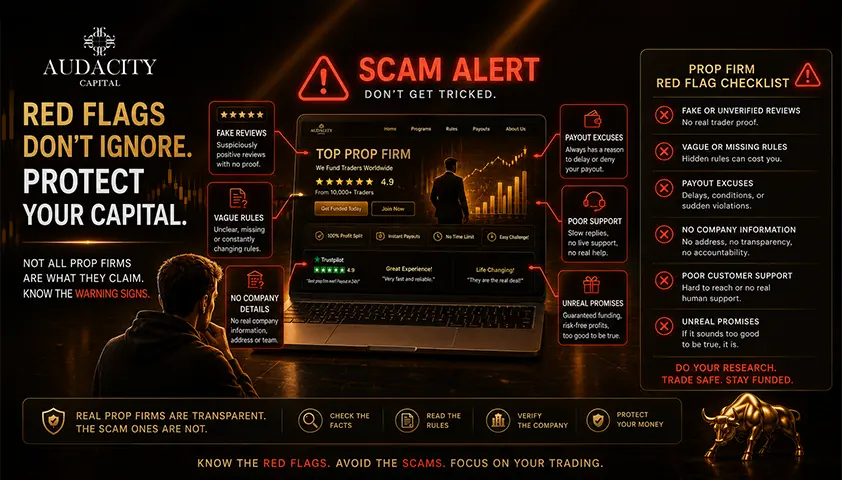
When individuals ask are funded trading accounts a scam, the truthful answer is some are, and you can learn how to identify them.
The following points are patterns, and not meant as accusations against any particular company. Use them as indicators.
Marketing red flags
- Guaranteed-profit or guaranteed-funding promises.
- ‘Easy funding’ or ‘anyone can pass’ messaging.
- A sky high profit split that's aggressively marketed as the main hook.
Rule and contract red flags
- Rules change after you pass the evaluation.
- The typical moving-the-goalposts ploy to prevent payments, fine-print clauses that allow the firm to change the rules on the fly.
- Rules that are very difficult to meet or so lenient that everyone passes. Both of these patterns indicate fee-farming, not real trading.
Money-grab red flags
- Being asked to fund a real trading account to take the challenge. A normal entry fee is okay, but not a live account.
- An extra fee demanded to access your funded account after you pass
- Failure to pay or denial with increasingly changing reasons
- A demand for reimbursement of a "penalty" or "release fee" to unlock your profit. This is always a scam. Never send money to receive money
Identity red flags
- Leadership is anonymous or the company is not registered.
- Stock-photo team pages
- Deceptive reviews and bogus licenses
- Phishing e-mails and fake Web sites that mimic legitimate companies.
- Mandatory paid training upsells as part of the offer.
When it's too good to be true, it likely is. The patterns listed above indicate how predatory operators act and are your first line of defense.
Read more about our guide Red Flags in Prop Trading Firms
The honest reality: legit doesn't mean easy
Here's the "real" part of the marketing myth buster. Even a completely legal company isn't a walk in the park or a revenue machine.
The facts are startling. Fewer than 7% of traders ever hit a payout, and over 85% of traders are never profitable in the long-term.
And even legit businesses make the bulk of their income from evaluation fees, so they make money just because a majority of traders do not.
This isn't a scam. It's the good business sense of the model, and a true company won't lie about it.
So it helps to re-think the concept of what a ‘funded account' is. It's not an edge and not a guarantee, it's capital and structure.
It provides the experienced and disciplined trader access to size they would otherwise lack and rules which promote risk control. It doesn't provide any one with a winning formula or a short-cut.
It is a real chance for those who have true talent and realistic expectations, not a get-rich scheme.
And to close the loop on simulation, simulated doesn't equal fake, and doesn't equal scam, provided conditions are fair and payouts are real, to close the loop on simulation. The issue only arises when a company is evasive or won't pay.
How to protect yourself: doing your due diligence
There is no regulator to hold most prop firms accountable, so it's up to you to do your due diligence. Use the checklist above as a list of actions, rather than a reading activity.
Where Audacity Capital fits
Audacity Capital has been established in London since 2012, so we've been through all of the major industry shakeouts, including the 2024-2025 wave that saw weaker operators close their doors.
We pay out real cash to funded traders, our rules are clear and unchanging, there are no moving goal posts after you pass, and our interest is aligned – the firm does better when its traders do better.
Our sincere message is brief. Judge Audacity by the exact same payout-and-transparency standard you would use on any other firm. Do your own verification.
If you do, you should look for an experienced, well-known operator instead of a flashy, newcomer promising more than they can deliver. We will never tell you that funded trading is easy or risk-free, because it isn't. We will tell you that if you're skilled, disciplined, realistic, then you deserve a firm that will be straight. If you are interested in this, check out our Funded Trader Program and how it operates.
FAQ
Yes. Experienced and disciplined traders do make genuine winnings. But, it is heavily based on skill, risk management and realistic expectations, and most traders do not make a payout. Treat it as a real chance, not a sure bet.
Legitimate companies do, and a consistent payout history is the best indicator of a company's legitimacy. Protect yourself by verifying documented payout proof from independent sources before you buy, rather than trusting marketing alone.
They are not handing out cash. You typically trade simulated capital, and the firm profits from evaluation fees, which most traders fail, plus a share of the winners. In effect, the firm is paying to find and back genuinely skilled traders cheaply.
In most cases you trade a simulated or demo account that mirrors live market conditions, while the payouts you earn are real cash. This is legitimate as long as the firm is transparent about it and actually pays withdrawals.
Most retail prop firms are not regulated as financial institutions, because they are not brokers and do not hold client funds, so there is no regulatory safety net. A minority that offer live accounts or are backed by a regulated broker face more oversight, and broader regulation is widely expected to increase.
KYC and AML checks are standard, and they are actually a positive sign that the firm is real and has the capital to pay. Only share details once you have confirmed the website is genuine, since phishing and fake sites exist, and never wire any penalty or fee to release a payout.
For a skilled, disciplined trader with realistic expectations who treats the fee as risk capital, they can be a legitimate way to access larger capital. They are not a get-rich-quick scheme, and most traders lose their fee, so go in clear-eyed.
A wave of firms closed in 2024 and 2025, including ones that denied payouts, changed rules after traders passed, or had no real capital behind their accounts. Those failures exposed weak and bad-faith operators rather than proving the whole model is a scam, which is exactly why track record matters so much.

Handa nang maglapat ng disiplinadong panganib sa crypto? Galugarin ang mga bagong instrumento ng crypto ng Audacity Capital at dalhin ang iyong diskarte sa pangangalakal.
Matuto PaNewsletter
Sumali sa aming newsletter.
Sumali sa Aming Social Community

Simulan ang Iyong Paglalakbay Ngayon Gamit ang Aming Libreng Pagsubok
Ipagmalaki ang iyong mga kasanayan at tagumpay sa pamamagitan ng mga sertipiko at makakuha ng pagkilala para sa iyong pagsusumikap at dedikasyon mula sa mga potensyal na mamumuhunan at kasamahan.
Libreng PagsubokMga Kaugnay na Artikulo
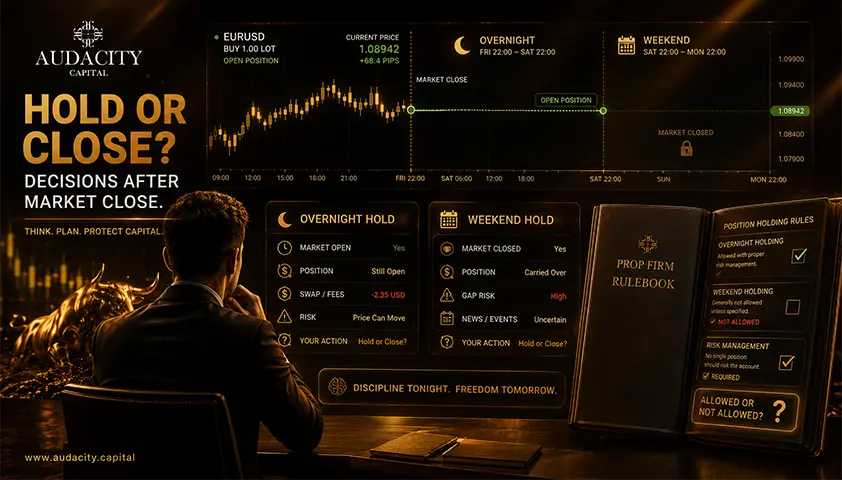
Can You Hold Trades Overnight or Over the Weekend on a Prop Firm?
Can you hold trades overnight or over the weekend on a prop firm? Learn the rules, risks, gap exposure, and which prop firms allow swing trading.

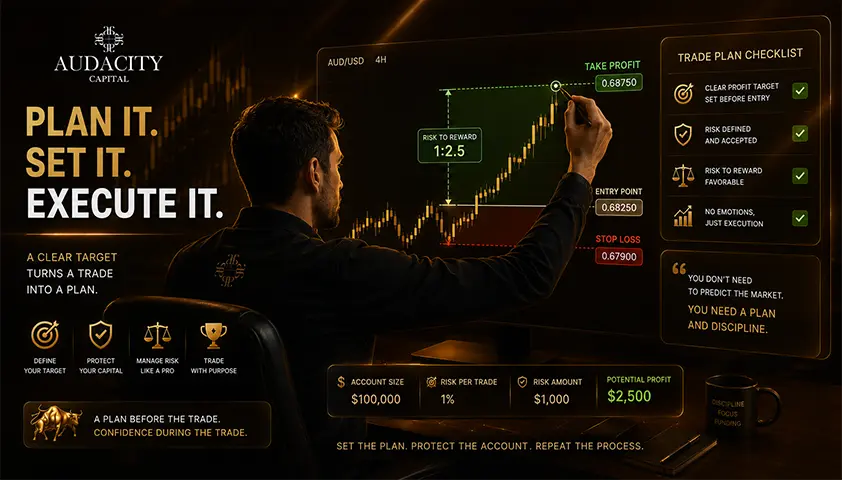
What Is Take Profit in Trading? A Detailed Guide for Traders
Learn what a take profit is, how to set one well using technical levels, risk-reward, and ATR, plus partial profits, trailing stops, and a funded-trader lens.

Do You Pay Taxes on Prop Firm Payouts? A Funded Trader's Guide
In almost every country, prop firm payouts are taxable income, not capital gains. Learn how they are taxed, what you can deduct, and why records matter.

Best Local Payment Methods for Forex Prop Trading
Compare the best local payment methods for forex prop trading by region and learn faster, cheaper prop firm withdrawals with fewer delays.