



Risk Management in Trading: Strategies, Rules and Examples


Introduction
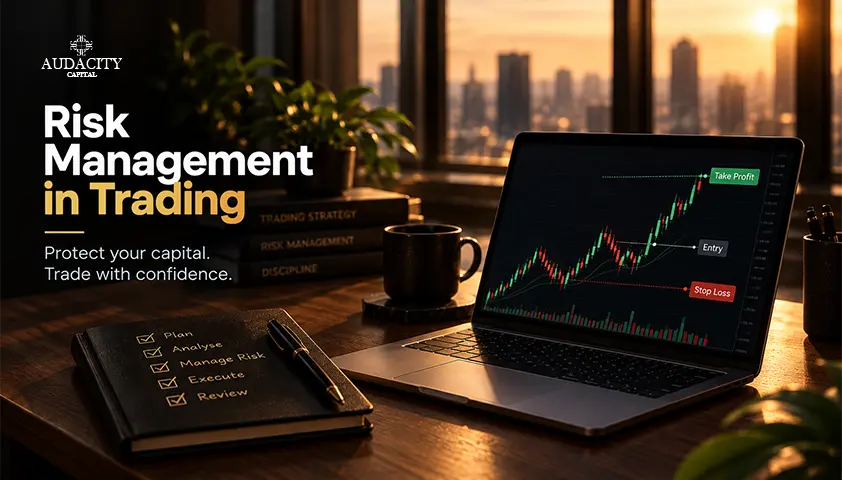
Trading is not only about finding profitable setups. It also entails knowing how to limit and manage losses. A sound trading approach, even when positively tested, may still lead to losses if the trader opens too many positions at once or gets scared and nervous when the market goes against them. The market is unpredictable, and anything can happen. Any strategy can fail, and prices do go against the trader sometimes.
Risk management in trading assists traders to know what portion of the trading account to risk, when to cut losses, and how to avoid overexposure to the market’s unpredictable behavior. Poor risk control and too much leverage will erode a trader’s account. A few losing trades can erase the profit from many winning trades.
Traders, therefore, need to adopt effective risk management practices if they intend to stay consistent in their trading activities. This article allows traders to familiarize themselves with risk management basics that can help them develop a proper mindset towards trading and enable them to make risk management part of their trading DNA. Keep reading to gain more insight.
What Is Risk Management in Trading?
What is risk management in trading? It is a process designed to measure and control the risks associated with the potential losses on positions that a trader has taken. Thus, trading risk management assists traders in determining the amount of capital at risk, methods for reducing losses, and the most reliable ways to protect open positions from adverse swings in the market.
Its main objectives include:
- Preserving trading capital: Keeping losses manageable so traders can continue trading.
- Preparing for unexpected movements: Accounting for volatility, economic announcements, and sudden price changes.
- Limiting individual losses: Setting predefined exit points and acceptable loss limits.
- Maintaining consistency: Following established rules during both winning and losing periods.
- Controlling overall exposure: Managing the combined risk of multiple open positions.
Risk Management vs. Risk Avoidance
Risk management and risk avoidance are two different concepts. Trading in the financial market is never certain, and even the most carefully crafted trade plans may result in substantial losses. Professional traders and investors deal with uncertainty every day and have to decide which risks to take and which to avoid. For instance, a trader may decide to open a position with a stop-loss order and determine the size of the position so that the planned loss is acceptable.
Why Does Risk Management Matter?
Imagine there are two traders with identical strategies. One trader risks a small amount on every trade, while the other takes way too big positions. Even if both traders have comparable winning trades, the second one is at a considerably higher risk of having a streak of losing trades that will devastate his/her account.
Hence, traders should use risk management to stay in control and to be able to make the right decisions. Despite not being able to promise success, risk management can prevent many unfortunate surprises and even help aspiring traders to continue trading without giving up.
Types of Trading Risk Every Trader Should Know
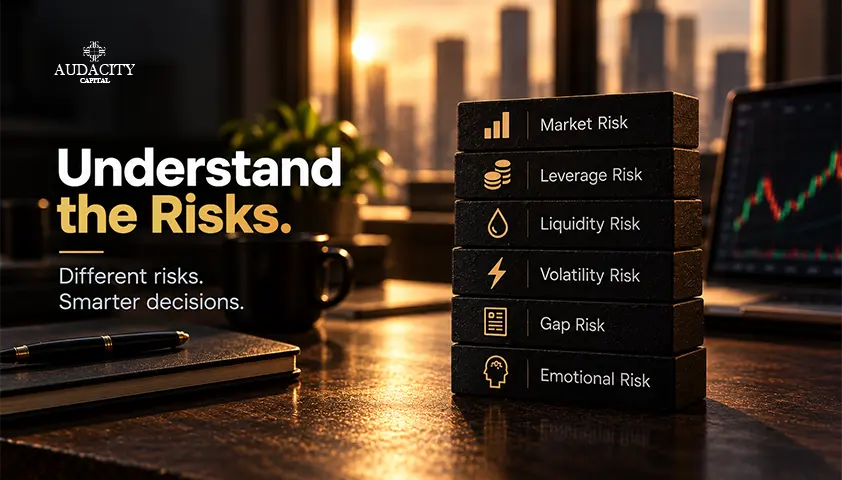
Identifying the different factors that can cause you to lose money is the first step to effective trading risk management. There are many different risks in the financial markets that can affect your trades. Identifying these risks will help you to know how much to size your positions, how much you are willing to lose, and be prepared for any surprises.
Risk Type | Explanation | Example |
Market Risk | Losses caused by unfavorable price movements. | A forex pair begins to drop immediately after making profits. |
Leverage Risk | Leverage magnifies exposure, making losses large relative to the capital committed. | A leveraged forex position moves against the trader. |
Liquidity Risk | Difficulty entering or exiting a position at the expected price. | A thinly traded asset has a wide bid-ask spread. |
Gap Risk | Prices jump between trading periods, potentially bypassing a stop-loss price. | A stock opens below its stop price after overnight news. |
Volatility Risk | Rapid price changes increase uncertainty and may cause slippage. | A cryptocurrency experiences a sudden price swing. |
Emotional Risk | Fear, greed, or frustration leads to poor trading decisions. | A trader increases position size to recover a previous loss. |
These risks can often be combined. For example, if there is an unexpected economic announcement, this can cause large price movements, increased spreads, and slippage. If the trader has used leverage, they could have a bigger loss than expected.
Understanding these can help traders plan ahead. However, there is no one method to completely mitigate all types of risks. Stop-loss orders can help reduce losses but cannot guarantee that they will be filled at the desired price if there is a gap in the market.
The key takeaway is that effective risk management begins with identifying what could go wrong, estimating the potential impact, and deciding how much exposure is acceptable before placing a trade.
Core Risk Management Principles
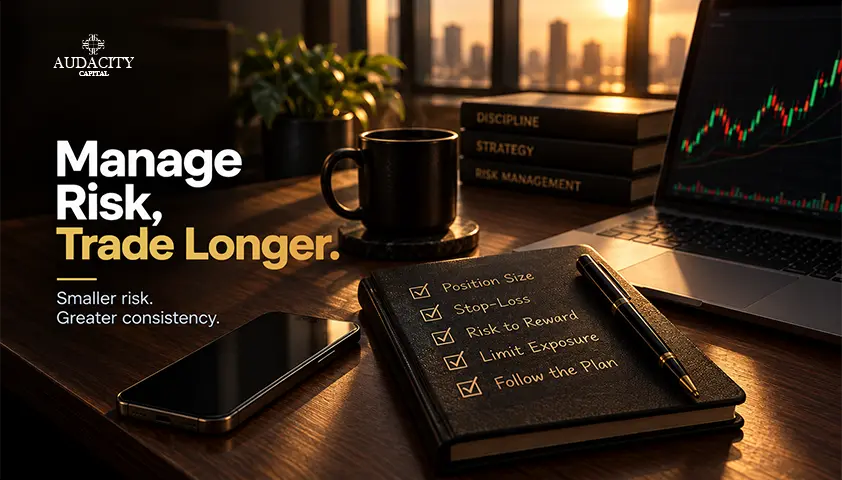
Effective trading risk management relies on measurable rules rather than guesswork. Traders need to know what they are willing to lose, how big their positions should be, and whether their strategy can make profits in the long run. The following are principles that can help traders quantify risk.
Risk-to-Reward Ratio
Risk-to-reward ratio compares how much you stand to lose versus how much you stand to gain. If you place a trade risking $50 to target $100, then this gives you a 1:2 R:R ratio. This means you stand to gain double what you are risking. However, this doesn’t mean that you will win. The market may sometimes not hit your profit target.
Position Sizing
The position size you use mostly depends on your account equity, risk limit, and how far away the stop loss is.
Position Size = Amount at Risk / Risk per Unit
If you are willing to risk $50 and each unit would lose $5 at your stop loss, this would leave you with a position size of 10 units. Calculations can be more complex depending on what you are trading. You may need to take into consideration contract sizes, pips, fees, and currency conversions.
Maximum Drawdown
Maximum drawdown measures the largest decline from a peak in account value to a subsequent low over a specified period. This will help traders understand how much their capital has dropped and how much they need to recover. For example, if the account drops by 20%, then you would have to make 25% on the remaining capital to get back to your starting point.
Win Rate and Expectancy
Win rate is the percentage of winning trades, and expectancy is an estimation of how much you will make/lose on average per trade. Having a high win rate doesn’t automatically mean that your strategy is profitable. This is because frequent small gains can be outweighed by occasional large losses. While looking at your win rate and expectancy, you should also take account of costs incurred from trading.
Risk per Trade and Total Exposure
Risk per trade is the amount that a trader wants to lose on a position that hits their stop-loss. Total exposure is the total risk that a trader holds across all positions, including correlation. These can be used together. Before entering any trades, you should consider how much you are willing to risk, calculate position sizing, and consider drawdowns and total exposure. While none of these will give you the full picture, using them all will help to make your decisions more disciplined.
Practical Strategies on How to Manage Risk in Trading
Understanding how to manage risk in trading helps traders protect their capital and make more disciplined decisions. Although there is no guaranteed way to avoid losses, by having a consistent approach to risk management, you can limit any excess risk and adapt to the changing market conditions.
Set a Risk Limit Before Entering a Trade
Before opening any trades, decide how much you can afford to risk. Some traders risk 1% of their account equity. However, this usually depends on their strategy and financial situation. A 1% risk on a $5,000 account equals $50 per trade.
Use Stop-Loss Orders Appropriately
Stop-loss orders can provide structure to your trading strategy. It simply determines when you want to close a losing position. A stop-loss should be placed using a strategy that takes into consideration the appropriate position sizing. Stop orders do not guarantee that you are filled at that particular price, especially when there is a gap in the market or high volatility.
Calculate Position Size Before Placing an Order
You can calculate how much you want to risk based on the number of pips between your entry and stop. If you increase your stop, you will be risking more for each unit so you need to reduce your position size to keep your risk to the same amount. Calculating position size based on your entry and stop prevents guesswork.
Avoid Excessive Leverage
Leverage enables you to increase your position size with a smaller deposit but also exposes you to greater risk. As such, it is important that you understand how margin works and how much you could lose. Avoid increasing your leverage simply because your broker or trading platform permits you to do so.
Diversify Without Duplicating Risk
Diversifying your portfolio between different assets can help reduce reliance on one market. However, having more than one instrument does not mean that your portfolio is diversified. Assets can move in similar ways when reacting to certain economic news, interest rate changes, and market falls.
Limit Correlated Positions and Total Exposure
Look at your overall risk. For example, if you open a number of forex positions that are all related to USD, you are increasing your exposure to that currency movement. Think about how having multiple losses could affect your account.
Maintain a Trading Journal
Record why you entered or exited a trade, your risk management plan, what happened, and any feelings that influenced the trade. This will help identify any patterns in your mistakes. Some mistakes may include constantly adjusting your stop loss, impulsive entries, or over-risking after a loss.
Establish Daily and Weekly Loss Limits
Define your limits. This means that you won’t go on an emotional trading spree if you have a bad session. Once you hit your limit, don’t try to chase your losses by increasing your position size.
Key Takeaway: Effective risk management begins before a position is opened. Establish clear limits, calculate exposure carefully, and follow your rules consistently rather than changing them in response to short-term market movements.
Risk and Return Trade-Off in Financial Management
The risk and return trade-off in financial management describes the relationship between the potential return of an investment and the uncertainty involved in achieving it. Generally, investments with higher expected returns carry more risk, while investments that are less risky will often have lower expected returns. However, this does not always mean that you will make more profit by taking more risk. Even low-risk investments can reduce in value.
Understanding the Trade-Off in Active Trading
Traders will look at how much they stand to gain from a trade, how much they could lose, the probability of success, and how much risk they are taking on overall. Take the example below:
- Trade A: Risking $50 to potentially earn $75 (Risk-to-Reward Ratio = 1:1.5)
- Trade B: Risking $50 to potentially earn $150 (Risk-to-Reward Ratio = 1:3)
Trade B has a better risk-to-reward ratio. But if the probability of success for Trade B is much less than that of Trade A, then the expected value of Trade A could be better. This highlights the importance of considering the reward one can make and how likely it is they will make it.
How to Apply the Risk-Return Principle
Consider what your financial goals are, how much experience you have, how long you want to invest, and how much risk you can take. Consider if the potential trade will offer enough profit to cover the risk involved, after transaction costs, slippage, and the potential for greater losses.
Good risk management in trading allows traders to take on some risk, but in a way that will fit their plan and financial situation. Trading with discipline means that you are realistic when considering opportunities. Just because there is the potential for more profit does not mean it will be the best decision.
Risk Management in the Trade Life Cycle
Risk management in the trade life cycle is the continuous process of identifying, assessing, and controlling potential losses from the moment a trader opens a position to the moment he/she closes it. Applying risk controls at every stage helps traders make informed decisions rather than reacting emotionally to every fluctuation in the market. These are the steps involved;
Stage 1: Pre-Trade Planning
Before placing any trade, you should look at what is happening in the market. Look for where you could enter, exit, and place your stop loss. Work out the correct size of the position to take depending on your risk. Check your current positions so that you don’t overexpose your account to risk. Constantly checking and reviewing your account allows you to know exactly how much money you are risking.
Stage 2: Order Execution
Execution can also present risks which can affect the true cost of your trade. Bid/Ask spread, liquidity, order types, and slippage should be considered. For example, if there is a large economic announcement, then you may get a worse price when using a market order. Knowing this will help you to understand the differences between your intended entry price and the actual price.
Stage 3: Trade Monitoring
While you are waiting for your trade to play out, you should be watching the price action, how much you have left on, your margin usage, and any market news. You should be sticking to your trading plan and not making any last-minute decisions based on short-term price movements. If circumstances change, you may need to make some changes, but these should be done according to pre-set rules.
Stage 4: Trade Closure and Review
Once you have exited from a position, you should take a look at the results from your trade. This is a good time to take into account any costs involved, as well as any slippage or price difference. You should also consider whether your trading was in line with your strategy and learn from any mistakes you made so you can avoid them in future.
A losing trade does not automatically indicate poor risk management. Even well-planned trades can fail. The key distinction is whether the trader followed a sound process and kept losses within reasonable limits. Conversely, a profitable trade may still reflect poor decisions if the trader ignored risk controls and simply benefited from favorable market movements. Consistent risk management throughout the trade life cycle helps traders evaluate decisions objectively, learn from mistakes, and maintain discipline across changing market conditions.
Risk Management in Prop Firms: What Traders Need to Know
Risk management is very important when it comes to prop trading firms. This is because there are certain rules that must be followed to control losses in trading. Prop firms often have limits set on how much you can lose, and if you exceed this limit, you will not qualify for funding or will lose your funded account.
Key rules traders should understand include:
Daily loss limit: This is the maximum amount of loss you can have in one day. This can include losses not yet realized, commissions, and swaps depending on the firm.
Maximum drawdown: The maximum amount of loss you can have in your account. This can be fixed, trailing, or calculated using balance or equity depending on the program.
Position sizing and leverage: Some programs will have rules around position sizing and leverage.
Consistency rules: Some programs will have rules around how much profit can be made in a trading day. Or other performance requirements.
Trading restrictions: You must also understand the trading restrictions of a firm to avoid surprises. Some programs will limit you from trading news, overnight, weekend, and some strategies.
Before purchasing a challenge, traders should read the firm's current rules and understand how losses are calculated, when limits reset, and what constitutes a breach. A strategy that works within one firm's rules may violate another's.
Common Trading Risk Management Mistakes to Avoid
Even the best trading strategies can be ruined by simple risk management mistakes. Knowing what to avoid will help keep your trading capital safe and encourage you to make more consistent decisions. Some of the risk management mistakes traders make include;
Risking too much on one trade: Putting too big a stake on one trade can cause large losses to your account if the trade goes against you. Limit your risk by pre-defining how much you are willing to risk.
Moving stop-losses farther away: This increases the amount of risk that was originally intended to be taken. You should stick to your exit rules.
Overleveraging: Using too much leverage increases your exposure, which could cause you to lose more and put pressure on your margin. Size your positions based on the risk you are comfortable with.
Ignoring correlated positions: Several trades may be influenced by the same underlying market factor, meaning that you may have more exposure than you think.
Only focusing on risk to reward: Aside from looking at the potential profit you can make, you should also consider your chances of success and past trading performance.
Ignoring fees and slippage: Spreads, commissions, and unfavorable execution prices can reduce actual returns and increase trading costs.
No performance tracking: Without a trading journal or regular performance checks, you may find yourself making repeated errors.
By following predefined rules, accounting for trading costs, and reviewing decisions regularly, traders can identify weaknesses in their approach and improve their ability to manage risk over time.
Conclusion
Risk management in trading is essential for protecting capital and making disciplined decisions. Managing your risk can be done by using proper position sizing, stop losses, leverage, and exposure. This helps you to manage any potential losses. Assessing risk-to-reward ratios, costs of trading, and performance will also help you to make better decisions.
Effective risk management extends throughout the trade life cycle, from planning and execution to monitoring and reviewing results. However, no strategy will completely remove the uncertainty of the market. Therefore, ensure you have rules for managing your risk in writing, backtest your strategy using historical data or paper trading, and analyze your performance to have a better idea of how well your strategy is working. This will not prevent you from losing money but will help keep your losses at a manageable level.
FAQs
It is the process of identifying, measuring, and controlling potential trading losses.
Use stop-loss orders, calculate position sizes, limit leverage, and set clear risk limits.
It is a guideline to risk no more than 1% of your account equity on a single trade.
A 1:2 ratio is a common benchmark, but profitability also depends on win rate and trading costs.
No. It helps control losses but cannot guarantee profits.

Handa nang maglapat ng disiplinadong panganib sa crypto? Galugarin ang mga bagong instrumento ng crypto ng Audacity Capital at dalhin ang iyong diskarte sa pangangalakal.
Matuto PaNewsletter
Sumali sa aming newsletter.
Sumali sa Aming Social Community

Simulan ang Iyong Paglalakbay Ngayon Gamit ang Aming Libreng Pagsubok
Ipagmalaki ang iyong mga kasanayan at tagumpay sa pamamagitan ng mga sertipiko at makakuha ng pagkilala para sa iyong pagsusumikap at dedikasyon mula sa mga potensyal na mamumuhunan at kasamahan.
Libreng PagsubokMga Kaugnay na Artikulo
Risk Return Trade Off in Financial Management: A Complete Guide
A complete guide to the risk return trade off in financial management: types of risk, sources of return, and how to strike the right balance.


What Are The Risks Of Forex Trading For Beginners?
Understand the risks of forex trading for beginners. Learn about the potential pitfalls and challenges involved in the forex market.

Funded Forex Trader : How To Trade During A Recession ?
Funded Forex Trader : how to Trade During a Recession. Start trading with a funded account now!

Struggling To Face Losses In Forex Trading? Here’s How To Bounce Back
Learn how to recover from losses in forex trading with proven strategies, mindset tips, and a step-by-step plan to rebuild confidence and trade consistently.