


Position Sizing in Trading: How to Calculate Your Trade Size



Position sizing in trading is a formula that determines how many shares, lots, or contracts a trader may need for a trade. The exact number comes up after considering how much capital, entry price, and stop loss you, as a trader, want to risk.
Choosing a trade size without working out the possible loss can put more capital at risk than intended. A calculation helps bring that risk into view before an order is placed. In this guide, we will look at how position sizing works, how to calculate trade quantity, and how to apply the method using practical examples in Indian rupees.
What Is Position Sizing in Trading?
Deciding how many units of a security to buy or sell in a particular trade is called position sizing in trading. But the quantity of units is not random, and it relies on:
- The money available.
- The possible loss on each unit.
- The level at which the trader plans to exit if the market moves in the wrong direction.
Let's break down what is position size in trading by separating the four most important yet confused terms:
- Position size is the amount of shares, lots, or contracts held in a trade.
- Position value is the total value of the position at the entry price.
- Risk per trade is the amount a trader plans to lose if the stop-loss executes at the specified price.
- Margin is the funds required to open or maintain a position when margin trading is permitted.
Consider two traders who buy a stock at ₹2,500. Both have ₹10,00,000 in capital and decide to risk ₹10,000 on the trade. The first sets a stop-loss at ₹2,450, giving a planned risk of ₹50 per share. The calculation allows 200 shares. The second sets a stop-loss at ₹2,350, giving a risk of ₹150 per share, so the quantity falls to 66 shares when rounded down.
Both traders have the same planned risk, but their position sizes and total position values are different. The stop-loss distance helps explain why.
Why Is Position Sizing Important?
Individuals often confuse the purpose of position sizing in trading with making every trade successful. But in reality, it is meant to decide what amount of exposure is reasonable before the result is known. Even a well-planned trade can fail, and a series of losses is possible. And if the quantity is massive, these losses can reduce trading capital faster than anticipated.
There are three main ways in which position sizing in trading can help:
- By keeping losses within a planned range, as the quantity is linked to the amount the trader is prepared to risk.
- By making trades easier to compare. Different stocks may need different quantities because their prices and stop-loss distances are not the same.
- Most importantly, by discouraging emotional decisions because a trader has a plan to follow instead of increasing the next trade to recover the loss. After multiple losing trades, emotional decisions may present that a winning trade must be close, a belief that the trading community knows as the gambler's fallacy. The market does not owe a trader a profit after a losing streak, and increasing the position size does not improve the quality of the setup.
SEBI's research also gives Indian traders a reason to take risk seriously. SEBI in FY25–FY26 found that about 87.7% of individual traders in the equity derivatives segment incurred losses. While the research doesn't directly prove that poor position sizing caused every loss, it does underline the need to understand exposure before trading derivatives.
What Determines Your Position Size?
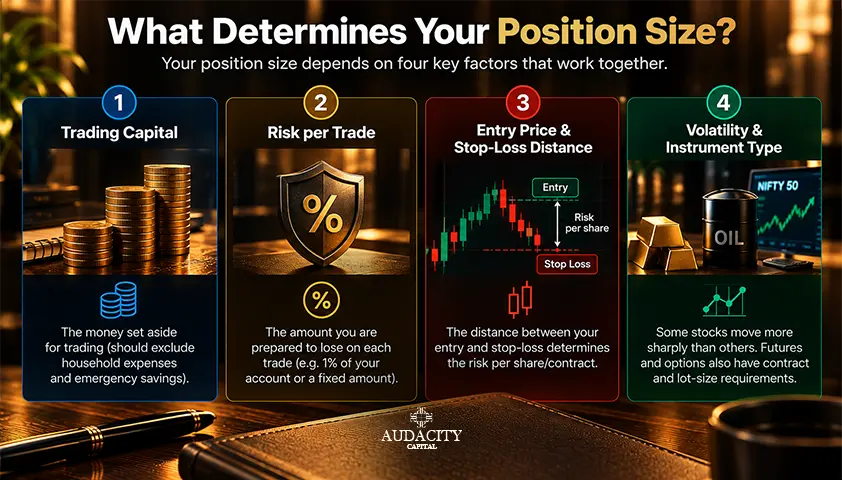
There are a lot of factors that determine the position size, but before coming down to how many shares to buy or sell, you need to consider a few things.
Position sizing in trading depends heavily on:
- The capital set aside for trading.
- The amount that can be risked.
- The entry and stop-loss prices.
- The kind of instrument being traded.
These four factors work together, and therefore changing even one can change the quantity.
Trading capital
The money kept aside for trading activities is called the trading capital. This amount is very crucial and should exclude the share of your household expenses, emergency savings, medical savings, and other financial commitments. After all, any calculation is only useful when it is based on money the trader can genuinely afford to expose to market risk.
Acceptable risk per trade
After capital, a trader also needs to decide the loss they can bear if a trade goes against them.
Traders may decide a percentage of their trading capital, a fixed amount, or whatever suits them. It's not a rule that every trader must follow, but a 1% risk example is often used to explain the calculation.
Entry price and stop-loss distance
Next comes the entry price, where traders plan to open the position. Plus, there's a stop-loss that marks the level at which the trade idea may no longer hold. A wider gap between these prices means more risk per share. To keep the same risk budget, the trader would generally need to take fewer shares.
Volatility and instrument type
Some stocks move more sharply than others, so the stop-loss distance may need to reflect the price movement. Futures and options also have contract and lot-size requirements that must be checked before deciding the final quantity.
How to calculate position size in trading?
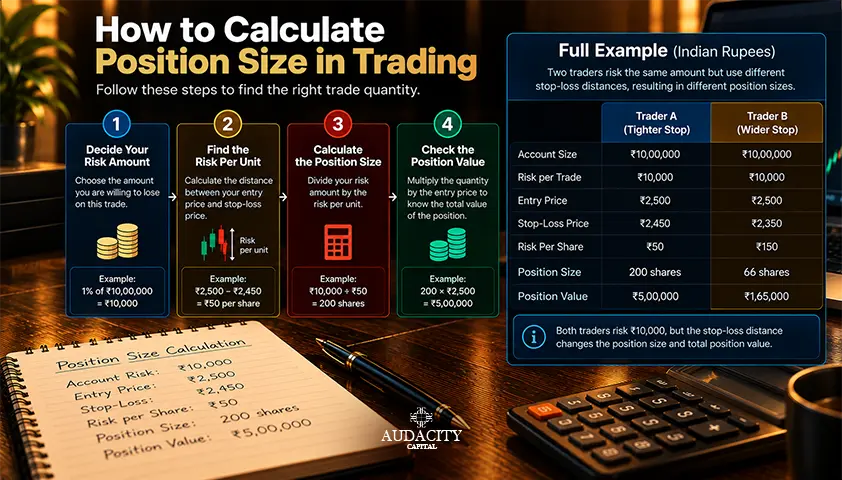
After the trading capital and acceptable risk are clear, working out the number of shares that fit the plan is the next step. For any trader, knowing how to calculate position size in trading is easier when the calculation is broken into a few steps.
The basic formula is: Position Size (Units) = Account Risk Amount ₹/ Risk Per Unit ₹
- For a long stock trade, the risk per share = The entry price - The stop-loss price.
- For a short trade (when the stop is above the entry), the risk per share = The stop-loss - The entry price.
Coming back to "how to calculate position size in trading", follow these steps:
Step 1: Finalise the amount you can risk
If the trading budget is ₹1,00,000 and the illustrative risk budget is 1% for one trade.
₹1,00,000 \times 1% = ₹1,000
The planned risk is therefore ₹1,000.
Note: This is an example to explain the formula, not a recommended percentage for every trader.
Step 2: Find out the entry and stop-loss prices
If a trader plans to buy a stock at ₹500 and places a stop-loss at ₹480, the difference is ₹20 per share.
Step 3: Calculate the quantity
In this step, divide the risk budget by the amount at risk per share.
₹1,000 \20= 50 shares
The calculated position size is 50 shares.
Step 4: Check the position value
As mentioned earlier, the position value is the number of shares multiplied by the entry price.
50*500=₹25,000
The position value is ₹25,000, while the planned loss at the stop price is ₹1,000. These are different figures. While the first is the value of shares purchased, the second is the intended risk if the stop executes at ₹480. However, the actual losses may differ because brokerage, taxes, slippage, and sudden price gaps do affect the final result. So, the calculation does give a kickstart for planning the trade; it is not a guarantee of the exit price.
How to calculate position size in stock trading: An Example
When you compare two trades with the same risk budget but different stop-loss distance, understanding how to calculate position size in stock trading becomes easier. Let's break it down with an example:
A trader has ₹2,00,000 trading capital and has set an illustrative risk budget of ₹2,000 for two trades. Both these trades have the same entry price, which is ₹760, but different stop-loss levels.
In Trade A, the stop is placed at ₹750, giving a risk of ₹10 per share. Dividing ₹2,000 by ₹10 allows a position of 200 shares.
In Trade B, the stop is placed at ₹710, giving a risk of ₹50 per share. The same risk budget now allows only 40 shares.
Parameter | Trade A | Trade B |
Trading capital | ₹2,00,000 | ₹2,00,000 |
Planned risk | ₹2,000 | ₹2,000 |
Entry price | ₹760 | ₹760 |
Stop-loss price | ₹750 | ₹710 |
Risk per share | ₹10 | ₹50 |
Position size | 200 shares | 40 shares |
Position value | ₹1,52,000 | ₹30,400 |
The table shows a clear difference: Trade B has a wider stop-loss distance and therefore, to keep the same planned risk, the quantity has to be smaller. This is also one of the reasons why traders should calculate position size after deciding where the trade idea would no longer hold.
If the calculation gives you a fraction of a share, round it down to a whole share when your broker doesn't allow fractional trading. And always check your available funds, charges, and broker requirements before you place the order.
Common Position-Sizing Methods
To decide trade quantity, there are many ways, but each of them works differently. The one that is easy to use isn't necessarily the one that keeps the risk under control; therefore, traders must understand what the calculation takes into account.
Fixed-quantity sizing
Buying or selling the number of units each time is called fixed quantity. For example, a trader may use 50 shares for every stock trade, but those 50 shares of one stock may have a very different risk profile from 50 shares of another trade. Therefore, it is still important to consider the stop-loss distance and price movement.
Fixed-percentage risk
Fixed-percentage risk begins with the amount (or a set percentage) a trader is ready to lose if the trade goes downhill. The amount may be set as a percentage of trading capital.
Volatility-based sizing
Some traders use volatility to adjust their quantity. ATR (Average True Range) is a measure that shows how much an instrument has been moving over a selection period. So, if the price movement becomes wider, a trader may need a wider stop and a smaller position to keep the planned risk within the chosen limit. ATR is a reference, though, not a guarantee of where the price will move next.
Fixed capital allocation
You decide a fixed amount to put into every trade, say ₹20,000. How many shares you get just depends on the entry price. Good for splitting capital, but not for measuring risk - you still need to look at your stop loss and possible adverse price movement.
Method | Main use | Limitation |
Fixed quantity | Keeps the number of units constant | Risk can change from trade to trade |
Fixed-percentage risk | Links quantity to a risk budget | Depends on the chosen stop-loss |
Volatility-based | Accounts for typical price movement | Volatility measures do not predict future prices |
Fixed capital allocation | Sets a limit on money invested | Does not measure the possible loss by itself |
There's no method that removes risk from trading. The useful method is the one you get and can apply consistently.
Position Sizing for Intraday, Delivery and F&O Trading in India
Position sizing also depends on the type of trade being placed. The same approach doesn't blindly apply to every market segment because intraday trading is delivery-based investing, whereas futures and options do not carry the same costs or risks.
Intraday stock trading
When you are trading intraday, you close before the day ends. A stop near your entry feels safer, but it doesn't actually make the trade low risk. Markets move fast, slippage happens, and brokerage adds up quickly. Brokerage, STT, and other applicable charges should be considered alongside the planned risk. Broker-provided margin should not be treated as a reason to increase the quantity.
Delivery and swing trading
Delivery and swing trades often stay open overnight or for a few days. While they are open, results, economic releases, or global market moves can lead to a stock opening well above or well below its previous close. For example, if you have a stop at ₹480, you may not get out at ₹480 if the stock opens much lower. Traders need to account for this when deciding position size.
Futures and options
Futures and options need extra care because contracts trade in specified lot sizes. Traders cannot always choose any number of units they like. Do check NSE's current contract specifications before calculating quantity.
If you buy an option, you can lose the entire premium if it expires worthless. Selling options is a different game altogether, and selling an uncovered call can, in theory, lose unlimited money. Futures losses can also keep growing as the underlying moves against you.
Margin is just the money you need to put up to take the trade (it's not the most you can lose). So your quantity should come from how much you are willing to lose and the contract details, not from how much margin your broker lets you use.
How Volatility, Stop-Losses and Gaps Affect Position Size?
The amount a trader plans to lose is based on certain assumptions about the entry and exit prices. But markets do not always move in a smooth way. A sudden price change, a gap at the opening, or a poor order fill can make the actual loss larger than expected.
Volatility is one factor to consider. If a stock's normal price movement becomes wider, the stop-loss may need more room. Keeping the same quantity while moving the stop farther away increases the planned loss per share. Traders generally need to reduce the quantity to keep the overall risk similar.
A lot of traders use ATR to see recent price action and decide how far their stop should be. It makes sense to use it when one stock moves just a little, and another one makes big swings every day. Still, ATR comes from past data only. It cannot promise that the next session will stay in that same range.
Overnight gaps create another difficulty. A stock may close at ₹450 and open at ₹420 after an unexpected earnings announcement. If the planned stop-loss was ₹435, the order may not be filled at that price. Slippage also happens when price moves fast or when there are not enough buyers or sellers at the price you expected.
And lastly, look at all your positions together, not just one by one. If you hold several stocks from the same sector, they can all fall together when some common news hits them. The SEBI investor guide to risk management is useful background here: market risk can be managed, but it cannot be removed entirely.
Common Position-Sizing Mistakes to Avoid
A position size formula can help you plan a trade, but it cannot really save you if you just ignore what it tells you. Problems mostly start when emotions or convenience take over.
Below are some mistakes that you should avoid.
- Trying to recover losses quickly: When you increase the next position after a loss, it can make an already bad situation worse.
- Treating available margin as spare risk capital: Margin is the money that you need to hold a position; it is not what you should risk on it.
- Moving the stop just to increase quantity: The stop should come from the trade setup. It should not be moved just because you want to take more quantity.
- Leaving costs out of the calculation: Brokerage, STT, exchange fees, and slippage- they all affect the final result.
- Using one quantity across different instruments: The same number of shares can have very different risk in stocks that have different prices and different movements.
- Becoming overconfident after profits: A winning streak can make you take bigger trades, but it does not mean you will not lose.
- Ignoring combined exposure: Many positions can depend on the same sector or same market direction, so their risk can go up together.
These mistakes show why position sizing should be part of your trading routine. You have to check the quantity before you enter and also keep an eye on it after the order is filled. A calculation cannot help much if you keep changing the plan whenever the market becomes uncomfortable.
Position Sizing Tools and a Simple Checklist
A spreadsheet, broker platform, or position size calculator can make the calculation easier, especially when you are comparing several trade setups. The tool should take the account equity, planned risk amount, entry price, and stop-loss price as inputs, then calculate the quantity that fits the risk budget. For futures and options, the contract lot size must also be considered. The NSE's contract information can help traders check the relevant details.
Before placing an order, ask:
- Have I decided the risk amount?
- Does the stop fit the trade setup?
- Is the quantity correct?
- Have I considered costs and gaps?
- Does the position fit my overall exposure?
Conclusion
Position sizing connects theory of trade analysis to structured risk management. Understanding how to calculate position size in trading changes risk control from emotional reaction into an objective mathematical process. While effective position sizing cannot eliminate market risk or guarantee profitable strategy outcomes, calculating size before entering trades prevents individual failed positions from damaging long-term trading capital in Indian financial markets. That is what is position size in trading helps you with.
FAQs
Position sizing in trading means how many shares, contracts, or units you take in a trade. It decides your exposure based on your capital and how much risk you are okay to take. So, what is position size in trading? It is basically the scale of your trade.
To calculate position size in stock trading, you divide the total risk budget in ₹ by the risk per share, which is the entry price minus the stop-loss price. The formula is Account Equity x Risk % divided by Entry Price minus Stop Loss Price. This is how to calculate position size in trading stocks.
Risking 1% per trade is a standard guideline that many traders follow to save capital during losing streaks, but it is not a SEBI rule or statutory rule. Your risk depends on your capital size, strategy win rate, and personal risk tolerance. Position sizing in trading can be 1% or different, as per you.
Yes, it does. Intraday trading has high frequency and leverage, which amplifies drawdowns. Calculating position size based on intraday stop distances prevents failed setups from destroying daily capital limits.
Futures and options position sizing must operate within exchange-defined lot sizes. Traders calculate monetary exposure per lot under adverse price moves and adjust total lot count to fit overall risk budget. That is how to calculate position size in trading for F&O.
Position size is the gross quantity or total market value of units held in a security. Margin represents the collateral deposit required by the broker or exchange to open and hold that position. They are different; position sizing in trading shows exposure, and margin shows money needed.
No, it cannot prevent losing trades or guarantee profits, because market price movements remain probabilistic. But it controls how big your loss will be when the setup fails.
Yes, when volatility increases, position size should reduce. Higher volatility means you need a wider stop loss to avoid noise, which means you need a smaller quantity to keep risk the same. This is key to how to calculate position size in stock trading.

Ready to apply disciplined risk to crypto? Explore Audacity Capital's new crypto instruments and bring your trading strategy.
Learn MoreNewsletter
Join our newsletter to stay up to date on features and releases.
Join Our Social & Community

Start Your Journey Today With Our Free Trial
Proudly showcase your skills and accomplishments through certificates and get recognition for your hard work and dedication from potential investors and peers.
Free TrialRelated Articles
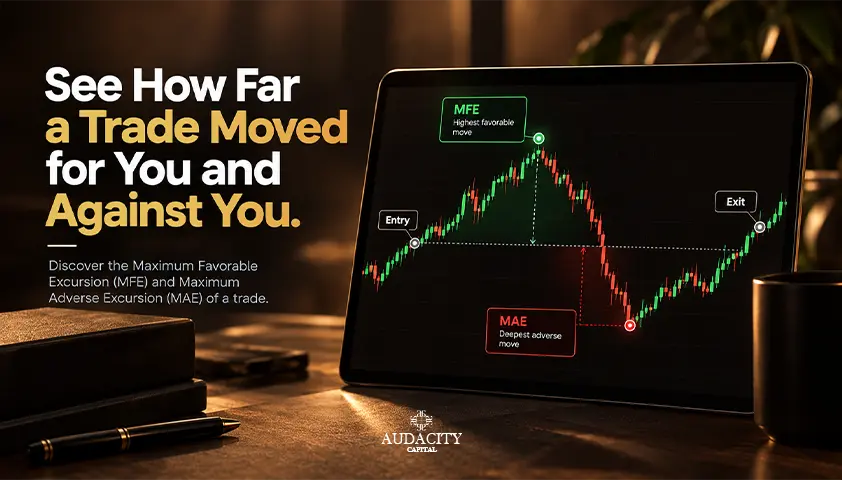
Maximum Favorable Excursion: How MFE and MAE Read a Trade
Learn how Maximum Favorable Excursion and MAE reveal a trade's best and worst open moves, exit giveback, and possible entry or exit problems.


Bearish RSI Divergence: How to Spot It, Confirm It and Trade It
Learn how to identify bearish RSI divergence, confirm reversal signals, plan entries and exits, and manage risk with practical forex trading examples.
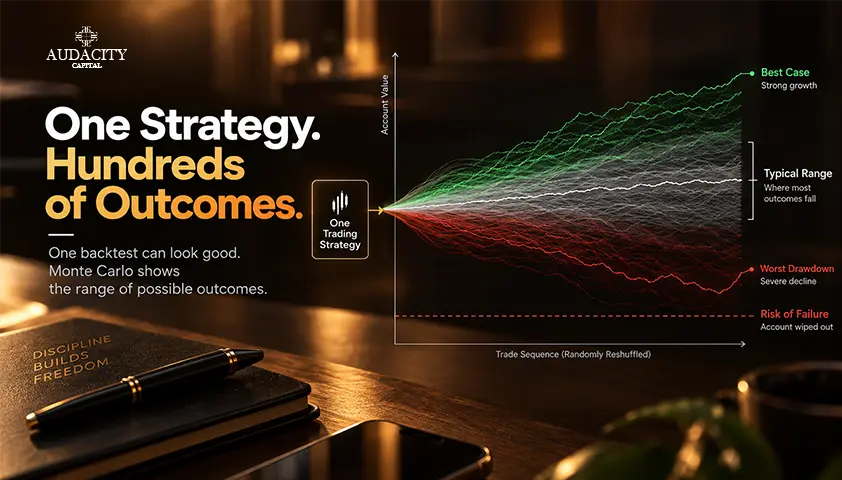
How to Stress-Test a Trading Strategy With Monte Carlo
Learn how Monte Carlo simulation reshuffles trades, estimates drawdown and losing-streak ranges, and tests a strategy beyond one backtest.
Risk of Ruin in Trading: Formula, Examples and How to Reduce It
Learn what risk of ruin in trading means, how the formula works, what affects it, and how position sizing can reduce the chance of account failure.