



Swing Trading vs Day Trading: Which Is Right for You?



THE SHORT ANSWER Day trading means opening and closing positions inside the same session, so nothing is held overnight. Swing trading means holding for days or weeks to catch one larger move. Neither style is more profitable than the other in the abstract, and most retail traders lose money at both. What separates them is what they demand from you. Day trading costs you time and pays you back in fast feedback. Swing trading costs you patience and pays you back with overnight risk. Pick the one that fits the hours you actually have, not the one that looks more exciting. |
Most traders pick a style by accident. They watch someone work a 5-minute chart, decide that is what trading looks like, and never ask whether it fits the life they have.
The swing trading vs day trading decision is not really a question about profit. Both styles work for some people and quietly ruin others, and the deciding factor is rarely the strategy itself. It is whether you can be at the screen when your setup appears, whether you can sleep with a position open, and whether your costs are eating whatever edge you think you have.
Here is what each one demands, what each one costs, where each one breaks, and the part almost no comparison mentions: how a prop firm’s rulebook changes the answer completely.
What is day trading?
Day trading is opening and closing positions within a single trading day, so no position is held overnight. A trade can last seconds or hours. What defines the style is that the book is flat by the close.
Day traders work intraday charts, usually the 1, 5, 15 and 30 minute, and trade the sessions where their market has real volume. They tend to take several positions a day and lean on execution speed and tight risk per trade. The trade-off is engagement. You have to be there when the setup forms, and you have to keep making clean decisions under time pressure for hours at a stretch. Our day trading guide for beginners covers the mechanics in full.
What is swing trading?
Swing trading is holding a position for days or weeks to capture one larger move, rather than slicing that same move into intraday pieces. It is a medium-term style. Holding for months is position trading, and buying to hold for years is investing.
Swing traders work higher timeframes, typically the 4-hour, daily and weekly, and may take only a handful of positions a month. Charts get checked once or twice a day rather than watched. The trade-off is exposure. Your position stays open through news, through sessions you are asleep for, and across the weekend.
Swing trading vs day trading: the comparison
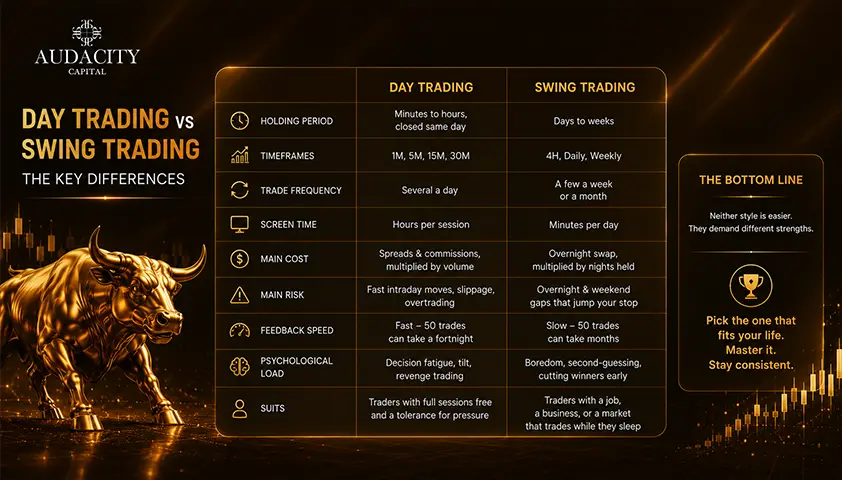
Day trading | Swing trading | |
|---|---|---|
Holding period | Minutes to hours, closed same day | Days to weeks |
Timeframes | 1M, 5M, 15M, 30M | 4H, daily, weekly |
Trade frequency | Several a day | A few a week or a month |
Screen time | Hours per session | Minutes per day |
Main cost | Spreads and commissions, multiplied by volume | Overnight swap, multiplied by nights held |
Main risk | Fast intraday moves, slippage, overtrading | Overnight and weekend gaps that jump your stop |
Feedback speed | Fast. Fifty trades can take a fortnight | Slow. Fifty trades can take months |
Psychological load | Decision fatigue, tilt, revenge trading | Boredom, second-guessing, cutting winners early |
Suits | Traders with full sessions free and a tolerance for pressure | Traders with a job, a business, or a market that trades while they sleep |
The differences that actually decide it
Time is the constraint, not ambition
The first honest question is not which style suits your personality. It is which style your calendar permits.
Day trading a session you cannot attend is not day trading. It is gambling on a chart you glanced at between meetings. If your market’s active hours land while you are at work, in class or asleep, you do not get to be a day trader in that market, however much you like the idea. Swing trading exists precisely because most people have a day.
The costs run in opposite directions
The claim that swing trading is simply cheaper is half true, and the half that gets left out is the half that costs money.
Day trading bills you per trade. Every position crosses the spread, and on a commission account you pay going in and coming out. Five round trips a day compounds into a serious hurdle before a single directional call has been made.
Swing trading bills you per night. Positions held past the daily rollover incur a swap, or overnight financing charge, which can be positive or negative depending on the pair and the direction you hold, and is typically charged triple on Wednesday to account for the weekend. Hold a negative-swap position for three weeks and the carry quietly eats into the move you waited for.
Neither style is free. They just invoice you differently.
Your risk window sits either inside the session or outside it
Day traders carry the risk of the session: fast moves, thin liquidity around news, slippage on stops when a release lands. They are flat by the close, so whatever happens overnight is not their problem.
Swing traders trade that away for a different exposure. Markets gap. A position sitting comfortably above its stop on Friday can open below it on Monday, and a stop-loss order cannot protect you at a price that never traded. Gap risk is the true cost of the swing trader’s freedom, and it is why position size matters more here than beginners tend to assume.
Feedback speed decides how fast you learn
Day trading produces a large sample quickly. Fifty trades in a fortnight tells you something real about your process. Swing trading might take three months to produce fifty trades, which means three months before you know whether the idea holds up.
That cuts both ways. Fast feedback teaches faster, and it also lets you damage an account faster. Slow feedback protects you from your worst impulses, and hides your worst habits for longer.
The psychological demands are different, not lighter
Day trading punishes decision fatigue: the fourth hour at the screen, the revenge trade after a loss, the setup you take because you have been staring at nothing for ninety minutes.
Swing trading punishes impatience: the winner you close three days early because sitting through a pullback is uncomfortable, the trade you force because you have not placed one in a week. It is less stressful minute to minute. It is not automatically easier, and we cover why in is day trading easier than swing trading.
Is Day Trading Easier Than Swing Trading?
Neither day trading nor swing trading is universally easier. The difficulty depends on how much time you have, how quickly you make decisions, your risk tolerance, and how comfortable you are with holding positions overnight.
For many beginners, swing trading may feel easier to manage because it generally requires less screen time and gives traders more time to analyze a setup before entering or exiting a position. Swing traders may check higher-timeframe charts once or twice a day rather than monitoring price movements continuously.
Day trading can be more demanding because traders need to monitor the market during active sessions, react quickly to price movements, and make repeated decisions within a relatively short period. Frequent trading can also increase exposure to spreads, commissions, slippage, and decision fatigue.
However, swing trading is not automatically easier. Holding positions for several days or weeks introduces overnight and weekend risk, including price gaps and unexpected market movements while the trader is away from the screen. Swap or overnight financing costs can also affect longer-held positions.
Day Trading vs Swing Trading: Which Is Easier?
Factor | Day Trading | Swing Trading |
|---|---|---|
Screen time | Usually higher | Usually lower |
Decision speed | Fast | More time to decide |
Trade frequency | Higher | Lower |
Overnight exposure | Usually avoided | Common |
Main challenge | Fast decisions and discipline | Patience and managing open risk |
Transaction costs | Can increase with frequent trades | Usually fewer transactions |
Suitable schedule | Requires dedicated trading time | More flexible around work or other commitments |
The key difference is not which strategy is objectively easier, but which demands you can realistically manage. A trader with several hours available during market sessions may find day trading manageable, while someone with a full-time job may find swing trading easier to fit into their schedule.
Ultimately, easier does not mean more profitable. Both approaches involve risk, and neither guarantees consistent returns. The better choice is the trading style that fits your available time, risk-management approach, and ability to follow a trading plan consistently.
Which one makes more money?
Neither, structurally. The style is not where the money comes from.
Day trading offers more opportunities and faster compounding in theory, then hands a good part of it back in transaction costs and execution errors. Swing trading captures larger moves per trade and gives back time and gap risk. On paper the two roughly wash out. In practice, the spread between traders inside the same style dwarfs the difference between the styles.
The research is less flattering than either camp likes to admit. The large majority of retail traders lose money over time, and the ones who trade fastest and most often tend to do worst. The numbers are in our breakdown of whether day trading is profitable, and they are worth reading before you commit to a style on the strength of someone’s screenshot.
Choose a style because you can execute it. Not because it looks more lucrative.
How much capital does each style need?

There is no single number, but the constraints differ, and one of them is a rule rather than a guideline.
Day trading US stocks in a margin account brings in the pattern day trader rule. Four or more day trades in five business days flags the account, and it then has to hold $25,000 in equity to keep day trading.
Two things it is not. It does not apply to forex or futures, and it does not apply to swing trading, because a position held overnight is not a day trade. Traders who cannot meet the $25,000 threshold and still want to trade US equities often swing trade for exactly that reason.
Past that rule, the practical minimum is set by risk, not regulation. If you cannot risk 1% of your account and still size a position sensibly against your stop, the account is too small for the setup, whichever style you are trading. Our guide to how much money you need to start swing trading works through the tiers.
How prop firm rules change the answer
This is the part generic comparisons leave out, and for a funded trader it matters more than any timeframe debate. Trading simulated capital means trading inside a rulebook, and a rulebook is never style-neutral. Some rules punish day traders. Others make swing trading impossible.
Daily loss limits are a day trader’s problem
A daily loss limit, commonly 5%, caps how much you can lose in a single day. For a swing trader taking two positions a week it is close to invisible. For a day trader having a bad morning it is a wall, and breaching it is the most common way funded accounts are lost. The rule exists to stop the exact behavior that ends most day trading careers, which is worth sitting with rather than resenting. Our guide to drawdown in prop trading explains how the limits interact.
Overnight and weekend holding decides whether swing trading is even possible
Plenty of firms close positions before the weekend, forbid overnight holds entirely, or sell the permission as a paid add-on labeled a "swing account." If you are a swing trader, read that rule before you read the profit split. A firm that flattens your book every Friday is not a firm you can swing trade with.
Audacity Capital permits overnight and weekend holding on the funded programs.
Static vs trailing drawdown is a swing trader’s problem
A trailing drawdown limit follows your account’s high-water mark upward. For a swing trader holding a position that runs deep into profit and then retraces, a trailing limit can breach the account on an ordinary pullback, on a trade that is still open and still valid. A static drawdown is fixed against your starting balance and does not chase you up.
Audacity Capital uses static drawdown. For a swing trader that is not a small detail.
Minimum trading day requirements
Most evaluations require a minimum number of trading days. Day traders clear that without noticing it exists. A swing trader who takes three positions a month has to plan around it, because a rule written to prove consistency can quietly push you into trading a style you do not trade.
So which should you choose?
Day trading is a reasonable fit if you can be at the screen for your market’s active hours, you make decisions cleanly under pressure, you have a hard rule for stopping after a loss, and you would rather not carry risk overnight.
Swing trading is a reasonable fit if you have a job or a business, your market’s best hours fall in your night, you can leave a position alone through a drawdown, and you accept that a gap will eventually go straight through a stop.
If you are new, start with swing trading. Not because it is easy, but because it gives you time to think, costs less to run while you are still learning, and does not require you to be right within thirty seconds.
Can you trade both?
Yes, and plenty of traders do. The mistake is doing it by accident.
Trading both deliberately means two plans, two risk budgets and ideally two accounts, so that a swing position does not get panic-closed during a bad intraday session. Trading both accidentally means a day trade that went against you and has now been promoted to "a swing trade." That is not a style. That is a loss you have not accepted yet.
Common mistakes to avoid
- Turning a losing day trade into a swing trade to avoid booking the loss
- Sizing a swing position as though the stop will hold through a weekend gap
- Day trading a session you cannot realistically attend
- Ignoring swap costs on a multi-week hold and wondering where the profit went
- Switching styles after a losing streak instead of after a review
- Choosing a style based on the returns someone showed you rather than the hours you have

Are You Looking For Instant Funding Trading Programs?
Funded Trader ProgramWhere Audacity Capital fits
Both styles are supported here. Audacity Capital is a proprietary trading firm, so traders trade a simulated funded account on MT5 or DXTrade under a published set of rules, and keep up to 90% of the simulated profits they generate.
For day traders, the daily loss limit is the rule to respect. For swing traders, overnight and weekend holding is permitted and the drawdown is static, which are the two rules that most often make holding a position for a week impractical elsewhere.
To be plain about it, a funded account is capital and structure, not an edge. It will not turn a day trader into a swing trader, or make either one profitable, and most people who attempt an evaluation do not pass it. What it does is put a proper risk framework around the style you have already chosen, which is more than most traders ever build for themselves.
Explore the Funded Trader Program or start with the free monthly trading competition.

Free Prop Firm Challenge
Free Prop Firm ChallengeFrequently asked questions
Most run from a couple of days to a few weeks. If your positions are routinely open for months, that is position trading. If they close in the same session, they were never swing trades.
A single daily check is usually enough, and it should have a purpose: manage the open position, mark the levels, act on the plan. Watching a swing position tick is how swing traders talk themselves into day trading it.
Intraday trading needs liquidity and movement inside the session, so major forex pairs and index CFDs are the usual homes. Multi-day trading rewards markets that trend and respect higher-timeframe structure, which again includes forex, plus indices and commodities. Thin, erratic instruments punish both.
No, it is a subset. Scalpers take dozens of positions for very small moves, often holding for seconds. Every scalper is a day trader, most day traders are not scalpers, and the cost structure of scalping is unforgiving.
Multi-day trading, yes, and it is the most common reason people choose it. Setups are found and orders placed outside working hours, and pending orders do the rest. What you cannot honestly do around a full-time job is trade a session that runs while you are working.
It stays open and it stays exposed. Markets can gap on the Sunday or Monday open, past your stop, on news that broke while they were closed. Some traders reduce or close on Friday for that reason. Others accept the risk and size for it.
Usually, at least at first, because you restart your learning curve and your sample size at the same time. Switching after a considered review is a decision. Switching after three losing trades is tilt with better branding.
Related Article
Is Day Trading Easier Than Swing Trading? (Beginner’s Guide 2026)
Check latest guide How Much Money Do You Need to Start Swing Trading? (2026 Guide)
Read the full guide here: Is Day Trading Easier Than Swing Trading?
Read the guide about best forex trading strategy

Handa nang maglapat ng disiplinadong panganib sa crypto? Galugarin ang mga bagong instrumento ng crypto ng Audacity Capital at dalhin ang iyong diskarte sa pangangalakal.
Matuto PaNewsletter
Sumali sa aming newsletter.
Sumali sa Aming Social Community

Simulan ang Iyong Paglalakbay Ngayon Gamit ang Aming Libreng Pagsubok
Ipagmalaki ang iyong mga kasanayan at tagumpay sa pamamagitan ng mga sertipiko at makakuha ng pagkilala para sa iyong pagsusumikap at dedikasyon mula sa mga potensyal na mamumuhunan at kasamahan.
Libreng PagsubokMga Kaugnay na Artikulo

10 Best Futures Prop Firms for Swing Trading In 2026
Compare the best futures prop firms for swing trading in 2026 with overnight holding, flexible rules, fast payouts, and funded accounts.


How To Choose The Right Prop Firm – A Complete Checklist
Learn how to choose the right prop trading company with our expert guide. Compare fees, rules, profit splits, and platforms to trade confidently.

What Is A Black Swan Event in Trading & Finance?
Learn what a black swan event is in trading and finance, with real examples, market impact, and strategies to manage risk during extreme events.

Introducing Ability One: One Step To Funding With Static Drawdown