


12 Trading Risk Management Tools Every Trader Needs


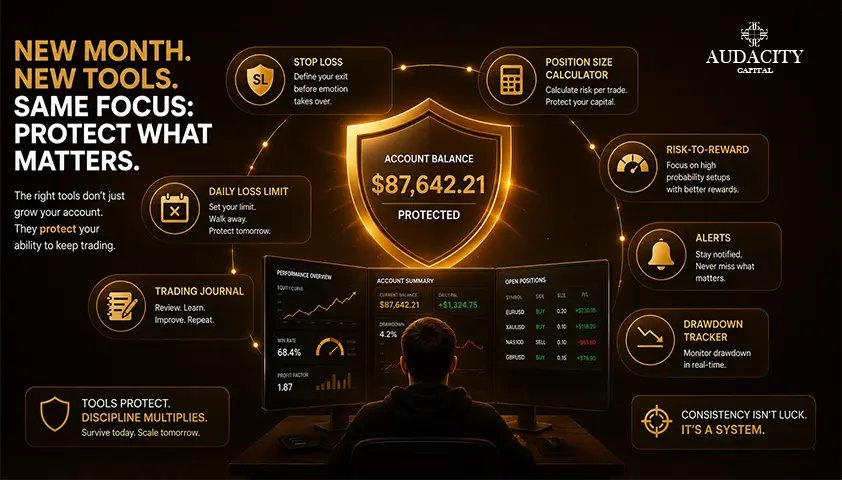
Almost every trader knows the rules. Risk a small percentage per trade. Use a stop. Keep a journal.
Almost none of them follow those rules consistently. That gap, between knowing and doing, is where most accounts get damaged, and it is exactly the gap trading risk management tools exist to close.
Today in this guide we are going to organize those tools by when you actually use them: before the trade, during the trade, and after it. You will get the formula behind every calculator, so you are never dependent on a product.
Why Tools, and not Just Rules?
Before listing anything, it is worth making the case for the category. Rules live in your head. Tools live in the world, and they do two specific jobs that willpower does not.
First, they remove arithmetic errors.
Sizing a position by feel is where most oversizing happens. A calculator turns a risk rule into an exact number of shares, contracts, or lots, with no guesswork and no rounding in the wrong direction.
Second, they remove the decision from the moment you are least objective.
An exit attached at entry, or an automated daily limit, acts when you would hesitate, freeze, or rationalize. The tool does the thing you promised yourself you would do, at the moment you are most tempted to break the promise.
The context supports this, though it needs to be handled carefully.
Commonly cited third-party estimates suggest a large majority of retail traders lose money, with figures often quoted in the region of 70% to 95% depending on the market and the timeframe measured.
One widely referenced study of over 20,000 futures traders is reported to have found the large majority losing money over a long horizon. Survey data has also suggested that a meaningful share of active traders do not consistently apply position sizing. Treat all of these as third-party estimates to verify, not settled fact.
The framing that matters: the tools are not what makes risk management work. Discipline does that. The tools are what make it happen consistently, on the trades where you would otherwise cut corners.
Before the Trade: Sizing and Planning Tools
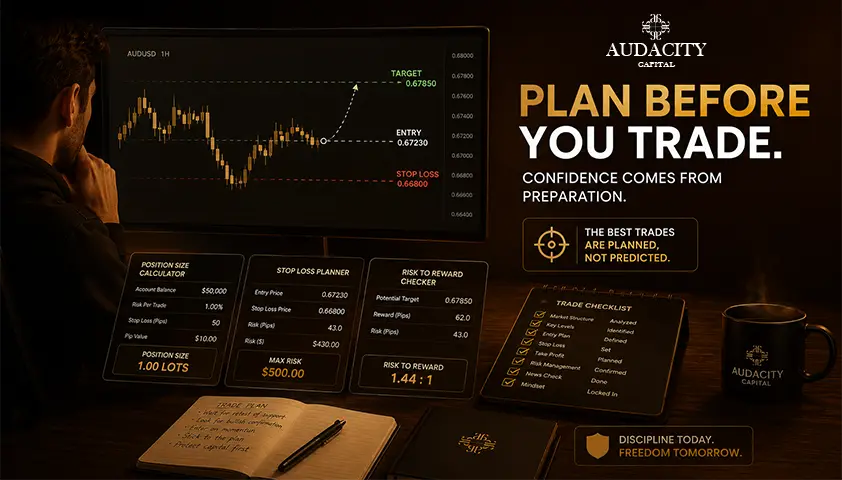
These are the tools you use before you ever click buy. They decide how much you can lose before you commit to anything.
Stage | Tool | What it does | Formula | Free or paid |
Before | Position size calculator | Returns exact size for a set risk | (Account × Risk %) ÷ (Entry − Stop) | Free |
Before | Pip value / lot size | Converts risk to correct forex lots | Uses pip value per pair and lot | Free |
Before | R:R and breakeven win rate | Tests whether a trade is worth taking | 1 ÷ (1 + R:R) × 100 | Free |
Before | Daily loss limit planner | Caps losses for the session | Account × Daily Risk % | Free |
During | Bracket / OCO orders | Attaches stop and target at entry | Platform native | Free |
During | Drawdown monitor | Tracks equity against its peak | (Peak − Equity) ÷ Peak | Free/paid |
During | Risk automation | Blocks trades past a set limit | Rule-based add-on | Often paid |
After | Trading journal | Logs and analyzes trades | Spreadsheet or software | Free/paid |
After | Analytics / expectancy | Measures edge across a sample | Expectancy formula | Free/paid |
After | Risk of ruin / Monte Carlo | Models streak survival | Simulation | Free/paid |
1. Position size calculator: the most important tool you can use
If you use one tool, use this one. A position size calculator is the single most valuable risk tool available. You enter your account balance, the percentage you are willing to risk, and your stop distance, and it returns the exact number of shares, contracts, or lots to trade.
The formula, so you never depend on a product:
Position Size = (Account Size × Risk %) ÷ (Entry Price − Stop Loss)
For example: a $25,000 account risking 1% is $250 of risk. On a $185 entry with a $182 stop, the risk per share is $3. That gives 83 shares.
The forex version accounts for pip value:
Lot Size = (Account Balance × Risk %) ÷ (Stop Loss in Pips × Pip Value)
Example: a $10,000 account risking 2% with a 50-pip stop on EUR/USD gives 0.40 standard lots.
On risk percentage, professionals are commonly described as risking between 0.5% and 2% per trade, with 1% the most cited figure.
Treat that as a convention, not a prescription. Free position size calculators are widely available across broker sites and independent tools, named here only as examples of the category, not as endorsements.
2. Pip value and lot size calculators
These forex-specific tools matter because pip value is not constant. It varies by currency pair, by lot size, and by your account currency. That is why a fixed lot size does not carry the same risk across different pairs.
A trader using the same lot size on EUR/USD and GBP/JPY is not taking the same risk, and probably does not realize it. Pip value and lot size calculators feed directly into position sizing and correct that blind spot.
These sit at the core of practical forex risk management tools, because they turn an abstract risk percentage into the right number of lots for the specific pair in front of you.
3. Risk-to-reward and breakeven win rate calculators
A risk-to-reward calculator tells you what you stand to gain against what you stand to lose.
In one line, Risk-Reward Ratio = (Take Profit − Entry) ÷ (Entry − Stop Loss).
The genuinely underused companion is the breakeven win rate:
Breakeven Win Rate = 1 ÷ (1 + R:R) × 100
This tells you the win rate a setup actually needs just to break even.
A 3:1 setup needs only a 25% win rate to break even before costs. That is why it is a risk tool and not a math curiosity: it tells you whether a trade is worth taking before you take it, rather than after a losing week.
4. Daily loss limit planner
This is the most underused pre-trade calculation of all.
Daily Max Loss = Account × Daily Risk %
Divide that figure by your per-trade risk, and you get the maximum number of losing trades you can take before you stop for the day.
Why this matters more than it sounds: it converts a vague intention to "stop after a bad run" into a specific number decided in advance, while you are calm. That is the practical defense against revenge trading.
Traders on funded or evaluation accounts often have a daily loss limit imposed anyway, so knowing your number is not optional. It is the line between staying in the game and blowing a session.
During the Trade: Execution and Monitoring Tools
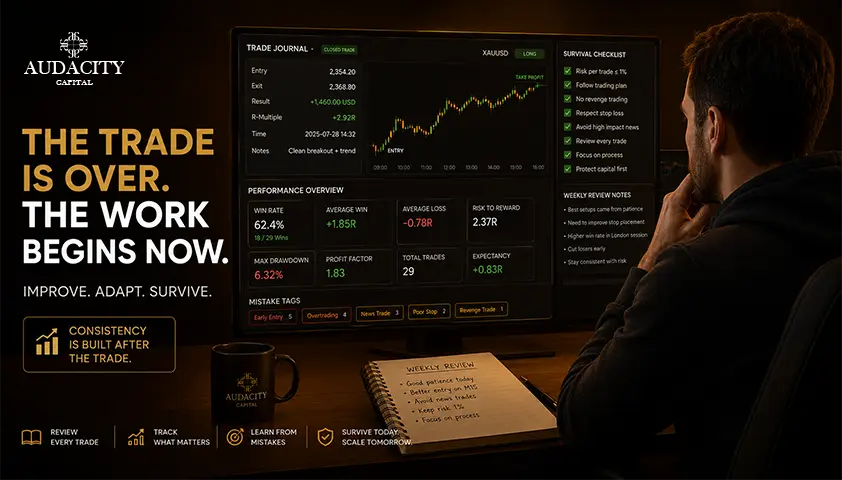
These act while a position is open. Several are platform features most traders never bother to turn on.
5. Bracket or OCO orders.
A bracket, or one-cancels-other order, attaches a stop loss and a take profit at the moment you enter, so both exits exist before emotion does. When the target hits, the stop cancels automatically, and the reverse.
This is the single highest-value platform feature for risk, because it removes the exit decision from the moment you are least able to make it.
6. Trailing stops.
These protect an open profit without manual management, moving the stop as price advances. For placement mechanics, see our stop loss guide.
7. Price and margin alerts.
These notify you at a level rather than forcing you to watch a screen all day. Watching invites overtrading. Alerts do the opposite.
8. Drawdown monitors.
These track your equity against its peak, and drawdown is the number that actually determines survival. An account falling from $5,000 to $4,500 is in a 10% drawdown.
This matters most for anyone trading under a maximum-drawdown rule, where breaching the level ends the account regardless of how the position eventually plays out.
9. Risk-automation software.
This is the most valuable category for traders who break their own rules. Some platforms and third-party add-ons can block new trades once a daily loss limit is reached, or reduce position size in volatile conditions.
That is as close as software gets to enforcing discipline mechanically.
Note: Third-party risk add-ons and expert advisors run at your own risk, need to be tested before you rely on them, and must comply with your broker's or funded program's automation rules. Check the rules before you install anything, because using a prohibited tool can cost you the account.
After the Trade: Journals, Analytics and Survival tools

These turn results into improvement, and this is the section most traders skip entirely.
10. The trading journal.
This is the highest-leverage tool of all. Modern journals import trades automatically from your broker, plot them on charts, and report by setup, time of day, and holding period.
For risk specifically, a good trading journal tracks your win rate, your drawdown, your expectancy, and the behavioral patterns behind your oversized losses.
Put plainly: without a journal, traders repeat the same mistake without ever seeing the pattern. A spreadsheet counts as a journal if you actually fill it in. The format matters far less than the habit.
11. Analytics and expectancy tools.
Expectancy tells you the average result you can expect per trade across a sample, and whether a strategy has a genuine positive edge rather than one good week. A strategy can win often and still lose money, or win rarely and still be profitable. Analytics tools show you which one you have.
12. Risk of ruin and Monte Carlo simulators.
This is the most under-used category and the most sobering. Risk of ruin is the modeled probability of a losing streak deep enough to end your account. Monte Carlo tools simulate thousands of possible orderings of your trades to show the range of outcomes, not just the average.
The illustration, presented as attributed third-party estimates to verify: even at a 50% win rate, a run of roughly nine to eleven consecutive losses should be expected across a long sample.
At 1% risk per trade, a trader could absorb around 20 consecutive losses for a 20% drawdown. That is what turns "risk one percent" from a slogan into a survival calculation.
Protecting capital matters more than chasing returns, because the deeper the drawdown, the harder the recovery. A 50% loss requires a 100% gain just to get back to even.
How to Choose your Toolkit?
A position size calculator, bracket orders on the platform you already use, and a spreadsheet journal cover the large majority of the need.
A trader using those three consistently is managing risk better than one paying for a suite of tools they never open.
The problem was never a lack of tools. It was a lack of consistent use.
So when should you pay?
Pay only when a tool changes a decision or removes work you would otherwise skip. In practice, the honest justification for a paid journal is automatic trade import, because manual logging is exactly what people abandon after a busy fortnight. If a paid feature saves you from quitting the habit, it earns its cost.
A few practical checks before you commit:
- Confirm the journal actually supports your broker and platform before paying. Not all of them do.
- Watch for subscription stacking, where a calculator, a journal, and an analytics tool quietly become three monthly bills.
- Treat any pricing you read as subject to change, and verify it directly.
One more thing, and it is the reason to read these lists carefully. Many "best risk tool" rankings are published by the vendors themselves, who conveniently rank their own product first.
Treat rankings skeptically. Use their factual detail, the formulas and feature descriptions, but test free tiers before committing to anything.
Your minimum viable stack: a position size calculator, bracket orders, a journal you will actually keep, and a written daily loss limit. That combination covers the real work, and almost all of it is free.
The Limits of Risk Management Tools
This is the honest core, and the right note to end the body on. Risk management tools for traders are powerful, but they have hard limits.
1. A calculator does not manage risk.
You do. Tools compute and enforce. They do not decide. The decision to take the trade, and to respect the number, is always yours.
2 .Tools cannot supply discipline.
A trader who widens stops will widen them regardless of what a calculator said. Automation that can be switched off will be switched off by someone determined to keep a losing trade alive.
3. A journal only works if it is reviewed.
An unread journal is a data-entry hobby. The value is in the review, not the logging.
4. Garbage in, garbage out.
Position sizing is only as good as the stop it is based on. A size calculated from a level you do not actually respect is meaningless, because you will move the stop and destroy the math.
5. No tool creates an edge, and none makes anyone profitable.
They make good habits repeatable and bad habits visible. That is the whole job.
Think of the tools as scaffolding. They are not the risk management itself. They are the structure that lets your risk management survive contact with a bad day.
Conclusion
The value of good trading risk management tools is not in owning them. It is in using them on every trade, organized around when they actually help.
The honest buying position stands: most of what matters is free, and a paid tool should only replace work you would otherwise skip.
The limits stand too. Tools remove arithmetic error and friction, but they cannot supply discipline, sizing is only as good as the stop behind it, and no tool creates an edge or makes anyone profitable.
The practical next step is not to collect more trading risk tools. It is to assemble the minimum viable stack, a position size calculator, bracket orders, a journal you will actually keep, and a written daily loss limit, and use it on every trade without exception.
Frequently Asked Questions
A position size calculator. It converts a risk rule into an exact number of shares, contracts, or lots, and sizing by feel is where most account-damaging losses begin. If you adopt only one tool, adopt this one and use it on every trade.
Divide the money you are willing to risk by the distance to your stop. Formally, Position Size = (Account Size × Risk %) ÷ (Entry − Stop). A $25,000 account risking 1% is $250 of risk, so with a $3 stop distance that gives 83 shares.
Usually not. A free position size calculator, bracket orders on your platform, and a spreadsheet journal cover most of the need. Paid tools are worth it mainly when automatic trade import stops you from abandoning the journal, which is the feature people most often quit without.
It is the modeled probability that a losing streak wipes out your account. It matters because long losing runs are statistically normal. As an attributed third-party estimate, even at a 50% win rate a streak of nine to eleven losses should be expected across a large sample, which is why fixed small risk per trade is a survival tool.
There is no universal answer, and this is not advice. Professionals are commonly described as risking between 0.5% and 2% per trade, with 1% the most cited convention, since at 1% a trader could absorb roughly 20 consecutive losses for a 20% drawdown. Treat these as conventions to test, not rules.
Partly. Some platforms and add-ons can block new trades after a daily loss limit or reduce size in volatile conditions. But automation can be disabled by a determined trader, so it supports discipline rather than replacing it, and any third-party tool must comply with your broker's or program's automation rules.
Beyond entries and exits, track your risk per trade, your actual stop versus your planned stop, your drawdown, your expectancy, and the circumstances around your largest losses. That is where the repeatable mistake usually shows up, and where a review turns data into a change in behavior.
It is the win rate a strategy needs simply to break even at a given risk-to-reward ratio, calculated as 1 ÷ (1 + R:R) × 100. A 3:1 setup needs only about a 25% win rate to break even before costs, which is why the ratio you trade at matters as much as how often you win.

Handa nang maglapat ng disiplinadong panganib sa crypto? Galugarin ang mga bagong instrumento ng crypto ng Audacity Capital at dalhin ang iyong diskarte sa pangangalakal.
Matuto PaNewsletter
Sumali sa aming newsletter.
Sumali sa Aming Social Community

Simulan ang Iyong Paglalakbay Ngayon Gamit ang Aming Libreng Pagsubok
Ipagmalaki ang iyong mga kasanayan at tagumpay sa pamamagitan ng mga sertipiko at makakuha ng pagkilala para sa iyong pagsusumikap at dedikasyon mula sa mga potensyal na mamumuhunan at kasamahan.
Libreng PagsubokMga Kaugnay na Artikulo

Stop Loss Orders To Reduce Risk
Earn more profit by using stop loss orders techniques to reduce risk in forex trading. One of the best strategy to keep more profit.


What Are The Risks Of Forex Trading For Beginners?
Understand the risks of forex trading for beginners. Learn about the potential pitfalls and challenges involved in the forex market.

Funded Forex Trader : How To Trade During A Recession ?
Funded Forex Trader : how to Trade During a Recession. Start trading with a funded account now!

Struggling To Face Losses In Forex Trading? Here’s How To Bounce Back
Learn how to recover from losses in forex trading with proven strategies, mindset tips, and a step-by-step plan to rebuild confidence and trade consistently.