


What Is ICT in Trading? A Beginner's Guide to the ICT Trading Method



Introduction
ICT (Inner Circle Trader) is a trading methodology that focuses on understanding how institutional participants influence price movements through liquidity, market structure, and price action. Developed by Michael J. Huddleston, ICT has become one of the most widely discussed trading approaches among forex, indices, and futures traders.
Unlike traditional trading methods that rely heavily on indicators, ICT teaches traders to analyse how banks and large financial institutions move the market. By understanding concepts such as liquidity, order blocks, fair value gaps, and market structure, traders aim to identify higher-probability trading opportunities before major price movements occur.
What Is ICT in Trading?
ICT in trading stands for Inner Circle Trader, a trading methodology developed by Michael J. Huddleston. Rather than relying on traditional technical indicators such as moving averages or RSI, ICT teaches traders to analyse price action, market structure, liquidity, and institutional order flow to understand how financial markets move.
The core idea behind ICT trading is that large financial institutions—including banks, hedge funds, and other professional market participants—have a significant influence on price movements. Instead of following retail trading signals, the ICT methodology focuses on identifying the footprints these institutions leave behind, such as liquidity zones, order blocks, fair value gaps, and changes in market structure. Traders use these concepts to anticipate potential market moves rather than reacting after they occur.
Over the years, ICT trading has gained widespread popularity among forex, indices, futures, and cryptocurrency traders because it provides a structured way to interpret price action without depending heavily on lagging indicators. Many of the concepts commonly associated with Smart Money Concepts (SMC), including liquidity and order blocks, originate from the educational framework introduced by Michael J. Huddleston.
Although ICT terminology can appear complex at first, the underlying principles are straightforward. By understanding how institutional traders seek liquidity and manage large positions, traders can develop a deeper understanding of market behaviour and make more informed trading decisions. Learning ICT begins with understanding these core concepts before progressing to a complete trading strategy.
Who Created ICT?
ICT was developed by Michael J. Huddleston, an independent trader and educator better known by his online name, Inner Circle Trader (ICT). After spending many years studying the forex and futures markets, Huddleston created a trading methodology based on institutional price action rather than traditional indicator-based analysis.
Through free educational videos, chart analysis, and trading lessons, he introduced concepts such as liquidity, order blocks, fair value gaps, market structure, and optimal trade entry (OTE). These ideas have since become widely recognised within the trading community and have influenced what is now commonly referred to as Smart Money Concepts (SMC).
Today, many educators and traders build upon the terminology and concepts introduced by Michael J. Huddleston, making ICT one of the most influential price action methodologies among retail traders.
What Does ICT Stand For?
ICT stands for Inner Circle Trader, the trading name of Michael J. Huddleston, who developed the ICT trading methodology. Over years of studying the forex and futures markets, Huddleston introduced a price action framework focused on liquidity, market structure, institutional order flow, and Smart Money Concepts. Today, the term ICT is widely used to describe both the educator and the trading methodology that has influenced thousands of retail traders worldwide.
How Does the ICT Trading Strategy Work?
The ICT Trading Strategy runs on four main building blocks. Once you understand how these blocks connect, the remaining ICT Trading Concepts will start making a lot more sense.
First comes the ‘Market structure’. It means tracking whether the price is making higher highs and higher lows in an uptrend or lower highs and lower lows in a downtrend. This shows you the general directions before you plan any entry.
Liquidity is the next piece. This ICT strategy concept looks at where stop losses and pending orders sit above old highs or below old lows. It is because price often gets pushed toward these pools before reversing, which traders call a liquidity grab or a stop hunt.
Third, the Institutional order flow builds on this by studying candle patterns like order blocks and fair value gaps. Both of these are known to mark sports where a bank or large fund entered the market. This part of the ICT Trading Method is what beginners often find the hardest to spot.
The fourth and final piece is timing. This ICT Forex Strategy divides the trading day into specific windows called killzones, which are tied to sessions like London and New York. The biggest and cleanest moves tend to happen during these periods because trading volume from these major markets overlaps.
Core ICT Concepts

Now that you understand where the ICT Trading Strategy comes from, it's time to explore the concepts that define it. Each principle serves a specific purpose, but it's how they work together that creates a complete trading framework.
Market Structure
Anyone new to the ICT Trading Strategy needs to get comfortable with the market structure before touching anything else, since every later concept depends on reading this correctly.
- In an uptrend, price forms a Higher High followed by a Higher Low, then another Higher High, repeating that pattern as buyers stay in control.
- A downtrend mirrors this exactly, forming a Lower High followed by a Lower Low as sellers stay in charge.
- A Break of Structure simply means price pushed past an old high or low in the same direction the trend was already moving, confirming that the trend is still intact.
- Whereas a Market Structure Shift means price broke structure in the opposite direction, often the earliest warning that momentum is turning.
Liquidity
Liquidity is the fuel behind every move that ICT traders care about, since large institutions cannot fill enormous positions without a deep pool of opposite orders waiting nearby.
- Buy-side liquidity refers to clusters of resting buy orders and stop-loss orders that accumulate above a recent swing high. These orders typically belong to short sellers placing protective stops or breakout traders expecting the price to continue higher.
- Sell-side liquidity is the opposite. It forms below a recent swing low, where stop-loss orders from long traders and sell-stop orders from breakout traders tend to accumulate.
A liquidity grab occurs when the price briefly moves beyond one of these liquidity zones, triggering the resting orders before quickly reversing in the opposite direction. In the ICT Trading Strategy, this move is often viewed as a sign that liquidity has been collected and can mark the beginning of a potential trading setup.
Order Blocks
In the ICT Trading Strategy, order blocks are price zones where institutional buying or selling is believed to have occurred before a major market move. Instead of focusing on a single candle, traders view these areas as potential zones where the price may return before continuing in the same direction.
A bullish order block is typically the last bearish candle before a strong upward displacement, while a bearish order block is the last bullish candle before a sharp downward move.
Not every candle before a large move qualifies as a valid order block. Stronger setups often have additional confluence, such as a liquidity sweep, clear price displacement, and a fair value gap in the same direction.
Fair Value Gaps (FVG)
A fair value gap (FVG) is a three-candle price pattern that forms when the first candle's wick and the third candle's wick do not overlap, leaving an untraded price range between them. In ICT terminology, this gap represents a price inefficiency, created when the middle candle moves so aggressively that the market leaves part of the price range relatively untouched.
ICT traders often expect the price to revisit all or part of the gap before continuing in the original direction. This process, known as rebalancing, is why fair value gaps are commonly used as potential areas for trade entries or pullbacks. Instead of entering immediately after a strong move, many traders wait for the price to retrace into a fair value gap before looking for confirmation to enter a position.
Breaker Blocks
A breaker block forms when a previously identified order block fails to hold, and the price breaks through it with strong momentum. Instead of acting as support or resistance, the zone is invalidated, signaling that market conditions may be shifting.
This type of move is often accompanied by a liquidity sweep, as the breakout frequently triggers stop-loss orders resting around the failed order block. Once the level is broken, it can take on the opposite role. A former support zone may begin acting as resistance, while a former resistance zone can become support.
In the ICT Trading Strategy, breaker blocks are viewed as potential signs of a changing market structure. Traders often watch for the price to revisit the breaker block before looking for confirmation that the new trend direction is likely to continue.
Mitigation Blocks
A mitigation block is a price zone where institutions are believed to manage or rebalance existing positions rather than initiate new ones. Unlike a standard order block, it does not typically form after a liquidity sweep.
Instead, price makes a modest pullback before continuing in the prevailing direction. Because mitigation blocks lack the added confirmation of a liquidity sweep, traders generally treat them as a supporting signal rather than a standalone trade setup. They are most effective when combined with other ICT concepts, such as market structure, liquidity, or fair value gaps.
Premium & Discount Zones
Premium and discount zones divide a trading range into two halves using the most recent swing high and swing low as the boundaries. The midpoint of that range, known as equilibrium, sits at the 50% level and separates the two zones.
When the price is below the equilibrium, it is considered to be in the discount zone, where ICT traders look for potential buying opportunities. When the price is above the equilibrium, it is in the premium zone, where traders look for potential selling opportunities. The concept is based on a simple principle: buying at relatively lower prices and selling at relatively higher prices within the current trading range.
Optimal Trade Entry (OTE)
Optimal Trade Entry (OTE) is an ICT concept that uses a Fibonacci retracement to identify a high-probability entry zone after a strong price move. Instead of entering immediately, traders wait for the price to retrace before looking for an opportunity to join the trend.
The OTE zone typically falls between the 61.8% and 79% Fibonacci retracement levels, with the 70.5% level often highlighted as a key area of interest. The setup is considered stronger when this retracement aligns with other ICT concepts, such as an order block, fair value gap, or liquidity level, providing additional confirmation for a potential trade.
ICT vs Traditional Technical Analysis
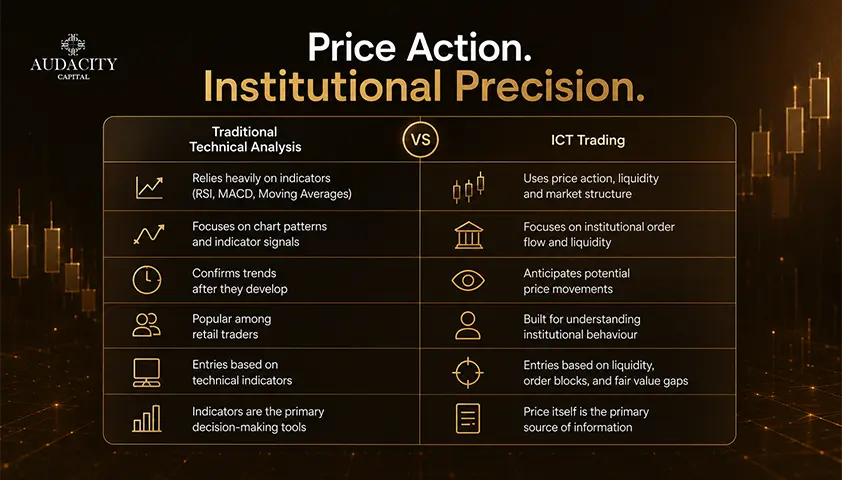
Although both ICT trading and traditional technical analysis aim to identify profitable trading opportunities, they approach the market in very different ways. Traditional technical analysis often relies on indicators, chart patterns, and trend-following tools to confirm price movements. In contrast, ICT trading focuses on understanding how institutional participants influence the market by analysing price action, liquidity, market structure, and order flow.
Rather than asking, "Which indicator gives the best signal?", ICT traders ask "Where is the liquidity, and how are institutions likely to move the market?" This shift in perspective helps traders understand the reasons behind price movements instead of simply reacting to them.
Traditional Technical Analysis | ICT Trading |
Relies heavily on indicators such as RSI, MACD, and Moving Averages | Primarily uses price action, liquidity, and market structure |
Focuses on chart patterns and indicator signals | Focuses on institutional order flow and liquidity |
Confirms trends after they develop | Attempts to anticipate potential price movements based on market structure |
Popular among retail traders | Designed around understanding institutional market behaviour |
Entries are often based on technical indicators | Entries are based on price action concepts such as liquidity, order blocks, and fair value gaps |
Indicators are the primary decision-making tools | Price itself is the primary source of information |
It's important to note that ICT trading and traditional technical analysis are not necessarily competing methods. Many traders combine elements of both approaches to develop a trading style that suits their experience, risk tolerance, and preferred markets. ICT simply places greater emphasis on understanding why price moves, rather than relying solely on indicator-generated signals.
ICT vs Smart Money Concepts (SMC)
SMC → Simplified market concepts
ICT → More detailed execution framework
SMC focuses on: liquidity, order blocks, market structure, and general institutional behavior.
ICT focuses on: those same concepts with added depth, including killzones, timing models, and specific entry frameworks.
Both approaches share many ideas, but ICT generally provides a more detailed rule-based framework, while SMC presents a broader and more simplified interpretation of similar market concepts.
Why Traders Use ICT
ICT trading has become one of the most popular price action methodologies because it offers a structured way to understand how financial markets move. Instead of relying solely on technical indicators, the methodology encourages traders to analyse the underlying factors that influence price, such as liquidity, market structure, and institutional activity.
Many traders are drawn to ICT because it provides a clear framework for interpreting price action rather than relying on subjective market opinions. By focusing on institutional concepts like order blocks and liquidity sweeps, traders aim to better understand the reasons behind market movements instead of simply reacting after they occur.
Another reason for ICT's popularity is its emphasis on risk management. The methodology encourages traders to wait for high-quality setups and well-defined entry areas, which can help improve risk-to-reward ratios and promote disciplined trading. While no trading approach guarantees success, many traders appreciate ICT for its structured, rules-based approach to analysing the markets.
Whether trading forex, indices, commodities, or cryptocurrencies, ICT concepts can be applied across multiple financial markets, making the methodology suitable for traders with different trading styles and experience levels.
Is ICT Good for Beginners?
Yes, beginners can learn the ICT Trading Strategy, but it requires patience and consistent practice. The concepts may feel overwhelming at first, and they become easier to understand when learned step by step.
Learn the concepts → Study charts → Practice on demo → Backtest setups → Build consistency → Trade with real capital
Demo trading and backtesting allow beginners to test ICT ideas without risking money while developing their understanding of market structure, liquidity, and trade execution. Once a trader can apply the concepts consistently, moving into a structured funded environment can become a more realistic next step.
Advantages of ICT
- The ICT Trading Strategy has earned its popularity for a few solid reasons that go beyond just being trendy online.
- It gives traders a rules-based, objective structure to follow, rather than vague gut feelings about where price might go next.
- It focuses on institutional footprints like order blocks and liquidity sweeps instead of leaning on lagging indicators that only confirm a move after it happens.
- It naturally supports strong risk management, with precise entries allowing tight stop losses and favorable risk-to-reward setups more often than not.
Limitations of ICT
No trading approach is perfect, and the ICT Trading Strategy comes with a few challenges:
- Steep learning curve: The strategy includes many concepts and terms that can take time to understand and apply correctly.
- Requires patience: High-quality ICT setups may not appear every day; traders have to wait for the right conditions.
- Subjective analysis: Many concepts rely on interpretation, which can lead to different traders viewing the same chart differently.
- Market conditions matter: Choppy or low-volume markets can make it harder to separate valid setups from normal price noise.
Learn the ICT Trading Strategy
Instead of repeating
- Step-by-step
- Timeframes
- Examples
add this section:
Understanding what ICT is and learning how to apply it are two different things. Once you're familiar with the core concepts such as liquidity, market structure, order blocks, and fair value gaps, the next step is learning how to combine them into a complete trading plan.
👉 Read our complete guide on the ICT Trading Strategy to learn how to identify setups, manage risk, and apply ICT concepts in real market conditions.
Conclusion
ICT is more than just another trading methodology—it is a way of understanding how financial markets move through the lens of liquidity, market structure, and institutional activity. By focusing on price action instead of relying heavily on technical indicators, ICT helps traders develop a deeper understanding of why prices move rather than simply reacting to market signals.
Although the terminology may seem complex at first, the core concepts become easier to understand with consistent study and practice. Whether you're a beginner exploring price action for the first time or an experienced trader looking to better understand institutional market behaviour, ICT provides a structured framework that can improve the way you analyse the markets.
Learning what ICT is is only the first step. Once you're familiar with its core principles, you can begin exploring how these concepts work together in real market conditions by studying a complete ICT Trading Strategy, where you'll learn about trade setups, market timing, and risk management in greater detail.
Frequently Asked Questions
ICT is short for Inner Circle Trader, the name under which Michael J. Huddleston trades and teaches, and where this entire methodology gets its identity.
It is, provided beginners stay patient with the ICT Trading Strategy, study the terminology properly, and put in real hours on a demo account before going live.
No single number applies across the board, and many consistently profitable traders following the ICT Trading Method win less than half their trades overall.
Definitely, tight entries and clear risk control fit funded account rules well, and Audacity Capital specifically allows traders to apply their own strategy freely.
Execution usually happens on the 1-minute or 5-minute chart, but the bias is always decided first on the daily or 4-hour chart.
Not quite, as SMC borrowed heavily from ICT teachings before evolving into a slightly broader and more beginner-friendly version of similar ideas.

Handa nang maglapat ng disiplinadong panganib sa crypto? Galugarin ang mga bagong instrumento ng crypto ng Audacity Capital at dalhin ang iyong diskarte sa pangangalakal.
Matuto PaNewsletter
Sumali sa aming newsletter.
Sumali sa Aming Social Community

Simulan ang Iyong Paglalakbay Ngayon Gamit ang Aming Libreng Pagsubok
Ipagmalaki ang iyong mga kasanayan at tagumpay sa pamamagitan ng mga sertipiko at makakuha ng pagkilala para sa iyong pagsusumikap at dedikasyon mula sa mga potensyal na mamumuhunan at kasamahan.
Libreng Pagsubok