


What Is Stop Loss in Trading? A Complete Beginner's Guide


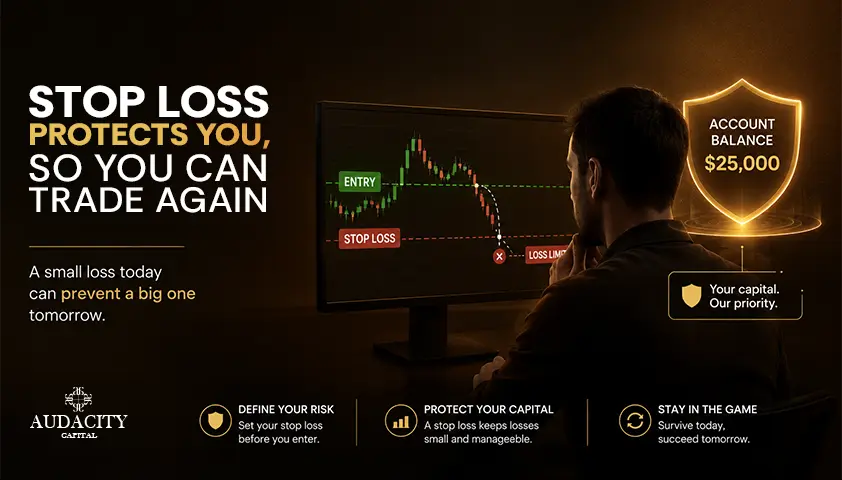
A stop loss is an order you place in advance that automatically closes your trade once price moves against you by a set amount, capping the loss on that position.
Understanding what is stop loss in trading is the first real step toward managing risk instead of hoping the market comes back.
Here is the problem. Most beginners are told to always use one, but nobody explains what actually happens when it triggers, or why they keep getting stopped out of trades that later go their way.
The stop loss meaning goes deeper than "sell when I lose money."
This guide covers how a stop loss executes, the types available, how to choose your level, what a stop cannot protect you from, and what changes when you trade with leverage.
What is a Stop Loss in Trading?
A stop loss, or stop loss order, is an instruction placed in advance with your broker to automatically close a position once price reaches a predetermined level. The loss on that trade is capped at an amount you accepted before you entered.
Two things make it foundational.
First, it removes the need to watch the market every second, because the exit is already sitting there waiting.
Second, and more importantly, it forces you to define your risk before you enter, while you are still calm and objective rather than mid-trade and emotionally invested.
Deciding where you are wrong before money is on the line is one of the most valuable habits in trading, and a stop loss builds it in automatically.
There is also a capital-preservation angle that beginners underrate.
Protecting capital matters as much as making a return, because a trader who avoids catastrophic losses stays in the market and can take the next opportunity. Blow up an account and no strategy can help you.
Good risk management starts with knowing, at the moment you enter, exactly how much a single trade can cost you.
A stop loss is one half of a planned exit. The other half is the take profit, the level where you close for a gain.
How does a Stop Loss Work?
Here is how a stop loss works.
You choose a stop price, also called the trigger price, when you place or modify the trade. The order then sits inactive with your broker. It does nothing until one of two things happens: price reaches your stop price, or you cancel it.
The order remains active the whole time in between.
When the price reaches your stop price, the order triggers.
Here is the mechanic almost everyone skips: the broker converts that triggered order into a market order, which is an instruction to close the position at the best available price right now.
It does not wait for your exact level. It fills wherever the market currently is.
Understanding this consequence is the whole point.
In a normal, liquid market, the fill will be at or very close to your stop price. But in a fast-moving market, the fill can be worse than the level you set.
This is precisely why a stop loss caps your intended risk rather than guaranteeing an exact result. With that piece in place, stop loss explained properly means you are no longer surprised when a fill differs slightly from your level.
The Formulas and Examples
The math is simple.
- For a long (buy) position: stop price = entry price minus your risk amount.
- For a short (sell) position: stop price = entry price plus your risk amount.
Stock example (dollars): You buy a stock at $50 and decide $5 per share is the most you will risk. Your stop goes at $45. If price falls to $45, the order triggers and the position closes automatically.
Stock example (rupees): You buy at 500 rupees and are willing to risk a maximum of 50 rupees per share. Your stop sits at 450. If price touches 450, the trade closes.
Forex example (pips): You go long EUR/USD at 1.1000 and place your stop 30 pips below, at 1.0970. If the price falls to 1.0970, the position is closed at the best available price. For a short, the same logic flips: you would place the stop above your entry.
The Types of Stop Loss Orders
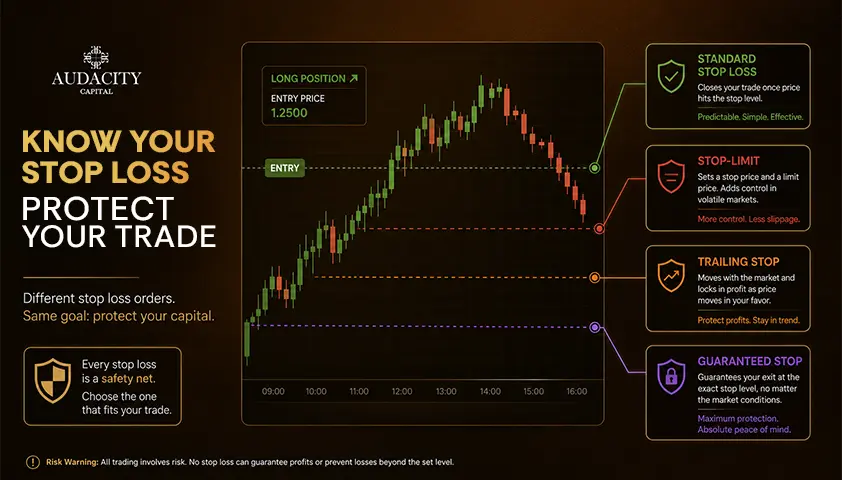
Not all stops behave the same way. Four types matter, and the differences come down to whether they protect your price, your execution, or both.
Type | How it triggers | Guarantees price? | Guarantees execution? | Typical cost | Best for |
Standard (fixed) | Becomes a market order | No | Yes | Free | A defined, unchanging exit |
Trailing | Becomes a market order, level follows price | No | Yes | Free | Protecting open profit on a trend |
Guaranteed (GSLO) | Guaranteed fill at your level | Yes | Yes | Fee or wider spread | Event risk and gap exposure |
Stop-limit | Becomes a limit order | Yes | No | Free | When price control beats certainty |
1. Standard (fixed) stop loss
The default. You set a fixed price level and it does not move once placed. When price hits it, the order becomes a market order and closes the position.
Use it when you want a clear, unchanging point that says your trade idea is wrong.
The tradeoff: it prioritizes getting you out over getting you a specific price, so the fill can slip in fast markets.
2. Trailing stop loss
A trailing stop loss automatically follows price as the trade moves in your favor, staying a set distance behind it. It locks in gains as the trade runs, while still giving it room to breathe, and it never moves against you.
If price reverses, the stop stays where it last trailed to. Use it to protect an open profit on a trending trade without babysitting the screen.
The tradeoff: a normal pullback can trail you out of a trade that then continues, so the trailing distance matters.
3. Guaranteed stop loss (GSLO)
A guaranteed stop loss, or GSLO, is offered by some brokers and guarantees your exit at exactly the price you set, even through a price gap or extreme volatility. This is the only type that removes slippage and gap risk entirely.
Brokers typically charge for it, either a fee or a wider spread, often only when the stop is actually triggered. Use it around known event risk or on positions held through gaps.
The tradeoff is the cost, and availability varies by broker and instrument, so always verify before relying on it.
4. Stop-limit order
A stop-limit order triggers a limit order rather than a market order, so it will only fill at your specified limit price or better. The crucial consequence: it gives you control over the price you accept, but it can fail to execute entirely if price runs straight past your limit.
That means in the exact scenario a stop loss matters most, a fast collapse or a gap, a stop-limit can leave you still holding the position. Use it when price control matters more than certainty of exit, and understand the tradeoff clearly: it does not guarantee you get out.
The pattern to remember: a standard stop guarantees execution but not price, a stop-limit guarantees price but not execution, and only a GSLO guarantees the price, usually for a fee.
Why Every Trader Needs a Stop Loss
The benefits are practical and stack up fast.
- It caps the loss on any single trade, so no one position can seriously damage your account.
- It protects capital, which matters as much as making a return, because staying solvent is what lets you take the next opportunity.
- It removes emotion by making the exit decision in advance, rather than mid-trade when fear and hope are loudest.
- It lets you step away from the screen, because the exit is already set.
- It enforces consistency, which is what turns a strategy into a repeatable result rather than a series of one-off decisions.
- It makes position sizing possible. This is the one most beginners miss. You cannot calculate how large a trade should be until you know where the idea is wrong, and the stop is what defines that.
That last point is the bridge to placement. Once you know your stop distance, your position sizing follows from it, and sound risk management becomes a calculation rather than a guess.
How to Decide Where to Place Your Stop Loss
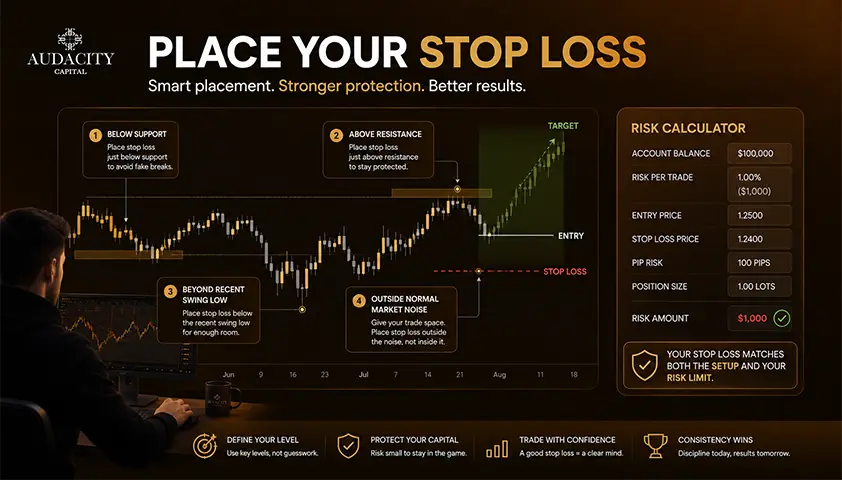
There are four common methods. The technical one deserves the most weight because it is the one that actually works.
1. Percentage-based.
The simplest starting point: decide a percentage of the entry price you are willing to lose. One commonly cited beginner range is around 5 to 10 percent, though treat that as one illustrative suggestion, not a rule.
It is useful for getting started, but blunt, because it ignores what the chart is telling you.
2. Technical.
Place the stop just beyond the level that would prove your trade idea wrong. For a long, that usually means just below a recent swing low or support level. For a short, just above a swing high or resistance.
For example: you buy at 500 rupees, the recent swing low sits at 450, so your stop goes just below it at 445, giving the level a little breathing room. This method is superior because it ties your exit to the actual reason you entered.
When you get stopped out, it means something: the market invalidated your idea, not just wobbled.
3. Volatility-based.
Use a measure such as ATR (Average True Range) to set the distance so that normal fluctuation does not stop you out. The same fixed distance is not appropriate for every instrument.
A volatile asset needs more room than a quiet one, and a stop that suits one market can be far too tight for another.
4. Fixed money risk.
Decide the exact amount you are willing to lose on the trade, then derive your position size from the stop distance. Risk stays constant across trades even as your stop distance changes.
Tie it all together with one rule: your stop distance and your target must be consistent with your risk-reward ratio, because a wider stop demands a proportionally larger reward to stay worth taking.
How Far is Too Far, and How Tight is Too Tight?
There are two failure modes.
A stop set too tight gets triggered by ordinary market noise, so you lose on trades whose direction you actually called correctly, then watch them run to where you expected.
A stop set too wide either produces an oversized loss, or, if you size the position correctly for that distance, leaves you with a position so small the trade is barely worth taking.
The resolution is the single principle that fixes most beginners' stop-loss problems: the stop belongs where the chart says your idea is wrong, and your position size then adapts to that distance. Never the other way around.
If the correct stop level implies a loss larger than you want to take, the answer is to trade a smaller position, not to squeeze the stop closer.
A stop is not a place to hide from a loss. It is the point at which your trade idea has objectively failed, and moving it closer just to feel safer only means you get stopped out by noise while the idea is still valid.
The Limitations of a Stop Loss
A stop loss is essential, but it has real limits, and pretending otherwise costs money.
1. A standard stop does not guarantee your exit price: Because it becomes a market order when triggered, it fills at the best available price, not necessarily your level.
2. Slippage: In fast-moving or illiquid markets, the fill can be worse than your stop price. This is most common around news releases and the market open, when prices move quickly and liquidity thins out.
3. Gap risk: Price can jump straight past your stop level without ever trading there. This happens most often on positions held overnight or over a weekend, and it can produce a loss larger than you planned, because the market simply reopens beyond your level.
4. Premature exits: A stop set too close gets triggered by normal noise, taking you out of trades that would have worked.
5. Stop clustering: Resting stop orders naturally pile up at predictable levels, such as round numbers and just beyond obvious swing highs and lows. Price is often drawn toward that concentration of orders before reversing, which is why placing your stop at the single most obvious level is rarely wise.
This is a market-structure and liquidity effect, simply where orders sit, not brokers or market makers working against you.
6. Stop-limit non-execution: If you use a stop-limit order, a fast move can run past your limit and leave you in the trade entirely.
Stop Losses in Forex, CFD and Leveraged Trading
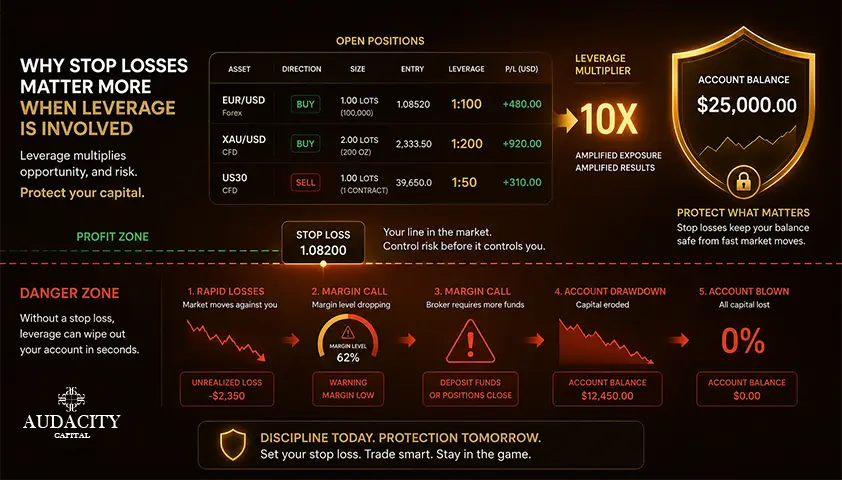
Stops are measured in pips, and the spread counts against you.
In forex and CFD trading, you set the distance in pips rather than a share price.
Remember that a long position is closed at the bid, so factor the spread into your stop distance. Ignore it and you will be stopped out slightly earlier than the chart alone would suggest.
Leverage is exactly why a stop is non-negotiable here.
Leverage magnifies the loss per pip, so an unstopped leveraged position can do damage out of all proportion to the size of the price move.
On a cash stock position a bad day hurts. In a leveraged position without a stop, it can be catastrophic. Disciplined risk management is not optional once leverage enters the picture.
The distinction that matters most: a stop loss is not a stop-out.
Stop loss | Margin stop-out |
Your chosen exit | Broker-forced exit |
Set in advance | Happens when margin runs out |
At your level | At whatever price is available |
A stop loss is the risk exit you decide in advance. A stop-out, or margin close-out, is your broker automatically closing positions because your margin has run out.
A stop-out is not risk management. It is the failure state a stop loss exists to prevent. A trader relying on the broker's margin call as their risk control has no risk control at all.
Gap exposure is heightened on positions held over weekends and holidays, when markets can reopen well away from where they closed.
This is one situation where a guaranteed stop is worth considering.
Finally, a generic note for anyone trading a funded or evaluation account.
On accounts with a daily or maximum drawdown limit, breaching that limit ends the account. A stop loss is what keeps a single trade from breaching that limit and ending everything.
Common Stop Loss Mistakes to Avoid
Each of these is a habit worth breaking, with the fix built in.
Mistake #1: Trading with no stop at all.
This leaves the loss uncapped and one bad trade able to define your whole month. Always define your exit before you enter.
Mistake #2: Widening or moving a stop away from price when the trade goes against you.
This is the single most damaging habit in trading. It converts a small planned loss into a large unplanned one and destroys the math behind your position sizing. The rule: you may move a stop to reduce risk, such as to breakeven, never to increase it.
Mistake #3: Setting stops too tight and getting knocked out by ordinary noise.
Mistake #4: Placing stops at the most obvious round numbers, where orders cluster and price is often drawn before reversing.
Mistake #5: Relying on a mental stop. It only works if you honor it every single time, and under real pressure most people hesitate. An order placed with your broker removes that decision at the moment it is hardest to make.
Mistake #6: Remove a stop before a news release, which is exactly when you need it most.
Mistake #7: Failing to size the position from the stop distance, which makes your stop level arbitrary.
Conclusion
A stop loss is an order placed in advance that automatically closes a position at a level you chose, capping the loss and, just as importantly, defining your risk before you enter, while you are still objective.
Keep the mechanics in mind.
A triggered standard stop becomes a market order, so the fill can differ from your level.
The four types matter: standard, trailing, guaranteed, and stop-limit, with only a guaranteed stop locking your exit price.
And the placement principle that beats every shortcut is this: put the stop where the chart says the idea is wrong, then size the position to that distance, rather than squeezing the stop to fit the size you wanted.
Stay honest about the limits. Knowing what is stop loss in trading at this level means accepting that a stop caps intended risk, it does not make losses impossible, and that slippage and gaps are real.
The hard part is not setting the stop. It is leaving it alone. The traders who last are the ones who treat it as non-negotiable.
Related Articles
Stop Loss Orders To Reduce Risk
Stop Loss in Day Trading : How to Use It Effectively?
Frequently Answer Questions
No. A standard stop becomes a market order when triggered and fills at the best available price, so in fast markets or gaps you can get a worse price than your level. Only a guaranteed stop loss locks the exit price, and brokers usually charge a fee or wider spread for it.
There is no universal number. A commonly cited starting point for beginners is around 5 to 10 percent of the entry price, but a better approach is to place the stop just beyond the level that would prove your trade wrong, then size the position from that distance. Treat any percentage as illustrative, not a rule.
Usually the stop was too tight for that instrument's normal volatility, or it sat at an obvious level where resting orders cluster. Giving it more room based on volatility or market structure, paired with a smaller position, often fixes it.
Yes. If price gaps past your stop or slippage occurs in a fast market, the fill can be worse than your level. This is why gap-prone positions held overnight and trades around news events carry extra risk.
A stop loss becomes a market order and prioritizes getting you out at the best available price. A stop-limit becomes a limit order that will only fill at your price or better, which means it can fail to execute entirely in a fast move and leave you in the position.
Only in your favor. Moving a stop to breakeven or trailing it to protect profit is sound. Widening it to avoid being stopped out turns a small planned loss into a large one and is one of the most damaging habits in trading.
Rarely. A mental stop only works if you honor it every single time, and under real pressure most traders hesitate. An order placed with your broker removes that decision from the exact moment it is hardest to make.
A stop loss is the exit you choose in advance to cap your risk. A stop-out is your broker force-closing positions because your margin ran out. A stop-out is not risk management. It is the outcome a stop loss is meant to prevent.

Handa nang maglapat ng disiplinadong panganib sa crypto? Galugarin ang mga bagong instrumento ng crypto ng Audacity Capital at dalhin ang iyong diskarte sa pangangalakal.
Matuto PaNewsletter
Sumali sa aming newsletter.
Sumali sa Aming Social Community

Simulan ang Iyong Paglalakbay Ngayon Gamit ang Aming Libreng Pagsubok
Ipagmalaki ang iyong mga kasanayan at tagumpay sa pamamagitan ng mga sertipiko at makakuha ng pagkilala para sa iyong pagsusumikap at dedikasyon mula sa mga potensyal na mamumuhunan at kasamahan.
Libreng PagsubokMga Kaugnay na Artikulo

What Is a Breaker Block in Trading? A Complete Guide for 2026
Learn what a breaker block is in trading, how bullish and bearish breaker blocks form, how to identify them, and how traders use them in SMC and ICT.

What Is BOS in Trading? A Complete Guide to Break of Structure (2026)
Learn what BOS in trading means, how Break of Structure works, how to identify bullish and bearish BOS, and how traders use it in market analysis.

Prop Firms With No Consistency Rule in 2026
Compare prop firms with no consistency rule. Find firms offering flexible profit requirements, trading conditions, and payout policies for traders.

Spread Betting vs CFD Trading
Spread betting vs CFD trading for UK traders: how each is priced, the real tax difference and its conditions, expiry costs, and which suits which trader.