


10 Price Action Trading Strategies: Complete Guide 2026



Key Highlights
Price action trading is a methodology that relies on the analysis of historical price movements to make trading decisions, rather than relying primarily on lagging technical indicators (like Moving Averages or RSI).
In a nutshell, this is what you need to know about this trading strategy:
- Successful trading begins with identifying Support and Resistance, which act as the floor and ceiling for market fluctuations.
- Patterns like the Pin Bar indicates potential rejection and a possible reversal opportunities at key zones
- Traders must distinguish between Trending markets for maximum profit extension and Mean Reversion for trading back to value.
- Using precise Position Sizing formulas ensures that no single trade violates the tight drawdown limits required by prop firms.
- By removing lagging indicators, traders reduce "analysis paralysis" and focus on the real-time battle between buyers and sellers.
Price Action Trading Strategies
Price action trading is the art of making market decisions based on the movement of price itself. Unlike other methods, price action trading prioritizes price movement over lagging indicators like Moving Averages or RSI. Here, you get to focus entirely on what the price chart is telling you right now.
Before proceeding further, it’s important to point out that all technical data (including price action) is based on past events. Price action is simply the "least lagging" because it has no additional mathematical smoothing.
In the world of prop trading, price action is a favorite among professional traders. It allows for tight stop losses and high reward-to-risk ratios. This is essential for passing the strict drawdown rules set by prop firms.
Thus, by mastering price action, you learn to read the "story" of the market. Through it, you’re able to identify areas of high liquidity and institutional interest. This article breaks down the core strategies you need to succeed. Read on to learn more!
Understanding the Foundation: Support and Resistance

Support and Resistance levels are the most basic building blocks of price action. Support acts as a floor where price tends to bounce upward. On the other hand, resistance acts as a ceiling where price tends to fall.
Prop traders look for "strong" levels that have been tested multiple times. Please note that while multiple touches show historical significance, traders should look for a fresh rejection rather than assuming a level is "invincible" the fifth time it is hit. In institutional trading, frequent touches can weaken a level as the "orders" sitting there are gradually filled/absorbed.
However, once a level is broken, its role often flips.
- Support: A price zone where buying interest is strong enough to overcome selling pressure.
- Resistance: A price zone where selling interest is strong enough to overcome buying pressure.
- Role Reversal: When resistance is broken, it often becomes new support.
High-Probability Price Action Patterns
Patterns help traders identify potential reversals or continuations in the market. These visual cues represent the psychological battle between buyers and sellers. Recognizing these early gives you a significant edge.
The Pin Bar (Reversal Pattern)
A Pin Bar has a long "wick" or "tail" and a small body. The long wick shows that the price tried to move in one direction but was aggressively pushed back. This indicates a strong rejection and a likely move in the opposite direction. Therefore, look for a wick that is at least two-thirds the length of the entire candle, protruding into a key support or resistance zone. And only trade these when they protrude into established Support/Resistance.
Also, don’t just trade a Pin Bar in isolation. Require at least two factors (e.g., Pin Bar + Support Level + Downtrend Line Break).
The Engulfing Candle
An Engulfing pattern consists of two candles. The second candle completely "covers" or engulfs the body of the previous one. In this case, the body of the second candle must completely overlap the body of the first, signifying a total shift in momentum. Note that a bullish engulfing pattern can indicate a shift in momentum, particularly at key level.
Inside Bars (Continuation or Reversal)
An Inside Bar is a candle that stays within the high and low range of the previous candle. This represents a period of consolidation or "breathing" in the market. Traders wait for a breakout of this range to enter a trade. It’s important to note that an Inside Bar breakout often fails initially. It’d, therefore, be a good idea to wait for a "retest" of the broken range for a safer entry as the “failed” breakout is often a "stop run" before the real move.
Pro Tip: Price action signals are most reliable during high-volume sessions (London/New York open). To avoid “fake outs,” wait for a breakout followed by a successful retest of the range boundary.
Top Price Action Trading Strategies
These are the most commonly used price action trading strategies among professional traders.
- Pin Bar Reversal – Signals strong rejection at key levels
- Engulfing Pattern – Indicates a shift in momentum
- Inside Bar Breakout – Shows consolidation before expansion
- Support & Resistance Bounce – Trades reversals at key levels
- Breakout Trading – Captures momentum after key level breaks
- Trend Pullback Entry – Enters during retracement in trend
- Range Trading – Trades within sideways markets
- Trendline Rejection – Uses dynamic support/resistance
- False Breakout – Trades failed breakouts (trap moves)
- Multi-Timeframe Confluence – Aligns signals across timeframes
When Should You Use Each Price Action Strategy?
- Trending markets → Trend pullbacks, breakout strategies
- Ranging markets → Support/resistance bounce, mean reversion
- High volatility → False breakout, engulfing patterns
- Low volatility → Inside bar setups
Price Action Strategy Comparison
Strategy | Best Market | Signal Type |
|---|---|---|
Pin Bar | Reversal | Rejection |
Breakout | Trending | Momentum |
Range Trading | Sideways | Mean Reversion |
Trend Pullback | Trending | Continuation |
Trend Following vs. Mean Reversion
Success in prop trading requires knowing the current market environment. You must decide if the market is trending or moving sideways. Each environment requires a different mindset and strategy.
Trading the Trend
Prop firms love trend traders because trends offer the largest profit targets. In an uptrend, you look for Higher Highs (HH) and Higher Lows (HL). You enter on the "pullback" to a support level or a trendline.
Mean Reversion
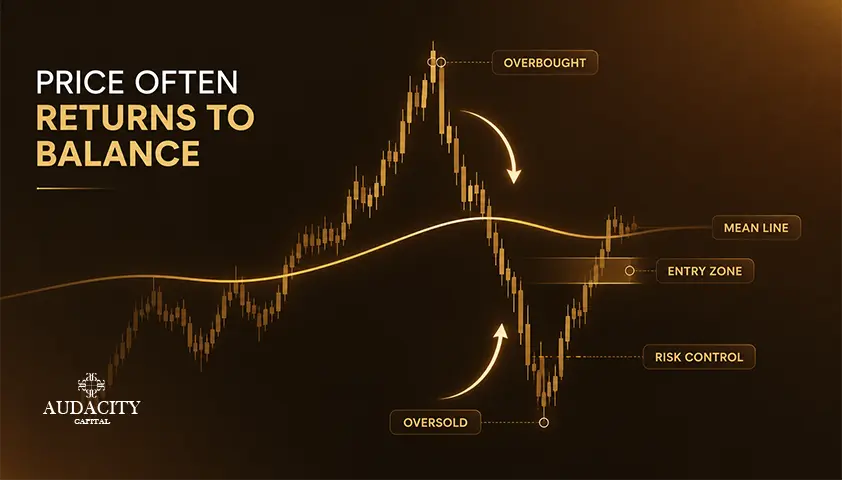
Mean reversion assumes that price will eventually return to its average. If price moves too far away from its value area, it is considered "overextended." Traders then look for price action signals to trade back toward the middle.
Pro Tip: Value in Mean Reversion refers to a Moving Average or a Volume Profile Point of Control.
Practical Trading Example: The Support Bounce
Let's look at a real-world scenario on the GBP/USD currency pair. Price has been trending downward but hits a major support level at 1.2500. You observe the market closely as it approaches this zone.
Instead of crashing through, the price forms a large Bullish Pin Bar. The long wick dips below 1.2500 but the candle closes back above it. This shows that buyers are defending this price level aggressively.
You enter a "Long" (Buy) position at the close of the Pin Bar. Your stop loss is placed 5 pips below the wick of the candle. You set a Take Profit target at the nearest resistance level, aiming for a 1:3 reward-to-risk ratio.
Risk Management for Prop Traders
Even the best price action strategy will fail without proper risk management. Prop firms have strict "Daily Loss" and "Total Drawdown" limits. This means that you must calculate your position size before every single trade.
To calculate your position size, use the following formula:
Lot Size = Risk Amount / (Stop Loss in Pips × Pip Value of 1 Standard Lot)
Example:
- Account: $100,000
- Risk (0.5%): $500
- Stop Loss: 20 pips
- Pip Value (EUR/USD): $10 per lot
- Calculation: $500 / (20 x 10) = 2.5 Lots
By using this calculation, you ensure that even if the trade hits your stop loss, you only lose the pre-determined $500. This discipline is what separates funded traders from those who fail.
A word of caution: "Pip Value" changes based on the currency pair (e.g., USD/JPY or Gold have different values).
Price Action Trading Checklist
Before entering a trade, ask:
- Is price at a key support/resistance level?
- Is there a clear price action signal (pin bar, engulfing)?
- Does the setup align with the trend?
- Is the risk-to-reward ratio at least 1:2?
- Am I risking less than 1%?
Common Mistakes in Price Action Trading
- Trading patterns without context
- Ignoring support and resistance
- Overtrading low-quality setups
- Using inconsistent risk management
- Relying on a single signal
Why Price Action Trading Works
Price action reflects real-time buying and selling pressure. It shows how market participants react to key levels, making it one of the most direct ways to read market behavior.
Best Timeframes for Price Action Trading
Higher timeframes like the 4-hour (H4) and Daily (D1) provide more reliable signals and reduce market noise. Lower timeframes such as M5 or M15 offer more trading opportunities but require faster decision-making and experience due to increased volatility.
Comparing Different Price Action Tools
Tool | Primary Use | Best Market Condition |
Trendlines | Identifying direction | Trending markets |
Horizontal Levels | High Liquidity Entry and Exit | All market conditions |
Precise Entry triggers | Near key levels | |
Measuring pullbacks | Strong trends |
Conclusion
Price action trading is not about predicting the future. It is about reacting to what the market is doing in the present moment. By focusing on clean charts and horizontal levels, you remove the noise that confuses most traders.
To succeed in a prop firm, you must combine these strategies with extreme discipline. Focus on one or two patterns and master them across different timeframes. Consistency is the only path to becoming a funded professional.
Start by practicing on an Audacity Capital demo account to recognize these patterns in real-time. Once you can identify support, resistance, and rejections without thinking, you are ready for the challenge. Keep your risk low, your head clear, and follow the price.
Learn, practice, and apply your trading strategy in Audacity Capital's free monthly trading competition.
FAQs
Price action is often considered superior because it is not lagging. Indicators use past price data to create a line, whereas price action reflects the result of buying and selling pressure.
Higher timeframes like the 4-hour (H4) and Daily (D1) are generally more reliable. They help filter out the "noise" found on smaller timeframes like the 1-minute chart.
No, it is better to master 2 or 3 high-probability patterns like the Pin Bar and Engulfing candle. You need to remember that the quality of your setup is much more important than quantity.
Yes, price action is based on human psychology, which exists in every market. It works effectively for Forex, Stocks, Commodities, and Crypto.
Most successful prop traders’ risk between 0.5% and 1% per trade. This allows them to survive a losing streak without hitting the maximum drawdown limit.

Kriptoya disiplinli risk uygulamaya hazır mısınız? Audacity Capital'in yeni kripto enstrümanlarını keşfedin ve ticaret stratejinizi getirin.
Daha Fazla BilgiBülten
Yeniliklerden haberdar olmak için bültenimize katılın.
Sosyal Topluluğumuza Katılın

Bugün Yolculuğunuza Başlayın Ücretsiz Denememizle
Becerilerinizi ve başarılarınızı sertifikalar aracılığıyla gururla sergileyin ve potansiyel yatırımcılardan ve akranlarınızdan sıkı çalışmanız ve özveriniz için takdir alın.
Ücretsiz Denemeİlgili Makaleler
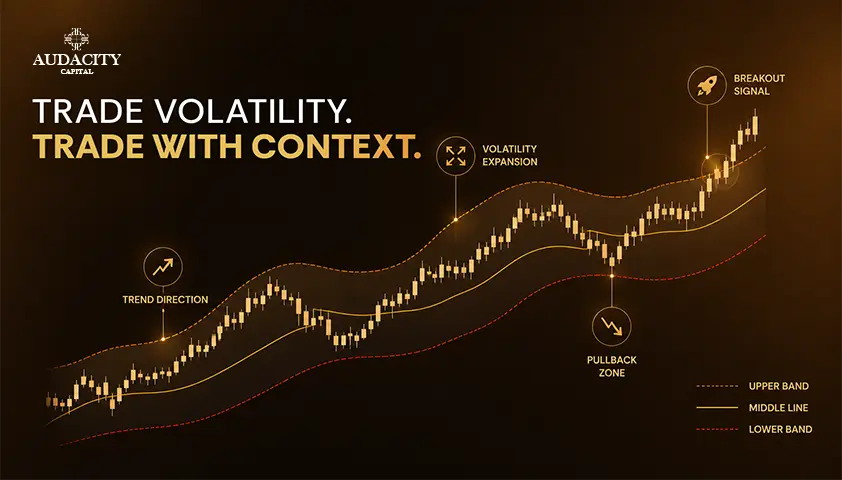
Keltner Channel Trading Strategy: How to Read Volatility With Context
Discover how Keltner Channels measure market volatility, spot trend pullbacks, and confirm breakouts. Includes setup rules, settings, and testing methods.

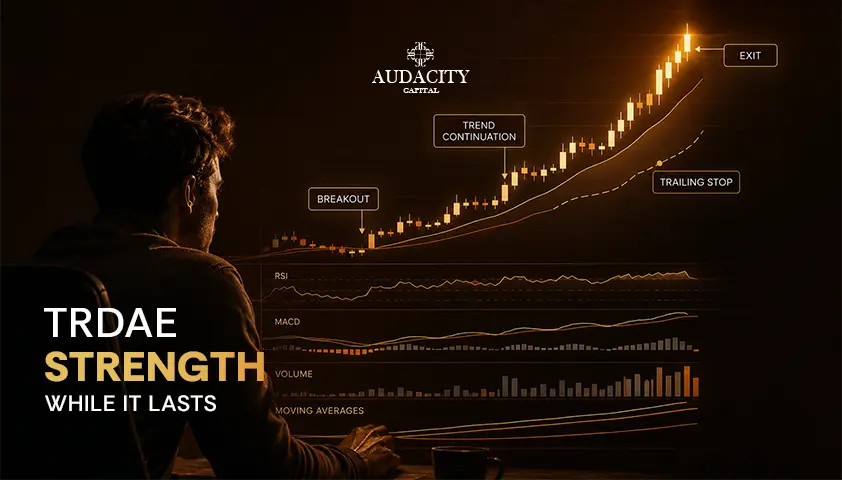
Momentum Trading Strategy: A Comprehensive Guide
Master the core principles of a momentum trading strategy. Learn how to use key indicators, manage sharp-reversal risks, and master exit timing.
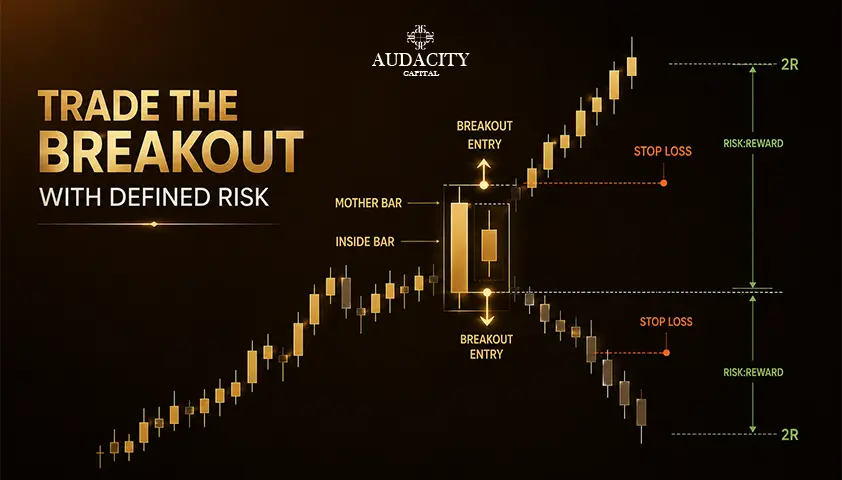
Inside Bar Trading Strategy: Rules, Entries and Risk Guide
Master the inside bar trading strategy with practical rules for pattern identification, entry triggers, stop placement, risk management, and testing.
Mean Reversion Trading Strategy Explained (2026)
Prices that stretch too far tend to snap back to an average, but only in the right market. Learn the tools, the setup, and the trend risk.