


End-of-Day Trailing Drawdown Explained: Formula, Examples & Rules



End of day Trailing Drawdown
End-of-day trailing drawdown is a risk management rule used by many prop firms to determine the maximum loss a trader can incur before violating account rules. Unlike intraday trailing drawdown, which updates continuously throughout the trading day, end-of-day trailing drawdown only adjusts after the market closes.
Because the drawdown threshold remains stable during active trading hours, many traders consider it one of the most flexible drawdown models available. Understanding how end-of-day trailing drawdown works can help traders manage risk more effectively and avoid unnecessary account breaches.
Read on to learn more about the end-of-day trailing drawdown!
What Is End-of-Day Trailing Drawdown

Prop firms that provide an end-of-day trailing drawdown will only make changes to the maximum stop loss level after the markets have closed and after the balance has increased.
Many traders prefer end-of-day trailing drawdown because it provides greater flexibility during intraday trading compared to real-time trailing drawdown models.
End-of-Day Trailing Drawdown Formula
Understanding the formula behind an end-of-day trailing drawdown can help traders avoid accidental account breaches and manage risk more effectively.
Formula
New Drawdown Limit =Highest End-of-Day Balance−Maximum Drawdown Allowance
Example
Metric | Value |
|---|---|
Starting Account Balance | $50,000 |
Maximum Drawdown Allowance | $2,000 |
Highest End-of-Day Balance | $52,000 |
New Drawdown Floor | $50,000 |
In this example, even if the account reaches $53,000 during intraday trading, only the closing balance of $52,000 will be used to calculate the new drawdown level.
This is one of the main reasons many traders prefer end-of-day trailing drawdown over intraday trailing drawdown.
How End-of-Day Trailing Drawdown Works (Example)
Suppose you start with:
Metric | Value |
|---|---|
Starting Balance | $50,000 |
$2,000 | |
Initial Drawdown Floor | $48,000 |
During the trading day, your account rises to $51,500 before closing at $51,000.
Because end-of-day trailing drawdown only considers the closing balance, the new drawdown floor becomes:
$51,000 − $2,000 = $49,000
The following day, the account reaches $55,000 intraday and closes at $52,500.
The new drawdown floor becomes:
$52,500 − $2,000 = $50,500
However, some prop firms stop the trailing drawdown at the initial account balance, while others allow it to move above the starting balance. Traders should always review the firm's drawdown rules before purchasing a challenge account.


Audacity Capital Empowering Traders Since 2012
Join the Prop FirmEnd-of-Day Drawdown vs Static Drawdown
While both drawdown models are considered trader-friendly, they operate differently.
Feature | End-of-Day Trailing Drawdown | Static Drawdown |
|---|---|---|
Moves Up With Profits | Yes | |
Moves Down | No | |
Fixed Risk Level | No | |
Based On Account Growth | Yes | |
Best For | Active traders | Swing traders |
Flexibility | Medium | High |
With a static drawdown, the loss limit never changes regardless of account performance. In contrast, an end-of-day trailing drawdown moves upward as the account grows, helping prop firms protect capital while still rewarding profitable traders.
End of Day Drawdown Vs Trailing Drawdown

An end-of-day drawdown will typically calculate the maximum loss based on the balances available in your trading account at the close of official trading hours. These types of calculations help provide additional flexibility to traders who like to ride out market dips and peaks.
The trailing drawdown, on the other hand, will update on a real-time basis and is dependent on the highest realized equity. These real-time calculations are what make it restrictive, as the profits will be locked in immediately they’re made.
Table Comparison of End-of-Day Drawdown and Trailing Drawdown
Feature | Trailing Drawdown | End of Day Drawdown |
Calculation Timing | Continuous and updated on a real-time basis. Every tick will be recorded. | The drawdown will be calculated at the close of the active trading session. |
Basis of Calculation | Highest open equity, including your unrealized profits and losses. | Only the closed trade balance or the realized profits and losses are taken into account. |
Sensitivity | Very sensitive. It reacts to every peak made during intraday trading. | Low and doesn’t consider intraday peaks. |
Impact/Effect on Intraday Trading Activities | It increases as soon as a new high is made | It will only increase if the profits are able to hold until the end of trading. |
Risk Level to the Prop Trader | Higher and more restrictive | Low and is among the most forgiving types of drawdowns you’ll encounter when trading. |
Recommended for: | Day traders and scalpers | Position traders and swing traders |
Key Risk | An account breach that happens when an open trade goes on a bear run, thus reversing all gains made earlier. | Giving back profits but without experiencing any breach or rule violation. |
Let’s imagine a scenario where you have a $50,000 trading account and a $2,000 drawdown limit. As you go about your trading activities, the account makes a profit of $1,000 on the open trade positions, before going on a reversal that leads to it losing $500.
Trailing Drawdown: Your highest account balance on this day was $51,000, which will cause the drawdown to rise to $49,000.
End of Day Drawdown: If your trading day ends with a loss of $500, it means that your new account balance will be $49,500. The prop firm will recalculate the drawdown based on this new balance, as opposed to the peak of $51,000 recorded during the day.
Intraday Vs End Of Day Trailing Drawdown
The intraday drawdown measures the largest peak-to-trough decline in the trading balance of a funded account within a day’s trading activities. Prop firms using this drawdown rule will consider the account balance changes and price movements happening during the normal trading hours.
Table Comparison of Intraday and End-of-Day Trailing Drawdown
Feature | End of Day Trailing Drawdown | Intraday Trailing Drawdown |
Calculation Timing | At the end of the trading day | Real-time or continuous |
Balance Basis | Only the realized profit will be considered in the calculations | Realized + unrealized profits |
Sensitivity | Relaxed | Fast moving |
Risk Level to the Trader | Low. An end-of-day trading enables you to ride out intraday swings | High risk level that can lead to premature account termination |
Recommended for: | Day traders and swing traders | High-frequency traders and scalpers |
Stress Level | Lower | High |
In intraday trading, if the account balance rises to $103,000, the drawdown limit will lock onto this new balance, even if the closing balance drops to $100,000. For an end-of-day drawdown, the limit will only change if the closing balance changes.
Advantages of End-of-Day Trailing Drawdown
Many traders consider end-of-day trailing drawdown one of the most balanced risk models offered by prop firms.
Greater Trading Flexibility
Intraday market fluctuations do not immediately affect the drawdown calculation.
Reduced Stress
Traders can focus on executing their strategy rather than constantly monitoring a moving drawdown threshold.
Better Risk Management
Because the drawdown updates only after the market closes, traders have a more stable framework for managing risk.
Suitable for Multiple Trading Styles
The structure works well for:
- Day traders
- Swing traders
- Momentum traders
- Trend-following traders
Disadvantages of End-of-Day Trailing Drawdown
Despite its benefits, end-of-day trailing drawdown is not perfect.
The Drawdown Still Trails Upward
As account balances increase, the drawdown threshold also rises.
Less Flexible Than Static Drawdown
Static drawdown accounts generally provide greater long-term flexibility.
Requires Careful End-of-Day Risk Management
Large losses near market close can significantly impact the next day's drawdown level.
Which Traders Benefit Most From End-of-Day Trailing Drawdown?
Not every trader benefits equally from the same drawdown model.
Best For
- Day traders
- Swing traders
- Momentum traders
- Trend traders
- Traders who hold positions through intraday volatility
Less Suitable For
- Ultra-high-frequency scalpers
- Traders who frequently overleverage
- Traders who rely on aggressive recovery strategies
Most traders prefer end-of-day trailing drawdown because it provides more room to manage normal market fluctuations while still maintaining effective risk controls.
Why Many Traders Prefer End-of-Day Trailing Drawdown
Many traders prefer end-of-day trailing drawdown because it provides more flexibility than intraday trailing drawdown. Since the drawdown threshold only updates after the trading day closes, traders can hold positions through normal market fluctuations without worrying about unrealized profits immediately increasing their risk limits.
This makes end-of-day trailing drawdown particularly popular among swing traders, momentum traders, and traders who prefer a less restrictive risk management model.
Which Prop Firms Use End-of-Day Trailing Drawdown?
Many futures prop firms use end-of-day trailing drawdown because it provides traders with greater flexibility during active trading sessions. Unlike intraday trailing drawdown, the drawdown threshold only adjusts after the trading day closes, allowing traders to manage positions without being affected by temporary intraday fluctuations.
Prop Firm | End-of-Day Trailing Drawdown |
|---|---|
Topstep | Yes |
Apex Trader Funding | Yes |
Alpha Futures | Yes |
FundedNext Futures | Yes |
Bulenox | Yes |
Tradeify | Yes |
Note: Audacity Capital uses a rollover-based daily drawdown model rather than a traditional end-of-day trailing drawdown. This means the daily loss limit is recalculated at rollover and remains fixed throughout the trading day.
Common End-of-Day Trailing Drawdown Mistakes
Ignoring the Closing Balance
Many traders focus on intraday profits and forget that only the end-of-day balance affects the drawdown calculation.
Assuming the Drawdown Will Reset
Once the drawdown limit moves upward, it generally does not move back down.
Overleveraging Near Market Close
Large losses late in the session can significantly impact the next day's drawdown threshold.
Confusing End-of-Day and Intraday Drawdown
These are different risk models and should not be treated the same way when planning trades.
Conclusion
End-of-day trailing drawdown is one of the most trader-friendly drawdown models used by prop firms. Unlike intraday trailing drawdown, it only adjusts after the market closes, giving traders greater flexibility to manage positions during active trading hours.
By understanding how the drawdown is calculated, comparing it with other drawdown models, and applying sound risk management principles, traders can reduce the likelihood of account breaches and improve their long-term consistency.
FAQ
It refers to a rule used by prop firms to limit the total amount of capital that an evaluation or funded trading account can afford to lose on any one trading day.
Yes. The end of day drawdown limit will usually reset at the beginning of each trading day and will be based on the account balance present on the previous closing day.
Prop firms use it for three reasons: to safeguard firm capital, encourage traders to trade with discipline, and to promote consistent profitability.
An end of day drawdown updates the limit after the market closes while the trailing drawdown does the same on a real time basis.
The only way to remain a funded trader is by learning to avoid large drawdowns. For this, you must learn how to use daily stop limits, the importance of diversification, and most importantly, how to avoid overleveraging.

Ready to apply disciplined risk to crypto? Explore Audacity Capital's new crypto instruments and bring your trading strategy.
Learn MoreNewsletter
Join our newsletter to stay up to date on features and releases.
Join Our Social & Community

Start Your Journey Today With Our Free Trial
Proudly showcase your skills and accomplishments through certificates and get recognition for your hard work and dedication from potential investors and peers.
Free TrialRelated Articles

Instant Funding vs the Challenge: Which Funded Account Should You Choose?
Two routes to a funded account, one honest comparison. See how instant funding vs challenge differ on cost, drawdown, and profit split, and which route fits you.


How Much Does an Instant Funded Account Cost?(2026 updated)
Sticker price tells only half the story. See what an instant funded account cost really covers, why it runs 2 to 3x a challenge, and if it's worth it.

What Is Take Profit in Trading? A Detailed Guide for Traders
Learn what a take profit is, how to set one well using technical levels, risk-reward, and ATR, plus partial profits, trailing stops, and a funded-trader lens.
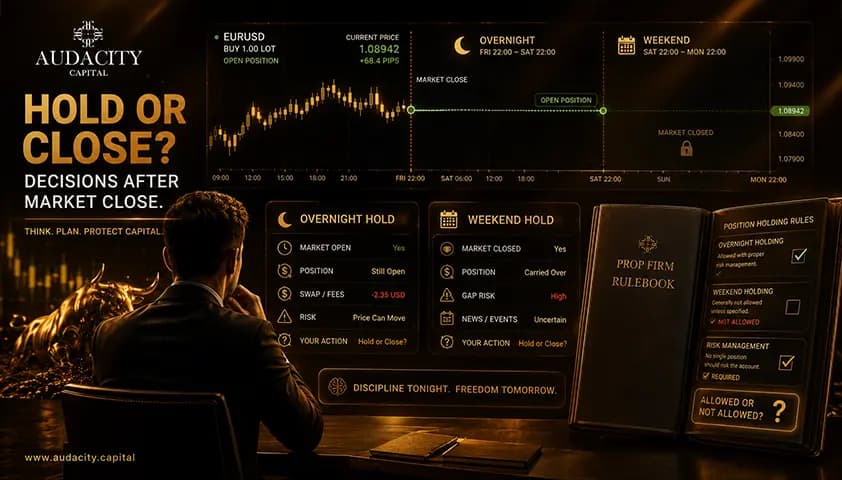
Can You Hold Trades Overnight or Over the Weekend on a Prop Firm?
Can you hold trades overnight or over the weekend on a prop firm? Learn the rules, risks, gap exposure, and which prop firms allow swing trading.