


What Is Static Drawdown? How It Works + Examples



A static drawdown is a fixed maximum loss limit that remains unchanged regardless of account growth. If a trader exceeds this limit, the account is breached. Unlike trailing drawdown, static drawdown does not adjust upward as profits increase.
Key Highlights
Protecting trading capital and maintaining account integrity is a key priority when using a funded account. A static drawdown refers to a fixed limit placed on the total loss that this account can incur, and is normally measured from the starting balance. In a nutshell:
- A loss level refers to the drawdown limit at which the account balance must stay
- The ‘Hard Stop’: It’s a permanent violation that occurs when the account’s balance dips below this level during trading.
- Fixed Floor: It’s a level that doesn’t adjust upwards and will remain anchored at the same point until the moment when you initiate your first payout.
- Proper risk management within your static drawdown limit will help the trading account remain safe and compliant.
Static Drawdown
A static drawdown is a fixed loss limit used by prop trading firms to determine the maximum amount a trader can lose before violating account rules. Unlike a trailing drawdown, the drawdown threshold does not move upward as profits increase. Instead, it remains fixed at a predetermined level based on the starting account balance.
Because the loss limit never changes, many traders consider static drawdown one of the easiest drawdown models to manage. It provides predictable risk parameters, greater flexibility when trading, and a larger profit cushion as account balances grow.
In this guide, you'll learn how static drawdown works, how it is calculated, the advantages and disadvantages of this model, and how it compares to trailing drawdown.
How Does A Static Drawdown Future Prop Firm Work?

A static drawdown works by setting a fixed equity (balance) floor once the funded account has become active. Let me use an example to try to explain how this drawdown works.
Let’s say that you have started with a balance of $100,000 in your funded account. The prop firm has, in turn, assigned a 10% static drawdown limit to your trading activities.
What this means is that if the account hits the $90,000 limit, it will be game over for you!
My years in the industry have taught me that this limit will never increase, regardless of how much profit you rake in during trading. Your floor limit will remain static and tied to the opening balance.
By doing this, the prop trading firm will have created a permanent line, which too many traders assume is flexible, leading to failure. In most cases, confusion will set in when the equity has increased.
If, for instance, you’re able to grow your equity to $112,000 from $100,000, it means you have raked in a profit of $12,000. For many traders, the immediate thought will be that they now have additional room.
But this couldn’t be further from the truth. No matter how much profit you make, the floor will remain fixed at the $90,000 mark. As a result, you can only afford to lose $22,000 before breaching the rules.
What I am trying to say here is that the earlier success recorded by the account doesn’t matter. As soon as your account balance hits the fixed floor limit of $90,000, the prop firm will shut it down!


Audacity's Trading Program
Funded Trader ProgramStatic Drawdown Formula
A static drawdown uses a fixed loss limit based on the starting account balance. Unlike trailing drawdown, the drawdown threshold does not move as profits increase.
Formula
Static Drawdown Floor =Starting Account Balance−Maximum Drawdown Allowance
Example
Metric | Value |
|---|---|
Starting Account Balance | $100,000 |
Maximum Drawdown | $10,000 |
Static Drawdown Floor | $90,000 |
Even if the account grows to $120,000, the drawdown floor remains fixed at $90,000.
How Traders End Up Miscalculating Risks
Watch closely, and you’ll notice that there’s a common pattern that emerges among all funded traders. And it goes like this: disciplined traders rake in early profits, which then lead to improved position sizes. This, in return, leads to improved confidence levels and an eagerness to increase lot sizes.
While some may think that this is a good approach to trading, the hard truth is that the static drawdown doesn’t increase with each recorded win. Do you remember that $90,000 hard floor limit we mentioned earlier? The one that was set when the funded account became active?
Learn more about What is Drawdown in Trading?
That same floor will remain no matter how much profit you make. This means that when you increase your position sizing after having recorded some early wins, you’ll also inadvertently reduce your error margin. What do I mean by this?
In an ordinary $100,000 funded account that has a 0.5% risk per open position, you’ll have the leeway to make about 20 losses before hitting your static drawdown limit. Now, when you increase your risk to 2%, it means you’ll only be able to tolerate five losses before hitting the same limit.
Looking at this explanation, the math is quite clear: choosing to take on additional risk after recording an early win will leave you with less room for making a mistake.
Understanding How an Account Balance Can Mislead You in a Static Drawdown Model

Free Funded Account Challenge
free prop firm challengeThe psychological trap in a static drawdown will become stronger as the balance in your funded account increases. When your trading dashboard shows that you have $112,000 at your disposal, the urge to trade based on this high number will rise.
But what you need to understand is that the account’s enforcement mechanism will not account for the prevailing balance: it will only measure how far you have moved from the initial floor. It’s not unheard of to find a funded trader being shocked by the drop in their account, yet they have remained largely profitable.
You need to understand that the fixed rule doesn’t measure your profits and losses (P&L) curve. It does, however, provide one essential benefit: predictability. It has no moving target, which means that you’re in a position to determine your failure point from your starting position. For those who are able to understand this one rule, it becomes easier for them to model their risk exposure.
Best Prop Firms With Static Drawdown
Not all prop firms use a pure static drawdown model. Some firms use trailing drawdown, while others use hybrid risk management structures that combine fixed and dynamic drawdown rules.
Prop Firm | Static Drawdown Available |
|---|---|
Alpha Futures | Yes |
Bulenox | Yes |
Tradeify | Yes |
My Funded Futures | Selected Programs |
Apex Trader Funding | Selected Programs |
Take Profit Trader | Yes |
Note: Drawdown models can vary between account types and may change over time. Always review the latest challenge rules before purchasing a prop firm evaluation.
Static vs Trailing Drawdown

A trailing drawdown will increase with every new tick made, thus securing your profits while also tightening the risk parameters. On the other hand, you have the static drawdown, which will remain unchanged even after you make consecutive gains.
Unlike trailing drawdown, a static drawdown remains fixed regardless of account performance. While trailing drawdown moves upward as profits increase, static drawdown provides a consistent risk threshold throughout the trading period.
Not sure whether a static drawdown or trailing drawdown is better for your trading style? Read our detailed Static Drawdown vs Trailing Drawdown comparison guide.

Audacity Capital Empowering Traders Since 2012
Join the Prop FirmAdvantages of Static Drawdown
Many traders prefer static drawdown because it provides a predictable and easy-to-manage risk framework.
Fixed Risk Parameters
The drawdown limit never changes, making it easier to calculate risk exposure.
Greater Trading Flexibility
Profits do not tighten the drawdown threshold, allowing traders to manage positions more freely.
Ideal for Swing Trading
Static drawdown is often preferred by traders who hold positions for multiple days or through market volatility.
Easier Risk Management
Because the loss limit remains fixed, traders can create long-term trading plans without constantly monitoring a moving drawdown threshold.
Less Psychological Pressure
There is no concern about protecting a rising drawdown floor after a profitable trading session.
Disadvantages of Static Drawdown
Although static drawdown offers flexibility, it may not be suitable for every trader.
Less Profit Protection
Unlike trailing drawdown, profits are not automatically locked in as the account grows.
Can Encourage Excessive Risk-Taking
Some traders become overly aggressive because the drawdown threshold remains unchanged.
Larger Potential Losses
A profitable account can still lose a significant portion of its gains before reaching the static drawdown limit.
Not Available at Every Prop Firm
Many prop firms prefer trailing drawdown models because they provide stronger capital protection.
Who Should Use Static Drawdown?
Static drawdown is often preferred by traders who value predictable risk management and greater flexibility when managing open positions.
Best For
- Swing traders
- Position traders
- Conservative traders
- Traders who hold positions overnight or over the weekend
- Traders who prefer fixed risk parameters
- Traders looking for a larger profit cushion as their account grows
Less Suitable For
- Aggressive scalpers
- Traders who frequently increase position sizes after profitable trades
- Traders who prefer dynamic risk models that lock in profits automatically
Because the drawdown threshold remains fixed, static drawdown can be easier to manage than trailing drawdown. However, traders must still maintain disciplined risk management, as profits are not automatically protected when the account balance increases.
Conclusion
A static drawdown is one of the simplest drawdown models used by prop firms. Because the loss limit remains fixed regardless of account growth, traders benefit from predictable risk management and greater flexibility when managing positions. Understanding how static drawdown works can help traders choose the right prop firm and avoid unnecessary account breaches.
FAQ
Many beginner traders underestimate the mental effort that’s needed to manage their trading risk limits. When using the trailing drawdown, you’re required to keep track of all changing limits. In a static drawdown, the limit remains the same, reducing the need for constant recalculations.
Yes. If, for example, you were to risk 0.5% of your capital on each trade, it means you’ll be able to accommodate about 20 back-to-back losses before violating the firm’s rules.
The consistency this drawdown limit provides allows for accurate back testing of trading strategies by traders.
Evaluation challenges and funded trading accounts favor the static drawdown model because it has a simple enforcement. The firm will set a threshold when the account becomes active and check it later to determine whether you have exceeded the limit. It eliminates the need to watch multiple changing targets.
Unlike other drawdown models, the static drawdown doesn’t reward early wins. It instead seeks to establish whether you can maintain a consistent risk management plan, making it more of a psychological than a strategic test.

Ready to apply disciplined risk to crypto? Explore Audacity Capital's new crypto instruments and bring your trading strategy.
Learn MoreNewsletter
Join our newsletter to stay up to date on features and releases.
Join Our Social & Community

Start Your Journey Today With Our Free Trial
Proudly showcase your skills and accomplishments through certificates and get recognition for your hard work and dedication from potential investors and peers.
Free TrialRelated Articles
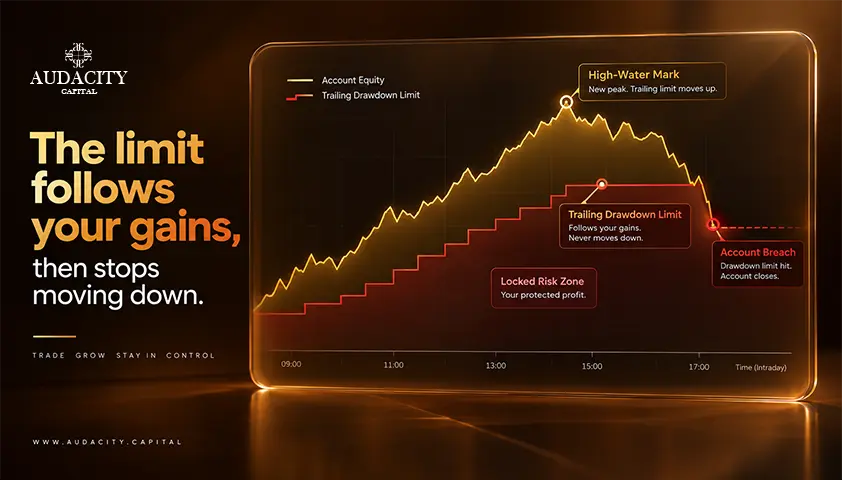
Intraday Trailing Drawdown: How It Works and How to Trade It
Intraday trailing drawdown lifts your loss limit with every equity high, open profit included. See the formula, lock rules and how to trade it.


What Is a Daily Drawdown in a Prop Trading Firm?
Understand daily drawdown in trading, how it is calculated, and why managing daily losses is crucial for funded traders.

Trailing Max Drawdown
Understand trailing max drawdown rules in prop trading. Learn how it works, how it’s calculated, and how traders manage drawdown limits.

7 Balance-Based Drawdown Prop Firms in 2026 : Honest Review
Compare the 7 best balance-based drawdown prop firms in 2026. Explore drawdown models, profit splits, trading rules, and funding options to find the right prop firm.