


Best Copy Trading Platforms for 2026



Copy trading lets you automatically mirror the trades of experienced traders in your own account, which is exactly why it has become one of the most popular ways for beginners to step into the markets.
Instead of learning to analyze charts, read news, or manage positions on day one, you follow someone who already does those things, and their trades appear in your account in real time.
This guide covers the best copy trading platform options for 2026, explains how copy trading actually works, and, just as importantly, lays out honestly what it can and cannot do for you.
Here is the frame to hold on to from the start. Copy trading is a convenient way in, but it is not guaranteed easy money, and it keeps you dependent on the decisions of other people.
When they have a bad run, so do you. That trade-off matters, and most roundups skip past it because they earn a commission when you sign up.
We are going to take a different approach: rank the established, well-regulated platforms fairly, then be straight with you about the limits, so you can decide whether copying others or building your own trading skill is the smarter path.
What is Copy Trading?
Copy trading means automatically replicating the trades of an experienced trader in your own account, in real time and in proportion to how much you have allocated.
The trader you follow is usually called a Leader or a signal provider. When they open a position, your account opens the same position. When they close it, yours closes too. You do not place the trades yourself, the platform does it for you based on the trader you have chosen.
The appeal is obvious. Copy trading lets beginners participate in the markets without deep technical or fundamental analysis, in a largely passive way.
If you do not have the time or the confidence to trade actively yet, following someone with a track record feels like a sensible shortcut.
It helps to separate a few related terms, because they often get blurred together:
- Social trading is the broader idea of following, discussing, and observing other traders, similar to a social network built around the markets.
- Copy trading is the specific act of automatically replicating one trader's positions in your own account.
- Signal services only notify you when a trader takes a position. You still place the trade yourself.
- MAM/PAMM accounts hand your capital to a manager who trades a pooled account on behalf of many investors at once.
How does Copy Trading Work?
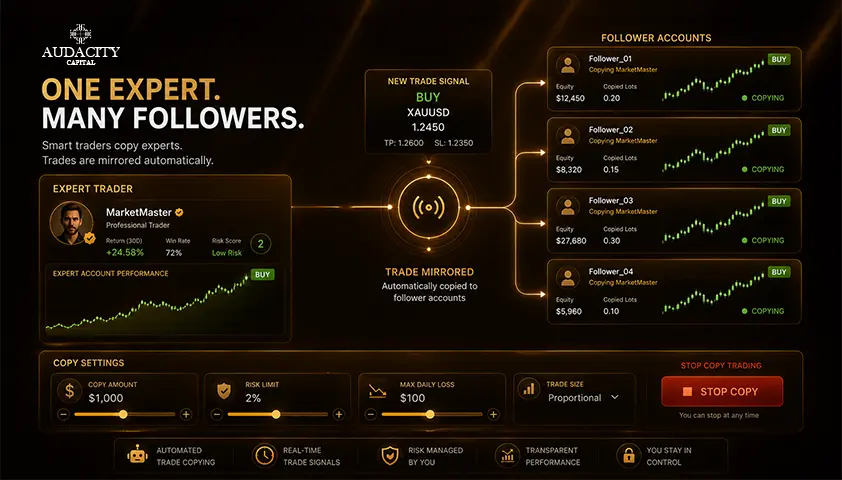
The mechanics are simpler than they sound. Here is the standard flow:
Step 1: Choose a platform or broker.
Pick a regulated copy trading platform or a broker that supports copy trading, either natively or through a connected tool.
Step 2: Browse and vet the Leaders.
Review the available traders by their track record. We cover exactly what to check in the next section, but the short version is: look deeper than the headline profit number.
Step 3: Allocate your capital.
Decide how much to assign to one trader or, better, spread across several.
Step 4: Let the trades mirror automatically.
Once you are copying a Leader, their trades open and close in your account automatically and proportionally to what you allocated.
Step 5: Keep control.
You can adjust your allocation, set risk limits, and stop copying at any time. You are never locked in.
Costs vary a lot, so read them carefully before you commit.
Some platforms charge only the spread, which is the difference between the buy and sell price. Others add a performance fee paid to the copied trader, a monthly subscription, or a spread markup.
Fees eat directly into your returns, so a strategy that looks profitable on paper can shrink once the costs come out.
As for how much you need to begin, the typical minimum deposit to start copying often sits somewhere around $100 to $500, though this depends heavily on the platform and the individual trader you follow.
Note: Treat these figures as illustrative. They change often and vary by region, so always verify current terms on the platform's own site.
The Best Copy Trading Platforms for 2026
Below are the established, well-regulated copy trading platforms worth knowing for 2026. We have ranked them fairly, led by the platform that tops nearly every credible list.
For each platform, you will find what its copy-trading offering is, its regulation, one standout strength, and one honest note.
Platform | Copy method | Regulation | Typical minimum | Standout |
eToro | Native (CopyTrader) | FCA, CySEC, ASIC | ~$50 to $200 (varies) | Most beginner-friendly, social-first |
AvaTrade | AvaSocial, DupliTrade, ZuluTrade | Central Bank of Ireland, ASIC | Varies | Multiple copy routes plus education |
Pepperstone | Third-party integrations | FCA, ASIC | Varies | Low cost, flexible integrations |
ZuluTrade | Dedicated copy platform | EU portfolio manager | Depends on broker | Deep Leader analytics |
IC Markets | Multiple integrations + IC Social | ASIC, CySEC | Varies | Tight ECN-style spreads |
NAGA | Native social + copy | Varies by region | Varies | Blended social and copy feed |
Vantage | App + third-party tools | Varies by region | Varies | Competitive forex/CFD pricing |
Exness | Native social trading | Varies by region | Varies | Native copying, tight spreads |
1. eToro - Best overall copy trading platform
eToro is the platform most credible lists put at the top, and for good reason. Its CopyTrader system and Popular Investor program sit inside a large social community, and the platform spans multiple asset classes, including real stock and crypto ownership rather than only CFDs.
The interface is intuitive and built for beginners, and there is a demo account to practice before you commit real capital. Regulation is strong, covering the FCA, CySEC, and ASIC.
Standout: the most beginner-friendly, social-first copy experience available.
Note: verify the current minimum and regional availability, since features and asset access vary significantly by country.
2. AvaTrade - Best for multiple copy options and education
AvaTrade offers copy trading through several routes, including AvaSocial, DupliTrade, and ZuluTrade, which gives you flexibility in how you follow other traders. It is backed by strong regulation from the Central Bank of Ireland and ASIC, and it pairs that with solid educational resources for newer traders.
Standout: multiple copy platforms plus genuinely useful education.
Note: verify current spreads and minimums before you open an account.
3. Pepperstone - Best low-cost copy trading via integrations
Pepperstone has no native social network, but it makes up for that with strong third-party integrations, including DupliTrade, Myfxbook AutoTrade, cTrader Copy, and CopyTrading by Pepperstone via Pelican.
Its low-cost Razor accounts and support for MT4, MT5, and cTrader make it a natural fit for traders who already work in those platforms. Regulation covers the FCA and ASIC.
Standout: low costs and flexible copy integrations for MT4/MT5 traders.
Note: verify which copy tools are available in your region, as availability differs by location.
4. ZuluTrade - Best dedicated copy trading platform
ZuluTrade is the veteran of the space, a purpose-built copy platform that mirrors Leaders across forex and other assets into connected broker accounts, commonly via MT4 or MT5. It works with a wide range of brokers and is itself regulated as a portfolio manager in the EU.
Standout: a focused, broker-agnostic copy platform with deep Leader analytics.
Note: minimums depend on the broker you connect it to, so verify those separately.
5. IC Markets - Best for tight spreads and broad copy access
IC Markets provides broad copy-trading access through ZuluTrade, Myfxbook AutoTrade, cTrader Copy, and its own IC Social app, all paired with ultra-tight, ECN-style spreads. It is regulated by ASIC and CySEC.
Standout: low spreads combined with several copy options in one place.
Note: verify the current copy tools and account terms for your region.
6. NAGA - Best social-plus-copy experience
NAGA blends a social feed with auto-copy features, giving you a place to observe, discuss, and mirror traders in one environment.
Standout: a genuinely blended social and copy experience.
Note: verify regulation, costs, and regional availability, which vary depending on where you are based.
7. Vantage - Best for competitive forex/CFD copy pricing
Vantage offers copy trading through its app and third-party tools, with pricing that stays competitive across forex and CFDs.
Standout: cost-competitive copy trading for price-conscious traders.
Note: verify the exact copy method and terms in your region before depositing.
8. Exness - Best for native, low-spread social trading
Exness provides native social trading with real-time copying and very competitive spreads, so the copying happens inside its own environment rather than through a bolt-on tool.
Standout: native copying paired with tight spreads.
Note: verify availability and terms in your region, since these differ by market.
What to Look for in a Copy Trading Platform
Not all copy trading platforms are built to the same standard, and the differences that matter most are not the ones the marketing pages lead with. Here is what to prioritize, in order.
1. Regulation and safety, first and always.
Prioritize platforms tied to well-regulated brokers, such as those overseen by the FCA, ASIC, CySEC, or an equivalent authority. Look for segregated client funds, negative balance protection, and investor compensation schemes. Be cautious with lightly regulated, offshore-only entities. Strong regulation is your first line of defense.
2. The quality and transparency of the Leaders.
Judge a trader on their full record, not a glossy profit chart. Check the win rate, ROI, and especially the drawdown, which is how much the account has fallen from its highest point. A large drawdown tells you how much pain you would have sat through to earn those returns. Also look at how long the track record is, the trader's risk score, and the actual strategy behind the numbers.
3. Trading costs and spreads.
Tight spreads and reasonable fees matter because they eat into every copied return. A small cost difference compounds over hundreds of trades.
4. Platform compatibility.
Check which platform the copying runs on, whether that is MT4/MT5, cTrader, or a proprietary system, and make sure it suits how you want to trade.
5. Minimum deposit.
Confirm the entry point fits your budget and that you can start without overcommitting.
6. Risk-management controls.
Look for allocation limits, a one-click stop-copy option, and drawdown caps that automatically stop copying if losses hit a level you set.
Honest advice: One habit protects you more than any single feature: diversify across several traders, for example three to five, rather than betting everything on one.
And be wary of the flashiest returns. The eye-catching numbers are often produced by the riskiest strategies, the ones most likely to reverse hard.
The Risks and Honest Limits of Copy Trading
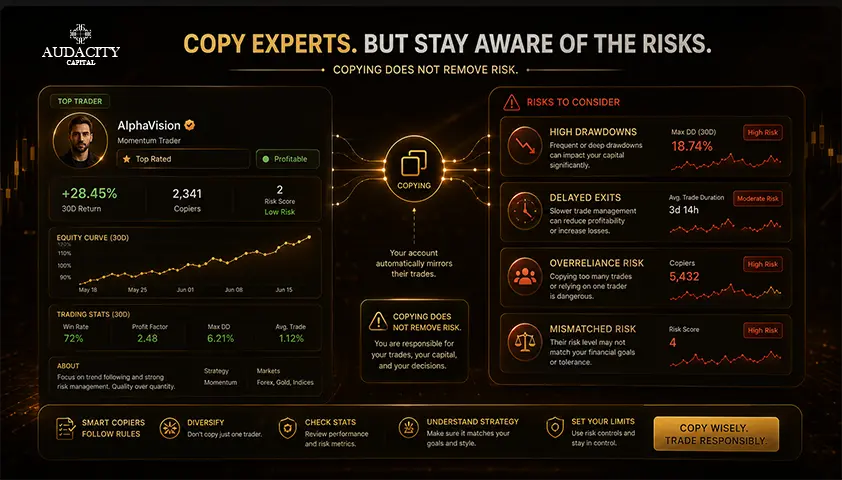
Now let’s discuss the reality. Copy trading is legitimate, but it carries real risks that you need to understand before you allocate a single dollar.
1. Past performance does not guarantee future results.
A trader's great run can reverse at any time. The strategy that produced last year's returns may not survive this year's market conditions, and the numbers on a profile page describe the past, not the future.
2. You are dependent on the Leader.
Even strong providers have bad stretches, and some blow up accounts entirely. When you copy someone, you are trusting another person with your capital and inheriting every one of their decisions, good and bad.
3. Most copied strategies do not beat the market over time.
The flashiest returns are frequently the riskiest, produced by aggressive strategies that eventually give back their gains. Consistency is rarer than it looks on a leaderboard.
4. The CFD risk reality.
A large share of retail accounts lose money trading CFDs, commonly cited across the industry at somewhere between 51% and 89%. That figure applies whether you trade yourself or copy someone else, because you are still exposed to the same instruments.
5. You can lose more than you invest.
With leveraged CFD products, losses can exceed your initial deposit. Copy trading is not guaranteed passive income, and treating it that way is how people get hurt.
6. It does not build your own skill.
This is the limit that matters most in the long run. Copy trading keeps you reliant on others. You can follow someone for years and still not understand market structure, risk, or how to make your own decisions.
The Bottom Line
Copy trading is a real way into the markets, not a scam, and for a beginner it genuinely lowers the barrier to getting started.
If you take this route, stay with well-regulated brokers, spread your allocation across several traders instead of betting on one, watch the drawdown as closely as the headline returns, and set your risk limits before you deposit a single dollar.
Just hold on to the honest part too. Copying someone keeps you tied to their decisions and their bad stretches, most copied strategies do not beat the market over time, and none of it teaches you to read a chart or manage a position on your own.
A copy trading platform can carry you for a while, but it will not turn you into a trader. If you are after lasting results rather than a passive shortcut, the smarter long-term move is to build your own skill and discipline, so that the good decisions in your account eventually become yours.
Related Articles
The Best Prop Firms That Allow Copy Trading in 2026
Frequently Asked Questions
It can be, but results vary widely and most copied strategies do not beat the market over time. Profitability depends on the traders you copy, the fees you pay, and market conditions. Past performance never guarantees future results, so treat any historical return as context, not a promise.
The mechanics are legitimate on regulated platforms, but it is not low-risk. You can lose money, and with CFDs you can lose more than you put in. Reduce the risk by using only regulated brokers, diversifying across several traders, and setting clear risk limits.
It varies by platform. Many let you start with around $100 to $500, though some set higher minimums per copied trader. Whatever the entry point, only use capital you can genuinely afford to lose.
Generally no. Most prop firms prohibit copy trading, trade copying, and signal-copying on funded accounts because they require your own independent trading. Copy trading is a broker-account activity, not a funded-account one, so always check a firm's specific rules before you assume anything.
Social trading is the broader idea of following, discussing, and observing other traders. Copy trading is the specific act of automatically replicating a chosen trader's positions in your own account. One is about watching and learning, the other is about mirroring.
Look past the headline returns at the full picture: win rate, drawdowns, how long the track record is, the risk score, and the underlying strategy. Favor consistent, lower-risk providers over the flashiest returns, which are often the riskiest and least durable.
Not really. It can teach you a little by observation, but because it is largely passive and dependent on others, it does not build the independent skill and discipline that trading your own strategy does. To grow as a trader, you eventually need to make your own decisions.
They vary by platform. Some charge only the spread, while others add a performance fee paid to the copied trader, a subscription, or a markup. Check the full cost structure before you start, because fees reduce your returns on every trade.

هل أنت مستعد لتطبيق مخاطر منضبطة على العملات المشفرة؟ استكشف أدوات التشفير الجديدة من Audacity Capital واجلب استراتيجية التداول الخاصة بك.
اعرف المزيدالنشرة الإخبارية
انضم إلى نشرتنا الإخبارية.
انضم إلى مجتمعنا الاجتماعي

ابدأ رحلتك اليوم مع تجربتنا المجانية
اعرض مهاراتك وإنجازاتك بفخر من خلال الشهادات واحصل على تقدير لعملك الجاد وتفانيك من المستثمرين المحتملين والأقران.
تجربة مجانيةمقالات ذات صلة

Copy Trading in India: How It Works, Best Platforms & Risks (2026 Guide)
Want to know how copy trading works in India? Explore copy trading India platforms, legal aspects, risks, benefits, and expert tips for beginners.

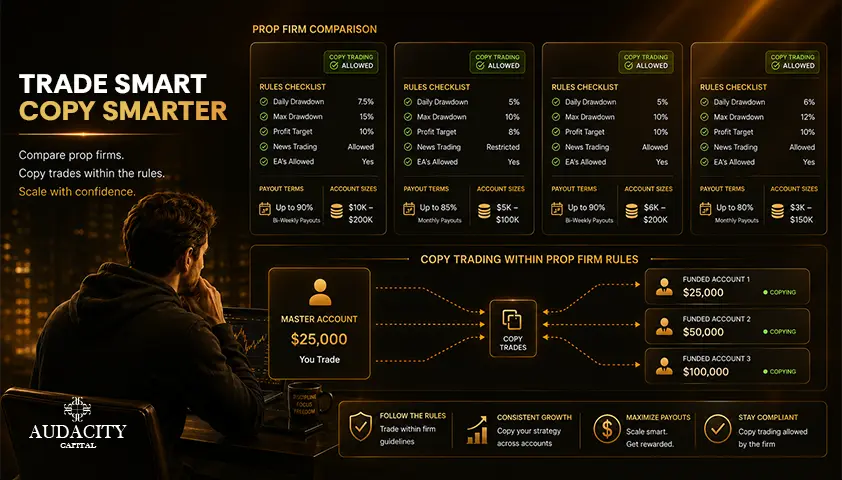
The Best Prop Firms That Allow Copy Trading in 2026
A guide to prop firms that allow copy trading in 2026. Learn internal vs external copying, the firms that permit trade copiers, and how to stay compliant.