


10 Best EAs to Pass Prop Firm Challenges in 2026


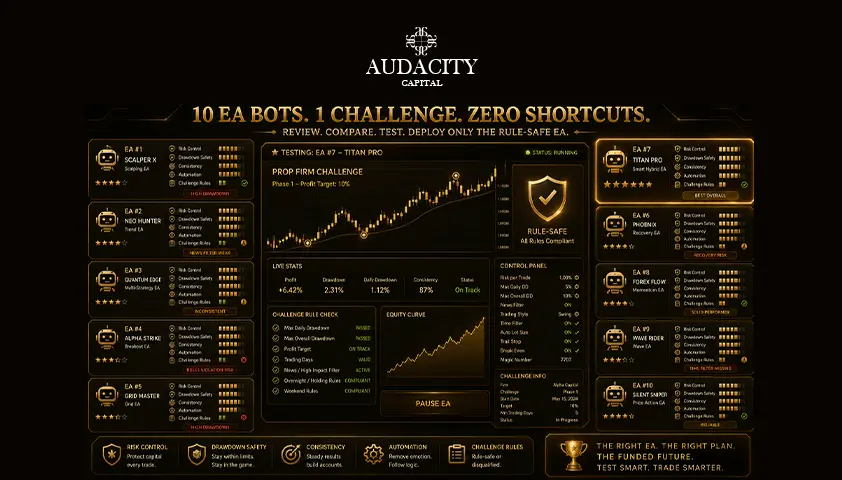
An Expert Advisor (EA) is an automated trading bot for MetaTrader that places trades for you according to coded rules.
Traders often look for EAs during prop firm evaluations because automation can help remove emotion from decision-making and support consistent execution.
However, no EA can guarantee a successful evaluation or funded account. Many companies limit or even ban the use of automation, some ban specific bots entirely and the most hyped ‘prop firm EAs' do the same strategies that lead to drawdown or terminated accounts.
So this is not a hype roundup. The honest version: The EA categories are worth considering, ones to avoid, how to know if your EA firm does allow automation, and also how to configure and test the bot first before risking a paid account!
Can you actually use an EA to pass prop firm challenges?
Yes, often, but the rules determine it all, and this is the most helpful part of the page.
The answer to 'Do prop firms allow EAs?' depends on the firm.
Some companies allow automated trading based on certain circumstances. Some ban particular named bots. Some prohibit the use of automation completely. There are even platforms that don't support the normal MetaTrader EAs.
Platform compatibility is often overlooked by traders. Standard MT4 and MetaTrader 5 EAs are not supported on DXTrade, cTrader or Match-Trader. But, if they only provide one of those platforms for an account, standard MT4 and MT5 EAs may not function on those platforms without additional integration.
The most important rule to remember: The EA is the trader's responsibility.
If the account is breached, it is terminated, whether the losing trade was executed by human or bot.
Ultimately, traders remain responsible for all activity on their accounts, regardless of whether trades are executed manually or through automation. The first thing is to ensure in writing that your firm doesn't ban your type of EA and that it is not on the banned list.
The table below shows an example snapshot to illustrate the variation of policies. Prop firm rules are subject to change, so be sure to check all entries on the firm's live terms before you act. Verified as of early 2026.
Firm (example) | EA stance | Common conditions / banned types | Platform note |
FTMO | EAs allowed | No HFT, no latency or reverse arbitrage | MT4 / MT5 |
FundedNext | EAs allowed | Specific named EAs banned | MT4 / MT5 |
FundingPips | EAs allowed on MT5 | Martingale, grid, and HFT banned | MT5 |
Audacity Capital | EAs permitted on eligible MT5 accounts | Must comply with trading rules and risk parameters | MT5 only; not supported on DXtrade |
Note: Prop firm EA policies frequently change. Always review the latest trading rules and permitted strategies on the firm's official website before purchasing an evaluation or funded account.
It's a straightforward message.
Start by reviewing your firm's automation policies, platform limitations, and prohibited-strategy rules before selecting or deploying any EA. A compliant EA is far more important than a popular one.
What makes an EA suitable for a prop firm challenge?
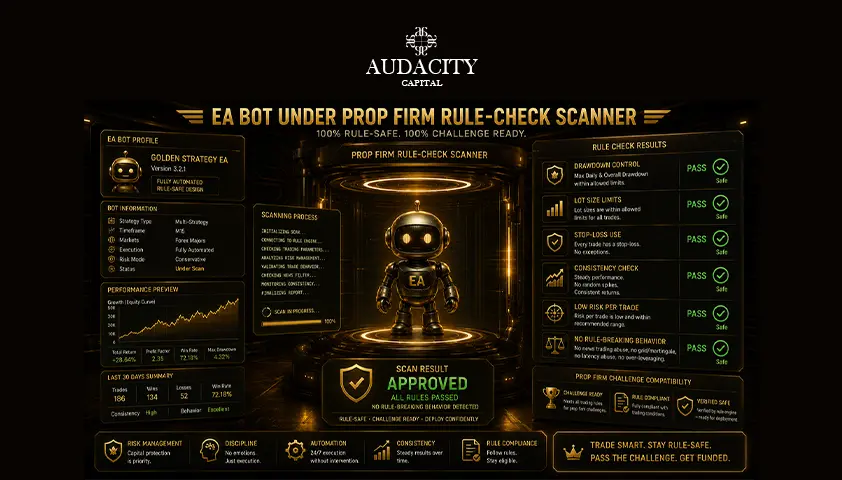
The term "best" is a marketing one. The right word is “suitable” and suitability concerns risk management, uniformity and conformance to rules. A prop suitable expert advisor ticks these boxes:
Built-in risk controls: This implies that a hard stop-loss on each and every trade, a fixed percentage position sizing, and an equity or drawdown cap are all hard-coded and not bolted on.
Low-variance results: Slow and gradual results, not big swings. Usually a big equity rise will lead to a big equity decrease, and this will trigger a daily drawdown or maximum drawdown limit.
Configurable to your firm's limits: You should be able to set the EA's own ceilings below the firm's thresholds.
A permitted strategy: No martingales, no grid, no HFT, no arbitrage. More on those below.
An honest and independently established track record: A real-time Myfxbook or FX Blue history, and not a vendor's own 'back testing' screen shot. A backtest is a hypothesis. The verified live record is evidence.
A transparent vendor: No trade logs, real refunds and no “guaranteed pass” statements. If a seller offers a pass rate, be wary of the entire deal.
If a bot fails this checklist, no amount of marketing can fix that.
The 10 best EAs to pass prop firm challenge in 2026
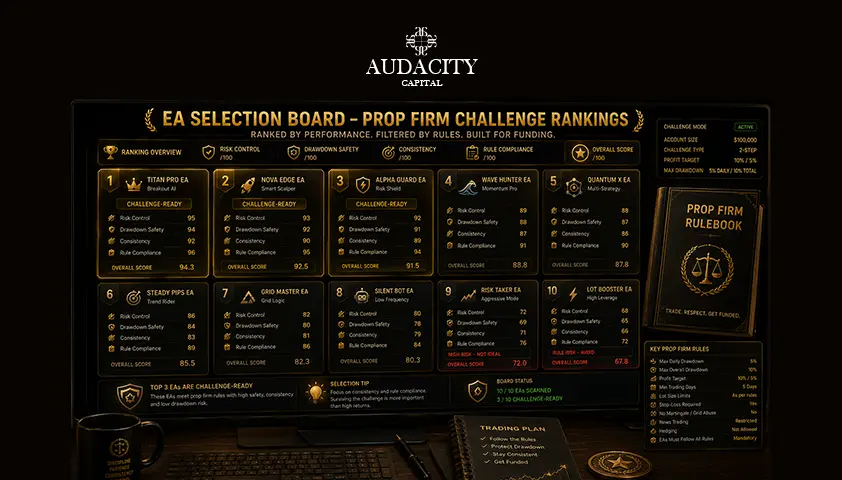
Absolutely no one claims a bot is the best; if they do, they're selling it.
This is a listing of prop firms ranked by strategy type with each listed entry having an honest verdict, risk flag; the right prop firm EA is completely up to your prop firm guidelines and your risk tolerance.
Group 1: Trend-following and swing EAs (usually the most prop-suitable)
These trade at a lower frequency and directional trend that has established entry/exit levels.
This is typically the best category to review when looking for a drawdown rule for investing, rather than high frequency or recovery strategies. It is also the least hyped, which is a plus.
EA 1: FTMO Gold Trader
Strategy: Gold trend & breakout trading bot, usually traded at higher time frame and at less frequency. It isn't a simple job position, defined stops are used.
Prop-suitability: Most firms allow trend-following styles, and the bot is typically able to be set within a firm's daily and maximum drawdown limits.
Risk flags: First, the "FTMO" in the name is not affiliated with the company FTMO and is unofficial vendor branding. No endorsement implied. It is less risky than grid or HFT, but be sure to verify stop logic and ensure that it is closing stops on the losers. Check for it on any banned lists.
How to verify: Use its live history on Myfxbook or FX Blue instead of the vendor backtest, make sure it is an EA that is allowed by your firm, demo-test it with the same rules before you spend money on it.
Verdict: It is ideal for traders seeking a directional, stop-loss bot and willing to thoroughly check the build before installing it. No bot guarantees a pass, and the risk is yours.
EA 2: 1000pip Climber System
Strategy: A directional, signal-based, low frequency strategy with a known risk-per-trade and longer term time frame.
Prop-suitability: Holds determine suitability. Overnight and weekend-hold rules differ; this only applies to firms that allow holding through the overnight and weekend periods. For reference, Audacity Capital has weekend holding in its rules.
Risk flags: Clean standalone swing bots will be very difficult to find, so availability and the live record will be the most important things to look at here. Be alert for over-leverages on holds and gap risk on weekends.
How to verify: Test the live third party record on Myfxbook or FX Blue, and not the vendors backtest, confirm that the vendor's EA is allowed by your firm and is not banned, then forward-test with the same challenge conditions on a demo account.
Verdict: This is a good match if a firm permits holding trades, but will depend on the live record. No guarantee of a pass, and the trader carries the risk.
Group 2: Mean-reversion and range EAs
These fade extremes or trade inside ranges. They can be consistent, but they can also contain averaging or grid logic, so it is the mechanics that's more important than the marketing.
EA 3: GPS Forex Robot
Strategy: A counter-trend reversal bot that trades against short-term moves. Verify if there is a predefined stop for each trade.
Prop-suitability: It was not designed to adhere to prop firm rules, so drawdown caps need to be manually set. Suitability depends on the firm permitting the style and the bot respecting your limits.
Risk flags: Ensure that it is not contributing to loss of positions (average behaviour) and substantial drawdown risk. Check out the live mechanics before believing it.
How to verify: Use the Myfxbook or FX Blue record from any vendor backtest, then demo test it on the same rules, confirming that the firm offers it and it's not banned.
Verdict: It's only for traders willing to do some digging into its loss-handling and put hard caps on their own. There is no guarantee of a pass and the risk is yours.
EA 4: Pivozon
Strategy: A pivot and reversal range bot on MT4 that defines a range and trades reversals from its edges, at a moderate frequency.
Prop-suitability: Applies to companies that have standard rules. Verify that it doesn't breach any scalping frequency restrictions.
Risk flags: This is a thin slot, since a famous, verifiable pure-range product barely exists. Additionally, range systems are tough to trade in large trends; size accordingly. Check the record and make sure of permission carefully.
How to verify: Check if there's a real third-party history, ask for permission and banned lists, and forward-test before paying.
Verdict: A specialized choice for range traders who can verify it independently. If you're unable to verify a live record, move away. No guaranteed pass.
Group 3: Scalping EAs
High-frequency, short-hold bots. There are some companies that permit regular scalping. Many limit or prohibit tick scalping and scalpers are very sensitive to the broker feed, making results difficult to replicate in real market conditions.
EA 5: Forex Fury
Strategy: A low-volatility scalper that trades inside a narrow daily window, with short holds. This is standard scalping, very different from banned tick scalping that makes hundreds of orders per minute.
Prop-suitability: A number of companies permit regular scalping, others don't allow it, and HFT variants are commonly prohibited. Check with your firm before you begin.
Risk flags: It ships without a hard stop by default, so add one. It is feed-sensitive, can be frequency capped at some firms and is not available wherever scalping or HFT is banned. Make sure it's not on the banned list, as there are several named scalpers in there.
How to verify: Live record on Myfxbook or FX Blue first, then explicit firm permission and then demo test on the exact rules.
Verdict: This is only viable when scalping is allowed and when it is configured with a hard stop. No bot passes for you and the risk is your own.
EA 6: Night Hunter Pro
Strategy: An Asian-session scalper that trades thin, low-liquidity hours. This is the textbook case of a strong backtest and a fragile live result.
Prop-suitability: Many firms restrict low-liquidity-hours scalping, and even where it is allowed, live performance often diverges sharply from the backtest.
Risk flags: High slippage and spread-widening in thin hours can wreck results that looked clean in testing. This category is widely flagged as fragile, so treat it with heavy caution.
How to verify: Demand a live third-party record, not a backtest, check firm rules closely, and demo-test for an extended period before trusting it on a paid account.
Verdict: Only for experienced traders who understand thin-liquidity risk and will monitor it constantly. No guaranteed pass, and most who lean on night scalpers are disappointed live.
Group 4: News-trading EAs
These trade around high-impact releases. Some firms allow news trading, many restrict it, and slippage during a release can breach drawdown in a single trade.
EA 7: OCO News Straddle EA
Strategy: A one-cancels-the-other straddle. It places a buy-stop and a sell-stop before a release, and cancels the opposite order when one triggers.
Prop-suitability: News-trading permission varies sharply by firm. Audacity Capital allows news trading within its rules, but many firms do not, so confirm EA news trading is permitted before you run it.
Risk flags: Slippage and gapping during a release can blow your drawdown in one trade. There is no famous, verifiable branded product here, so treat this as a cautionary archetype.
How to verify: Confirm the firm allows EA news trading first, then look for any real live record, then demo-test across several news events on the exact rules.
Verdict: High-risk and event-dependent, suitable only at firms that explicitly allow it and only for traders who accept single-trade blow-up risk. No guaranteed pass.
EA 8: Pending-Order Straddle Bot
Strategy: The same family as above, using pending orders or a straddle around scheduled events.
Prop-suitability: Suitability hinges entirely on the firm permitting news trading and the order types involved.
Risk flags: Whipsaw and partial-fill risk are common, and results swing hard with each event. Named, verifiable news bots are scarce, so this whole group is largely cautionary.
How to verify: Same path. Firm permission first, a real record next, then extended demo testing.
Verdict: Approach as an education in why news automation is risky rather than a dependable challenge tool. No bot passes for you.
Group 5: Grid, martingale, and bot-generator or multi-strategy EAs (high-risk)
This is the category most of the famous, heavily marketed "prop firm EAs" actually fall into, and it is the one to treat with the most caution. Grid and martingale systems and most "guaranteed pass" bots live here. Read this group as a warning, not a recommendation.
EA 9: FXStabilizer PRO
Strategy: A grid and martingale recovery system. In plain terms, it stacks orders into a move and increases position size after losses to try to recover them.
Prop-suitability: Even where a firm technically allows EAs, this style routinely breaches the typical 5 percent daily and 10 percent maximum drawdown limit. Several firms ban grid and martingale outright.
Risk flags: High blow-up risk. Its backtests can look spectacular precisely because the catastrophic-failure trade has not happened yet in the sample. One bad sequence fails an otherwise clean challenge. This is a cautionary entry, not an endorsement.
How to verify: If you insist on evaluating it, study the live drawdown on Myfxbook or FX Blue, confirm whether the firm bans the strategy, and demo-test until you see a losing sequence, because you will.
Verdict: The risk profile is fundamentally at odds with prop drawdown rules. Most accounts running this style do not survive a single bad run. No guaranteed pass, and the risk is entirely yours.
EA 10: EA Studio (plus "pass-or-refund" bot services)
Strategy: EA Studio is a bot-generator platform that lets you build your own rule-aware expert advisor. That is the constructive use. The red-flag counterpart is the "PropFirmEA" style of service that markets a specific pass rate or a pass-or-refund guarantee, which is exactly the kind of ad this article exists to demystify. Remember too that standard EAs cannot run on DXTrade, cTrader, or Match-Trader.
Prop-suitability: A build-your-own tool can be configured to your firm's rules, which is genuinely useful. Any service marketing a fixed pass rate or a guaranteed pass is a red flag, full stop.
Risk flags: Treat "94% pass rate" and "pass-or-refund" claims as warnings, not features. Verify independently and assume the marketing is generous to itself.
How to verify: For a self-built EA, backtest within your firm's rules, then forward-test on a demo using the exact conditions. For any "pass" service, demand independent proof and check your firm's banned list before paying anyone.
Verdict: Bot generators suit traders who want control over a rule-aware system. Guaranteed-pass services suit no one. No bot, built or bought, passes a challenge for you.
EA | Strategy type | Allowed at (examples) | Key risk | Verify via |
FTMO Gold Trader | Trend / breakout | Most firms allowing trend EAs | Stop logic; unofficial branding | Myfxbook / FX Blue |
1000pip Climber | Swing / directional | Firms allowing holds | Gap and over-leverage risk | Myfxbook / FX Blue |
GPS Forex Robot | Mean reversion | Firms allowing reversal styles | Possible averaging | Myfxbook / FX Blue |
Pivozon | Range | Standard-rule firms | Fails in strong trends | Myfxbook / FX Blue |
Forex Fury | Scalping | Firms allowing scalping | No default stop; feed-sensitive | Myfxbook / FX Blue |
Night Hunter Pro | Night scalping | Firms allowing thin-hour scalping | Slippage; fragile live | Myfxbook / FX Blue |
OCO News Straddle | News | Firms allowing news trading | Single-trade blow-up | Myfxbook / FX Blue |
Pending-Order Straddle | News | Firms allowing news trading | Whipsaw; partial fills | Myfxbook / FX Blue |
FXStabilizer PRO | Grid / martingale | Few; banned at many | Catastrophic drawdown | Myfxbook / FX Blue |
EA Studio / pass services | Generator / various | Depends on build | Guaranteed-pass marketing | Independent proof |
Prohibited EA strategies that get accounts banned (avoid these)
If you remember one section, make it this one. The strategies that dominate "pass your challenge on autopilot" marketing are usually the exact strategies that get accounts banned.
They can show dazzling backtests and impressive personal-account returns, and they still routinely breach the typical 5% daily and 10% maximum drawdown limit.
Most automated traders who fail or get terminated were running one of these.
1. Latency or reverse arbitrage.
Exploiting price or feed discrepancies between brokers. Firms treat this as cheating, and it is the fastest route to a ban and a closed account.
2. HFT and tick scalping.
Hundreds of trades in seconds. This strains the firm's servers and is widely prohibited as a category, even where ordinary scalping is fine.
3. Martingale.
Doubling position size after every loss. It looks unstoppable until one extended losing run wipes the account.
4. Grid trading.
Stacking more and more orders into a losing position. The same flaw applies. The drawdown that ends you is always one move away.
These are not edge cases. They are the most common reason EA users lose a funded account.
Automated trading does not soften the rule. If the strategy is banned, the account is gone, no matter how clean the rest of your challenge looked.
How to run an EA without breaching the rules
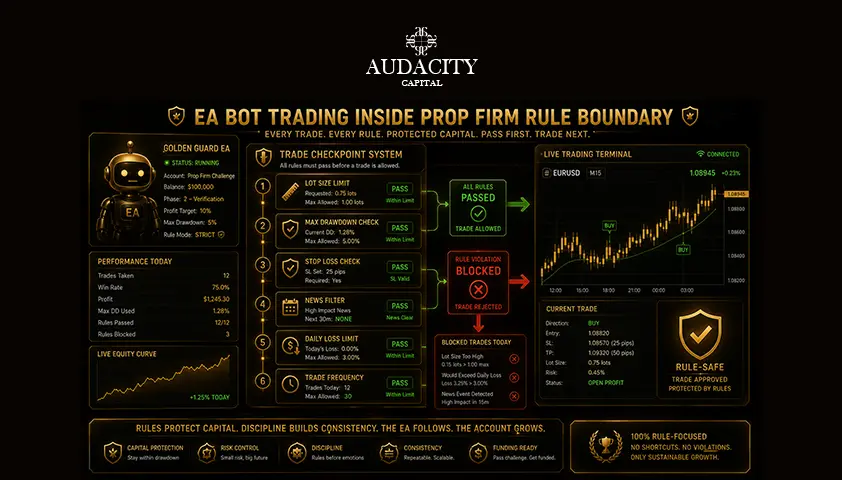
If you have a verified, permitted bot, this is the practical setup that keeps you inside the lines. Treat it as a checklist.
Step 1: Cap the EA's risk below the firm's limits.
Set the bot's own maximum drawdown beneath the firm's threshold, and keep risk-per-trade small. Many disciplined traders use 0.5 to 1 percent per trade. These figures are illustrative, not advice.
Step 2: Confirm permission, twice.
Verify the firm allows the EA, allows the strategy, and that the specific bot is not on a banned list. Get it in writing where you can.
Step 3: Backtest, then forward-test.
Run backtesting within the firm's rules, then forward-test on a demo with the exact challenge conditions before you pay for an evaluation.
Step 4: One EA per account, unique magic number.
Running multiple bots or duplicated trades across accounts can trip copy-trading or collusion flags. Assign a unique magic number to keep things clean.
Step 5: Use a stable VPS.
A reliable virtual private server keeps the EA running so trades are not missed by a dropped connection.
Step 6: Monitor, do not set and forget.
You are responsible for every trade. Watch the bot, especially around news and session changes, and be ready to step in.
The honest truth: an EA is a tool, not a shortcut
Here is the reframe that protects you. No EA guarantees a pass.
"Guaranteed pass" and "X percent pass rate" marketing is a red flag every single time, and automated traders fail for the same reasons manual traders do: over-risking, running prohibited strategies, and breaching the drawdown limit.
Automation can enforce discipline you might struggle to hold by hand. It cannot replace a tested, rule-compliant strategy or sound risk management.
The bot is the steering wheel. The strategy and the discipline is the driver.
If you want the discipline that sits underneath any successful evaluation, automated or manual, read our guide on how to pass a prop firm challenge.
When you are ready, Audacity Capital permits EAs on MetaTrader 5 in our funded trader program, within our risk rules. The capital and structure are real. The work is still yours.
FAQ
It can place every trade automatically, but it cannot guarantee a result. The strategy still has to be sound and rule-compliant, and you remain responsible for every trade it makes.
Some are real tools. Any service promising a guaranteed pass or a specific pass rate is a red flag. Verify the track record independently, check your firm's rules, and assume the marketing overstates itself.
Lower-frequency trend or swing systems with hard stops tend to fit drawdown rules best. Grid, martingale, HFT, and arbitrage are the riskiest and are banned at many firms.
Usually yes. A stable VPS keeps the bot running so trades are not missed by a connection drop, which matters for any automated system that trades while you are away.
Yes. If the bot uses a prohibited strategy, sits on a banned list, or breaches a rule, the account is terminated. It makes no difference whether the breaching trade was placed by hand or by software.
Look for third-party-verified history on Myfxbook or FX Blue rather than the vendor's own backtest, then demo-test on the exact challenge rules. A live record is evidence. A backtest is only a claim.
No. Some allow them with conditions, some ban specific named bots, and some ban automation entirely. Certain platforms, including DXTrade, cannot run standard MetaTrader EAs at all.
Neither is inherently cheaper. Both pay the same evaluation fee, and both fail if the strategy or risk control is weak. A bot is not a discount on skill.

Bereit, diszipliniertes Risiko auf Krypto anzuwenden? Entdecken Sie die neuen Krypto-Instrumente von Audacity Capital und bringen Sie Ihre Trading-Strategie mit.
Mehr erfahrenNewsletter
Treten Sie unserem Newsletter bei, um auf dem Laufenden zu bleiben.
Treten Sie unserer sozialen Gemeinschaft bei

Beginnen Sie Ihre Reise heute Mit unserer kostenlosen Testversion
Präsentieren Sie stolz Ihre Fähigkeiten und Leistungen durch Zertifikate und erhalten Sie Anerkennung für Ihre harte Arbeit und Ihr Engagement von potenziellen Investoren und Kollegen.
Kostenlose TestversionVerwandte Artikel
Inside Bar Pattern: Meaning, Examples and Trading Rules
Learn how to identify the inside bar pattern, compare entry and stop rules, and assess false breakouts before testing a trading strategy.


Trade Deficit Explained: Causes, Effects and Markets
What a trade deficit is, what actually causes it, why it can widen in a strong economy, and why the textbook currency rule often fails.

GTC in Trading: What Good Till Cancelled Orders Mean and How to Use Them Properly
Learn what GTC means in trading, how Good Till Cancelled orders work, when to use them, and the risks of leaving pending orders active.
Best Trading Simulator Apps in 2026: Practice Trading Risk-Free
Compare the best trading simulator apps in 2026 for stocks, forex, futures and crypto. See features, markets, realism, pricing and beginner-friendly options.