



10 Scalping Trading Strategies That Actually Work in 2026



A scalping trading strategy is a short-term trading approach designed to profit from small price movements by executing multiple trades throughout the day. Successful scalpers rely on speed, discipline, technical analysis, and strict risk management to capture consistent gains while limiting losses.
Whether you trade Forex, stocks, indices, cryptocurrencies, or commodities, choosing the right scalping trading strategy can help improve your decision-making and overall consistency.
In this guide, you'll discover 10 proven scalping trading strategies, when to use them, the indicators they rely on, and the risk management principles that help protect your capital.
What Is a Scalping Trading Strategy?A scalping trading strategy is a short-term trading approach where traders open and close multiple positions throughout the day to profit from small price movements. Most scalpers hold trades for seconds to a few minutes and rely on technical analysis, high liquidity, and strict risk management. |
|---|
Strategy | Best For | Market Condition | Timeframe | Skill Level |
|---|---|---|---|---|
Moving Average Scalping | Trend following | Trending markets | 5 min | Beginner |
VWAP Scalping | Institutional price levels | High-volume sessions | 1–5 min | Intermediate |
Bollinger Band Mean Reversion | Reversal trading | Ranging markets | 1–5 min | Intermediate |
Stochastic Range Scalping | Range trading | Sideways markets | 1–5 min | Beginner |
Fast RSI Pullback Scalping | Trend pullbacks | Trending markets | 1–5 min | Intermediate |
Support & Resistance Scalping | Price action | Ranges & key levels | 1–5 min | Beginner |
Breakout Scalping | Momentum trading | Breakouts | 1–5 min | Intermediate |
Pivot Point Scalping | Intraday support/resistance | Active sessions | 5 min | Intermediate |
Price Action Scalping | Pure chart reading | Any market | 1–5 min | Advanced |
Momentum & Volume Scalping | High-volatility moves | Session opens & news | 1–5 min | Advanced |
Why Scalping Trading Requires Discipline
Scalping is one of the fastest-paced trading styles. Traders enter and exit positions within minutes—or even seconds—aiming to capture small price movements that accumulate into meaningful profits over time. Success depends on focus, quick decision-making, and disciplined risk management, while hesitation and poor execution can quickly lead to losses.
Many guides explain scalping in theory but fail to provide strategies that can be applied in real market conditions. This guide takes a practical approach, covering 10 proven scalping trading strategies with clear entry and exit concepts, the market conditions where they perform best, and the limitations every trader should understand.
You'll also learn the risk management principles that help scalpers survive losing streaks, protect their capital, and stay consistent over the long term.
What scalping really is
Scalping means taking a high number of trades and holding each one for a short period, usually a few minutes, to capture small price moves. A scalper is not trying to catch the whole daily range. They are trying to take a slice out of it, repeatedly, with a high win rate and tight risk on every position.
The maths behind it matters. Because targets are small, your losers have to stay small too, or a single bad trade wipes out several good ones. A scalper living on a five pip target cannot afford twenty pip stops. That is why entries need to be precise and why most serious scalpers trade only during the hours when their chosen market is liquid and moving.
One more thing worth being clear about from the start. Scalping and high frequency trading are not the same. HFT relies on automated systems firing off trades in fractions of a second to exploit micro fluctuations. Manual scalping, the kind covered here, is about reading a chart and executing clean setups over a few minutes. The distinction is not just academic. It is the difference between a skill you can learn to execute by hand and an automated arms race that most retail traders have no business entering.
10 Best Scalping Trading Strategies
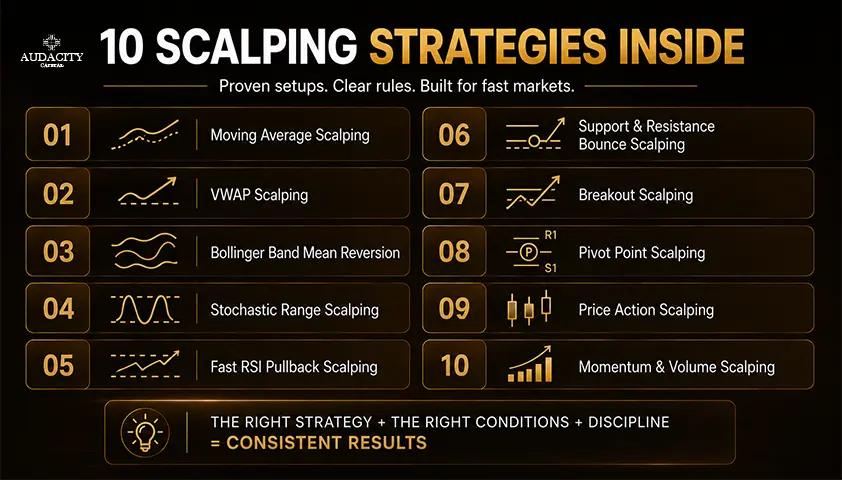
There is no single best scalping trading strategy for every trader or market condition. Some strategies perform better in trending markets, while others are designed for ranging or high-volatility environments. The key is choosing a strategy that matches the current market structure, your trading style, and your level of experience.
Below are 10 proven scalping trading strategies used by traders across Forex, indices, stocks, cryptocurrencies, and commodities.
1. Moving average scalping
Moving averages smooth out price noise and show you the underlying direction, which is exactly what a scalper needs to avoid trading against the flow. The most reliable version uses two exponential moving averages, commonly the 9 EMA and the 21 EMA, on a five minute chart.
The setup is simple. When the 9 EMA sits above the 21 EMA and both are sloping up, you only look for buys. You wait for price to pull back and touch the faster 9 EMA, then enter long when a candle rejects that level and closes back in the trend direction. Your stop goes just below the recent swing low, and you target a fixed move or the previous high.
Some traders add a third line to build a ribbon, using 9, 21 and 55 EMAs. When all three fan out cleanly in one direction, the trend is strong and pullback entries have the wind behind them. When they tangle together, the market is ranging and this strategy should sit on the bench.
The weakness is chop. In a sideways market the EMAs cross back and forth and generate one false signal after another. Only trade this when there is a clear, visible trend on the chart.
2. VWAP scalping
The volume weighted average price is the line institutions watch to judge whether they are getting a good fill. That alone makes it one of the most respected reference points on an intraday chart, and price reacts to it constantly.
There are two clean ways to scalp VWAP. In a trending session, treat it as dynamic support or resistance. During an uptrend, wait for price to dip back to VWAP and enter long on a bounce, targeting the session high. During a downtrend, sell rallies into VWAP. In a ranging session, do the opposite and fade the extremes, entering back towards VWAP when price stretches too far from it.
VWAP works best on liquid instruments such as major indices and the most heavily traded currency pairs, and it shines in the first couple of hours after a major session opens, when volume is high and the line carries real weight.
The catch is that VWAP loses meaning in thin, low volume conditions. Late in a quiet session, price can drift straight through it without so much as a pause. Match this strategy to the busy hours and it earns its place.
3. Bollinger Band mean reversion
Bollinger Bands wrap two standard deviations around a 20 period moving average, which means price spends most of its time inside them. When it stretches to the outer band, it is statistically extended, and in a ranging market it tends to snap back towards the middle.
To trade it, wait for price to tag the upper or lower band and print a rejection candle, something like a pin bar or a small reversal pattern. Enter against the extreme, so sell at the upper band and buy at the lower band, and target the middle band. Your stop sits just beyond the recent wick.
The single most important filter here is trend. In a strong trend, price rides the outer band for long stretches and mean reversion becomes a fast way to lose money. This is a range strategy, full stop. Add a momentum check, such as a stochastic or RSI reading, so you are only fading exhaustion rather than fresh strength.
4. Stochastic range scalping
The stochastic oscillator measures where price sits within its recent range and flags overbought and oversold conditions. In a market bouncing between two levels, it is a natural fit for a scalper.
Use a standard 14, 3, 3 setting or speed it up slightly for faster signals. Once you have identified a clear range, buy when the stochastic crosses up out of oversold territory below 20, and sell when it crosses down out of overbought territory above 80. Pair every signal with a real support or resistance level so you are buying near the bottom of the range and selling near the top, not somewhere in the middle.
This strategy is at its best in quieter, sideways sessions, the kind you often get between the major market opens. It struggles badly in trends, where the oscillator can sit pinned in overbought or oversold for ages while price keeps running. Range first, signal second.
5. Fast RSI pullback scalping
The relative strength index is usually set to 14 periods, but scalpers often shorten it dramatically to make it more responsive. A two or five period RSI reacts quickly and catches short term extremes that the standard setting smooths over.
The approach borrows from the well known Connors style. First establish the trend using a longer term filter, such as price trading above its 200 EMA for longs. Then, within that uptrend, wait for the fast RSI to plunge to an extreme, below 10 or 15, which signals a sharp pullback. Enter long into that dip and exit as price recovers and momentum returns. Flip the logic for a downtrend, selling brief spikes above 85 or 90.
The core idea is that you are buying temporary weakness inside strength, not trying to pick a top or bottom in open space. Without the trend filter, this strategy will happily walk you into the front of a freight train, so never skip it.
6. Support and resistance bounce scalping
This is the foundation everything else is built on. Markets respect levels where buyers and sellers have clashed before, and a scalper who can read those levels cleanly barely needs anything else.
Mark the obvious intraday support and resistance zones before you trade, using prior highs and lows and areas where price has reversed more than once. Then buy near support and sell near resistance, with a tight stop just beyond the level and a target at the opposite side of the range or a sensible partial along the way. Wait for confirmation. A long lower wick rejecting support, or a bearish candle stalling at resistance, tells you the level is holding before you commit.
The failure mode is obvious once you know it. Levels break, and when a strong trend arrives it slices through support or resistance as if it were not there. Keep stops disciplined, respect the break when it comes, and do not marry a level that has clearly given way.
7. Breakout scalping
Instead of fading levels, breakout scalping trades the moment price escapes them. When a market has coiled into a tight consolidation, the eventual break often produces a fast, clean move, which is exactly the kind of momentum a scalper wants.
Mark the box of a consolidation, or use the opening range, the high and low of the first fifteen to thirty minutes of a session. Enter when price breaks decisively out of that zone, ideally on expanding volume, place your stop on the opposite side of the box, and target a measured move roughly equal to the height of the range.
False breakouts are the enemy here. Price pokes out, traps everyone who chased, then snaps back inside. The simple defence is patience. Rather than jumping on the first break, wait for price to push out, come back and retest the level from the other side, then continue. You miss a few of the fastest moves, but the trades you do take are far higher quality.
8. Pivot point scalping
Pivot points give you a set of objective levels calculated from the previous session's high, low and close. You get a central pivot with support levels below and resistance levels above, all mapped out before the session even starts, which removes a lot of guesswork.
Price interacts with these levels naturally throughout the day. A common scalp is to buy a bounce off the first support back towards the central pivot, or sell a rejection at the first resistance. When price breaks cleanly through the central pivot with momentum, you can scalp the continuation towards the next level up or down.
Pivots are especially popular on currency pairs and indices because so many traders watch the same numbers, which turns them into a bit of a self fulfilling map. As with any level based method, they work best when the market is rotating rather than trending hard in one direction all day.
9. Price action scalping
Some of the sharpest scalpers use no indicators at all. Price action scalping means reading raw candles and structure, and acting on the patterns that show a shift in the balance between buyers and sellers.
The building blocks are familiar. Pin bars with long wicks show rejection of a level. Engulfing candles show one side taking control. Inside bar breaks show a coiled spring releasing. The skill is trading these signals only at meaningful locations, so a bullish engulfing candle right at support is worth taking, while the same candle floating in the middle of nowhere is not. Enter on the close of the signal candle, place your stop beyond its wick, and target the next structural level.
This is the cleanest style on the list and also the most demanding. It needs screen time, pattern recognition and the discipline to wait for the right context. There is no indicator to lean on, just you and the chart, which is precisely why the traders who master it tend to be very good.
10. Momentum and volume scalping
The final strategy is about riding short, sharp bursts of energy. When a market suddenly picks up pace on rising volume, that momentum often carries far enough to hand a scalper a quick profit if they get in and out cleanly.
Watch for expanding volume alongside a run of strong candles pushing in one direction. Rather than chasing the very first candle, wait for a shallow pullback and enter as the move resumes, riding the wave until it stalls. Your exit signal is momentum fading, which usually shows up as volume drying up, candles shrinking, or a strong candle appearing in the opposite direction. When the fuel runs out, you are out.
Momentum scalping thrives around session opens and in the drift that follows big economic releases, when order flow is one sided and moves extend. The caveat is that the moments right around a major news release are also the most violent, with spreads widening and price whipping in both directions before it settles. Let the initial spike pass and trade the cleaner move that follows rather than jumping into the chaos itself.
How to manage risk when scalping

You can trade every setup above perfectly and still lose money if your risk management is loose. Scalping magnifies this more than any other style, because you are taking so many trades that small errors compound fast. Get the risk side right and mediocre setups can still make money. Get it wrong and even great setups will not save you.
Start with the size of your losers. Because scalping targets are small, your stops have to be small too, and your risk per trade should be a modest fraction of your account, often well under one per cent. The whole model depends on any single loss being trivial next to the run of wins around it. The moment you widen a stop to avoid being wrong, you have broken the maths that makes scalping work.
Understand the relationship between win rate and reward. Many scalpers run a high win rate with a reward that is smaller than their risk, which is fine as long as the win rate genuinely supports it. What quietly kills accounts is a string of small wins followed by one oversized loss that erases them all. Cap your downside on every trade and never let a scalp turn into an unplanned swing trade because you refused to take the stop.
Respect your costs. Spreads and commissions are a rounding error for a swing trader and a serious drag for a scalper taking dozens of trades a day. Trade liquid instruments with tight spreads, and be honest about how much of each small target the transaction cost is eating. A five point target on a two point spread is a very different trade to a five point target on a half point spread.
Trade the right hours. Almost every strategy here performs best when your chosen market is liquid and moving, which usually means the busy period around a major session open. Scalping thin, sluggish conditions is a fast way to collect small losses and pay spreads for the privilege. If the market is not offering clean movement, the correct trade is often no trade at all.
Finally, protect yourself from yourself. The biggest risk in scalping is not any single setup, it is overtrading, revenge trading and the urge to make it all back after a couple of losers. Set a daily loss limit before you sit down, and when you hit it, stop for the day without negotiation. A scalper who lives to trade tomorrow beats one who blows up chasing today.
Key takeaways
- Scalping is about stacking small, high probability wins with tight risk, not catching big moves. Precise entries and small losers are non-negotiable.
- Match the strategy to the market. Trend based methods such as moving average and momentum scalping need a clear trend, while mean reversion, stochastic and range methods need a sideways market. Trading the wrong one in the wrong conditions is the fastest route to a losing day.
- Support and resistance underpins almost everything. Even the indicator based strategies work best when aligned with real levels on the chart.
- Liquidity is your friend. Nearly every strategy here performs best during the busy hours around major session opens, and struggles in thin, quiet conditions.
- Risk management is what keeps you in the game. Keep every loser small, respect your spreads and commissions, and never let a scalp turn into an unplanned swing trade.
- Know your numbers. A high win rate only works if a single oversized loss cannot wipe out the wins around it, so cap your downside on every trade.
- Protect yourself from yourself. Set a daily loss limit before you start, and when you hit it, stop for the day without negotiation.
Turn Your Knowledge Into Opportunity
Practice your trading skills in our Monthly Trading Competition, where top traders can earn a Free Funded Account.
FAQ
Scalping is one of the harder styles to start with because it demands fast decisions, tight discipline and a lot of screen time. Beginners often do better learning on higher timeframes first, then speeding up once their risk management is solid. If you are drawn to it early, start on a demo and focus on one strategy until it becomes second nature.
There is no fixed answer, and anyone who gives you one is guessing. Scalping returns depend on your win rate, your risk per trade, the number of quality setups the market offers and your discipline in taking only the good ones. Small, consistent gains compounded over time are the realistic goal, not overnight riches.
The best markets for scalping are the most liquid ones with tight spreads, since your costs eat directly into small targets. Major currency pairs and heavily traded indices are the usual homes for scalpers. Whatever you choose, focus on the hours when it is genuinely active, as liquidity is what makes clean scalping possible.
Most scalpers work on the one to five minute charts, often using a higher timeframe such as the fifteen minute or hourly to judge the overall trend. Leaning towards the five minute chart rather than the very lowest timeframes tends to produce higher quality setups and is easier to execute cleanly, which suits most traders better.
Scalping is a manual style where a trader reads a chart and executes short term setups over a few minutes. High frequency trading uses automated systems to fire off huge numbers of trades in fractions of a second. Manual scalping is generally welcome at prop firms, while HFT and tick level automation are typically prohibited.

Bereit, diszipliniertes Risiko auf Krypto anzuwenden? Entdecken Sie die neuen Krypto-Instrumente von Audacity Capital und bringen Sie Ihre Trading-Strategie mit.
Mehr erfahrenNewsletter
Treten Sie unserem Newsletter bei, um auf dem Laufenden zu bleiben.
Treten Sie unserer sozialen Gemeinschaft bei

Beginnen Sie Ihre Reise heute Mit unserer kostenlosen Testversion
Präsentieren Sie stolz Ihre Fähigkeiten und Leistungen durch Zertifikate und erhalten Sie Anerkennung für Ihre harte Arbeit und Ihr Engagement von potenziellen Investoren und Kollegen.
Kostenlose Testversion