


What Is Paper Trading


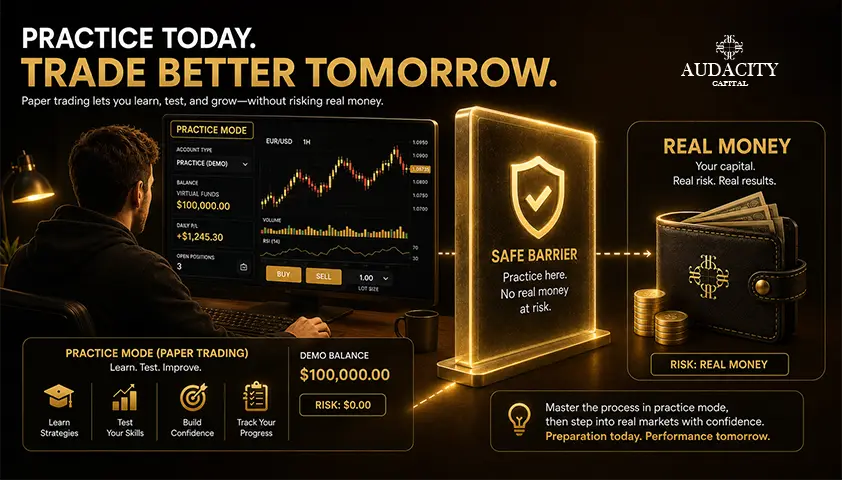
Paper trading is the practice of trading with virtual money instead of real capital, so you can learn how trading works and test strategies without risking anything.
In plain terms, you place trades in a realistic environment, watch how they would have played out, and build skills before your own money is on the line.
It is the smartest place most beginners can start. It is also not the whole picture. Paper trading cannot reproduce the pressure of real money, and it will not earn you a single penny, because there is nothing to win or lose.
In this guide, we cover how it works, what it can genuinely teach you, how it differs from demo accounts and backtesting, its real limitations, and how to do it properly so it actually helps.
What is Paper Trading?
Paper trading is simulated trading. You place buy and sell orders using virtual money, usually against live or near-live market data, so you experience realistic price movement without any real capital at risk.
Nothing you do touches the real market. No order reaches a real exchange, and no balance you build is money you can withdraw.
The name is older than the screens most of us trade on. Before electronic platforms existed, aspiring traders wrote their trade ideas down on paper, noted their intended entry and exit, then tracked how the market actually moved to see whether their ideas would have worked.
There was no clicking, no software, just a written record tested against reality. The habit stuck, and so did the name.
Today you will also see it called virtual trading or simulated trading. These are the same thing. The paper trading meaning has not changed since the pen-and-paper days: it is risk-free practice that mirrors real conditions.
Who uses it? Two groups mostly.
Beginners learning the basic mechanics of a platform and how markets move, and experienced traders testing whether a new strategy has merit before they commit real capital to it.
Both benefit from the same core advantage: you can be wrong and it costs you nothing but a lesson.
How does Paper Trading Work?
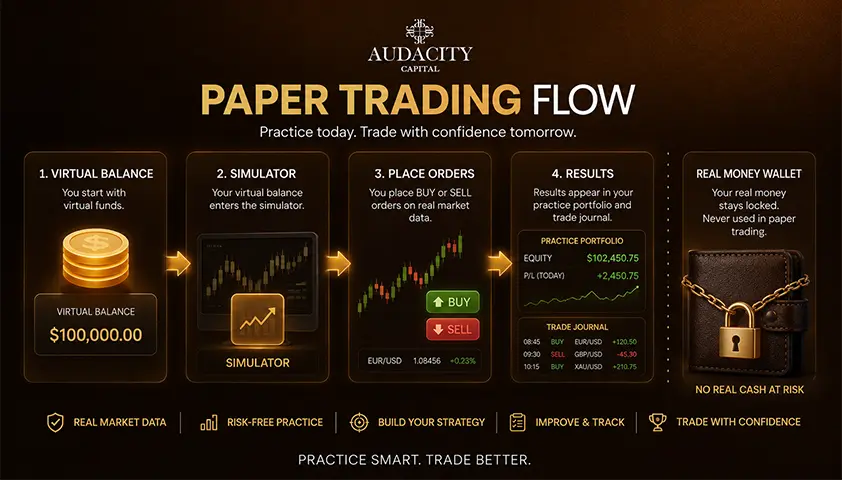
Here is the process, step by step, so the concept becomes concrete.
You open a simulated account and receive a virtual starting balance. This is commonly $10,000 or $100,000, and on many platforms you can adjust it to whatever figure you want.
From there, you trade almost exactly as you would with real money.
You place trades using the same order types you would use live: a market order (which fills at the current price), a limit order (which fills only at a price you set or better), and a stop-loss order (which closes a losing position at a predefined level to cap the damage).
Your positions then move against real-time market data, live charts, quotes, and news feeds, so the experience closely mirrors the real thing.
There are two common setups:
- Broker-integrated simulators run inside a broker's actual platform, so the interface is identical to the live one. You learn the exact buttons and screens you will later trade on.
- Standalone simulators run independently of any broker. They still use market data, but the environment is separate from any live account.
Two practical notes most beginners miss.
First, not every simulator uses live pricing. Some free platforms use delayed data rather than real-time feeds, which matters a great deal if you are practicing short-term strategies, because your fills and timing will not reflect reality. It is worth checking before you commit.
Second, most simulators are free, though some charge a subscription for advanced features or extra data.
The key point to hold onto: everything is hypothetical. That is how paper trading works, and that is exactly what makes it safe to learn on.
What You can Actually Practice
So what will you genuinely get out of it? Setting honest expectations here matters, so here is what you can realistically build.
1. The mechanics of the platform.
Placing, modifying, and closing orders until it becomes second nature, without the risk of an expensive mis-click.
2. How order types behave in practice.
Reading about a stop-loss is one thing. Watching it trigger and protect your position is another.
3. Entries and exits.
Where you get into a trade, where you get out, and how a strategy holds up across different market conditions.
4. Technical tools and indicators.
How tools like RSI, MACD, or Bollinger Bands actually behave in trending versus ranging markets, rather than just in theory.
5. Position sizing and risk rules.
How much to commit per trade and where to place protection, which is the foundation of sound risk management.
6. Journaling and review.
The habit that pays off most. Recording every trade and reviewing what worked turns random practice into real learning.
Paper trading applies across asset classes, whether you are looking at stocks, forex, options, futures, or ETFs, and it suits both day-trading and swing-trading styles. Whatever you plan to trade, you can rehearse it first.
Paper Trading vs Demo Accounts vs Backtesting
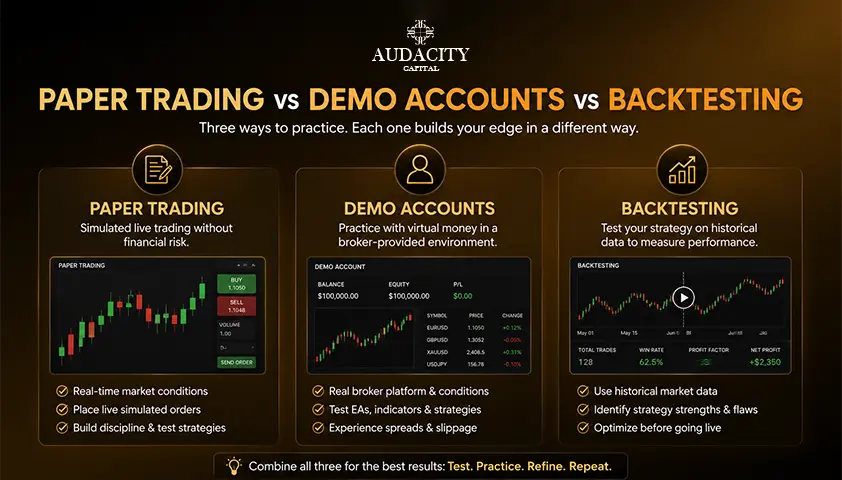
This is where a lot of beginners get tangled up, and few explanations clear it up properly. So here is the paper trading definition placed next to the two things people most often confuse it with.
Paper trading and a demo account are the same concept with different names.
Paper trading is the term the stock market uses. The forex and CFD industry calls the same thing demo trading.
So if you are a forex trader, a demo account is paper trading. Different label, identical idea: virtual money, live market conditions, no real risk. If you have ever wondered whether the two are different, they are not.
Backtesting is genuinely different.
Backtesting tests a strategy against historical data to see how it would have performed in the past, rather than trading live markets in real time. It answers "would this idea have worked over the last two years," not "how does this idea perform right now."
The two complement each other well: backtest an idea to see if it has promise, then paper trade it forward on live data to see how it holds up in current conditions.
Preprogrammed simulations and trading games are different again. These may not use real-time data at all. They are usually built to teach basics or make practice feel like a game, not to test a real strategy under real conditions.
Whatever the platform calls it, what actually matters is whether it runs on live data and lets you trade the way you genuinely would. That is what makes the practice transfer.
The Advantages of Paper Trading
The benefits are real, so here they are, kept tight.
Benefit #1: Zero financial risk.
You learn without putting a single dollar in harm's way.
Benefit #2: Freedom to make mistakes.
Errors that would be expensive with real money become free lessons here.
Benefit #3: A way to test a strategy first.
You can see whether an idea has merit before you ever fund it.
Benefit #4: Platform familiarity.
Knowing the interface before you trade it live prevents the costly errors that come from fumbling unfamiliar software under pressure.
Benefit #5: Exposure to different conditions.
You get to trade through both rising and falling markets and see how your approach copes.
Benefit #6: Confidence and routine.
Repetition builds a process, and a process is what separates disciplined traders from gamblers.
That is a strong list. But the next section is longer, and deliberately so, because honesty about the limits is what actually protects you.
The Limitations of Paper Trading
Do not skip this part, and do not let anyone soften it for you. These are the reasons paper results and live results often look nothing alike.
1. No real emotional stakes.
This is the big one. With nothing at risk, you do not feel fear or greed. You hold winners longer, cut losers more calmly, and take positions you would hesitate over with real money.
That is exactly why paper results are usually better than live ones. Trading psychology is the single biggest gap between simulation and the real thing, and simulation simply cannot manufacture it.
2. Overlooked costs.
Real trading involves spreads, commissions, and slippage and commissions that quietly erode your returns. Slippage is the difference between the price you expected and the price you actually got.
Simulators often understate or ignore these costs entirely, which flatters your results.
3. Too-favorable fills.
Real markets have liquidity limits and price gaps. A simulated fill can be cleaner and better than what you would actually get when you try to execute the same trade with real money in a live market.
4. Inflated confidence.
A strategy tested on a few instruments over a short period can look far better than it really is. A good week is not evidence. A narrow sample can convince you that you have found something when you have only found luck.
5. Delayed data.
Some free platforms use delayed pricing, which distorts short-term practice and gives you a false sense of your timing.
6. Nothing to gain.
You cannot earn money through paper trading. It is practice, not income. The number on the screen is not withdrawable and never was.
Consistent paper trading results are a good sign, not proof. The gap between paper and live trading is mostly psychology and costs, and both of those only show up once real money is involved.
How to paper trade properly (so it actually helps)
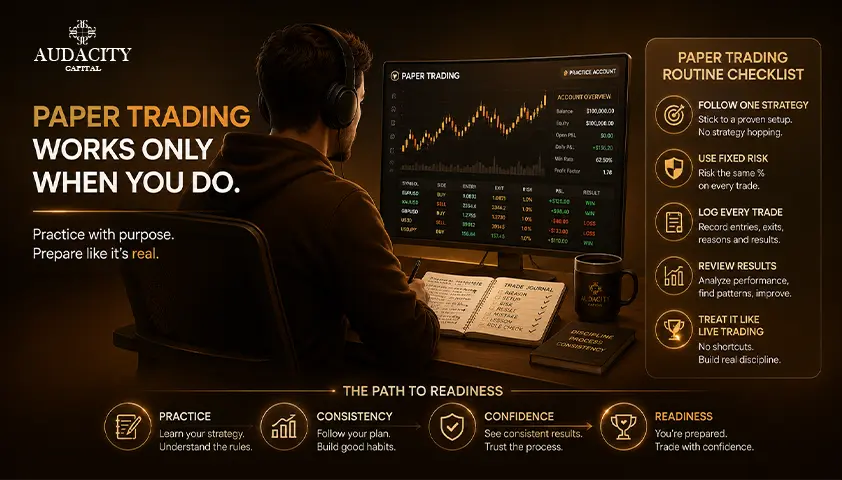
Most people do paper trading badly. They start with $100,000 of virtual money they will never have, take reckless positions because nothing is at stake, and quit the moment it stops feeling exciting.
That is just clicking buttons with fake money.
Doing it properly is different, and the principle behind it is simple: treat the simulated account exactly like a real one.
The closer your practice conditions are to your real conditions, the more of what you learn will actually transfer. Here is how.
1. Size it realistically.
Set the virtual balance to what you would actually fund. If you plan to trade with $1,000, do not practice with $100,000, or your simulated trading will teach you position sizing habits that fall apart the moment your real account is a fraction of the size.
2. Do the same research.
Prepare each trade exactly as you would if real money were on the line. No lazy entries you would never take live.
3. Apply real risk rules.
A stop loss on every trade, a fixed amount of risk per trade, and sensible position sizing. If you want a deeper dive into where to place protection and targets, our guide on Take Profit vs Stop Loss walks through the rules worth practicing.
4. Account for costs.
Factor in spread, commission, and a little slippage so your results are honest rather than flattering. Numbers that ignore costs are numbers you cannot trust.
5. Mirror your real objectives.
Trade the same time horizon and constraints you would trade under for real, whether that is a few trades a week around a job or full-time screen time.
6. Journal everything.
Record every trade with the reason you entered and the rationale for your exit price. This is where the learning actually happens. Reviewing your journal turns a pile of trades into a set of patterns you can improve.
7. Judge over a meaningful sample.
Assess yourself over a proper run of trades, not a good week. One strong stretch tells you almost nothing.
8. Transition gradually.
When you go live, start small and expect the psychology to feel different, because it will. The mechanics will be familiar. The emotions will not.
When Paper Trading Stops being Enough
At some point, risk-free practice has taught you everything it can. You know the platform, you can follow a plan, you can manage risk over a real sample, and your results are steady once you account for costs.
The only thing left to learn is how you behave when real consequences enter the room, and simulation cannot teach that.
This is the point where many traders look for practice with genuine consequences without betting their savings to get it. As a proprietary trading firm, this is where Audacity Capital fits in.
We give disciplined traders access to company capital through structured evaluation routes, the two-step Ability Challenge, the one-step Ability One, and the instant-funding Funded Trader Program, all on MT5 and DXTrade.
These are simulated funded accounts with trader-friendly rules, and the free trial is the paper-trading-adjacent way to see how you perform under our conditions before committing.
Related Articles
Best Free Paper Futures Trading Platforms
7 Best Paper Trading Simulators
Frequently Asked Questions
No. Paper trading uses virtual money, so there is nothing to win or lose. Its entire value lies in the skills, habits, and platform familiarity you build before risking real capital, not in the numbers on the screen.
There is no fixed answer. A useful benchmark is being able to follow your plan and manage risk consistently over a meaningful number of trades rather than a single good week, and then starting live with small size and modest expectations.
Yes, they are the same concept with different names. Paper trading is the term used in stock markets, while demo trading is what the forex and CFD industry calls it. Both let you trade virtual money on live market conditions with no real capital at risk.
Because real money introduces fear and greed that simulation cannot reproduce, and because live trading involves spreads, commissions, and slippage that simulators often understate. The strategy may be identical, but the conditions are not.
Most simulators use live or near-live data so the experience mirrors real conditions. However, some free platforms use delayed pricing, which is worth checking if you are practicing short-term strategies where timing matters.
Use roughly what you would actually fund. Practicing with $100,000 when you plan to trade $1,000 teaches position sizing habits that will not transfer to your real account, which defeats the point of the practice.
Yes. Experienced traders often use it to test whether a new strategy has merit or to learn an unfamiliar platform, all without putting capital at risk while they find out whether the idea holds up.
Backtesting measures how a strategy would have performed against historical data, while paper trading runs it forward in live market conditions in real time. Many traders use both, backtesting the idea first, then paper trading it to confirm it still works today.

Bereit, diszipliniertes Risiko auf Krypto anzuwenden? Entdecken Sie die neuen Krypto-Instrumente von Audacity Capital und bringen Sie Ihre Trading-Strategie mit.
Mehr erfahrenNewsletter
Treten Sie unserem Newsletter bei, um auf dem Laufenden zu bleiben.
Treten Sie unserer sozialen Gemeinschaft bei

Beginnen Sie Ihre Reise heute Mit unserer kostenlosen Testversion
Präsentieren Sie stolz Ihre Fähigkeiten und Leistungen durch Zertifikate und erhalten Sie Anerkennung für Ihre harte Arbeit und Ihr Engagement von potenziellen Investoren und Kollegen.
Kostenlose TestversionVerwandte Artikel

Paper Trading vs Live Trading: What's the Difference?
Paper trading vs live trading: Compare execution, psychology, risk, and performance to decide when you're ready to trade with real money.

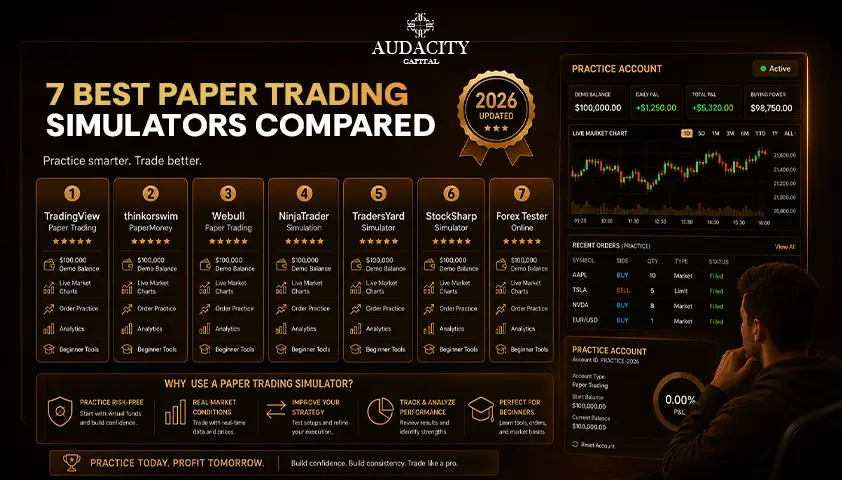
7 Best Paper Trading Simulators for 2026
Compare the best paper trading simulator options for 2026, including features, costs, asset coverage, limitations, and who each platform suits best.