


Carry Trading Strategy Explained (2026): How It Works + Examples



Carry Trading Strategy (Quick Answer)
A carry trading strategy involves borrowing a low-interest-rate currency and investing in a higher-yield currency to profit from the interest rate difference, while also considering exchange rate movements and risk.
Carry Trading Strategy: What Is It?
Every beginner and intermediate prop trader needs to familiarize themselves with one key strategy, the carry trade strategy. The strategy, which primarily relies on the interest rate differentials that exist between two currencies, is among the most relied upon strategies in the financial markets.
It also happens to be one of the few key factors that can impact the direction of a currency when pitted against another. With this in mind, there’s a need to learn of the different ways that you can use the carry trading strategy in your regular trading activities. This guide will teach you how to do so!
Read on to learn why this strategy is so important in the foreign exchange markets.
What Is a Carry Trade?
Picture this: you’ve recently found yourself in a situation that requires you to borrow money from a friend who is willing to lend it to you at a pocket-friendly rate. Once this money is in your possession, you then turn around and lend the same amount to another friend, but at a much higher rate.
Note: In Forex, this "borrowing" is implicit in the currency pair structure. When you buy AUD/JPY, you are technically long AUD and short JPY; the interest differential is handled by the broker via rollover (swaps).
Now, the difference between the two rates, also called the “carry” represents your potential profit. The same applies to the carry trade in trading. In forex, the carry trade occurs when you borrow money in a currency that has a lower rate, with the goal of investing it at a higher rate.
You should note that the carry is often secondary to capital gains/losses from exchange rate fluctuations. If the exchange rate moves against you by 1%, it can wipe out a whole year of 2.5% carry interest in days.
Key Elements of the Carry Trade Strategy
The interest rate differential that exists between two currencies is one of the key components of the carry trade strategy. Ideally, you should try to choose a currency pair where one of the currencies has a higher rate than its counterpart.
How to Use the Carry Trading Strategy (Step-by-Step)
- Identify a currency pair with a strong interest rate differential
- Choose a stable, low-volatility market
- Go long on the high-yield currency and short the low-yield currency
- Hold the position to earn positive swaps
- Monitor exchange rate movements and central bank policies
- Manage risk with stop-loss and position sizing
Simple Carry Trade Example (Beginner)
Borrow JPY (low interest) → Buy AUD (higher interest) → Earn daily interest while holding the trade.
Best Currency Pairs for Carry Trading
- AUD/JPY
- NZD/JPY
- USD/JPY (depending on rates)
- Emerging market pairs (higher risk)
Calculating a Carry Trade in Trading
The best way to understand the carry trade concept is with an example. So, let’s get mathematical:
Profit from interest = (Interest rate of the target currency – Interest rate of the funding currency) * Position Size.
Using the above information, let’s imagine a scenario where you’re looking to trade the Australian Dollar (AUD) against the Japanese Yen (JPY). During trading, assume the AUD interest rate is 3%, with the JPY offering just 0.5%.
If you happen to be holding $10,000 worth of the AUD/JPY currency pair, it means that your profit from this trade will be:
Daily Interest = (Target Rate − Funding Rate) × Notional Value ÷ 365
(3% – 0.5%) x $10,000 = $250 (annually)
The daily profit will thus be $0.68
NB: When it comes to calculating the profit, please understand that the interest earned is based on the notional value of the trade, not just the trader’s margin (deposit).
Real Life Carry Trade Example
Let’s use the explanation above to look at a real-life scenario. In this scenario, we will continue using the AUD/JPY pairing mentioned above.
If you decide to purchase the AUD while at the same time selling the JPY, with the expectation that the AUD will rise enabling you to also profit from the difference, it means you can profit from both the interest differential and currency appreciation if the AUD strengthens and the interest rates remain unchanged.
When Does Carry Trade Work Best?
- Stable markets
- Low volatility
- Risk-on environment
When Does Carry Trade Fail?
- Market crashes
- Risk-off sentiment
- Central bank policy changes
Pros and Cons of Carry Trading
Pros
- Earn passive interest (swap)
- Works well in stable markets
- Can generate consistent returns
Cons
- High risk during market crashes
- Currency volatility can wipe profits
- Sensitive to interest rate changes
Carry Trade Strategy Checklist
- Choose high interest differential
- Check volatility
- Monitor central banks
- Avoid high-risk periods
- Use stop-loss
Carry Trade vs Day Trading
Carry Trade | Day Trading |
|---|---|
Long-term | Short-term |
Earn interest | Earn price movement |
Low frequency | High frequency |
How to Use Carry Trade in Trading
There are several factors you need to keep in mind when using the carry trade strategy:
Many brokerage companies allow traders to receive the interest difference when they purchase a currency having a high interest, and then selling a low-interest-rate currency. Forex traders call this a positive swap (You should note that brokers take a cut. The "spread" on the interest rates means you rarely get the full central bank differential).
While inflation influences rates, central bank "hawkishness" is the more direct indicator. High inflation can hurt a carry trade if it leads to currency devaluation, something that is likely to happen because of the economic activities being conducted by each country.
In summary, the following are the key factors to remember when using this strategy:
- Focus on the Differentials: The core aim of the carry trade strategy is to borrow at a low-yield currency and invest the borrowed amount into a high-yield one. And while at it, don’t just look for high differentials; look for low volatility. A currency with 10% interest is useless if it drops 15% against the dollar annually.
- Factor in the Swap Fees and Resulting Costs: Please note that the overnight financing charges will have a direct impact on your profitability. Always keep an eye on the swap calendar where three days of interest are paid at once to account for the weekend.
- Watch Central Bank Policies: Global monetary policy changes can quickly affect the interest rates gaps, thus impacting the trade.
- Monitor Market Sentiment: The carry trade strategy works best in risk-on environments where the traders and investors are after high returns.
How Carry Trades Influence the Global Economy
From the explanation above, the carry trade may seem simple: borrow in a low interest rate currency, and park it where it will yield at a higher rate. But you need to remember that it is, in fact, a financial tidal wave.
Whenever billions of dollars pour into this strategy, it not only pads the trader’s bank accounts, it also reshapes the global capital flows, while rattling the prevailing exchange rates. In some cases, it can even shake entire economies. Below is a look at how it affects global economies:
- Floodgates into Emerging Markets: Emerging markets are a major magnet for carrying trade money. This is because money flows into them when their rates are shining brightly, causing asset prices to increase. But here’s the downside: the carry trade money is hot money. Therefore, if the risk sentiment was to drop, the tide will likely shift overnight.
- Currency Tug of War: Carry trades have the tendency to propel high-yield currencies while dragging the low-yield ones. Imagine a scenario where multiple traders borrow the yen at rock bottom rates to buy the AUD. The result here will be a strong AUD and a very weak yen. Such market moves will affect global growth rates and ripple through trade balances.
- Unwind = Shockwaves: Unwinding is the real danger because carry trades are described as "profitable", but they are "pennies in front of a steamroller" strategies. They offer steady, small gains but are vulnerable to massive, rapid losses during "risk-off" periods. When a market crisis hits, the first thing that all traders do is to stampede out of their carry trades. What follows is a spike of the funding currency, e.g., the yen, while the target currency, the AUD, in this case, begins to drop. A good example is the 2008 market crash which saw the yen surging as traders and investors rushed to dump positions they considered risky.
- From Boom to Bust: Carry trades help in turbocharging cycles on a macro scale. They can help in fueling asset booms and market growth during the good times. However, if the sentiment was to reverse, the emergent unwind can end up spreading panic across borders, thus exposing the fragile nature of the global markets.
In a nutshell, the carry trade is much more than a trader’s tool: it’s a global force. Its momentum build-up is fast, which can make it have brutal consequences when there’s a fallout.
Disclaimer: Please be advised that past performance of interest rates does not guarantee future exchange rate stability.
Key Highlights
The carry trade strategy is a cornerstone of the financial markets, primarily used by prop traders to capitalize on interest rate differentials between two currencies.
In a nutshell:
- The strategy’s core objective is to borrow a low-yield "funding currency" and invest in a high-yield "target currency" to capture the interest profit.
- While carry trades offer steady gains, they are highly vulnerable to "risk-off" periods where traders exit positions rapidly, causing sharp currency fluctuations and potential losses that can exceed interest earnings.
- In forex, brokers facilitate this process via "positive swaps," where traders receive interest for holding high-rate currencies overnight, though brokers apply a spread to the swap rate, meaning traders rarely receive the full central bank differential.
- Potential gains are determined by subtracting the funding currency's rate from the target currency's rate and multiplying that difference by the total notional value of the trade.
Conclusion
The carry trading strategy is a fundamental concept for traders, relying on the interest rate differential between two currencies. It involves borrowing a low-yield currency to invest in a high-yield currency, with the goal of profiting from the "carry" or interest rate difference. While appearing simple, the collective use of this strategy acts as a powerful financial force, reshaping global capital flows and exchange rates. Key factors for successful execution include focusing on the differentials, factoring in swap fees, watching central bank policies, and monitoring market sentiment, as the strategy thrives best in "risk-on" environments. The potential for sudden market shifts, or unwinds, highlights the strategy's inherent risks and global influence.
Learn, practice, and apply your trading strategy in Audacity Capital's free monthly trading competition.
FAQs
A carry trade occurs when a trader borrows money in a currency with a lower interest rate to invest in another currency that offers a higher interest rate, aiming to profit from the resulting differential.
The primary component is the interest rate differential that exists between the two currencies in the pair you are trading.
The profit is calculated by taking the interest rate of the target currency minus the interest rate of the funding currency, and then multiplying this difference by the position size.
They can act as a financial tidal wave by pushing money into emerging markets and causing a "currency tug of war," where high-yield currencies strengthen and low-yield ones weaken.
A positive swap is the term forex traders use when brokerage companies allow them to receive the interest difference for holding a currency with a high interest rate while selling one with a low rate.

¿Listo para aplicar un riesgo disciplinado a las criptomonedas? Explore los nuevos instrumentos de cripto de Audacity Capital y traiga su estrategia de trading.
Aprender másBoletín
Únase a nuestro boletín para mantenerse al día.
Únete a Nuestra Comunidad Social

Comienza Tu Viaje Hoy Con Nuestra Prueba Gratuita
Muestra con orgullo tus habilidades y logros a través de certificados y obtén reconocimiento por tu arduo trabajo y dedicación de posibles inversores y compañeros.
Prueba GratuitaArtículos Relacionados

Martingale Strategy in Trading
How the martingale trading strategy works, what the doubling arithmetic actually costs, why position sizing cannot create an edge, and where it is banned.


Momentum Trading Strategy: A Comprehensive Guide
Master the core principles of a momentum trading strategy. Learn how to use key indicators, manage sharp-reversal risks, and master exit timing.
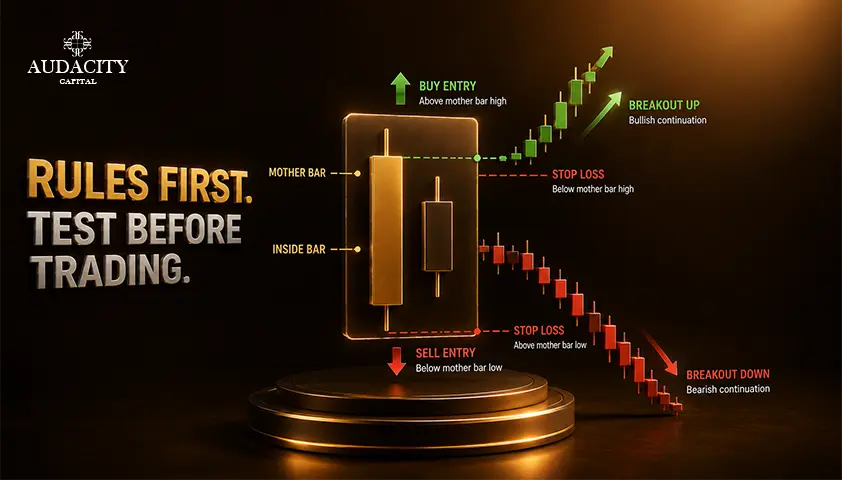
Inside Bar Trading Strategy: Rules, Entries and Backtest Guide
Learn a rule-based inside bar trading strategy. Get the pattern definition, three entry models, stop and target logic, and a backtest framework for your market.
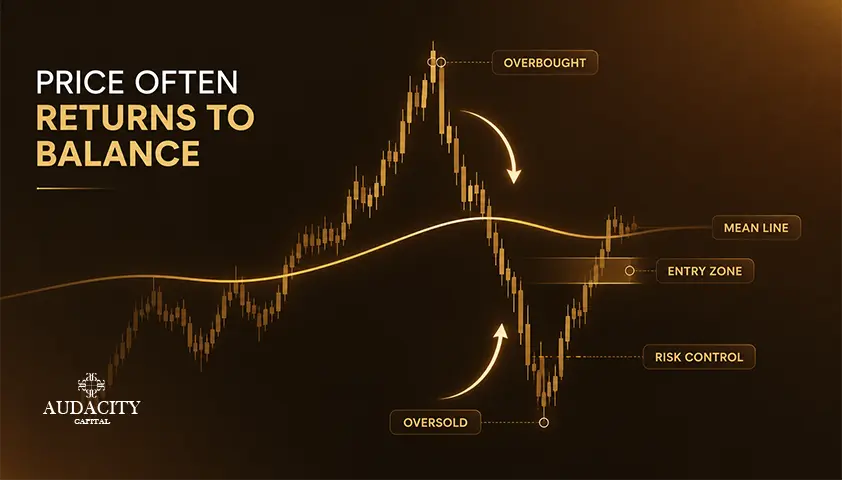
Mean Reversion Trading Strategy Explained (2026)
Prices that stretch too far tend to snap back to an average, but only in the right market. Learn the tools, the setup, and the trend risk.