


Copy Trading in India: How It Works, Best Platforms & Risks (2026 Guide)



Copy trading in India means connecting your capital to another trader's account so their buy and sell decisions replicate automatically in yours, scaled to what you've allocated. The mechanics stay consistent across platforms even when the marketing language differs. It operates by directly duplicating live trading decisions into your account in real time.
The people searching for this fall into two groups:
- Newcomers wanting exposure without a year of learning technical analysis.
- Professionals who understand trading but lack the hours to sit through a session.
Both spend real time comparing options before settling on the best copy trading app in India for their needs.
What complicates the picture is jurisdiction. Most copy trading runs through offshore forex and CFD brokers that SEBI doesn't oversee, and RBI has warned repeatedly against moving money to such platforms for margin trading. Losses replicate just as precisely as gains, so the format carries real capital risk on top of the regulatory one.
What is Copy Trading?
Copy trading in India is often used as a catch-all term, but it actually sits alongside two related formats that get bundled into the same conversation. Understanding what separates them helps explain why some platforms suit beginners, and others suit traders who already have a strategy in mind.
At its core, copy trading is the automatic replication of another trader's live positions into your own account, adjusted to the size of your allocation. You don't approve individual trades; the moment your chosen trader enters or exits a position, your account mirrors that action within seconds, and your returns move in the same percentage terms as theirs, minus any platform fees, the same way a mutual fund's NAV tracks the value of its underlying holdings.
The three formats that fall under this umbrella work a little differently from each other:
- Mirror trading replicates a fixed, rules-based strategy or algorithm instead of a live human trader, so the logic behind every trade is set in advance and doesn't shift based on day-to-day judgment.
- Social trading is the broader ecosystem these platforms are built on, where you can follow, message, and study other traders' performance publicly before deciding whether to copy anyone at all.
- Signal trading sends you a trade alert or recommendation that you execute yourself, either manually or through a semi-automated tool, instead of having the trade placed on your behalf.
Copy trading is the only one of the three that removes your input entirely once the connection is active, which is also why platform and trader selection matter more here than in the other two formats. A platform that only sends alerts isn't copy trading in the strict sense, even when it's marketed that way, because you're still the one deciding whether to act on every position.
How Does Copy Trading Work?
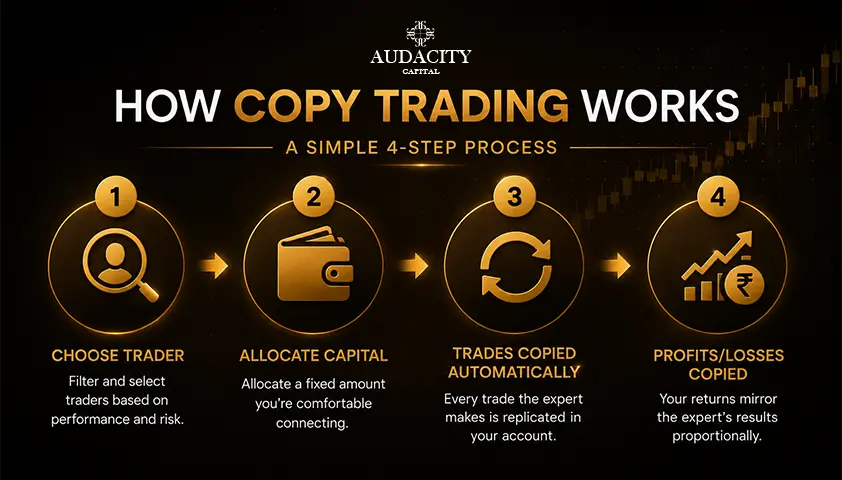
Copy trading in India follows the same four-stage sequence regardless of which platform or asset class you're using, even though the interface details vary from one app to another.
Choose trader -> Allocate capital -> Trades copied automatically -> Profits/losses copied proportionally.
The process starts with choosing a trader, and this is where most of the real work happens. Serious platforms let you filter by track record length, maximum drawdown, win rate, risk score, and the assets they typically trade, and spending time here matters more than almost any other step in the process.
Once you've picked someone, you allocate capital. A fixed amount you're comfortable connecting to their strategy, separate from money you might be trading yourself actively. Most platforms let you set this per trader, so you can spread an allocation across two or three people instead of committing everything to one strategy.
From that point, execution is automatic. When the trader opens a position, your account opens the same position within seconds, sized to match the proportion of capital you've allocated relative to theirs. When they close it, yours closes too, and your profit or loss reflects the same percentage return they achieved, adjusted for any fees the platform charges on top.
That proportional relationship is the entire value proposition and the entire risk. A trader's account can absorb a losing streak better than a smaller allocation can, which is worth remembering before connecting your capital to someone else's decisions.
Is Copy Trading Legal in India?
Copy trading in India doesn't have a dedicated legal framework, which is part of why the question comes up so often. SEBI regulates India's securities markets, including listed equities, mutual funds, and exchange-traded currency derivatives, but it doesn't license or oversee copy trading as a category, and none of the major copy trading platforms are SEBI-registered.
The bigger issue is forex. RBI permits retail participation in a narrow set of INR currency pairs through SEBI-registered brokers on recognised exchanges, and nothing beyond that. Most copy trading platforms run on offshore forex and CFD infrastructure that falls outside this framework entirely, and RBI has issued repeated public warnings against sending money abroad for margin-based forex trading through unauthorised platforms, including under the Liberalised Remittance Scheme.
Crypto occupies its own space. It isn't illegal to hold or trade, and gains are taxed under Section 115BBH, but it remains unregulated by SEBI and RBI as an asset class, so platforms like Bybit carry no investor protection if something goes wrong.
None of this makes copy trading illegal outright for an Indian resident, but it does mean the compliance responsibility sits entirely with the trader, not the platform. Before funding whatever you've shortlisted as the best copy trading app in India, checking current RBI and SEBI notifications is worth the ten minutes it takes.
Best Copy Trading Platforms in India
Finding the best copy trading platform in India isn't just about comparing features—it's about understanding how each platform approaches copy trading. Some focus on social investing, others specialise in forex signal copying, while a few integrate with third-party services instead of offering built-in copy trading.
The platforms below cater to different trading styles, experience levels, and markets, making it easier to find the option that best matches your goals.
1. eToro – Best for Social Investing
eToro helped popularise copy trading through its CopyTrader feature, allowing users to automatically replicate the portfolios of experienced investors across stocks, ETFs, cryptocurrencies, and CFDs. Its transparent trader statistics and social investing community make it one of the world's best-known copy trading platforms.
However, eToro is not officially available to residents of India, so Indian traders should verify availability before considering it.
Best for: Investors looking for diversified social investing.
2. ZuluTrade – Best for Forex Signal Copying
ZuluTrade connects traders with thousands of signal providers through a network of partner brokers. Its proprietary ZuluRank scoring system helps users evaluate traders based on performance, consistency, and risk rather than returns alone.
It's particularly suited to traders whose primary interest is forex and CFD copy trading.
Best for: Copying experienced forex traders.
3. AvaTrade – Best for Beginners
AvaTrade combines regulated forex and CFD trading with copy trading solutions such as AvaSocial and DupliTrade. Features like negative balance protection and a beginner-friendly interface make it one of the easier platforms for new traders to navigate.
Best for: Beginner copy traders.
4. Pepperstone – Best for Professional Execution
Pepperstone doesn't offer its own copy trading network. Instead, it integrates with popular third-party platforms like Myfxbook AutoTrade, DupliTrade, and MetaTrader Signals.
Its fast execution speeds and institutional-grade pricing make it popular among experienced forex traders.
Best for: Advanced forex traders.
5. IC Markets – Best for Low-Cost Copy Trading
IC Markets also relies on integrations such as Myfxbook AutoTrade, cTrader Copy, and MetaTrader Signals. Known for tight spreads and low-latency execution, it's a strong option for traders who prioritize execution quality over built-in social features.
Best for: Active forex and CFD traders.
6. Vantage – Best Native MT4/MT5 Copy Trading
Vantage offers its own copy trading application while supporting MT4 and MT5, allowing traders to follow experienced strategy providers without relying entirely on external services.
Its relatively low entry requirements make it appealing for traders exploring copy trading for the first time.
Best for: Forex copy trading.
7. Exness Social Trading – Best for Low Minimum Deposits
Exness provides a dedicated Social Trading app that allows investors to copy strategy providers with relatively small starting capital. The platform includes transparent performance metrics, risk scores, and flexible investment amounts.
Its accessibility has made it popular among traders seeking a simple way to start copy trading.
Best for: Beginners with smaller budgets.
8. NAGA – Best for Community-Based Trading
NAGA combines copy trading with a social trading network where traders can share ideas, discuss markets, and automatically replicate each other's trades. The platform supports forex, stocks, cryptocurrencies, commodities, and indices from a single account.
Best for: Traders who value social interaction alongside copy trading.
9. Bybit – Best for Crypto Copy Trading
Unlike most platforms on this list, Bybit focuses on cryptocurrency markets. Its built-in copy trading feature allows users to follow successful futures and spot traders directly within the exchange.
For traders interested primarily in digital assets, Bybit is one of the strongest crypto-focused copy trading options.
Best for: Cryptocurrency traders.
An Alternative to Traditional Copy Trading
Audacity Capital – Best for Traders Managing Their Own Accounts
Audacity Capital is not a traditional copy trading platform, so it shouldn't be compared directly with brokers that let users copy third-party signal providers.
Instead, it offers a different approach.
Rather than copying other traders, Audacity Capital funds traders who want to execute their own trading strategies. The firm also permits copy trading between accounts owned by the same trader, making it suitable for experienced traders managing multiple personal accounts while remaining compliant with the firm's trading rules.
If your objective is to develop your own trading skills rather than follow someone else's trades, a funded trading program like Audacity Capital may be a more appropriate alternative than conventional copy trading.
Best for: Experienced traders managing multiple personal accounts.
Comparison Table
Platform | Third-Party Copy Trading | Copy Between Your Own Accounts | Minimum Deposit | Markets | Best For |
|---|---|---|---|---|---|
eToro | ✅ | ❌ | ~$50–100* | Stocks, ETFs, Crypto, CFDs | Social investing |
ZuluTrade | ✅ | ❌ | Depends on broker | Forex, CFDs | Forex signal copying |
AvaTrade | ✅ | ❌ | ~$100–250* | Forex, CFDs | Beginners |
Pepperstone | Via integrations | ❌ | No minimum (Standard) | Forex, CFDs | Professional execution |
IC Markets | Via integrations | ❌ | ~$200* | Forex, CFDs | Low-cost trading |
Vantage | ✅ | ❌ | ~$50–200* | Forex, CFDs | MT4/MT5 copy trading |
Exness Social Trading | ✅ | ❌ | Low minimum* | Forex, Metals, CFDs | New traders |
NAGA | ✅ | ❌ | Varies | Multi-asset | Social trading |
Bybit | ✅ | ❌ | No fixed minimum* | Crypto | Crypto copy trading |
Audacity Capital | ❌ | ✅ | Evaluation challenge | Forex, Indices, Commodities | Self-directed funded traders |
*Minimum deposits and availability may vary depending on your country of residence, account type, and the broker's latest policies.
Advantages of Copy Trading
Copy trading in India appeals to a wide range of traders mainly because it lowers the barrier to entry without removing market exposure entirely. A few advantages come up consistently across platform comparisons:
- Beginner-friendly: You don't need years of chart-reading experience before participating, since the trader you're copying handles entries and exits for you.
- Passive investing: Once your allocation is set, the strategy runs without requiring you to watch the market all day, which suits people with full-time jobs.
- Learn from experienced traders: Watching how a copied trader manages a position, including when they cut losses, offers a practical education that reading alone rarely provides.
- Diversification: Spreading an allocation across two or three traders with different styles reduces dependence on any single strategy performing well.
These advantages explain why so many first-time investors treat the best copy trading app in India as their entry point into active markets.
Risks of Copy Trading

Every advantage of copy trading in India comes with a matching risk, and weighing both before allocating capital prevents the costliest surprises. The main risks worth understanding:
- Blindly following traders: A strong recent track record doesn't guarantee future performance, and copying someone purely because they're ranked highly ignores how that performance was achieved.
- No control: Once a connection is active, you can't intervene in individual trades, so you inherit every decision the trader makes, good or bad.
- Drawdowns: A trader's account can dip sharply before recovering, and your allocated capital drops by the same percentage during that stretch.
- Emotional investing: Watching your balance swing with someone else's decisions can trigger panic disconnections at exactly the wrong moment.
- Platform risk: Broker insolvency, technical outages, or execution delays can affect returns independent of the trader's actual performance.
- Strategy mismatch: A trader's risk appetite might not match your financial goals or time horizon, even when their returns look attractive.
Copy Trading vs Manual Trading
Deciding between copy trading in India and manual trading comes down to how much control and learning you're willing to trade for convenience.
Manual trading demands more time and a working understanding of technical and fundamental analysis, but every decision and every lesson that comes from a mistake is yours. Copy trading removes that learning curve by handing execution to someone else, at the cost of building your own skill and judgment over time. The table below breaks down the practical differences.
Aspect | Copy Trading | Manual Trading |
Control over trades | Limited, decisions follow the copied trader | Full control over every entry and exit |
Time required | Minimal once set up | Significant, ongoing market monitoring |
Learning curve | Low to start | Steep, but skills compound over time |
Skill development | Limited | Builds independent trading judgment |
Emotional involvement | Lower, though panic disconnects still happen | Higher, direct exposure to every decision |
Best for | Beginners, busy professionals | Traders wanting full ownership of the strategy |
Copy Trading vs Prop Trading
Copy trading and prop trading solve two different problems, even though both get mentioned in the same breath by traders exploring copy trading in India. Copy trading is built around following someone else's decisions:
- Follow others: Your returns depend on a trader you don't personally know continuing to perform well.
- Limited learning: Your own trading skill barely develops, since you're not the one making decisions.
- Dependent on signal provider: If that trader stops trading or hits a losing streak, your results move with them regardless of your own judgment.
Prop trading takes the opposite approach:
- Trade yourself: Every decision, and every lesson from it, belongs to you.
- Learn skills: Consistent practice on a funded account builds judgment; copy trading never asks you to develop.
- Funded capital: Firms like Audacity Capital provide trading capital once you clear an evaluation, removing the need to risk your own money to prove your ability.
- Long-term career: Prop trading rewards genuine, repeatable skill, a foundation that copy trading was never designed to build.
Read more about Prop Trading Vs Copy Trading
Can Beginners Use Copy Trading?
Beginners are actually one of the core audiences copy trading was built for, but that doesn't mean everyone should jump in immediately.
Who should: Beginners who understand basic market concepts, have researched a trader's history properly, and are starting with an amount they can genuinely afford to lose, fit this format well.
Who shouldn't: Anyone expecting guaranteed returns or unwilling to research a trader before allocating capital tends to run into trouble fast. Treating copy trading as a shortcut past due diligence, instead of just a shortcut past execution, is where most beginner mistakes start.
How to Choose a Copy Trader?
Picking the right trader matters more than picking the right platform, since even the best copy trading app in India can't fix a poor allocation decision. A practical checklist covers six things:
- Win rate: A high win rate alone means little without knowing the size of losses versus wins, so look at the full risk-reward picture together.
- Drawdown: Check the maximum drawdown a trader has experienced, since that number shows how much of a dip your own capital could realistically face.
- Risk: Review the leverage and position sizing a trader typically uses, because aggressive risk-taking can produce impressive short-term returns that don't hold up.
- Track record: Favour a long, consistent history spanning several months instead of someone riding a recent hot streak.
- Holding time: Understand whether a trader holds positions for minutes, days, or weeks, since that affects how closely their style matches your risk tolerance.
- Number of followers: A large following can indicate trust, but it isn't a substitute for checking the numbers yourself.
Running through all six before connecting your capital takes a few minutes and can save considerably more.
Common Mistakes Copy Traders Make
Most losses in copy trading in India trace back to a handful of avoidable habits, not genuine bad luck:
- Copying highest ROI: Chasing the biggest recent return usually means copying someone at the peak of a hot streak, right before it cools off.
- Ignoring risk: Focusing only on upside while skipping drawdown and risk-score data leaves you exposed to losses you didn't see coming.
- No diversification: Allocating everything to a single trader means their bad month becomes your bad month entirely.
- Investing too much: Committing capital you can't afford to lose turns a manageable strategy into real financial stress.
- Following unverified traders: Copying someone based on screenshots or social media hype, without checking a verified track record, is how most horror stories begin.
Is Copy Trading Worth It?
Whether copy trading in India is worth it depends entirely on what you're optimising for.
If convenience and market exposure matter more than building your own skill, a well-researched allocation to an experienced trader can genuinely work, provided you treat it as one part of a portfolio and not the whole strategy.
If you're looking to develop real trading ability or want full control over every decision, copy trading will always feel more like a ceiling than a solution.
For most people, the honest answer sits somewhere in between: useful as a starting point, risky as a permanent one.
Does Audacity Capital Allow Copy Trading?
For traders weighing Audacity Capital as a long-term alternative to conventional copy trading in India, the firm's own policy is worth spelling out clearly.
Yes. Audacity Capital allows copy trading between accounts owned by the same trader. This means you can copy trades between your own accounts or from your own external trading account, provided you remain the account owner.
However, copying trades from third-party traders, signal providers, account managers, or copy trading platforms is not permitted. This policy helps ensure every trader is evaluated based on their own trading decisions while still allowing those who manage multiple personal accounts to streamline execution.
[Explore Instant Funding →]
Related Articles
Best Copy Trading Platforms for 2026
FAQ
There's no dedicated law banning it, but most platforms run on offshore forex and CFD infrastructure outside SEBI's oversight, so it sits in a legal grey area.
It can be, but profitability depends entirely on the trader you copy and how you manage allocation, not on the platform itself.
It carries real capital risk, since losses copy exactly as faithfully as profits, plus added platform and regulatory risk on top.
It carries real capital risk, since losses copy exactly as faithfully as profits, plus added platform and regulatory risk on top.
The best copy trading app in India depends on your asset preference: eToro and Bybit for stocks and crypto, ZuluTrade and Vantage for forex-focused copying.
Yes, provided they research a trader properly and start with capital they can afford to lose entirely.
Yes. Profits fall under standard capital gains or business income rules depending on frequency, and crypto gains are taxed separately under Section 115BBH.
Yes, losses copy in the same proportion as profits, so a losing trader produces a losing outcome in your account too.
Social trading is the broader platform ecosystem of following and researching traders; copy trading is the specific act of linking your capital to replicate their trades automatically.
Yes, but only between accounts owned by the same trader, never from third-party signal providers or other traders' accounts.

¿Listo para aplicar un riesgo disciplinado a las criptomonedas? Explore los nuevos instrumentos de cripto de Audacity Capital y traiga su estrategia de trading.
Aprender másBoletín
Únase a nuestro boletín para mantenerse al día.
Únete a Nuestra Comunidad Social

Comienza Tu Viaje Hoy Con Nuestra Prueba Gratuita
Muestra con orgullo tus habilidades y logros a través de certificados y obtén reconocimiento por tu arduo trabajo y dedicación de posibles inversores y compañeros.
Prueba GratuitaArtículos Relacionados

Best Copy Trading Platforms for 2026
A 2026 roundup of the best copy trading platforms, how copy trading works, real risks and costs, and why building your own trading skill often wins.

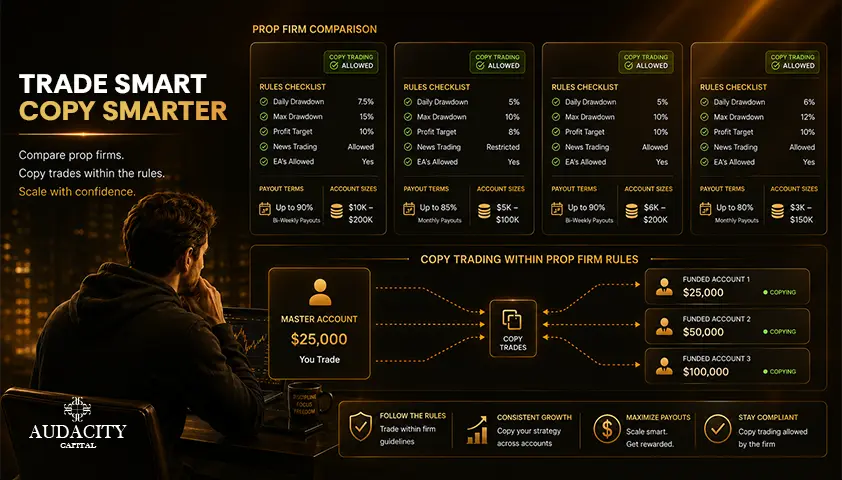
The Best Prop Firms That Allow Copy Trading in 2026
A guide to prop firms that allow copy trading in 2026. Learn internal vs external copying, the firms that permit trade copiers, and how to stay compliant.