




How Prop Trading Firms Work?



Key Takeaways
When a prop trading company accepts a trader, it allocates them a certain amount of capital to use in their trades. The size of the initial allocation and the profit splits ratio varies depending on the trader’s skill and proven track record.
Key Highlights
- Community Support: The prop trading firms provide structure and support, which make them ideal for beginners looking to build discipline.
- Reduced Risk and Profit Splits: Prop firms use their own capital to fund skilled traders in exchange for profit sharing, reducing the risk to your funds.
- Bonuses: Consistent profitability helps unlock additional capital, with potential access to more bonuses.
- Real Payouts: You can earn real payouts fast, with some firms unlocking your profits after a few days of trading.
How Prop Trading Firms Work
A prop trading firm operates by providing capital to seasoned and proven FX traders to use in financial markets. This enables the selected traders to earn a percentage of the profits generated without having to risk their own funds.
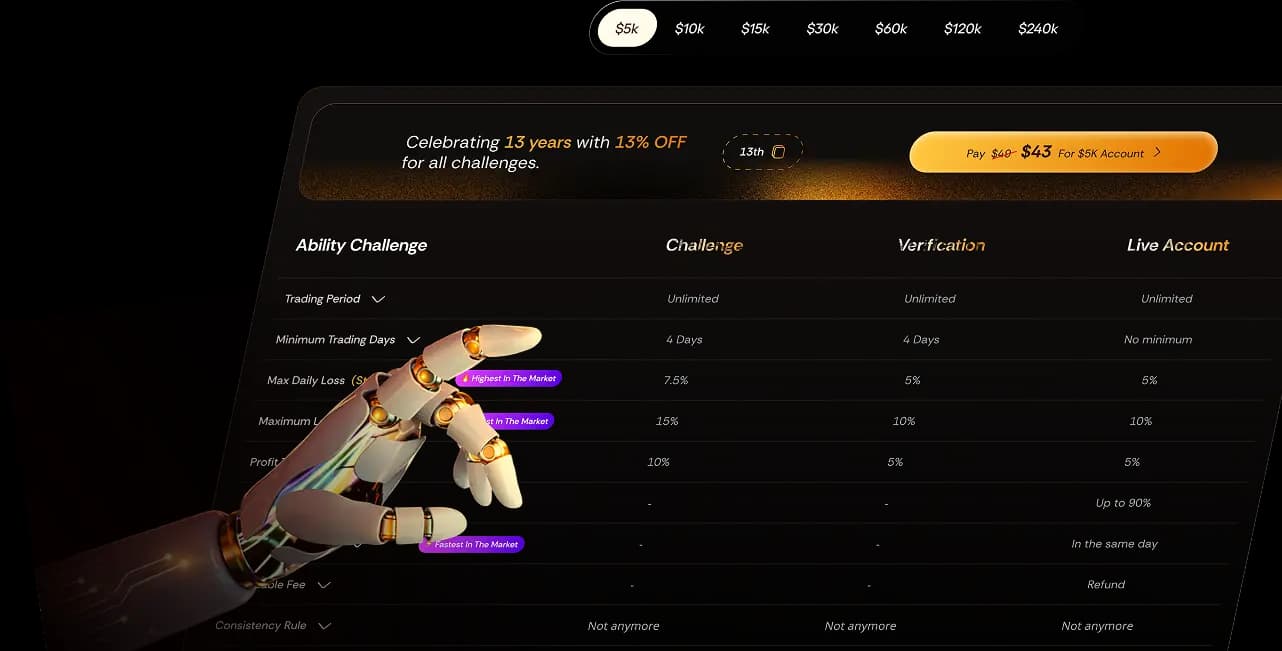
Traders interested in getting funded by these firms will typically have to pass an evaluation phase. The purpose of this challenge is to showcase their profitability and risk management styles, thus enabling the firm to make money from profit splits.
Continued profitability provides access to a larger capital pool and more advanced trading tools. Some of the rules a trader is expected to follow include max drawdown and daily loss limits.
Dive deeper into this topic what are prop trading firms and how they work
What Is a Prop Firm in Trading?

A prop firm provides traders with capital/funding, while the traders get to bring their skills. For one to qualify for funding, they must first take an evaluation test. On passing, they become eligible for profit splits and scaling opportunities, the latter being based on performance. Read more about What is Prop Trading?


Audacity Capital Empowering Traders Since 2012
Join the Prop FirmThe following is a more detailed look at how these firms work.
Evaluation Process
In the evaluation process, the prop firm will offer you a trading test. The test comes complete with virtual money and is designed to determine whether you have the skills to earn profits without losing your initial capital.
The prop firm will ask you to pay a certain fee that’s dependent on your account type. You’ll then get access to a simulated funded account where you get to trade your virtual capital. During the evaluation, you’ll be tasked with hitting certain targets within a set duration.
As you trade, the firm will keep track of your ability to:
- Manage risk
- Assign capital
- Do the above tasks in a consistent manner
Each firm will have its own evaluation model, but the three listed below are the most common:
- One-Step Challenges: The goal is to attain one profit target without deviating from your risk management plan.
- Two-Step Challenges: These are more relaxed than the one-step challenges, as their goal is to judge consistency and whether you can manage financial risk.
- Three-Step Challenges: It’s only used by select firms, and its goal is to add an extra verification layer meant to reduce the risk to the prop trading company.
- Instant Funding: In instant funding, traders get to skip the evaluation phase in a format that sees them get immediate access to live capital. The trader will, however, need to part with a higher upfront fee.

Audacity's Trading Competition
Free Prop Firm ChallengeI am a good example of someone who has gone through the evaluation phase, and lived to tell the tale! And while the times may have changed, the principle remains pretty much the same.
Knowledge of the risk rules and a good mental state form the foundation. But if you’re to execute your trading strategy, I recommend that you have in place a detailed step-by-step action plan.
At this point I’d like to emphasize that successfully passing the challenge will require you to eliminate all guesswork. Take your time to refine your strategy, making sure to treat the preparation phase like the Olympics.
Optimize all the details, no matter how minute they may seem. Remember, the consistent effort applied at this phase will contribute to your later success!
Risk rules & targets

The prop trading risk rules and targets are focused on using strict limits to preserve capital. Besides limits, this can also be achieved using diversification, proper sizing, and mandatory stops.
Examples of prop trading risks include:
- Per-trade risk
- Maximum drawdown
- Daily loss limit
- Position sizing
Targets, on the other hand, are used to gauge trading skills, and will usually require you to balance consistent controlled risk while passing the company’s challenges. Failure to do this will see your funding get taken away.
Common targets in prop trading are:
- Profitability per day
- Minimum trading days
Click here to learn more about prop trading risks and targets, and the common Prop Trading Challenges & Rules Explained.
Before I take you through what the funded account is, I’d like to provide you with some input derived from my experience. And I’ll start by mentioning that this is a highly effective tool.
I have come to view it as a low risk investment tool designed to provide you access to a larger capital pool. But this doesn’t mean that you should approach it as if it were a get-rich-quick scheme.
Taking on such an approach will only lead to regret and losses. In the right hands, I believe this tool will help eliminate the need to use personal savings when trading.
But for it to work, you must understand that it demands intense discipline and an ability to operate under strict, non-negotiable rules. Read on to learn about the funded account stage.
Check About Audacity's Free Prop Firm Challenge
Funded account stage
The funded account stage in prop trading is also known as the “real deal stage” and is one that you can only get into after passing the evaluation. In this stage, the focus will shift from proving a trading strategy to risk-managed growth that will help keep the account profitable.
Please note that there are various types of funded accounts, and that not all function the same way. Common models include:
- Live Funded Account: The profit payouts in these accounts are from the gains made in a real trading environment.
- Simulated Funded Account: You get to execute trades in a simulated environment. However, its payouts are real and pegged to performance.
- Hybrid Model: It’s a combination of the two models above, and its trades will only go live after you’ve attained certain milestones.
Click here to learn more about How Traders Get Funded?
Profit split
Profit splits help dictate how the prop firm will divide profits between it and the trader. In the funded programs, this profit split ratio is crucial in determining your potential payout, and is something you should consider when looking at different firms.
While at it, it will also be important to consider additional factors such as long-term scaling potential, evaluation rules, and challenge difficulty. The splits typically vary from firm to firm and are influenced by:
Learn more about Prop Trading Business Model
- Risk management policies: A firm offering a high profit split will have a stricter evaluation process to help it minimize risk. Companies that have an instant funding model may provide a lower split to boost eligibility chances.
- Market type and asset class: The norms practiced by each industry will differ by market. For instance, FX firms will provide an 80% split, while the future-focused ones can go as high as 90%.
- Scaling models: There are prop firms that choose to provide a base split that will increase as you attain the set milestones. This can also change when you prove consistency. Its goal is to reward long-term traders.
- Evaluation structures: The journey to getting to the funded account stage matters. Firms that have multi-step challenges will offer a higher profit split, with those that provide one-step challenges providing a lower split.
Funded Trader Program
Start Funded TradingScaling logic
Scaling a funded prop trading account will require you to manage risk, hit profit targets, and maintain consistent profitability. All this is needed to scale your account and unlock larger trading opportunities.
Below is a quick look at this process:
- Risk Management: Try to stick to the 1-2% rule when trading to help you effectively manage your daily drawdowns.
- Profit Targets: Many prop trading firms require their traders to hit a 5-15% profit target over a period of 30 days to scale.
- Consistency When Trading: The best move is to avoid relying too much on big single-day trading wins. Whenever possible, try to spread your profits evenly across the trades.
- Evaluation Metrics: Use the tools provided by the prop trading company to measure performance and set your trading goals.
- Scaling Plans: Different firms will have varied account increases, with many happening every three to four months.
As you contemplate this, make it a point to reinvest a percentage of your earnings/profits to help the account scale faster.
FAQ
Yes! Prop trading has been around for decades, and while the strategies may have evolved, the basics remain.
Absolutely. Anyone interested in becoming a prop trader should start by researching the available firms and learning about their evaluation processes.
The capital provided by prop trading firms is dependent on the type of funded account on offer. Some have instant funding while others have more detailed evaluation challenges.
Prop firms primarily make money through fees and profit splits. Whenever a trader turns a profit on a trade, they earn a percentage. So yes, prop traders do make money.
Most prop trading companies enforce a variety of rules, such as profit targets, daily loss limits, minimum trading days, and maximum loss limits. Some may also place a restriction on news trading.

¿Listo para aplicar un riesgo disciplinado a las criptomonedas? Explore los nuevos instrumentos de cripto de Audacity Capital y traiga su estrategia de trading.
Aprender másBoletín
Únase a nuestro boletín para mantenerse al día.
Únete a Nuestra Comunidad Social

Comienza Tu Viaje Hoy Con Nuestra Prueba Gratuita
Muestra con orgullo tus habilidades y logros a través de certificados y obtén reconocimiento por tu arduo trabajo y dedicación de posibles inversores y compañeros.
Prueba GratuitaArtículos Relacionados

Prop Trading Vs Institutional Trading
Learn the difference between prop trading and institutional trading, including capital sources, strategies, risk management, and career opportunities.


Prop Trading Vs Quant Trading
Learn the difference between prop trading and quant trading, including strategies, technology, risk management, and which approach suits your trading style.

Prop Trading Vs Investment Banks
Explore how prop trading differs from investment banks in strategy, capital, and risk management with insights from Audacity Capital.

Forex Vs Futures Prop Trading
Compare forex vs futures prop trading, including costs, leverage, risk, and profit potential. Find out which market is best for prop traders at Audacity Capital.