


Trade Deficit Explained: Causes, Effects and Markets


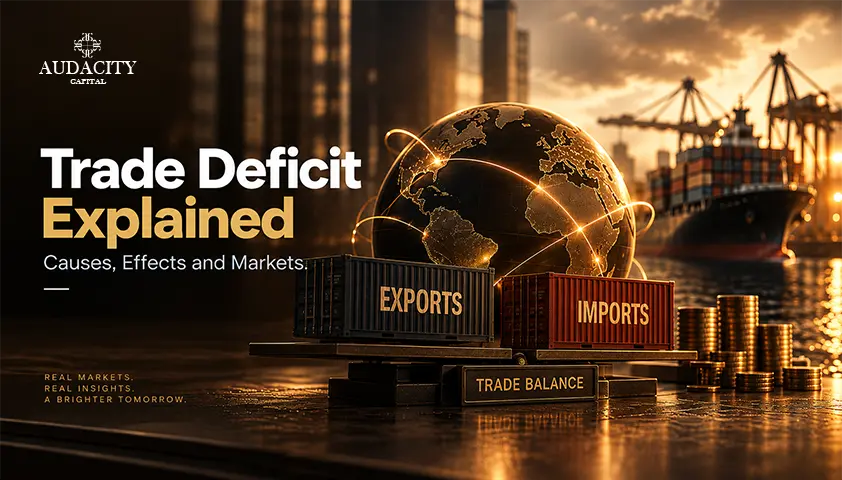
Every month, the trade balance figures appear in your economic calendar. In theory, an increasing deficit will weaken the currency, so you would expect to see the dollar weaken every time the number gets worse.
But traders following USD pairs have witnessed the contrary more than once. The deficit increases and the dollar rises regardless.
The mismatch between the textbook rule and real market behaviour is worth exploring. We will cover what the number is really measuring, what actually causes the increase, and why the relationship you have been taught is not very reliable in real life.
This content is educational and not financial or investment advice. Trading involves significant risk of losses.
What Is a Trade Deficit?
A trade deficit occurs when the value of imports surpasses the value of the exports of a country within a specific period of time. The math behind it is very simple: exports minus imports. If the result is negative it is a loss. If the result is positive, it is a surplus.
Here is where most people get confused because the headline number includes both goods and services while those tend to flow in opposite directions.
For instance, the United States has both a large deficit in goods and a surplus in services, according to the Bureau of Economic Analysis. The aggregate number understates both. In case you only read the headline, you lose all this information.
It is important to note that a trade deficit does not mean a loss of money because every dollar invested in imports comes back into the domestic economy through export payments or investments in domestic assets.
Data sources: Bureau of Economic Analysis (BEA), International Trade in Goods and Services. Foreign trade data from the U.S. Census Bureau.
How the Trade Deficit Is Measured and Reported
The mechanics of the release are important to anyone who watches it, and most trader-facing pages overlook the fine details.
The figure is compiled by the US Census Bureau and the Bureau of Economic Analysis. It is published monthly about 5 weeks after the month it covers.
Each release separates goods, services and the overall balance, as well as country-level detail. The previous periods are revised, which means that the first print is just an estimate and not a final figure.
The important factor for a trader is the timing. The release is also delayed and revised, meaning it covers conditions that are largely priced in by the market, based on the earlier releases.
Imports and exports flows provide information about the economy even before the report comes out and that explains why the release rarely causes major currency movement.
Verify the current and future release dates on the BEA international trade page before setting up your calendar, as release dates and lags can change.
Source: Bureau of Economic Analysis, international trade release calendar.
What Actually Causes a Trade Deficit

This is the part of the article that will change your entire understanding, so read carefully. The trade deficit is almost always seen as the outcome of trade behavior.
Economists generally treat it as the result of larger macroeconomic forces. Understanding what causes a trade deficit means looking past trade itself.
There are four main factors involved:
- Savings vs. Investment: If the country invests more than it saves, it needs to import money and hence a trade deficit.
- Government budget deficit: A larger budget deficit will decrease national saving and increase the gap.
- Foreign economic activity: If foreign activity is weak, exports will become more difficult to achieve.
- Exchange rate: When the currency is strong, imports become cheap while exports become costly.
What you need to remember is that a trade deficit occurs when the country spends more than it earns and the trade balance is the arithmetic result.
That's why targeted measures to trade flows don't necessarily shift the overall deficit, even if they alter trade partners.
One more distinction. The overall deficit is not the same as a bilateral trade balance with a single country. A bilateral deficit reflects comparative advantage and supply chain, not unfair treatment, while the total balance remains unchanged.
This framework is not ours, it is the economists who designed it, and we do not take a stance on any trade policy.
Driver | How it affects the balance | Why it is often missed |
Saving versus investment | Investing more than you save requires importing capital | It is an accounting identity, not a trade decision |
Government budget deficit | Reduces national saving, widening the gap | Discussed as a separate issue from trade |
Economic activity abroad | Exports are stunted by weak foreign demand | Attributed to competitiveness instead |
Exchange rate | Strong currency decreases import costs | Treated as an effect of the deficit, not a cause |
Sources: PBS NewsHour, column on the trade deficit and its macroeconomic determinants. Congressional Research Service, Introduction to US Economy: Trade Deficit.
Why a Trade Deficit Is Not Automatically Bad
There are costs and benefits to the deficit and its impact is debated. This is not to say that it is harmless. This section reports both sides with attribution and takes no position.
Begin with the counterintuitive fact. The deficit is larger when the economy is doing well. Growth increases the demand for imports and draws in foreign capital. Therefore, a widening deficit can coincide with low unemployment rather than high unemployment.
The Congressional Research Service emphasizes that point, which is the one piece of information that is most valuable to traders about the series. A deteriorating trade balance may be evidence of strength and not weakness.
As far as employment goes, caution is warranted. Trade alters the composition of employment among industries, shifting jobs across sectors. It does not follow that the overall deficit reduces total employment.
Large US deficits have coincided with sustained low unemployment.
The legitimate concerns are also worth hearing. Large deficits imply that the country builds up external liabilities over time. The same source also observes that this may be significant over a longer period of time.
Policy measures to decrease the deficit may also contradict other policy goals, including stable economic growth. Economists do not agree about where the balance of these influences lies, and covering both sides of the issue is the right thing to do.
Source: Congressional Research Service, Introduction to US Economy: Trade Deficit.
The Currency Rule Every Trading Guide Repeats, and Why It Fails

This is the part intended for you, the trader, and it is here that the usual glossary pages fail you.
Almost any trading-related page states the rule the same way: a surplus makes a currency stronger and a deficit weaker. The reasoning goes that importers need to sell domestic currency to buy foreign goods, adding selling pressure.
Give credit to the mechanism for what it is, because it is not wrong as far as it goes. The connection between trade deficit and currency starts with that idea.
The problem is that this explanation leaves out capital flows. The trade flows are only a tiny part of the currency turnover in relation to the capital flows. By definition, a country that has a trade deficit must have offsetting capital flows.
They can sustain the currency even when the deficit rises due to high interest rates or high demand for the country's assets. The interest rates and risk sentiment usually prevail.
The most evident example is a sustained stretch where the dollar appreciated while the United States ran record current account deficits, an episode commonly placed in the late 1990s.
Be sure to verify the exact period through the dollar index chart and BEA figures on the current account balance. Offer it as an established counterexample rather than evidence that the opposite holds true in all cases.
What should be remembered about positioning in this case is that the relation exists but only in the long-term perspective and cannot be considered reliable for short-term periods.
The lesson from all of the above is that the connection exists in the long-term perspective, but not in the short one. Thus, it cannot be used as a basis for trade on any one particular monthly report.
What the textbook rule says | What complicates it |
A deficit means net selling of the domestic currency | Capital inflows financing the deficit buy it back |
A widening deficit should weaken the currency | Rate expectations and risk sentiment usually dominate |
Trade flows drive exchange rates | Trade is a small share of daily currency turnover |
The release should move the pair | The data is lagged, revised, and partly priced already |
Sources: Forex Training Group, Understanding the US Trade Balance Economic Report, for the appreciation-despite-deficit observation. FxPro, AvaTrade, and Babypips glossary entries for the standard rule as taught.
How Traders Actually Use the Release
What follows from the last two sections is a more useful way to read the print, without any trade recommendation attached.
Three things matter more than the absolute number:
- Deviation from the consensus forecast: The market reacts to surprises, not just to levels.
- Revision to the prior month: A revision can quietly reverse the story.
- Composition: A deficit that widened because imports surged tells a different story from one that widened because exports fell. The two can carry opposite implications for domestic demand.
The number also feeds through a channel that is easy to overlook. Net exports are a component of GDP, so the trade balance affects growth estimates, and forecasters update their GDP tracking on the day of the release.
That indirect route is usually more consequential than any immediate currency reaction.
Be honest about the weight of the release. For most currency pairs, the trade balance is a second-tier event. It rarely produces the reaction that inflation or employment data delivers, and anyone planning around it should expect a modest move at best.
There is one exception. For currencies tied to commodity exports or export-led economies, the release carries more weight, because there the trade balance sits closer to the center of the growth story.
Trade Deficit vs Current Account Deficit
Coverage uses these two terms almost interchangeably, and the difference is real. Understanding trade deficit vs trade surplus is one distinction.
Trade deficit versus current account deficit is another, and it trips readers up constantly.
The trade balance covers goods and services only. The current account is broader. It adds cross-border income flows, such as returns on foreign investments, and transfers, such as remittances and aid.
A country can therefore run a trade deficit alongside a smaller current account deficit. In some cases, it can even run a current account surplus if income from foreign assets is large enough.
Why does this matter to you? Most academic and policy analysis of external imbalance uses the current account rather than the trade balance.
So a reader comparing a news headline against a research paper is often comparing two different measures without realizing it. Check which one a source is quoting before you draw any conclusion.
Conclusion
A trade deficit occurs when the value of imports exceeds the value of exports. At the broader macroeconomic level, it reflects the relationship between domestic saving, investment and capital flows.
That is why it widens in good times, and why it tells you far less about the currency than the standard rule suggests.
Here is the practical instruction. Next time the release lands, ignore the headline. Look at three things: the deviation from consensus, the revision to the prior month, and whether the change came from imports or exports. Those answer what the number actually says about demand.
One operational point for funded traders. Scheduled data sits on every economic calendar, and many funded programs restrict trading around it, so know your own program's news policy before the print.
Audacity Capital publishes its news trading rules for its simulated evaluation accounts, so check the current policy before you plan around any release.
Frequently Asked Questions
No, and the mechanism is the point. Money paid for imports returns to the domestic economy, either as payment for exports or as investment in domestic assets.
The deficit describes what a country received and how it financed the balance, not money that has simply disappeared abroad.
A budget deficit is the gap between government spending and revenue. A trade deficit is the gap between imports and exports.
They are connected only because government borrowing reduces national saving, which can widen the trade balance. They are distinct measures and should not be treated as the same thing.
Economists generally find that tariffs change the composition and direction of trade more than the overall balance, because the balance is determined by saving and investment.
A tariff may shift who a country trades with while leaving the total deficit largely unchanged. Any claim in either direction should be sourced rather than assumed.
Look at the shape rather than a ranking that dates quickly. The United States runs the largest absolute trade deficit, while several export-led economies run large trade surpluses.
For current figures, consult a named primary source such as the Bureau of Economic Analysis and note the period it covers.
The link is mostly indirect, running through GDP estimates, and specific sectors respond differently. Exporters and import-reliant retailers are affected in opposite ways by the same reading.
For index traders, the release is rarely a market-moving event on its own compared with inflation or employment data.

¿Listo para aplicar un riesgo disciplinado a las criptomonedas? Explore los nuevos instrumentos de cripto de Audacity Capital y traiga su estrategia de trading.
Aprender másBoletín
Únase a nuestro boletín para mantenerse al día.
Únete a Nuestra Comunidad Social

Comienza Tu Viaje Hoy Con Nuestra Prueba Gratuita
Muestra con orgullo tus habilidades y logros a través de certificados y obtén reconocimiento por tu arduo trabajo y dedicación de posibles inversores y compañeros.
Prueba GratuitaArtículos Relacionados

Prop Firms With No Minimum Trading Days
Prop firms with no minimum trading days compared, with evaluation rules, payout conditions and who each one suits.


Liquidity Sweeps Explained: How to Identify and Trade Them
Learn what a liquidity sweep is, how to identify bullish and bearish sweeps, spot sweeps vs breakouts, and use price action and market structure for confirmation.

Inside Bar Pattern: Meaning, Examples and Trading Rules
Learn how to identify the inside bar pattern, compare entry and stop rules, and assess false breakouts before testing a trading strategy.
Bull Flag Pattern: A Comprehensive Guide
How the bull flag pattern works, how to set the entry, stop and target, and what the research actually says about its reliability.