


What Is a Margin Call and How to Avoid One


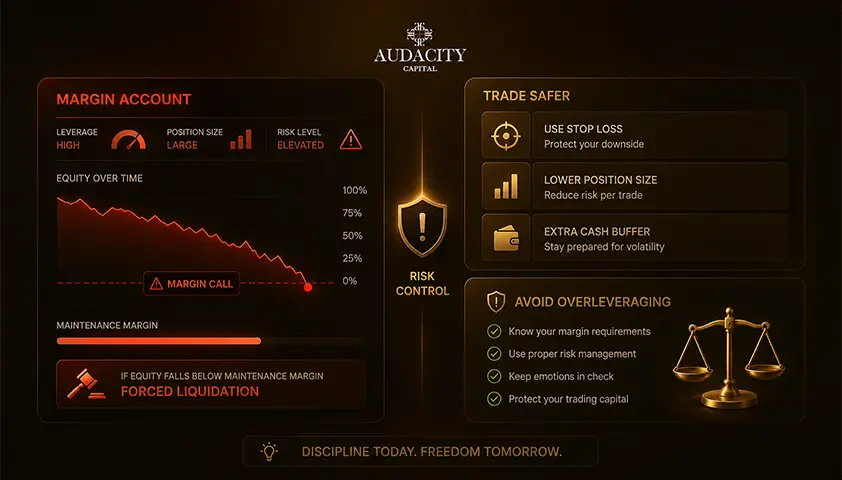
The term 'margin call' refers to the event where your leveraged account no longer holds sufficient equity to maintain its trades. Your broker then needs you to cover the deficit. A margin call is not just a losing position.
It imposes obligations on you and gives the broker certain rights.
When you face a margin call, you either deposit additional funds or eligible assets, liquidate positions, or otherwise address the deficiency.
The account must be restored to compliance. Otherwise, the broker can sell positions to protect the loan.
We'll explain how margin calls work in a U.S. margin account. You'll also see a worked example and tips on how to avoid one.
What Is a Margin Call?
A margin call is a shortfall in a margin account. This situation happens when the account equity becomes less than the maintenance margin that has been set by your broker for the positions you are holding.
Equity is basically the market value of your holdings minus any borrowed amount that you may owe to the broker. Other adjustments may be in effect based on the structure of the account.
The term "call" is historical. Brokers today do not call you, but notify you via email or the platform interface. The key factor is the account deficiency rather than the notice itself.
The margin account has fallen below the required level in relation to the margin used in trading. This is the operational definition of margin call, and it applies whether you notice it or not.
Initial Margin, Maintenance Margin and House Requirements
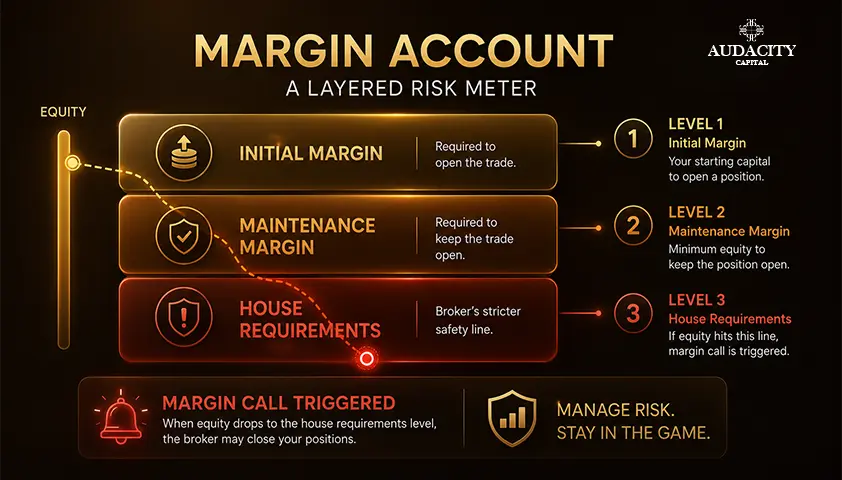
There are three concepts that need to be understood before any kind of calculation can make sense.
Initial margin is the amount of equity necessary to open or pay for a leveraged trade. The margin requirement on U.S. margin accounts is, generally, 50% of the cost of marginable securities according to Regulation T.
This means that you can leverage up to 50% of the purchase from the broker.
The maintenance margin is the minimum equity that should remain in the account after opening the position. Generally, the maintenance margin is 25% for long margin securities according to FINRA rules.
The house margin requirement is the broker's own policy. Typically, brokerages have higher margins than the regulatory minimums, and they are different depending on the security, concentration of the portfolio, volatility and trading strategy.
Even though you focus on 25%, you can get a margin call if the broker imposes the more stringent house margin requirement on your ticker or the account as a whole.
It is important to know what your broker requires currently, and not what the minimum regulation is, since it may be lower than what your broker demands. Always check the numbers with your broker before positioning. Both Regulation T and FINRA rules are subject to change.
What Triggers a Margin Call?
There are many possible initiators of a margin call. You do not necessarily need to initiate a new trade on that day.
1. The value of the leveraged trades decreases.
Losses decrease the equity in the account while the margin debt remains the same, lowering the equity percentage towards the maintenance margin level.
2. You use up more buying power or increased exposure.
With every additional leveraged trade, you use the maintenance margin cushion. Thus, there is little margin left for an adverse move.
3. A short position goes against you.
With the rise in the price of your shorted asset, both the liability and margin call increase.
4. The broker increases its house requirement.
An increase may result due to volatility, concentration, low liquidity, or security-specific risk and may push an account with stable requirements into a margin deficiency within one night.
A call might occur even if you didn't touch the account on that day. Requirements change over time.
Margin Call Example: How the Numbers Work
Here is a basic example of how a margin call occurs in a long-stock position. Suppose that a trader purchases $20,000 worth of a marginable stock. They use $10,000 of their own funds and borrow the remaining $10,000 from the broker.
If the broker's maintenance requirement is 30%, the call will be made when the account equity is less than 30% of the current market value.
The formula is:
Current market value minus margin loan equals 30% of current market value.
For the trigger point:
- Current market value − $10,000 = 0.30 × Current market value
- 0.70 × Current market value = $10,000
- Current market value = $14,285.71
In case the position is 200 shares bought at $100 each, the trigger price is around $71.43 per share.
Change only one variable now. If the broker applies a 40% house requirement instead:
- 0.60 × Current market value = $10,000
- Current market value = $16,666.67
- Trigger price = about $83.33 per share
Line Item | At Purchase | At 30% Trigger | At 40% Trigger |
Position value | $20,000 | $14,286 | $16,667 |
Margin loan | $10,000 | $10,000 | $10,000 |
Account equity | $10,000 | $4,286 | $6,667 |
Required equity | $6,000 | $4,286 | $6,667 |
The higher house requirement brings the call price closer to the entry. The broker's number is more important than any universal number. All numbers here are illustrative. Real requirements vary by broker, security, and strategy.
What Happens After a Margin Call?
When a call is issued, there are several responses to consider:
- Add cash to your account.
- Add marginable securities if allowed by your broker.
- Sell positions so as to reduce risk and raise your equity.
- Reduce your margin debt directly.
By FINRA disclosure, an institution is allowed to liquidate positions without notifying you if the account has a margin deficiency. Any mention of the deadline is no assurance of postponing liquidation.
Forced liquidation is not a punishment for your account but rather the protection of the asset securing the loan. This can still have a severe impact, however.
You might incur losses at a poor price, have tax problems, or even end up with a debt balance if the sale is not sufficient to pay the loan.
Margin Call vs Stop-Out or Automatic Liquidation
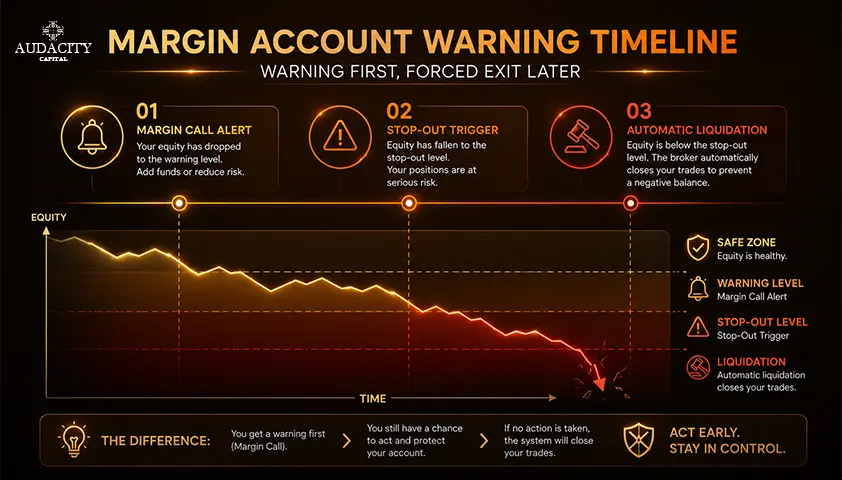
In the U.S. securities market, terms used include account equity, maintenance requirements, and margin call.
In leveraged forex and CFD accounts, brokers will usually quote the margin level percentage and stop-out percentage.
If the margin level goes under the stop-out level, the trading platform may automatically liquidate the positions.
This could start with the biggest losing position.
In both markets, dropping equity means that the trader needs to decrease their risk. The process is not exactly the same for each market. Using one market’s margin terms in another will mean making expensive assumptions.
How to Avoid a Margin Call
Most margin-call prevention happens before the account comes under pressure. Here are seven ways to reduce the risk:
- Use less than the maximum buying power available. The buying power figure on the platform is a ceiling, not a target. Trading well inside it preserves cushion.
- Monitor maintenance excess, not just cash balance or unrealized P&L. Maintenance excess is the true buffer between your current equity and the requirement.
- Know the broker's house requirements for the securities you actually trade. Concentrated, volatile, leveraged, or hard-to-borrow positions often carry higher requirements.
- Size positions so that one adverse move does not consume most of the cushion. Position size, not conviction, controls survivability.
- Avoid stacking highly correlated positions. If everything can move against you at once, effective leverage is higher than the account shows on paper.
- Plan exits and alerts before volatility expands. A stop order can reduce risk, but it cannot guarantee an execution price during a gap or fast market.
- Re-check margin requirements around earnings, macro events, and unusual volatility. House requirements often tighten precisely when traders are least likely to check.
A short pre-trade checklist helps: exposure size, margin loan amount, current maintenance requirement, cushion above the requirement, trigger price on the position, and known event risk in the coming days.
What Should You Do If You Receive a Margin Call?
If a call arrives, follow a sequence rather than reacting emotionally.
Step 1. Confirm the type and amount of the call, and check the current house requirement applied to the affected positions. Numbers can move quickly.
Step 2. Identify how much exposure must be reduced or how much eligible collateral is required to restore compliance.
Step 3. If the broker lets you choose what to sell, review your positions first. Consider concentration, liquidity, and potential tax consequences. Selling the most liquid losing position is not always the best long-term choice. Selling an illiquid position under pressure can also be costly.
Step 4. Do not assume a stated deadline prevents earlier liquidation. If the account remains deficient, the broker can act sooner.
Step 5. Once the account is stabilized, address the underlying leverage condition. Restoring the exact same exposure that produced the call usually sets up a repeat event.
Conclusion
A margin call arises if the account equity is less than the amount required to support your leveraged positions. Your exposure, margin loan, and account cushion will determine how close you are to the margin call.
Make sure that you are aware of the current margin requirements for your position and maintain sufficient cushion to cover your trading. Do not concentrate excessively and do not rely on the warning from your broker before forced liquidation.
Leverage increases your risk. A forced sale can lead to large losses or outstanding debt depending on the asset and account used.
Frequently Asked Questions
Yes. Under FINRA disclosures, brokers may liquidate positions without contacting you first when an account is in deficiency. Any stated deadline is not a guarantee of protection from earlier action. Policies vary by firm and are disclosed in the margin agreement.
The trigger occurs when account equity equals the required percentage of the position's current value. To find the trigger value, divide the margin loan by one minus the maintenance percentage. Then divide that value by the number of shares to find the trigger price per share. Actual figures depend on the broker's house requirement for the security.
Initial margin is the equity required to open a leveraged position. Maintenance margin is the minimum equity that must remain after the position is open. Initial margin governs whether you can enter the trade. Maintenance margin governs whether you can continue to hold it without a call.
Yes. Brokers can raise requirements at any time, on specific securities or across the account, and they often do so around volatility, earnings, or concentration concerns. This can produce a call even when you have not placed a new trade. Check your broker's policy for current numbers.
Not reliably. A stop order can reduce risk during orderly market conditions, but it cannot guarantee an execution price in a gap, a halted security, or a fast-moving market. Slippage past a stop can still leave the account in deficiency. Treat stops as one control, not a complete safeguard.
Yes. Short positions, uncovered options, and other strategies carry their own margin requirements that can expand as the underlying moves. A short that rallies increases both the liability and the required equity. Requirements vary widely by strategy and by broker.
No. A margin call is the account condition; forced liquidation is one of the possible outcomes if the call is not resolved. A trader can also meet a call by depositing funds, adding eligible securities, or closing positions on their own. Liquidation is what happens when the deficiency is not cured in time or when the broker chooses to act to protect the loan.

¿Listo para aplicar un riesgo disciplinado a las criptomonedas? Explore los nuevos instrumentos de cripto de Audacity Capital y traiga su estrategia de trading.
Aprender másBoletín
Únase a nuestro boletín para mantenerse al día.
Únete a Nuestra Comunidad Social

Comienza Tu Viaje Hoy Con Nuestra Prueba Gratuita
Muestra con orgullo tus habilidades y logros a través de certificados y obtén reconocimiento por tu arduo trabajo y dedicación de posibles inversores y compañeros.
Prueba GratuitaArtículos Relacionados
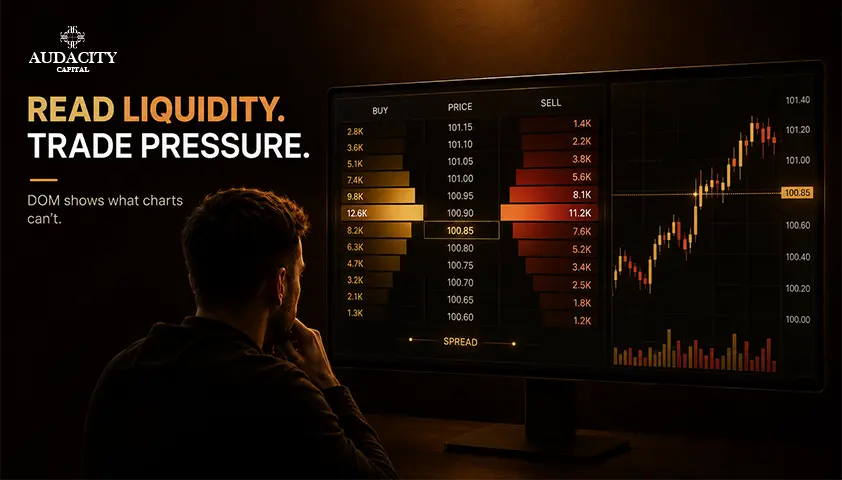
Depth of Market (DOM) Explained: How to Read Market Liquidity
Master Depth of Market (DOM) trading. Learn to evaluate order book liquidity, track real-time price response, and refine your execution with practical DOM insights.


Doji Candlestick Pattern: How to Read, Confirm and Trade It
Spot market indecision and price rejection with the Doji candlestick pattern. Learn how to identify key types and use location and confirmation rules to assess market balance.

Liquidity Sweep Trading: A Complete Guide
Learn what a liquidity sweep is, how to identify valid setups, and how to trade liquidity sweep strategies with confirmation, risk management, and real examples.
Cumulative Volume Delta (CVD): How to Read and Trade It
Cumulative Volume Delta (CVD) shows real buying vs selling pressure. Learn how CVD works, how to read divergence, and how to trade it across markets.