


What Is Arbitrage Trading?



Arbitrage trading involves profiting from the difference in prices of the same or similar asset in two different markets, by buying an asset at a low price in one market and selling it at a higher price in another.
It's promoted as low-risk (or, sometimes, risk-free) but it's not as simple as it sounds.
In this guide, we will tell you what arbitrage trading is, how it works, the different forms of arbitrage trading, whether it is really achievable and profitable, and, most importantly, why it is not allowed on funded accounts.
Arbitrage is a real concept in finance but is more an institutional game than the simple one it is often presented as.
What Is Arbitrage Trading?
At its core, arbitrage trading is profiting from a price discrepancy in the same or a related asset across different markets or platforms.
You are looking to buy the asset at a lower price and sell at a higher price with minimal directional exposure to the market.
Simply put, you're not betting on whether the price will go up or down. You just aim at benefiting from the price difference that should, in theory, be identical.
But why do any of these gaps exist?
They should not be in a perfectly efficient market. The moment one asset is priced differently in two places, buyers and sellers should rush in and close the gap.
In practice, things stay a little different due to a few persistent issues:
- Geography: same asset is listed on exchanges in various geographic areas and/or time zones.
- Technology and latency: price data can take time to travel and so can be slightly behind each other.
- Liquidity differences: thin markets update and fill differently than deep markets.
- Timing: trading sessions are overlapping and non-overlapping, leading to short mismatches.
There's a handy tip here. Arbitrage traders actually help to keep markets efficient. Each time they purchase low and sell high they push the two prices back towards each other. They perform a real market function in closing the gaps that they fill. This is real market self-correction, and not a loophole or a trick.
How Does Arbitrage Trading Work?
The basic idea of arbitrage is that it is when you buy and sell the same asset at the same time, but on two separate exchanges or in two different geographies, and you make the profits from the difference in the prices.
Here is an example:
Assume that a particular stock is priced at $100.00 on one exchange, and $100.05 on the other, at precisely the same time.
The arbitrageur will buy at $100.00 and sell at $100.05, pocketing the difference of $0.05 per share.
In the forex market, the same notion is referred to as triangular arbitrage, in which a forex trader buys or sells a currency through three separate transactions, such as EUR to USD, USD to GBP, and GBP back to EUR, thereby taking advantage of a combination of misquoted prices.
But now for the nuts and bolts, as this is where the easy-money story goes off the deep end.
First, the spread is very small. It's usually at the level of a fraction of a percent or a few pips.
In order to obtain that return, traders make large trades, and use heavy leverage, meaning that they hold a large position with a relatively small amount of capital, typically through margin, CFD, futures or options.
A small advantage can be extended through leverage, as can a loss when it goes awry.
Second, the opportunity windows are short.
As soon as a gap opens, other traders and their algorithms jump in, and the gap closes.
This implies that arbitrage requires extremely fast execution speed, sophisticated platforms, high-speed connections, and, in most cases, fully automated systems.
For instance, triangular arbitrage is almost always conducted through algorithms, since no one individual can calculate and place three trades before the window closes.
The lesson to be learned from the example is straightforward.
Arbitrage is a very infrastructure-intensive, fast-paced activity. The key does not lie in being clever but rather in having speedier technology and the deepest pockets.
This is not a guide on exploiting any platforms for pricing. It's a description of what makes the game so difficult to win.
The Main Types of Arbitrage Trading

There are several kinds of arbitrage and they vary primarily by the difference in price that they're focusing on and by who they are generally operated by. This is a quick reference.
Type | How it works | Who typically uses it |
Spatial (geographic) | Two markets or venues have different prices for the same asset. | Institutions, some active traders |
Triangular | Exploits pricing gaps among three currency pairs in forex | Almost always algorithms |
Statistical | Uses historical data and complex models to trade related assets | Quant funds and institutions |
Latency | Takes advantage of split-second price lag between feeds | High-frequency trading firms |
Merger | Trades around announced mergers and acquisitions | Hedge funds |
Convertible | Trades convertible bonds against the underlying stock | Institutional desks |
Interest-rate / covered-interest | Exploits interest-rate differences between currencies, hedged | Banks and institutions |
Temporal | Targets timing differences across trading sessions | Institutions and algos |
A few of these deserve a closer look:
- The classic case is spatial (or geographic) arbitrage, where there is one asset, two markets, and two prices.
- Triangular arbitrage targets a discrepancy among three related currency pairs and is a staple example of forex arbitrage. The mispricing is very short (milliseconds), therefore it is executed by machines.
- Statistical Arbitrage is based on historical correlations and complex algorithms that trade combinations of correlated securities. It's not a manual retail approach but a hedge fund and quant approach.
- Latency arbitrage refers to taking advantage of the time lag between an event that happens on a fast price feed and a slower feed. Make note of this one as it is the most applicable to the prop-firm prohibition we will cover next.
- Specialist institutional strategies include merger arbitrage and convertible arbitrage, both of which are based on corporate events and convertible securities.
Notice a pattern. Nearly all of the viable forms of these arbitrage trading strategies exist in the institutional or quant world and are driven by speed, scale and automation.
Is Arbitrage Trading Really Risk-Free or Profitable?
It's time for a good reality check. The low-risk aspect of arbitrage is earned for one reason, you have offsetting positions and you're not having a directional stance on the market. When both legs are a perfect fit, rising and falling prices shouldn't impact you. That is the theory.
But arbitrage isn't a guaranteed money spinner like many people think. Here are four reasons why.
1. Small gaps require heavy leverage.
The price difference is so small that traders place bigger trades and higher leverage, just to make an effort worthwhile. Leverage cuts both ways. Once something goes wrong, that same leverage can make the loss go out of hand.
2. Windows close in milliseconds.
Servers, direct market access, and better technology are all colocated at institutions and high-frequency trading firms. They are able to see and act on the gap before a retail trader's platform has loaded the quote. For the "average" trader, there's typically nothing left.
3. Transaction costs bite.
Spreads (the difference between the bid and offer price), commissions and financing charges can easily exceed the difference in price that you were looking for. Paper profits turn to losses once costs are taken out.
4. Risk of execution exists.
Arbitrage relies on the fill at the prices you expect on both sides. In real-life scenarios, one leg may fill while the other gets a worse price or it may not fill. You're now forced to hold a directional position you didn't want, rather than a locked-in gain.
The majority of profitable arbitrage is an institutional and quant game and it's really challenging for retail traders. It's not the sure thing and simple cash that the marketing claims it is.
When arbitrage is promoted as a sure money-making venture with no risk, take it with real skepticism.
Arbitrage Trading and Prop Firms: Why It Is Usually Banned
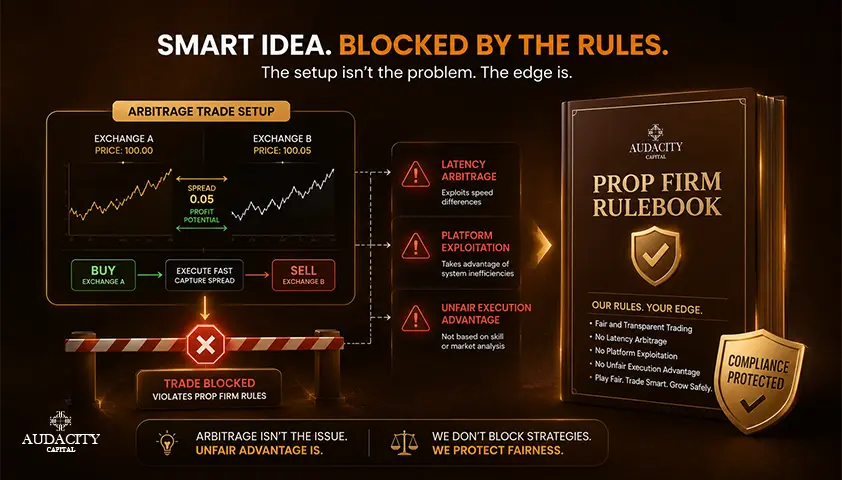
If you trade, or want to trade, on a funded account, this is the part that comes into play. So let's get straight to the point here: at nearly any prop firm, arbitrage, particularly latency arbitrage, is prohibited.
Here is why.
Proprietary trading firms like Audacity Capital give traders access to funded accounts that operate on a simulated price feed.
There, your skill, your discipline and your strategy are judged. Latency and feed arbitrage do not demonstrate any of that. They trade on the price that the feed has not fully processed just yet and exploit time lag or the slight discrepancy in the feed price.
From the firm's point of view, that is not trading. It's cheating.
The consequences are serious. Any attempts to do arbitrage or latency exploitation is one of the quickest ways to get a funded account closed and withdrawals canceled.
Prop firms employ risk-monitoring systems especially to identify this behavior such as same moves continuously and typical signatures of feed exploitation.
An account that gets flagged by those systems typically doesn't get a warning, it just gets taken out of the program.
Conclusion
Though it's labeled risk free, the truth of the matter is another. Arbitrage is based on high leverage, quick execution, and high-tech skills, and for that reason, it is thought to be mostly an institutional and quant game and very difficult for retail traders.
The thin margin can be wiped out by transaction costs and the execution risk can make a planned gain into a real loss.
The most significant point for funded traders is quite evident.
Arbitrage and particularly latency arbitrage is banned on funded accounts, since it is based on a simulated price feed and doesn't show real expertise, and can quickly lead to getting terminated and losing winnings.
Audacity Capital is a proprietary trading company that rewards real trading ability and not feed exploitation. You play your own strategy with a clear set of rules that are trader friendly, with a fixed drawdown, not trailing behind your profits, on trading platforms such as MT5 and DXTrade. If you want to build genuine skill in a low-pressure setting, you can practice in our free competition before committing to a funded path.
FAQ
Yes, arbitrage is legal and is very useful in keeping the markets efficient by eliminating price discrepancies. However, certain types of trading, like latency arbitrage, which take advantage of a broker's or prop firm's price feed can be considered a contractual violation and not illegal trading.
Not really, as it involves holding offsetting positions with no directional view, but small price spreads need heavy leverage, opportunities last for a few milliseconds, the cost of transaction could eat up the profit, and one side of the trade might get filled while the other does not. Real risk remains in every case.
Rarely with any success. Most often, profitable arbitrage is done by institutions and quant funds due to the use of advanced technology, fast execution speed, substantial capital, and sophisticated algorithms, hence beginners should stick to their strategy rather than indulging in arbitrage.
It takes advantage of price differences between three currency pairs, and makes the conversion one way through the pairs to get more of the starting currency than you began with. The window is very small, so that it is usually performed by algorithms instead of by hand.
Since the practice of latency arbitrage is based on using delays or discrepancies in the firm’s simulation feed instead of being a sign of a trader’s skills. This practice is considered cheating by many firms and can result in account termination and forfeiture of payouts.
It's taking advantage of the lag time that occurs between the time a price is updated in the real market and the time it is updated on a slower feed, following the updated price first. Exploiting a broker's or prop firm's feed in this way is typically prohibited and monitored for.
Usually yes. Since the difference in prices is relatively insignificant, arbitrage traders have to trade big amounts and use significant leverage to get any profit, which makes the risk higher in case of the wrong execution of any leg of their trade.
Generally no. Most prop firms forbid arbitrage and latency exploitation, and trying such techniques is one of the quickest ways to have your funded account shut down and to not get paid out for your trades. The funding system is set up to encourage legitimate trading skills.

¿Listo para aplicar un riesgo disciplinado a las criptomonedas? Explore los nuevos instrumentos de cripto de Audacity Capital y traiga su estrategia de trading.
Aprender másBoletín
Únase a nuestro boletín para mantenerse al día.
Únete a Nuestra Comunidad Social

Comienza Tu Viaje Hoy Con Nuestra Prueba Gratuita
Muestra con orgullo tus habilidades y logros a través de certificados y obtén reconocimiento por tu arduo trabajo y dedicación de posibles inversores y compañeros.
Prueba GratuitaArtículos Relacionados

Prop Firms With No Consistency Rule in 2026
Compare prop firms with no consistency rule. Find firms offering flexible profit requirements, trading conditions, and payout policies for traders.

What Is BOS in Trading? A Complete Guide to Break of Structure (2026)
Learn what BOS in trading means, how Break of Structure works, how to identify bullish and bearish BOS, and how traders use it in market analysis.

Micro Futures Contracts Explained
What micro futures contracts are, why a smaller size does not mean lower risk, the margin trap that catches small accounts, and what they actually cost.
Double Top Pattern: How to Trade It
Learn how to identify, confirm, and trade a valid double top pattern with precise targets and stops.