


Minimum Trading Days in Prop Firms: What You Need to Know (2026 Guide)



Minimum trading days in prop firms refer to the number of days a trader must actively place trades before passing an evaluation or qualifying for payouts.
Most firms require 5–10 trading days, while some offer no minimum requirement.
The goal is to ensure consistent performance—not a single lucky trade.
Typical ranges:
- 5–10 days → most common requirement
- 0 days → no minimum (rare, faster funding models)
- 10–20 days → stricter firms
In simple terms, prop firms use this rule to measure consistency over time—not one-time profits.
What Are Minimum Trading Days in Prop Firms?
Minimum trading days are a rule set by prop trading firms that requires traders to:
- trade on a certain number of days
- demonstrate consistent performance
- avoid passing challenges with a single big win
Unlike profit targets or drawdown limits, this rule focuses on trading behavior over time.
What Counts as a Trading Day?
To qualify as a valid trading day:
- At least one trade must be opened and closed
- Minimum lot size (typically 0.01 lots) must be met
- Trades must be executed during market hours
- Trades must be closed within the same trading day
If these conditions are not met, the day may not count.
Evaluation vs Instant Funding Requirements
Feature | Evaluation Challenge | Instant Funding |
|---|---|---|
Primary Goal | Prove consistency | Direct market access |
Minimum Trading Days | 5–10 days | Goal-based |
Focus | Discipline | Speed |
Payout Eligibility | After evaluation | After profit target |
Funding & Growth Milestones:
- Profit Target: 10% baseline
- Capital Cap: Scale up to $480,000
- Leverage Standard: consistent 1:100
Factors Influencing Minimum Day Count:
- Program Selection: Evaluation challenges usually require 5 to 10 days
- Risk Management: Firms use longer floors to weed out "lucky" high-volatility trades.
- Market Experience: Longer durations force exposure to different sessions
Why Minimum Trading Days Exist?

The minimum trading days requirement is a strategic baseline used by most prop firms to validate a trader's patience and technical consistency.
In this regard, you should note that:
- The global industry benchmarks range between 5 and 30 active trading days.
- It helps prevent single-trade 'lucky streaks' from gaming evaluation mechanics.
- It requires a minor transaction size (minimum 0.01 lots) to log an active session.
- The number of minimum active days acts as a structural guardrail to prevent high-stakes emotional gambling.
- Audacity Capital implements this duration rule to help create institutional-grade market participants.
What Happens After You Pass?
You’re probably wondering what will happen next after you have passed your evaluation. The table below should provide you with a clue of what to expect once these happens.
Please note that the table below is based on the Funded Trader Program at Audacity Capital:
Milestone | Achievement Metric | Benefit |
Entry Level | Meet 5 to 30 day minimum | Verification of trading strategy |
Profit Target | Hit 10% Baseline | Qualified for payout/scaling |
Initial Scaling | Consistent performance | Capital increase up to $480,000 |
Institutional Level | Multi-cycle success | Access to Institutional Loss Protection |
What These Minimum Active Days Mean for Prop Traders
For the individual trader, these time constraints represent a shift from retail speed to institutional endurance.
Through them, the trader gets to learn vital attributes such as:
- Mandatory patience: You cannot rush the funding process regardless of your PnL.
- Psychological pacing: It reduces the urge to 'hit and run' the market for quick wins.
- Skill verification: Proves that your edge remains viable over a multi-day cycle.
- Platform Familiarity: The duration allows you more time to master Audacity Capital's trading interface and dashboard metrics.
How Minimum Trading Days Affect Your Trading
Effects:
- Reduced Leverage: Many traders lower their risk per trade to ensure they don't hit drawdowns while waiting.
- Market Exposure: Prop traders are forced to see more sessions (London, New York, Asia), thus helping increase their experience.
Key Behavioral Changes in Traders
- Strategic Discipline: It prevents traders from walking away after one lucky trade, meaning they must stay consistent throughout the evaluation period.
- Volume Management: Encourages consistent lot sizing instead of erratic, high-risk position sizing.
Key Insight:
Minimum trading days shift traders from aggressive, short-term execution to structured, consistent performance.
Step-by-Step: How to Secure Your Minimum Trading Days
Follow these steps to ensure you meet the criteria without risking your capital:
- Hit the Profit Target: Try to reach your 10% target baseline first.
- Check the Dashboard: Log into your Audacity Capital dashboard to see your Current Active Days count.
- Execute Minimum Lot Trades: If you have 3 days left but already hit your profit, use 0.01 lot trades to fill the remaining days.
- Verify Close: Ensure all trades are closed before the market session ends to count for that specific day.
- Monitor Drawdown: Even during filler days, stay above the Institutional Loss Protection thresholds.
How to Make the Most of Minimum Trading Days as a Prop Trader
Successful prop traders treat the mandatory waiting period as a secondary training ground.
Lowering Risk After Profit Target Hit
They do this by:
- Once the 10% profit target is reached, switch to 0.01 lot 'placeholder' trades.
- Focus on capital preservation to protect the already-earned gains.
- Eliminate the risk of a late-stage drawdown failing the evaluation.
Journaling and Backtesting
Any seasoned trader will tell you about the advantages of journaling and backtesting. Through these two tactics, you get to learn the following trading tricks:
- Use the extra days to refine your trading log and performance metrics.
- Run backtests on Audacity Capital’s specific spreads and liquidity conditions.
It’s only through journaling and backtesting that you can truly strengthen your psychological resilience for the live funded stage.
The Dual-Edged Sword of the Minimum Trading Days
Every institutional rule has its trade-offs, which means that you can expect each rule to have its own set of advantages and disadvantages. Here’s a look at the two:
The Advantages
- Weeds out high-risk gamblers and protects the firm's capital.
- Builds long-term habits essential for managing $480,000+ accounts.
- Provides a data-rich environment for performance scaling audits.
- Reduces the likelihood of Revenge Trading by spacing out the trading sessions.
The Disadvantages
- Can be frustrating for highly skilled traders who hit targets in 24 hours.
- May lead to Boredom Trading if the challenge participant lacks discipline.
- Delays the transition to live payouts for efficient strategies.
- Adds an extra layer of psychological friction for impatient participants
Why Traders Fail the Minimum Day Rule

The following is a look at the 4 common mistakes showing why most traders fail prop firm evaluations:
- Inactivity: Not logging an active trade for a single business day during a required streak.
- Holding Too Long: Forgetting that trades must be closed within broker server time to count for that day.
- Lot Size Errors: Placing trades below the 0.01 lot minimum, which fails to trigger the active day count.
- Late Drawdowns: Hitting the 4% to 5% daily threshold while trying to rush the remaining days.
Summary Checklist: Staying Compliant
Ask yourself the following questions to help you stay compliant with the minimum trading days requirement set by most prop firms:
- Profit Target: Reached the 10% baseline?
- Daily Loss Limit: Stayed within the 4% - 5% daily threshold?
- Account Scaling: Ready to move toward the $480,000 cap?
- Trading Activity: Have you traded on at least 5 separate business days?
- Leverage: Have you maintained the 1:100 leverage standard?
Advanced Tips for Managing the Minimum Trading Days Clock
You can use the following tips to help you manage the clock better, ensuring you don’t break any rules that may cause you to miss out on becoming funded:
- The 'Placeholder' Strategy: Once your 10% profit target is secured, use 0.01 lot trades to safely complete remaining days.
- Capital Preservation: Prioritize protecting earned gains over seeking extra profit during the mandatory waiting period.
- Leverage Consistency: Maintain the 1:100 leverage standard throughout the process to keep your strategy’s integrity intact.
- Technical Prep: Use the mandatory days to master the Audacity Capital dashboard metrics and interface
Can You Complete Minimum Trading Days Safely?
Even if you hit your profit target early, you still need to complete the required trading days.
Experienced traders handle this by:
- reducing lot size
- focusing on capital preservation
- avoiding unnecessary trades
This helps protect profits while completing requirements.
Conclusion
Minimum trading days in prop firms are designed to ensure traders demonstrate consistency, discipline, and risk control over time—not just short-term success.
Mastering this requirement is about more than simply meeting a rule; it is about proving that your performance is repeatable and sustainable in real market conditions. While this rule may slow down the funding process, it helps build strong trading habits, reinforces patience, and prevents risky behavior.
By utilizing structured frameworks and scaling opportunities at Audacity Capital, traders can turn mandatory trading periods into a foundation for long-term growth and career stability.
In the long run, traders who focus on consistency—not speed—are more likely to succeed. Discipline in time management is just as important as discipline in risk management, and those who follow structured rules can transform this requirement into a strategic advantage rather than a limitation.
Learn, practice, and apply your trading strategy in Audacity Capital's free monthly trading competition.
Don't want to wait for minimum trading day requirements? Explore our Instant Funding program and start trading with funded capital without completing an evaluation challenge.
Frequently Asked Questions
They are the required number of days you must trade to pass an evaluation or qualify for payouts.
Typically 5–10 days, depending on the firm.
No, if minimum trading days apply.
Yes, some firms offer instant funding or flexible models.
To ensure consistency and reduce risky trading behavior.
You simply trade another day until the minimum count is met; your account is not failed for inactivity unless you breach a specific inactivity limit.
Audacity Capital is designed for efficiency; while there is a minimum floor, they prioritize getting skilled traders funded as soon as targets are reached.
No, your leverage remains consistent throughout the process to allow you to maintain your strategy’s integrity.
Yes, but Audacity Capital encourages institutional-grade discipline; ensure your strategy accounts for the volatility seen during news events.
No. Minimum trading days only count business days when the global markets (Forex, Gold, etc.) are open for execution.

Prêt à appliquer un risque discipliné aux cryptos ? Explorez les nouveaux instruments crypto d'Audacity Capital et apportez votre stratégie de trading.
En savoir plusNewsletter
Rejoignez notre newsletter pour rester informé.
Rejoignez Notre Communauté Sociale

Commencez Votre Voyage Aujourd'hui Avec Notre Essai Gratuit
Affichez fièrement vos compétences et réalisations grâce à des certificats et obtenez la reconnaissance de votre travail acharné et de votre dévouement auprès d'investisseurs potentiels et de pairs.
Essai GratuitArticles Connexes
GTC in Trading: What Good Till Cancelled Orders Mean and How to Use Them Properly
Learn what GTC means in trading, how Good Till Cancelled orders work, when to use them, and the risks of leaving pending orders active.

How Many Trading Days in a Year?
How many trading days are there in a year? See the number of U.S. stock market trading days in 2026, monthly totals, holidays and how markets differ.
Best Trading Simulator Apps in 2026: Practice Trading Risk-Free
Compare the best trading simulator apps in 2026 for stocks, forex, futures and crypto. See features, markets, realism, pricing and beginner-friendly options.
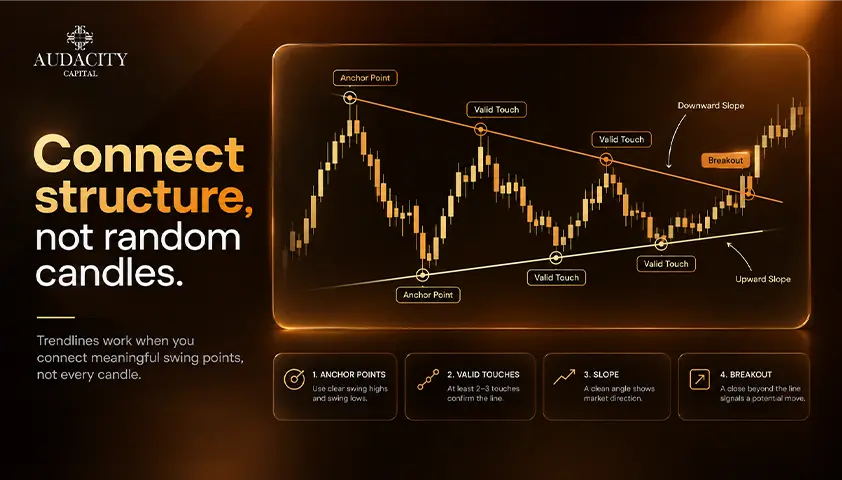
How to Draw Trend Lines
How to draw trend lines step by step, whether to use wicks or bodies, when a line is valid, and when to redraw versus accept a break.