



Range Trading Strategy: The 10 Best Range Trading Strategies in 2026


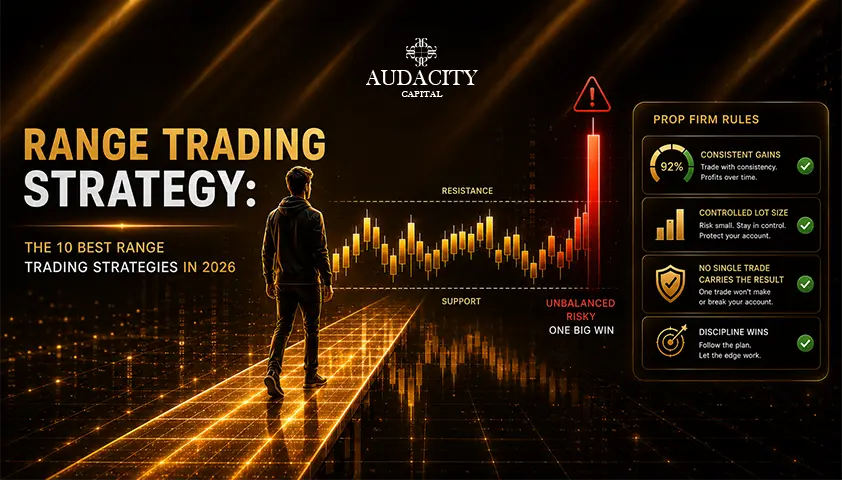
A range trading strategy is a trading approach that aims to profit from sideways markets by buying near support and selling near resistance. It works best when prices move within a well-defined range without establishing a strong uptrend or downtrend. Traders often use indicators such as RSI, Bollinger Bands, Stochastic, and ADX to confirm range-bound conditions before entering trades. |
|---|
Key Takeaways
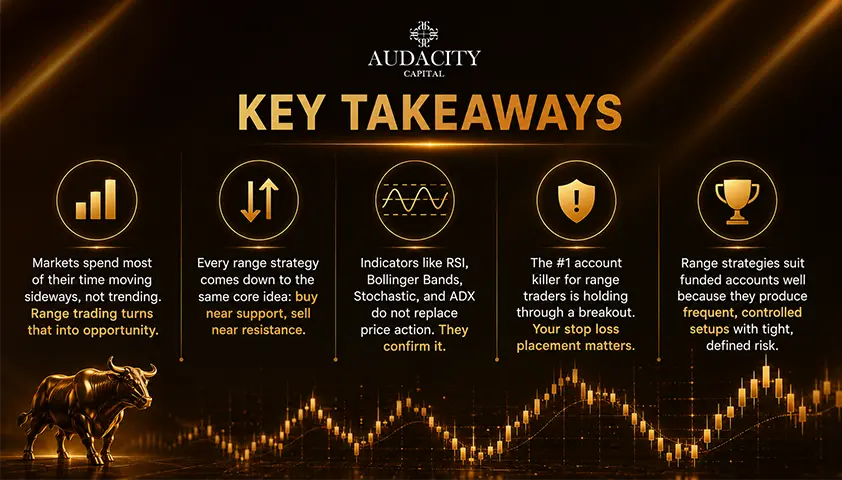
- Markets spend most of their time moving sideways, not trending. Range trading turns that sideways movement into repeatable setups.
- Every range strategy comes down to the same core idea: buy near support, sell near resistance, and get out fast when the range breaks.
- Indicators like RSI, Bollinger Bands, Stochastic, and ADX do not replace price action. They confirm it.
- The number one account killer for range traders is holding through a breakout. Your stop loss placement matters more than your entry.
- Range strategies suit funded accounts well because they produce frequent, controlled setups with tight, defined risk.
What Is Range Trading?
Range trading is a strategy built for sideways markets. Instead of chasing trends, you identify a zone where price keeps bouncing between a floor (support) and a ceiling (resistance), then trade the bounces.
The logic is simple. When price approaches support, buyers step in. When it approaches resistance, sellers take over. As long as neither side wins, price stays trapped in the range, and every touch of the boundary is a potential trade.
This matters because trends are rare. Most estimates put markets in ranging or consolidating conditions 60 to 70 percent of the time. Traders who only know trend following spend most of the week either overtrading choppy conditions or sitting on their hands. Range traders get paid in exactly those conditions.
How to Identify a Tradeable Range
Not every sideways patch on a chart is a tradeable range. Before applying any of the strategies below, confirm these conditions:
- At least two touches on each boundary. Two tests of support and two tests of resistance make the range valid. More touches equal more confidence.
- Clear, roughly horizontal boundaries. If support and resistance keep drifting, you are looking at a channel or a trend, not a range.
- Enough room to trade. The distance between support and resistance should be at least 2 to 3 times your spread plus stop distance. Tight ranges eat your edge in costs.
- Falling or flat volatility. Ranges form when momentum dies. A low ADX reading (below 25) or contracting Bollinger Bands confirm it.
- No major news pending. Scheduled events like NFP, CPI, or central bank decisions break ranges. Check the calendar first.
The 10 Best Range Trading Strategies in 2026
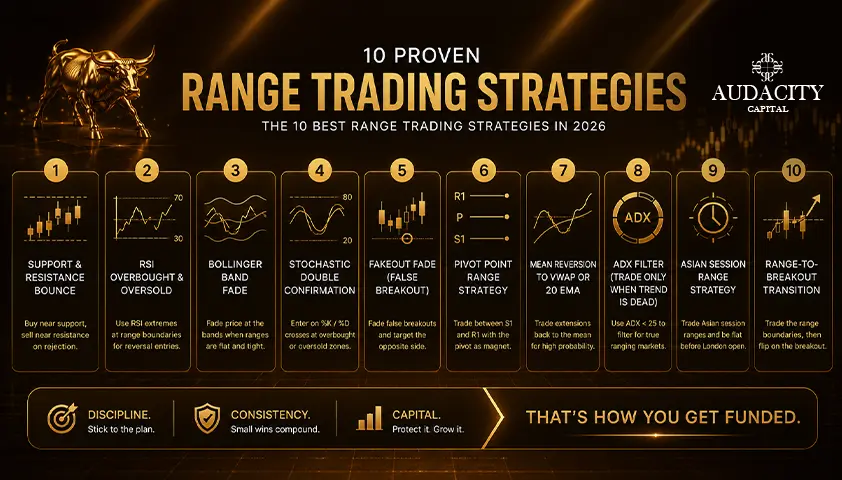
1. Classic Support and Resistance Bounce
This is the foundation every other range strategy builds on. Mark the range high and range low, then trade rejections at those levels using price action alone.
The key word is rejection. You are not buying because price touched support. You are buying because price touched support and printed a reversal signal, such as a pin bar, bullish engulfing candle, or a double bottom on a lower timeframe.
How to trade it:
- Entry: Buy on a bullish rejection candle at support. Sell on a bearish rejection candle at resistance.
- Stop loss: 10 to 15 pips (or one ATR) beyond the range boundary.
- Take profit: The opposite side of the range, or the range midpoint for a conservative target.
- Best for: All markets. Works especially well on 1H and 4H forex charts.
2. RSI Overbought and Oversold Reversal
RSI is a mean reversion indicator, which makes it a natural fit for ranges. In a sideways market, RSI readings above 70 near resistance and below 30 near support flag exhaustion with real accuracy.
The mistake most traders make is using RSI alone. In a trend, RSI can stay overbought for days. The filter is location: only take RSI signals when price is at a range boundary.
How to trade it:
- Entry: Buy when RSI drops below 30 while price sits at range support, then crosses back above 30. Reverse the logic at resistance.
- Stop loss: Beyond the recent swing point outside the range.
- Take profit: RSI returning to 50, or price reaching the opposite boundary.
- Best for: Forex majors and indices on 15M to 4H timeframes.
3. Bollinger Band Fade
In ranging conditions, Bollinger Bands act like dynamic support and resistance. Price touching the upper band signals stretched conditions to fade short. Price touching the lower band signals a long.
Confirm the market is actually ranging first: the bands should be flat and roughly parallel, and the middle band (20 SMA) should be horizontal. Expanding bands mean a breakout is underway and fading it will hurt.
How to trade it:
- Entry: Sell a close back inside the upper band after a touch or pierce. Buy a close back inside the lower band.
- Stop loss: One ATR beyond the band extreme.
- Take profit: The middle band first, the opposite band for runners.
- Best for: Quiet sessions and pairs with steady volatility, such as EURGBP or EURCHF.
4. Stochastic Double Confirmation
The stochastic oscillator excels in ranges because it measures where price closed relative to its recent high-low span. Above 80 near resistance and below 20 near support are high quality reversal zones.
The double confirmation comes from the %K and %D cross. Instead of acting on the overbought or oversold reading alone, wait for the two lines to cross back toward the middle. That cross is your trigger.
How to trade it:
- Entry: Buy when stochastic is below 20 at support and %K crosses above %D. Sell the mirror setup at resistance.
- Stop loss: Just beyond the boundary that produced the signal.
- Take profit: Opposite boundary, or exit when stochastic reaches the opposite extreme.
- Best for: Shorter timeframes (5M to 1H) where stochastic reacts quickly.
5. The Fakeout Fade (False Breakout Strategy)
Established ranges attract breakout traders, and most breakouts fail. The fakeout fade profits from their stop losses. Price pushes beyond the boundary, breakout traders pile in, momentum stalls, and price snaps back inside the range, forcing them out.
This is one of the highest reward setups in range trading because your entry is at the extreme and the whole range becomes your target.
How to trade it:
- Entry: Wait for price to break the boundary, then close back inside the range within 1 to 3 candles. Enter on that close.
- Stop loss: Beyond the fakeout wick. It is a tight, logical stop.
- Take profit: The opposite side of the range. Risk to reward is often 1:3 or better.
- Best for: Well known ranges on higher timeframes where breakout traders are active.
6. Pivot Point Range Strategy
Daily pivot points give you pre-calculated support and resistance levels that thousands of traders and algorithms watch. On range days, price frequently oscillates between S1 and R1 with the central pivot acting as a magnet.
Because pivots are objective, this strategy removes the guesswork of drawing your own levels. It is a strong choice for traders who struggle with subjective support and resistance.
How to trade it:
- Entry: Buy rejections at S1, sell rejections at R1, while price remains between S1 and R1 for the session.
- Stop loss: Beyond S2 or R2, or a fixed ATR-based distance past the entry pivot.
- Take profit: The central pivot first, the opposite pivot level second.
- Best for: Intraday forex and index trading, especially during the London session.
7. Mean Reversion to VWAP or the 20 EMA
In a range, price behaves like a rubber band around its average. The further it stretches from VWAP (intraday) or the 20 EMA (swing), the stronger the pull back toward it.
Rather than trading the outer boundaries, this strategy trades the return to the mean. It produces smaller wins but a higher hit rate, which suits traders who want smooth equity curves.
How to trade it:
- Entry: When price is extended 1.5 to 2 ATR from VWAP or the 20 EMA inside a confirmed range, enter toward the mean on the first reversal candle.
- Stop loss: Beyond the extension high or low.
- Take profit: VWAP or the 20 EMA itself. Do not get greedy past the mean.
- Best for: Indices, gold, and liquid forex pairs intraday.
8. ADX Filter Strategy (Trade Only When Trend Is Dead)
ADX does not tell you direction. It tells you trend strength, and that is exactly what a range trader needs to know. An ADX reading below 25, and ideally below 20, confirms the market has no directional conviction.
Use ADX as a permission filter layered on top of any strategy above. ADX below 20 means range strategies are live. ADX rising through 25 means stand down, because a trend is forming and your range edge is gone.
How to trade it:
- Entry: Only take range setups (strategies 1 to 7) when ADX on your trading timeframe is below 25.
- Exit rule: If ADX rises above 25 while you are in a position, tighten stops or exit. The range is dying.
- Best for: Every range trader. This single filter removes most losing range trades.
9. Asian Session Range Strategy
The Asian session is the most reliable range environment in forex. Liquidity is thin, major markets are closed, and pairs like EURUSD, GBPUSD, and USDCHF routinely drift sideways in a 20 to 40 pip band until London opens.
This session-based structure gives you a repeatable daily playbook: define the Asian range, trade the bounces, and be flat before the London open, when the range typically breaks.
How to trade it:
- Entry: After the Asian range is established (roughly 00:00 to 06:00 GMT), buy the range low and sell the range high on rejection signals.
- Stop loss: 10 to 15 pips beyond the boundary.
- Take profit: The opposite boundary. Close all positions before London open.
- Best for: Traders in African and Asian time zones. The session timing fits your day, not New York's.
10. Range-to-Breakout Transition Strategy
Every range eventually ends, and the traders who mapped the range are best positioned to trade its death. This strategy flips your range knowledge into a breakout play: the longer and tighter the range, the more explosive the eventual break.
You trade the range boundaries normally while the range holds, then switch bias the moment a confirmed breakout occurs, using the broken level as your new entry zone on the retest.
How to trade it:
- Entry: After a strong close beyond the boundary on rising volume or expanding ATR, wait for price to retest the broken level and enter in the breakout direction.
- Stop loss: Back inside the range, beyond the midpoint.
- Take profit: A measured move equal to the height of the range, projected from the breakout point.
- Best for: Higher timeframe ranges that have held for weeks. These produce the biggest breakouts.
Risk Management Rules for Range Traders
Range trading has a high win rate and a brutal failure mode: the breakout. One trend day can erase twenty winning bounces if you trade without rules. These are non-negotiable.
- Always use a hard stop loss. Never fade a boundary with a mental stop. When ranges break, they break fast.
- Risk a fixed percentage per trade. 0.5 to 1 percent per setup keeps a losing streak survivable.
- Never average down against a breakout. Adding to a loser at a broken boundary is how range traders blow accounts.
- Respect the news calendar. Flatten positions before high-impact releases. Ranges do not survive CPI.
- Track your range invalidation level. Decide in advance what price level kills the range. When it prints, you are out, no debate.
Range Trading vs Trend Trading: Which Fits You?
Trend trading offers big winners but long droughts between them. Range trading offers frequent, smaller winners with tight risk. Neither is superior. What matters is matching the strategy to the market condition and to your temperament.
Practically, the best traders in 2026 are condition-aware rather than strategy-loyal. They use a filter like ADX to classify the market, deploy range strategies in sideways conditions, and switch to breakout or trend strategies when volatility expands. Strategy 10 above is exactly that bridge.
Common Range Trading Mistakes to Avoid
- Trading ranges that are too tight. If spread and stop distance eat half the range, there is no trade.
- Entering on the touch instead of the rejection. The boundary is a zone of interest, not a buy button. Wait for confirmation.
- Ignoring the higher timeframe. A 15M range inside a strong 4H downtrend will break down. Trade with the bigger picture in mind.
- Overtrading the middle of the range. The edge lives at the boundaries. The middle is noise.
- Holding through a confirmed breakout. Hope is not a strategy. Exit and reassess.
Range Trading a Funded Account
Range strategies are a natural fit for funded trading. Prop firm programs reward consistency, controlled drawdown, and disciplined risk, which is exactly what range trading produces when executed with the rules above. Frequent setups with tight, defined stops make it easier to stay within daily loss limits while compounding steady gains.
At Audacity Capital, our Funded Trader Program lets you trade our capital instead of risking your own. Prove you can execute a disciplined strategy, keep your drawdown controlled, and grow your allocation as you hit profit milestones. If you have a range trading edge, we supply the capital to scale it.

Ready to trade our capital?
Join Funded Trader Program todayFinal Thoughts
Range trading rewards patience and punishes hope. Map the boundaries, wait for rejection, define your risk before you enter, and walk away the moment the range breaks. Do that consistently and sideways markets stop being dead time and start being your most reliable source of setups.
Master one or two of the strategies above, prove them on a demo or evaluation account, then scale them with capital that is not your own. That is the fastest path from strategy to income.
Frequently Asked Questions
Yes, when executed with discipline. Markets still spend the majority of their time in sideways conditions, and range strategies monetize those conditions with high win rates. Profitability depends on strict stop losses, trading only valid ranges, and stepping aside when volatility expands.
There is no single best indicator, but the strongest combination is price action at support and resistance, confirmed by RSI or stochastic for timing, with ADX below 25 as a filter to confirm the market is actually ranging.
It depends on your schedule. Intraday traders do well on 15M to 1H charts, especially during the Asian session. Swing traders find cleaner, more reliable ranges on the 4H and daily charts, where boundaries hold better and false signals are fewer.
Watch for warning signs: ADX rising through 25, Bollinger Bands expanding, shrinking bounces that fail to reach the opposite boundary, and rising volume near one edge. Scheduled high impact news is also a common range killer.
Yes. Range strategies suit evaluation programs well because they generate frequent setups with small, defined risk per trade, which helps you stay within daily and overall drawdown limits. Just avoid trading through major news events, and follow your firm's rules.
It is often easier to learn. The rules are visual and concrete: identify the boundaries, wait for a rejection, place the stop outside the range. The main habit beginners must build is exiting immediately when the range breaks instead of hoping for a return.

Prêt à appliquer un risque discipliné aux cryptos ? Explorez les nouveaux instruments crypto d'Audacity Capital et apportez votre stratégie de trading.
En savoir plusNewsletter
Rejoignez notre newsletter pour rester informé.
Rejoignez Notre Communauté Sociale

Commencez Votre Voyage Aujourd'hui Avec Notre Essai Gratuit
Affichez fièrement vos compétences et réalisations grâce à des certificats et obtenez la reconnaissance de votre travail acharné et de votre dévouement auprès d'investisseurs potentiels et de pairs.
Essai GratuitArticles Connexes

Spread Betting vs CFD Trading
Spread betting vs CFD trading for UK traders: how each is priced, the real tax difference and its conditions, expiry costs, and which suits which trader.


Averaging Down: Explained
What averaging down does to your breakeven and your exposure, the one question that settles whether to do it, and why leverage changes the answer entirely.

Prop Firms With No Consistency Rule in 2026
Compare prop firms with no consistency rule. Find firms offering flexible profit requirements, trading conditions, and payout policies for traders.

Trailing Stop Loss: How to Use It
How a trailing stop loss works, three ways to set the distance, the MetaTrader setting most traders get wrong, and what the trail costs you in return.