



Combining Fundamental and Technical Analysis: Why It Matters and How It Works


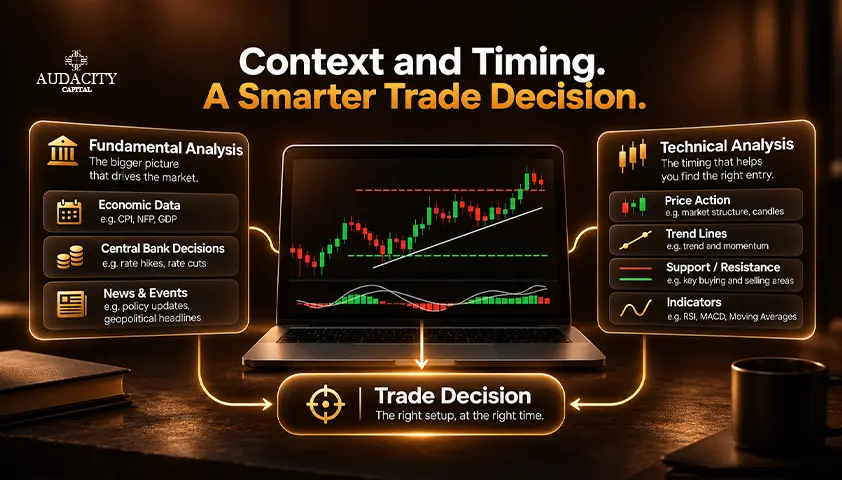
Fundamental and technical analysis answers two different questions. Fundamental analysis asks why a currency might gain or lose strength. Technical analysis asks how the price behaves currently.
Combining fundamental and technical analysis together allows a trader to form an overall picture of the market, understand its price structure, seek confirmation, and decide if a pattern is valid at all.
In this article, we cover both aspects of the topic: why the two approaches work well when combined, and how to combine them in one practical approach in forex.
Fundamental Analysis vs Technical Analysis: What's the Difference?
The fundamental vs technical analysis debate usually implies that traders have to choose which of these tools to use. Actually, both approaches offer something specific. So let us take a closer look at their features before combining them.
Fundamental Analysis
Fundamental analysis in forex is the study of those economic and political factors that affect a currency rate. A trader usually observes:
- Interest rates and central-bank policy
- Inflation
- Employment data
- Economic growth
- Scheduled economic releases
- Geopolitical developments
- Relative currency strength, meaning how one economy's outlook compares with another's
Since currencies trade in pairs, this is less of a question of whether an economy is strong on its own. The relevant factor is whether one economy appears stronger than the other.
Technical Analysis
Technical analysis analyzes the price itself. It examines the trends, structure of the market, levels of support and resistance, momentum, pattern recognition and technical indicators.
Technical analysis does not seek to understand the reason for price movement. It seeks to understand what the price is doing and whether this behavior is changing.
Fundamental Analysis | Technical Analysis |
Focuses on economic and monetary fundamentals | Focuses on price behaviour |
Helps explain why currencies may move | Identify how price is moving |
Uses interest rates, inflation, growth and economic data | Uses trends, structure, levels and indicators |
Provides a market bias | Provides confirmation and timing |
Compares relative economic strength | Evaluates current market behaviour |
There is no requirement that one approach should replace the other. Each has value in addressing different aspects of the same fundamental trading question: what is the big picture, and is price moving as it should according to this picture?
Why Combine Fundamental and Technical Analysis in Forex?
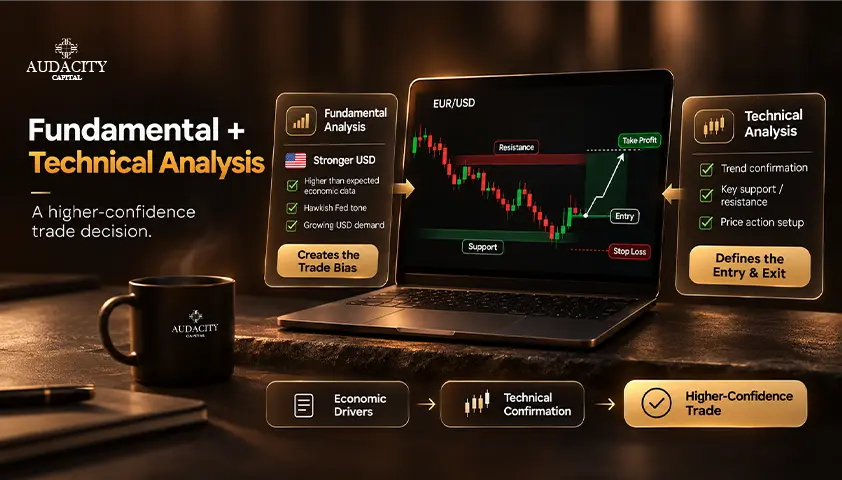
There are some limitations in both approaches that can be complemented by another one. Here is how the combination becomes valuable for traders.
Broader market context.
Fundamental analysis tells you about the economic factors behind your currency analysis. Without it, a trader will see market dynamics without understanding its cause.
Better price context.
Technical analysis tells you whether the price behavior is confirming or refuting your view. A strong economic argument will be of less importance when the market is moving the other way.
Confirmation between independent signals.
If a similar conclusion comes from two different approaches, this might indicate that the trader has better analytical confluence. The signals become much more significant than each one separately since they originate from different sources.
Better timing.
A trader might have a justified fundamental opinion, but he or she should evaluate if market structure suggests that one must act now. Typically, fundamentals give directions for several weeks and months ahead. They never specify a reasonable place to enter.
Reduced analytical gaps.
Fundamentals do not give accurate timing, and technicals do not necessarily reveal what economic reasons lie behind certain moves. The combination ensures that a trader would less likely rely on one incomplete picture.
Nothing here proves that the combination will ensure successful trading performance. What it shows is that the trader uses more complete data when making his or her decision, and uncertainty in each trade will remain.
How to Combine Fundamental and Technical Analysis Step by Step
A regular procedure will prevent fundamentals and technicals from becoming independent analyses. Here is a step-by-step guide: fundamental view, technical structure, confirmation, confluence, reassessment.
1. Develop fundamental market opinion.
Evaluate the two currencies in the pair. Consider expectations of central banks, interest rates, inflation, economic growth, employment figures, and key economic events. The aim is to establish which currency has a stronger fundamental outlook.
2. Determine the technical trend.
Analyze the general trend whether prices are making higher-highs or lower-lows and the location of the major support and resistance levels. You are determining whether price action confirms or contradicts the fundamental outlook.
3. Determine the key price levels.
Identify the critical support and resistance levels, prior highs or lows, and breakouts. Keep it practical as you need levels necessary for the decision-making process; not all of them on the chart.
4. Look for technical confirmation.
Depending on your method of analysis, the technical confirmation can be derived through price structure, breakouts, momentum, candle behavior, or technical indicators. There are no universally right indicators or setups. Choose a method which you understand and use it consistently.
5. Look for confluence.
The confluence in trading happens when various kinds of analysis confirm the same market outlook. For instance, positive fundamentals for USD combined with the bearish EUR/USD technicals means more analytical alignment. More confluence does not mean certainty.
Imagine the fundamental development which will make you doubt about the bias and price behavior, which will make you think the trade is no good any more. Being aware of the fact that you have taken a risk, you become much more careful.
6. Define what would invalidate the view.
Ask two questions. What fundamental development will invalidate the bias? What price action will indicate that the setup is no longer valid? Figuring out this aspect in advance keeps the analysis honest.
7. Reassess when new information arrives.
Economic expectations and market structure continuously evolve so don't consider your analysis definitive.
If you are unsure how to combine fundamental and technical analysis in forex trading, these seven rules can be used as a guide. The order is less important; all that matters is that you fulfill each one of them.
How Fundamental Analysis Helps Build a Market Bias
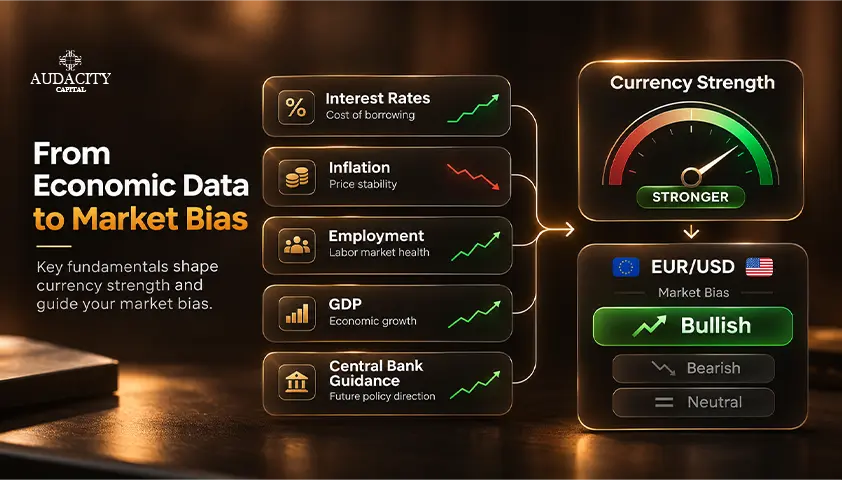
A market bias is a temporary viewpoint about which way a currency pair might be leaning at a certain time. The process of forming this view starts with fundamental analysis.
Interest-rate expectations play a key role. If the markets expect a central bank holding rates higher for longer than its counterpart, that would affect how the trader perceives the attractiveness of both currencies.
Guidance from the central bank gives insight into their view on the economic situation, including inflation, employment and growth.
The inflation, employment and growth statistics would put those expectations to the test. Market surprises play an important role here. An announcement that diverges significantly from forecasts can change expectations fast since the market reacts to how data matches its expectations, not the data alone.
This way, by taking all these factors into account for both economies, a trader is able to see whether one currency is more promising than another. That opinion forms the directional bias.
The major limitation is that a bias is not an entry signal. Fundamental analysis supplies us with economic information and direction but not an entry point, the stop level or price readiness to move. This is where technical analysis comes in.
How Technical Analysis Helps With Timing and Confirmation
After getting the big picture through fundamental analysis, traders may compare their fundamental views with the market reality using technical tools.
Technical analysis can help answer the following questions:
- Is price moving in line with fundamental bias?
- Is the market trending or ranging?
- What are important support and resistance levels?
- Does momentum confirm the view?
- Does price action confirm or invalidate the setup?
The indication of the bias by the trend that has proper structure may imply the bias being expressed in price. The sideways market within the range may imply that the view has not been taken into account yet or something else is preventing it.
The technical analysis does not provide forecasts for the exact prices. It is aimed at evaluating the price behaviour and the structure of the market in order to form an opinion about the entry points and the risks.
A chart shows where a view would be questioned and it is more valuable information than the forecast. The levels can be used by the trader as an instrument to determine when the view works and when it doesn't.
What If Fundamental and Technical Analysis Disagree?
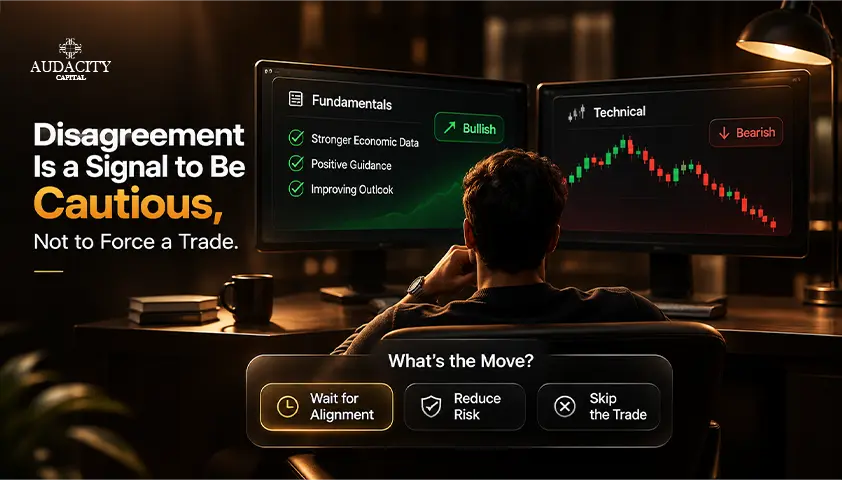
This happens quite often, probably even more than many novice traders realize. The view of the fundamentals suggests one direction while the chart structure suggests another. This is a natural process of the market analysis and it should be planned for.
In such cases, the trader may:
- Wait until you have technical confirmation before considering the view
- Reconsider whether your fundamental information has been priced into the market already
- Verify whether the two analyses are being done on separate time frames
- Revise the original fundamental analysis
- Wait until the price structure changes
- Avoid the setup completely
The timeframe check is frequently forgotten. A long-term fundamental view can coexist comfortably with a short-term view that takes the opposite direction and the two may not actually be contradictory at all.
Neither method should always override the other. Conflicting signals often mean there is not enough confluence yet. Waiting is a legitimate decision, and so is walking away. A conflict is information about the quality of the setup, not a problem that has to be resolved with a trade.
Neither one of the approaches should override the other at all times. If there is conflict between the two, it could simply mean that there still isn’t enough confluence.
Waiting is an acceptable choice here, and avoiding the setup altogether is too. A conflict is information regarding the quality of the setup; it is not an issue that must be addressed with a trade.
Example of Combining Fundamental and Technical Analysis on EUR/USD
This fundamental and technical analysis example is theoretical in nature. It does not involve any real market data whatsoever and is not a trade recommendation.
The Fundamental Side
Suppose that US inflation surprises on the upside while at the same time Fed rate expectations are relatively more hawkish. In addition, the Eurozone economy slows down and ECB rate expectations turn relatively more dovish. As a result, there might be a relatively positive fundamental bias for EUR/USD from the USD side.
The Technical Side
Subsequently, the trader analyzes the EUR/USD chart. For instance, the overall market trend is bearish, EUR/USD is trading below an important resistance zone, and lower highs and weak momentum continue to show up.
The Combined View
In this case, there is a USD-positive fundamental bias and bearish technical structure of EUR/USD.
Both perspectives have similar outlooks on the market situation. Here is how traders refer to such a market analysis as confluence. The trader can now establish how to invalidate his assumptions, for example, through changes in rate expectations or breaking through resistance and continue to monitor both.
The Alternative Scenario
Assume that fundamentals still remain favourable for USD, but EUR/USD is breaking higher through significant levels of resistance.
Here, the two methods contradict each other now. Instead of making the trade happen anyway, the trader would wait and reassess the fundamental view or choose another timeframe.
This is purely an educational example and it is not a forecast. Confluence does not imply any particular outcome since markets may work against even a well-supported view.
Common Mistakes When Combining Fundamental and Technical Analysis
Even though a trader has a good framework, a few mistakes could undermine your strategy:
- Applying technical analysis merely to validate an existing bias. Choosing certain technical elements which prove your fundamental view is not analysis. Let the chart question your view.
- Making a single economic indicator represents all the fundamentals. Usually one number such as CPI, GDP, employment etc. is not enough to explain the overall picture.
- Over-reliance on too many technical indicators. More indicators do not always mean more confirming factors. Overlapping tools usually repeat the same information.
- Ignoring the time frame involved. A long-term fundamental perspective can exist in tandem with a shorter-term price move that is in the opposite direction.
- Insists on trading against conflicting signals. There is no need for a setup just because the analysis has been completed.
- Confusing confluence with certainty. A number of signals can support a view, but do not necessarily assure its correctness.
- Does not update the analysis. Expectations and market structure constantly evolve, and so the view must change with them.
Conclusion
Fundamental and technical analysis are not opposing each other. One explains why the currency moves, while the other helps see how the price reacts, so combining fundamental and technical analysis provides a more complete picture than using just one of them.
It is quite simple to remember the strategy: build the fundamental view, analyze the technical setup, seek confirmation, look for confluence, and continue analyzing the changing market environment.
In case of contradiction between the fundamental and technical analysis, patience will be quite a rational choice. Do not forget that confluence gives some additional information but does not guarantee anything. No trading system can protect from risks during trading.
Ready to build the habits behind a structured analysis process? Explore the educational resources at Trader University and practise your approach with discipline. This content is for informational purposes only and is not investment, financial, legal or tax advice. Trading involves risk, and hypothetical examples do not guarantee actual results.
Frequently Asked Questions
Fundamental and technical analyses give you a different perspective on the same thing. The fundamental analysis tells you about the economy and its direction, while technical analysis lets you know about how the price behaves. When you blend these, you get a better insight into the market.
The sequence is simple. First you formulate your fundamental view, then you consider your technical analysis, then confirmation, and then the confluence of factors. Forming an idea of how the situation will change when the view gets invalidated makes the process much more disciplined and flexible.
Yes. Forex traders commonly use both. Fundamental analysis provides the broader economic context for a currency pair, such as rate expectations and relative growth, while technical analysis helps assess price behaviour, key levels and timing.
There is no universal rule. A common approach is to establish the broader market view with fundamentals first, then evaluate technical conditions to see whether price supports it. Some traders reverse the order, starting with the chart and checking the fundamentals second.
Confluence occurs when independent pieces of analysis support the same market view. For example, a relatively strong economic outlook for one currency and a chart structure that agrees with it. The more independent the signals, the more meaningful the alignment, though it never guarantees an outcome.
Traders can wait for confirmation, reassess the fundamental thesis, check whether different timeframes explain the conflict or avoid the setup altogether. Disagreement often signals that confluence is not there yet, so forcing a conclusion is rarely necessary.
Using multiple independent perspectives can provide more context, but it does not make outcomes certain. Markets remain uncertain, and no combination of methods guarantees successful trades. The benefit is a more structured, better-informed decision process, not a promise of better results.

Prêt à appliquer un risque discipliné aux cryptos ? Explorez les nouveaux instruments crypto d'Audacity Capital et apportez votre stratégie de trading.
En savoir plusNewsletter
Rejoignez notre newsletter pour rester informé.
Rejoignez Notre Communauté Sociale

Commencez Votre Voyage Aujourd'hui Avec Notre Essai Gratuit
Affichez fièrement vos compétences et réalisations grâce à des certificats et obtenez la reconnaissance de votre travail acharné et de votre dévouement auprès d'investisseurs potentiels et de pairs.
Essai GratuitArticles Connexes

Candlestick Patterns: How Traders Read Price Action on a Chart
Learn to read price action with proven candlestick strategies and improve trading consistency now with Audacity

How To Use Technical Indicators To Trade Forex?
Learn how to use technical indicators to trade forex step-by-step. Discover how to combine RSI, MACD, moving averages, and Bollinger Bands to identify trends, entry points, and improve your trading strategy.

Why Ex Military Are Good Traders?
Discover the new career opportunity for ex-military: trading. Banks and trading firms are hiring veterans for the trading floor.
Can You Ignore Fundamental Analysis?