


CFD Leverage Explained: What You Need to Know


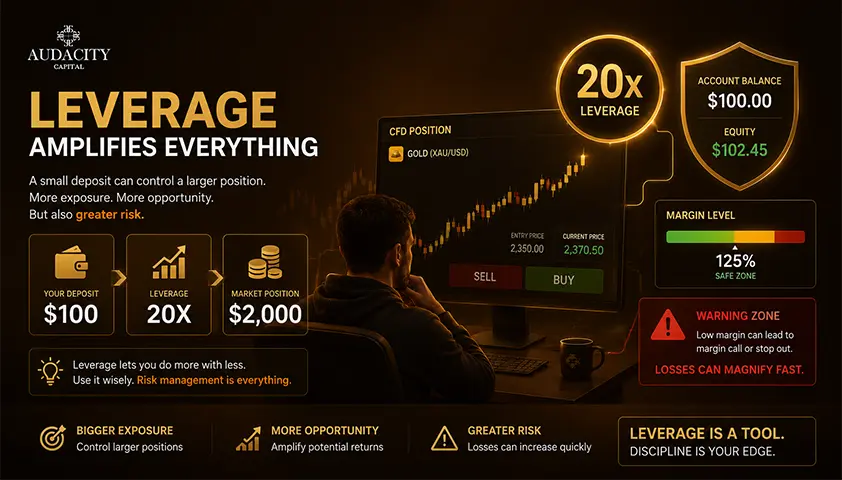
CFD leverage is the ratio of the total value of the position you control and the margin you post to control it. Since the contract for difference never provides you with any ownership of the underlying asset, you pay only a small part of its cost and the rest is held by the broker as margin.
Most explanations end with the phrase about magnifying gains and losses. This is correct, but virtually useless. This piece offers three things that those pages do not include: How a close-out is actually triggered, why leverage and risk are not the same number, and how much leverage you can get based on where your account is at.
Here is one thing which should be stated upfront. CFDs are complicated leveraged products, and most retail accounts end up in losses.
What CFD Leverage Is and Why It Exists?
The existence of leverage is due to the fact that a CFD deals with a difference in price, not a purchase.
When you open a contract for difference, you and the broker agree that you will settle the difference in the price of an asset when you open the contract until you close it.
You never purchase the asset, thus there is nothing to pay in full. The broker will only require a margin deposit as a security deposit against the potential losses on the position.
That's how it works. In practice, what leverage is in CFD trading is the size of that gap between the amount of exposure you have and the amount you posted to carry the exposure.
Leverage and margin are the same fact, stated two ways
Leverage is a ratio. Margin is a percentage. They are the inverse of each other, and it is convenient to see the inversion since most trading platforms show one and the rulebook quotes the other.
- A 2 percent margin requirement is 50:1 leverage.
- A 5 percent margin requirement is 20:1 leverage.
- A 20 percent margin requirement is 5:1 leverage.
The higher the margin requirement, the lower the leverage ratio will be. They are opposites as they describe the same relationship from two perspectives.
The formula with actual numbers
The formula is simple,
Leverage = notional position value ÷ margin posted
For example: You trade a position with a notional value of $50,000 with a margin of 2%.
The margin tied up is $1,000. Divide notional value by margin and you get the leverage of 50:1. In Indian currency, if notional value is ₹40,00,000 with a 2% margin, ₹80,000 will be the margin for controlling that position.
Hold on to the word notional. All that follows is dependent on it, since your costs, your profits, and your losses are based upon the notional value of the position, not the small margin you posted.
How Margin Actually Works on a Live Account?
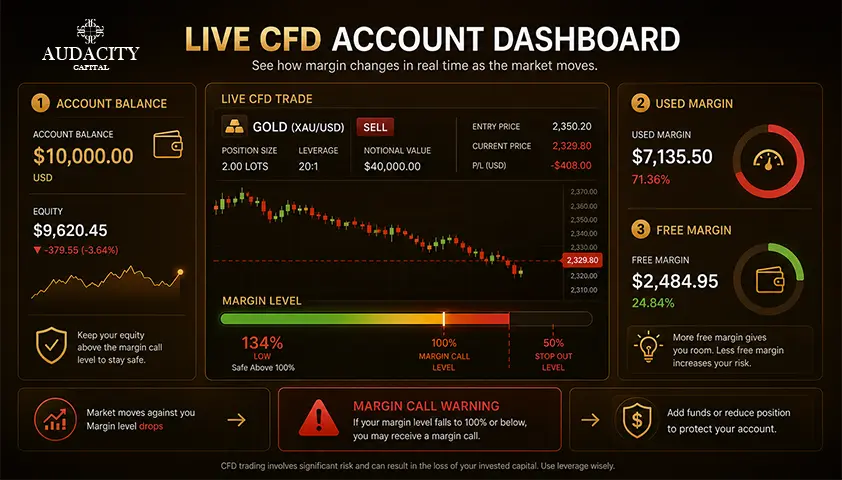
A broker can close your position because of a stop-out before your stop loss is reached. The reason for that forced closure isn't your stop-loss order; it's your account's margin level.
It's also the one that most readers come looking for.
There are five figures that move with respect to each other, and you will see these figures on any trading platform.
- BALANCE is your own closed money, your money from settled trades.
- EQUITY is balance plus or minus the profit or loss on your open positions.
- USED MARGIN is the money that's reserved for your open positions. This remains the same until the trade closes.
- FREE MARGIN is equity minus used margin. It is the room you have left to open up more positions or to take in a move against you.
- MARGIN LEVEL is equity divided by used margin, in percentage terms.
Why margin level is the number that matters
The number that the broker checks is margin level. Observe the states of a trade that goes against you.
Your used margin remains the same since it is fixed. However, your equity decreases with open losses.
Equity down, used margin flat, so the margin level percentage falls. That's how the accounts get closed.
Margin call, then stop-out
The margin call serves as a warning signal. Once your margin ratio reaches a certain level, you will get a margin call, which means you have little margin buffer.
The stop-out is a much more serious situation. This is when the broker automatically closes your positions due to reaching a certain margin level, usually from your biggest loss-making position.
For the European retail clients, this threshold is consistently fixed at 50 percent of the required minimum margin in every trading account.
The margin close-out can differ in other jurisdictions and brokers and therefore use the European regulation of 50 percent only as an example, not a universal requirement. Be sure to check your own account terms.
Watch it happen in numbers
Take an account with $2,000 of equity. You make a single trade where you need $1,000 of used margin. At that moment your margin level is $2,000 ÷ $1,000, which is 200 percent. Your free margin is $1,000.
Now the market moves against you and your open loss reaches $500. Equity falls to $1,500. Used margin is still $1,000. Margin level is currently at 150%.
The loss deepens to $1,000. Equity drops to $1000, margin level is 100 percent, and free margin is at zero. You are close to the warning zone.
The loss reaches $1,500. Equity is $500, margin level is 50 percent, and once that happens, a European retail account is on the standardized close-out. The position is force-closed.
This is why you were closed out when your stop was still some distance away.
The stop-out is not your own risk decision. When your equity is insufficient to cover the position, it is the broker who is looking to shield themselves from exposure. The impact of leverage on CFD trading is direct: the more you trade, the more you are at risk of falling short of your margin level before you are forced to close out your position.
Leverage Is Not the Same Thing as Risk
The leverage ratio on your account will not determine how much you stand to lose on a trade.
There are two factors that determine that, namely the size of the trade and the proximity of your exit point. Every other factor in the leverage discussion comes after this one correction.
A trader on a 500:1 account with a small position and tight stop would be risking less money than a trader on a 30:1 account with a large position and wide stop. Leverage is not a measure of your trade risk.
Prove it in numbers
Choose two traders who have the same starting amount ($5,000), trade the same asset, have the same distance to their stop loss, and have the same position size.
The only difference is the leverage ratio on their accounts, one at 30:1 and one at 500:1.
When the stop is hit, both lose the same amount, since it is determined by the distance to the stop and size of the position. The only differences are the margin that each one had to post to maintain the same position.
The 500:1 trader bound up less cash. The dollar loss is the same for both.
What high leverage actually changes
This part is to be treated seriously. A high margin requirement places a physical cap on the size of your position. Lower your margin requirement, and you raise this cap.
High leverage doesn’t add risk per se. Rather, it eliminates the limiting factor that was stopping you from going for too large a position.
If you have a set amount of risk as a trader, the leverage is not all that important. If the trader sizes from whatever the account will let her open, then the ratio is a deciding factor, since it directly determines how big the "whatever the account will let her open" will be.
Another effect of high leverage is the margin buffer. Large positions at high leverage have low free margin, and an ordinary adverse move may take the margin level down to the closeout level without reaching the stop level. This is a direct result of the mechanism given in the previous section.
So the line to remember: leverage determines how much of your account’s resources will be tied up by a position, while position size determines how much of your account’s resources can be lost on the deal. These figures are not equal.
How Much CFD Leverage You Can Actually Access?
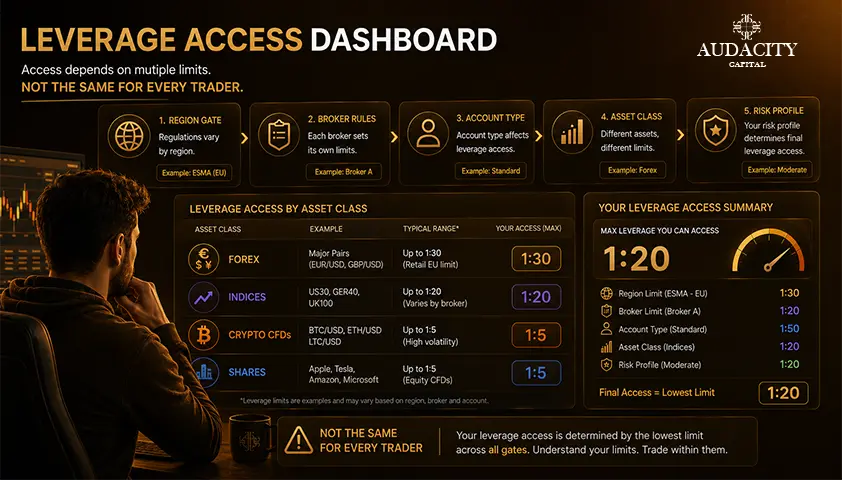
The amount of leverage a retail trader can access is determined by the entity your retail trading account belongs to, not by the market, and not by you.
That's why two people who have the same broker brand can see different numbers. The same brand may run multiple regulated entities, each of which has its own caps.
To grasp the concept of CFD margin and leverage, it is essential to understand who owns your account.
The European retail regime
The ESMA measures on product intervention, which have been in effect since 2018 for retail clients, cap leverage at the level of asset volatility:
- 30:1 on major currency pairs
- 20:1 on non-major currency pairs, gold, and major indices
- 10:1 on commodities other than gold and on non-major equity indices
- 5:1 on individual equities
- 2:1 on cryptocurrencies
In addition to the caps are a standardized margin close-out at 50% of the necessary margin, negative balance protection per account, limits on trading incentives, and a required risk warning that the provider must list its percentage of losing retail accounts.
The UK and Australia
Once out of the European jurisdiction, the UK maintained a similar system via the FCA, featuring the identical cap structure and protection for retail customers.
Australia too adopted a similar system following the introduction of its product intervention order by ASIC in 2021, having similar tiers for major and non-major pairs with similar close-out and negative balance protection provisions.
Attribute these figures to their regulators, note that they carry dates, and understand that caps depend on the specific entity you are onboarded with and can change.
Offshore entities
Many brokers run companies in lighter jurisdictions that provide much greater leverage, and traders shift their accounts in order to get it.
State this trade neutrally. Along with the increased leverage comes the loss of the protective package, including, above all else, negative balance protection and the standardized closing of positions. This is just a factual statement, not advice in any way.
The United States
CFDs are not available to US retail traders, which is why US-focused material discusses margin on futures and equities instead of contracts for difference.
Professional classification
Higher leverage is available to clients who meet a regulator's eligibility criteria for elective professional status and who give up their retail protections to obtain it.
There are criteria and they are strict. These are included here for completeness only and are not a recommended route.
The Costs That Leverage Multiplies
All costs of the leveraged position are based on the notional size, and not on the margin posted.
That is why leverage is often a surprise to many traders.
This is an essential piece of the CFD leverage explained puzzle, and nearly all the competing broker pages don't mention it.
1. Spread.
The spread is paid on the full position size. A higher leveraged position pays proportionally more for entering and exiting and that cost is deducted from an account that only ever covered a small amount of exposure.
2. Overnight financing.
Also called swap or rollover, this is the cost traders most often miss. It is charged on the notional value of the position for every night the position stays open.
If you have a leveraged position for weeks, the total amount of financing may be substantial compared to the margin used. In some combinations, depending on the difference in interest rates and direction, the swap may be a credit instead of a charge.
3. Commission.
For commission based accounts, commission depends on account position size, not on account deposit amount.
4. Gap risk.
This is the cost that can exceed your margin entirely. If the price hits your stop on a weekend or a news gap, it can move right over it and the fill will occur at the next price level, not at your stop price.
If negative balance protection is in effect, your limit of liability is the amount of money in your account. Where it does not apply, a single gap can produce a loss larger than your deposit.
Tie it together: leverage means a little deposit can control a big position, which means all the costs of the big position are proportional to the big number and not the small one. These are just examples and the specifics of financing rates, swap direction and commissions will depend on the broker and instrument.
When you understand that these costs are tied to your full exposure rather than just your margin deposit, the practical question becomes how to use leverage without letting it dictate your position size.
Using Leverage Without Being Used By It

Size the position, based on the fixed amount of risk and distance to your stop, NOT based on how much margin the account gives you.
This is the practical form of the earlier correction, and it is the habit that makes the leverage ratio largely irrelevant to how much a trade can cost you. Decide first how much you are prepared to lose if the stop is hit, then work backward to a position size, and let the margin fall where it falls.
Know your close-out level before you open the position. Keep enough free margin that a normal adverse move cannot drag your margin level to that threshold before your stop is reached. If it can, the position is too large for the account.
Count the aggregate. Several small leveraged positions in correlated instruments behave as one large position as far as margin and drawdown are concerned. Adding them up is the only honest way to see your real exposure.
Treat overnight and weekend exposure as a separate decision from the trade itself. Financing and gap risk both apply to the notional, so a position that made sense as an intraday trade may not make sense held for a week.
Check what your account actually offers. Look up the leverage cap on each asset class, the close-out level, and whether negative balance protection applies. These vary by entity, and most traders have never looked them up.
One honest note for anyone moving toward an evaluation or funded account. Leverage on funded and evaluation accounts is commonly set well below what retail brokers advertise, so a strategy carried over from a high-leverage retail account can behave very differently on the new terms. Position sizing that felt comfortable before may need to be rebuilt from the account's actual limits.
None of this makes trading safe. There is no recommended leverage level and no risk percentage that is correct for everyone. Most retail CFD accounts lose money, and disciplined process reduces avoidable errors rather than removing the underlying risk.
Conclusion
Three points separate this from the standard explanation. CFD leverage is the ratio between your notional exposure and the margin you post, nothing more. A close-out is triggered by your margin level falling to a set threshold, not by your stop loss. And the size of your position, rather than the leverage ratio on your account, decides what a trade can actually cost you.
The practical instruction follows from those three. Find out your own account's leverage caps, its close-out level, and whether negative balance protection applies. Then size every position from a fixed amount of risk rather than from the margin the account happens to make available.
CFDs are complex leveraged instruments. A high proportion of retail accounts lose money, losses can exceed your initial margin where negative balance protection does not apply, and CFDs are not available to US retail traders.
Frequently Asked Questions
It means you can control a position worth 30 times your posted margin, so every $1,000 of margin supports up to $30,000 of exposure. Put another way, the margin requirement is around 3.33 percent of the position's notional value. The 30:1 tier applies to major currency pairs under the European and UK retail regimes.
It depends on your jurisdiction and account terms. Where negative balance protection applies, as it does for retail clients under the European, UK, and Australian regimes, your loss is capped at your account funds. Where that protection does not apply, a sharp gap through your stop can produce a loss larger than your deposit.
Because your margin level fell to the close-out threshold before price reached your stop. As open losses erode your equity, margin level drops even though your used margin stays fixed, and once it hits the floor the broker force-closes positions to protect its own exposure. A larger position leaves less free margin buffer, which makes this more likely.
The ratio matters far less than the size of the position you open under it. A lower cap simply removes the option to oversize, which is why regulated retail tiers exist, but it does not decide your risk on any given trade. Position size and stop distance decide that, so focus there rather than on chasing a particular ratio.
No. Leverage changes the capital required to hold a position, not the return the market produces on it. A given price move delivers the same profit or loss regardless of the ratio, and higher leverage scales losses on exactly the same terms it scales gains, while also shrinking your free margin buffer.
CFD leverage lets you control a position without owning the underlying asset, so you post only a margin deposit against the price difference. Traditional stock margin involves borrowing money to buy shares you actually own, and the leverage available is usually far lower. CFDs also carry overnight financing on the full notional, which behaves differently from the interest on a stock margin loan.
Because leverage is set by the regulator of the entity your account sits with, not by the broker's own choice or by the market. The same brand often runs several regulated entities, each carrying the caps of its jurisdiction, so a trader onboarded in Europe sees the ESMA tiers while a trader with an offshore entity of the same brand may see much higher ratios and fewer protections.
Effectively yes, through overnight financing, also called swap. It is charged on the notional value of the position for every night you hold it open, which reflects the cost of the exposure the broker is funding on your behalf. On some pairs the swap can be a credit rather than a charge, depending on trade direction and the interest rate differential between the two currencies.

क्या आप क्रिप्टो पर अनुशासित जोखिम लागू करने के लिए तैयार हैं? Audacity Capital के नए क्रिप्टो उपकरणों का पता लगाएं और अपनी ट्रेडिंग रणनीति लाएं।
और जानेंन्यूज़लेटर
हमारे न्यूज़लेटर से जुड़ें।
हमारे सामाजिक समुदाय में शामिल हों

आज ही अपनी यात्रा शुरू करें हमारे नि:शुल्क परीक्षण के साथ
प्रमाणपत्रों के माध्यम से अपने कौशल और उपलब्धियों को गर्व से प्रदर्शित करें और संभावित निवेशकों और साथियों से अपनी कड़ी मेहनत और समर्पण के लिए पहचान प्राप्त करें।
नि:शुल्क परीक्षण