


How Does Trading Work?



Key Highlights
Trading involves buying and selling financial assets such as commodities, stocks, and forex to benefit from the emerging price movements.
In a nutshell, its key aspects include:
- Buying and Selling: You buy a financial asset at a low price with the hope of selling it at a higher price.
- Brokers and Trading Platforms: Online trades are conducted through brokerage accounts, which have a price-matching system, thus making them serve as an intermediary.
- Types of Assets: Some of the most commonly traded assets in the financial markets include company shares, currency pairs, and cryptocurrencies.
- Risk Management: Profitable traders manage their investment risk by setting up stop-loss orders and using position sizing.
How Does Trading Work?
Trading isn’t gambling. It’s structured buying and selling based on price movement. At its most basic, it involves buying and selling financial assets, such as stocks, options, bonds, futures, currencies, and commodities for profit.
Each asset comes with its own unique set of characteristics, level of risk, and potential for returns. Traders, therefore, need to have specific trading plans and strategies that will guide what they buy, when they sell, and how often they trade.
Trading at its core is based on expected price fluctuations, many of which tend to happen over a short period of time. For you to decide on when to open or close a trade, you’ll need to closely monitor price charts and use them in combination with other tools. Read on to learn more!
What Is Trading in Simple Terms?
Trading is the process of buying and selling financial instruments like cryptocurrencies, stocks, forex, and commodities, over short periods to make profits from the price movements. It differs from long-term investing in that its focus is on quick price fluctuations. The goal is to buy at a lower price and sell at a higher price, though identifying these points is not always straightforward.
How Does Trading Actually Work? (Step-by-Step)
The fundamental principle that helps trading work is the relationship between supply and demand. Demand increases when there are more buyers than sellers, and vice versa. Your profit as a trader will depend on the market prices finally matching the speculated amount.
Below is a step-by-step guide to help you understand how trading works:
- You start by choosing the market you’d like to participate in. Some of the markets you can consider include Gold, Forex, stocks, and indices.
- You place a buy or sell order. When placing an order, please be advised: buy means you expect the prices to rise, and sell means the prices are likely to fall.
- The broker executes the trade. Orders go to an exchange or liquidity provider where they’re executed. Brokers route orders to liquidity providers or exchanges where they are matched based on price and availability.
- Price moves. Price movements can be caused by a change in the supply and demand metrics, or because of other factors such as economic data, emerging news events, and institutions releasing corporate earnings reports.
- You close the trade. When you decide to close the trade you opened earlier, one of two things will happen: you’ll either have made a profit from the buying price or walked away with a loss.

Are You Looking For A Funded Trader Program?
Join the Funded Trader ProgramWhat Makes Prices Move?
Price movements in the financial markets can seem chaotic or even random at best when you first start trading. You may even say it appears as though the markets have a mind of their own. But the truth is, prices don’t change without a reason. And below is a look at some of the leading ones:
- Supply and Demand: The supply and demand concept is intuitive, as the more people want a certain item or stock, the scarcer it is bound to get, causing its prices to increase. And when a stock is in large supply, but with little to no demand, its price will decline. All financial markets, from stocks to forex and cryptocurrencies, work in this exact manner.
- Economic News: In your bid to answer the question, ‘How trading works for beginners?’ it will be important to research the effect economic news and data have on share prices. For instance, what happens when the Federal Reserve increases interest rates? In such an event, the dollar will grow stronger, translating to better returns for traders holding the U.S dollar.
- Interest Rates: When the Central Bank changes the interest rates, this has a direct effect on borrowing costs, asset prices, and investor behavior. For example, an increase in these rates will cause growth companies to lower their stock valuations and culminate in lower bond prices. On the other hand, lower rates lead to increased spending and a sharp rise in equity prices.
- Institutional Activity: Market sentiment, including fear and greed, plays a significant role alongside economic and institutional factors.
What Is the Role of a Broker?
A broker refers to an individual or financial entity that serves as an intermediary between the investors (traders) and the securities exchange. Brokers charge commissions or fees for the services they render, and generally fall under two categories: Full Service Brokers and Discount Brokers.
Both can be found online, helping make trading services more accessible to the everyday investor. Brokers facilitate trading in the following ways:
- Trading Platform (MT5, DXTrade): Financial brokers supply the software interface needed for trading. Platforms such as the MT5 provide real-time quotes, data analysis, and charting tools, which are things a prop trader needs to pass an evaluation challenge.
- Order Execution: While you already know the buy or sell order that you want to place, you’ll need someone to execute it for you. The broker takes care of the technical aspect of ensuring each order gets filled, and will typically do this using sophisticated trading programs.
- Spread/Commission: Brokers mainly generate revenue through two mechanisms: spreads and commissions. A spread is the difference between the bid and ask price. Commissions are a separate, fixed fee which the broker will charge for executing a trade order.
- Margin and Leverage: Leverage enables you to open a larger position using limited capital. A broker can make this possible by increasing capital efficiency and providing buying power. Margin refers to the collateral you’ll deposit to cover the risk of borrowing money. Your broker will manage this by requiring an initial margin (a percentage of the total trade value) to be deposited before opening a trade.
How Do Traders Make Money?
Traders make money from speculating on the market activities of various financial assets, e.g., stocks, commodities, and forex. Their trading activities revolve around buying these instruments at a low price and then selling them at a future date for a much higher price.
The following is a look at how traders make money:
Long Positions
A long position is where you buy an asset expecting that its price will increase. By taking this position, you’re practically betting on its future growth and projected profit potential.
You can establish a long position in diverse securities such as currencies, mutual funds, and stocks, or in derivatives such as options and futures.
Short Positions
Short selling is a trading strategy where you speculate on the downfall of a stock. A short seller is a trader who bets on and profits from the decline in a security’s price.
Portfolio managers and investors use this tactic as a hedge against the downside of a long position, while traders use it as speculation.
Leverage
Leverage operates as a type of loan from your broker, thus permitting you to open larger trade positions than your current capital allows.
You can say it acts as an amplifier that helps magnify both your potential gains and losses. For you to initiate a leverage position, you’ll first need to commit a fraction/percentage of the trade’s full value.
Risk Management
You can make money in the financial markets by using fundamental and technical analysis to identify high probability setups. Exploiting market volatility will also make this possible.
As you exploit these volatilities, make sure to manage your risk to prevent the losses from exceeding the profits made on the trades.
To get a better idea of how traders make money, consider this small practical example below:
If you buy EUR/USD at 1.1000 and sell at 1.1050, you profit from the difference.
What Is Risk in Trading?
Risk in trading refers to the ever-real possibility of losing all or a percentage of your capital when an open position starts to move against you. Knowing how to manage risk when trading can help significantly lower your exposure.
But how do you do this?
Start by Understanding that Losses are Normal
Many people begin trading with the mentality that trading success means winning almost all the time. But after incurring a few losses, frustration and doubt begin to set in.
For most beginner traders, this is where their foray into the trading world ends. What you need to understand is that losses are a normal part of the trading experience.
And as uncomfortable as this truth may be, you have to understand that it’s impossible to trade all year round without making a loss, no matter how good a trader you are.
With this in mind, you should note that losses come about because the markets are not predictable: at best, they’re probabilistic, and each trade you make is a bet on unknown outcomes.
Start Trading with Instant Funding
Trade with Instant CapitalStop Loss Orders
A stop loss order is an essential tool for traders who hope to secure their gains and curtail potential losses from their existing positions.
The stop loss order works by dictating when a security will be bought or sold: it does this by providing a predetermined stop price.
Stop-loss orders help limit losses, but execution is not guaranteed at the exact price due to slippage or market gaps.
Position Sizing
Position sizing is the process of determining the total amount of capital to allocate to a new trade. Its goal is to strike a balance between risk and reward.
It can help you to build a diversified portfolio by limiting the capital allocated to each asset class. Some of the factors to consider during position sizing include risk tolerance and trading psychology.
Emotional Discipline
Emotional discipline in trading matters because financial markets can challenge your discipline and decision-making. Financial markets are designed to test your confidence, patience, and decision-making.
With every losing trade, you’ll be tempted to adjust your system to make up for the losses suffered. However, you should remember that consistency is critical for long-term success.
How Is Trading Different from Investing?
Trading and investing are two leading approaches to making money in the currency markets – but while they are both after profit-making, their timeframes, mindsets, and strategies vary a lot.
What Is Trading?
Trading refers to the process of buying and selling financial assets such as cryptocurrencies, stocks, commodities, and currencies, for short-term gains.
Traders have to closely monitor the markets to take advantage of any emerging opportunities.
What Is Investing?
It refers to a long-term money-making strategy that’s focused on buying financial assets with the aim of holding them, allowing them to increase their value over time.
Investors choose to focus on the fundamentals – a company’s growth potential, profitability, and overall financial health – thereby ignoring short-term price swings.
Below is a short comparison table:
Trading | Investing |
Short-term | Long-term |
Technical focus | Fundamental focus |
Frequent trades | Buy and hold |

Take the Free Prop Firm Challenge
Free Prop Firm ChallengeCommon Misconceptions About Trading
There are many trading misconceptions out there, many of which are being spread by people who don’t have a good understanding of what trading is and how it works. To help clear any doubts you may have, let’s start by clearing three of these misconceptions:
- It’s not gambling
- It’s not instant money
- It’s not about predicting perfectly
Conclusion
While trading presents many money-making opportunities, it also carries significant risk. Price fluctuations, unexpected events, and market volatility can lead to losses. To become a profitable trader, you need discipline, careful risk management, and a thorough understanding of the markets. At Audacity Capital you’ll receive continuous learning to help you adapt to changing market conditions.
FAQs
The best way to get into trading is by finding a reputable platform, using its resources to learn as much as you can about trading, practicing on a demo account, and then opening a trading account.
Tradeable financial assets include stocks, cryptocurrencies, bonds, exchange-traded funds, commodities, derivatives, and currencies.
It’s a decision you make after conducting a thorough analysis of the price movements and researching upcoming news events and prevailing market sentiment.
They fail because the markets are competitive and uncertain.
No, not always. Losses are a normal part of trading and will happen even when using a strong strategy.

क्या आप क्रिप्टो पर अनुशासित जोखिम लागू करने के लिए तैयार हैं? Audacity Capital के नए क्रिप्टो उपकरणों का पता लगाएं और अपनी ट्रेडिंग रणनीति लाएं।
और जानेंन्यूज़लेटर
हमारे न्यूज़लेटर से जुड़ें।
हमारे सामाजिक समुदाय में शामिल हों

आज ही अपनी यात्रा शुरू करें हमारे नि:शुल्क परीक्षण के साथ
प्रमाणपत्रों के माध्यम से अपने कौशल और उपलब्धियों को गर्व से प्रदर्शित करें और संभावित निवेशकों और साथियों से अपनी कड़ी मेहनत और समर्पण के लिए पहचान प्राप्त करें।
नि:शुल्क परीक्षणसंबंधित लेख
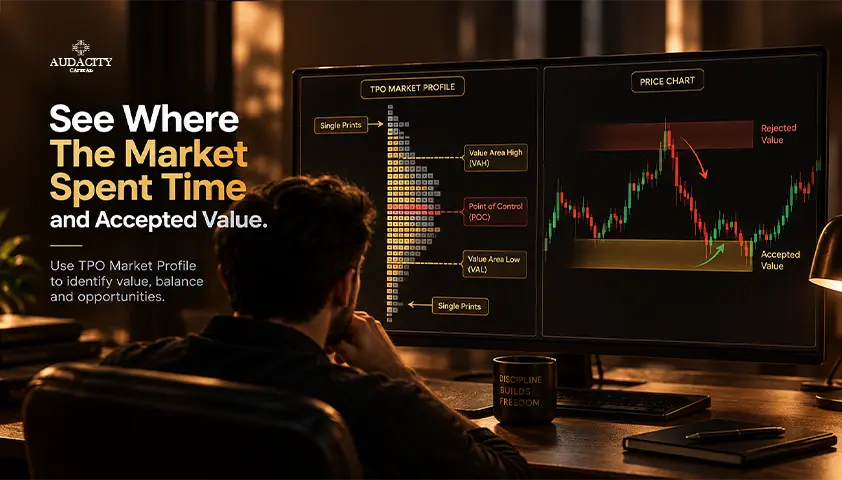
Market Profile Trading: How to Read TPO Charts
Learn Market Profile Trading with TPO charts, value area, POC, initial balance, day types, practical examples, and risk controls.

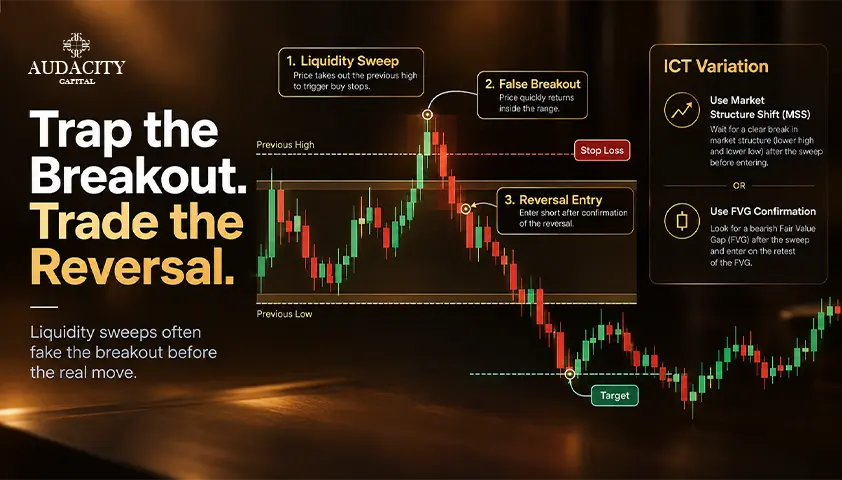
Turtle Soup Trading: Rules, Examples and ICT Variations
Learn turtle soup trading with original rules, ICT variations, bullish and bearish examples, risk controls, and a practical backtesting checklist.
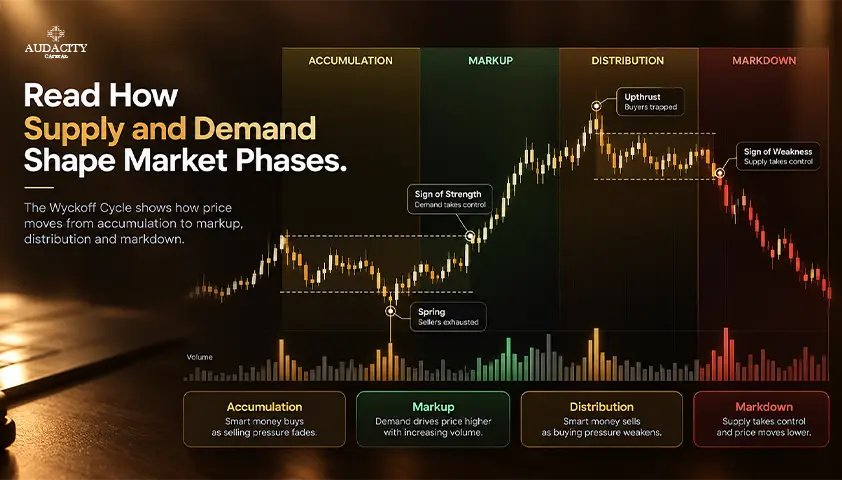
Wyckoff Method Explained: Phases, Rules and Examples
Learn the Wyckoff Method, its three laws, accumulation and distribution phases, trade examples, and the limits of price and volume analysis.
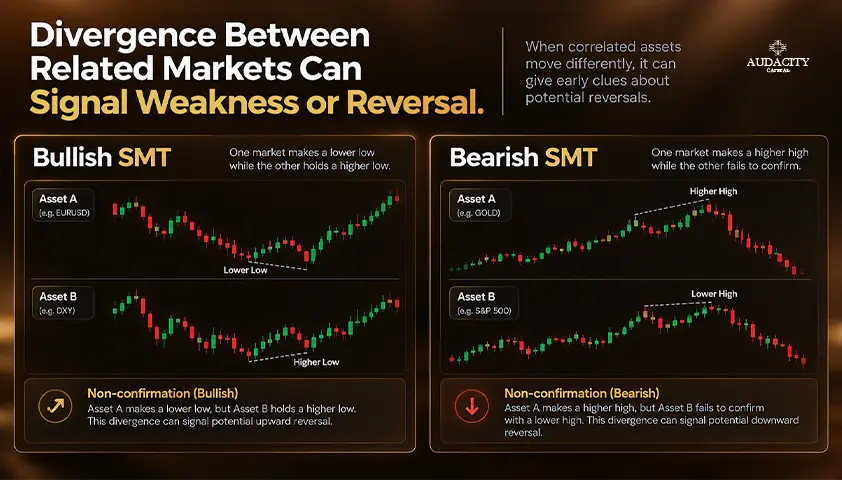
SMT Divergence in Trading: Bullish and Bearish Examples
Learn what SMT divergence means, how bullish and bearish setups form, which markets traders compare, and how to confirm signals and manage risk.