


Prop Trading Vs Broker Trading



Key Highlights
Broker trading and prop trading are two distinct ways of accessing the financial markets. Their major difference lies in their source of funding: broker traders use personal funds, while prop traders use firm capital. In a nutshell, this is what you need to know about the two:
- Source of Funding: Prop traders receive funding from a prop firm (from $20,000 to $1M) after passing an evaluation. Broker traders use their own capital to trade.
- Trading Restrictions: Prop firms have strict rules on the items that a trader can trade and how much they can lose. Broker traders have the leeway to operate as they wish.
- Profit Sharing: Prop traders will have to share their profits with the prop firm, while broker traders get to retain all the profits generated.
- Evaluation Phase: A challenge is a crucial aspect of funding in prop firm trading, as without it, a trader can’t get funded. Broker trading comes with immediate access to financial markets.
Prop Trading Vs Broker Trading
If you’re having trouble deciding whether to become a stockbroker or a Wall Street trader, it will be important that you start by understanding what each type of trading truly entails. For starters, both prop and broker trading involve the buying and selling of securities, but each comes with its differences.
Prop traders work in partnership with prop firms, which provide them with funds to open larger positions. Brokers, on the other hand, serve as sales agents working for themselves, but they’ll also need to deal directly with clients.
In this guide, we are going to look at how prop trading compares to broker trading, the differences between the two, and provide answers to the frequently asked questions about prop trading vs broker trading. Read on to learn more!
Learn more about latest guide Compare Prop trading to other models
What Do Prop Traders and Brokers Do?

I think it’s important to understand what these two professionals in the trading space do before taking a deeper look at their similarities and differences. To start with, you should note that while both prop traders and brokers deal in buying and selling securities, brokers are also sales agents.
It’s a role that allows them to work for multiple entities, such as brokerage and securities firms! My research and experience with these professionals show that they are tasked with obtaining and maintaining a roster of regular clients who can include both retail and institutional customers.
Moving on, we have prop traders, a career that many of us cherish and hope to advance in. Prop traders work for prop trading firms, and their roles include buying and selling financial instruments with the goal of profiting from rapidly changing market conditions.
Prop Trading Overview
One unique feature stands out in prop trading: traders don’t have to risk personal funds when trading. Instead, the firm provides the funds needed for traders to take larger positions, thus effectively boosting a trader’s earning potential.
The prop traders, in return, get to retain a share of the profits; please note that the percentage you’ll retain will vary greatly depending on the prop trading firm you have partnered with and the account type or level. Most firms will allow a trader to walk away with 50% to 90% of the profits.
But of course, there’s more to prop trading than simply receiving funds to use in trading.
Each trader wishing to work with a prop firm will first have to prove that they have what it takes to become a funded trader. The only way to do this is by passing an evaluation challenge. Prop firms will typically use a simulated environment to test this, with traders being required to follow strict rules.
Besides observing the rules, a trader will have to attain a preset profit target, while also taking care not to exceed the daily or maximum drawdowns. Prop trading firms use the evaluation phase to test your discipline and consistency as a trader.
Failure to achieve the profit target or exceeding the drawdowns set by the prop firm will cause you to fail the challenge. If you’re lucky enough to pass the multi-step challenge, the prop firm will provide you with a funded account that will allow you to trade in live market conditions.
You should note that funding will come with a whole new set of rules. For example, exceeding the limits will lead to account termination. To prevent this, you must always be in a position to use sound trading strategies and maintain proper risk management.
Overview of Broker Trading

Broker trading is by far the most popular type of trading. Most traders are familiar with it, as it doesn’t involve much: you simply need to find a reputable online broker, sign up, and begin trading the financial markets you like.
Traders using brokerage accounts are typically self-funded, which means that the trader will be responsible for making sure that the account remains profitable and in good standing. One way to do this is by ensuring that the account has the required level of funds at all times.
In addition, you’ll also need to keep track of your trading budget. Remember, your trading activities will be limited to your account size.
Some traders love broker trading because it’s highly independent. The trader has the freedom to decide when to trade and the trading activities to pursue. This will include deciding on the trading targets and the total amount of capital that they can afford to lose per trade.
Put simply, broker traders are in charge of their trading actions and will have a lot of freedom to find a trading style they like and can work with.
A Look at the Differences Between Prop Trading and Broker Trading
The reality in the trading world is that the more capital you have at your disposal, the bigger and better your returns will be. Trading with a small capital allocation will undeniably limit your position sizing, which will, in turn, affect your overall returns.
Having access to a large trading budget will make it easier for you to reap meaningful profits while allowing the trading account to scale at a faster pace. And if you’re careful and methodical with your risk management plan, any bad trades you may have made won’t have too much of an impact on your trading account balance.
For many broker traders, their biggest hindrance to opening large positions is the lack of capital. These traders are generally limited to using the funds that they can raise, much of which comes from their savings or income.
When you have a small capital allocation, growing the capital needed to trade large positions will take a considerable amount of capital, effort, time, and discipline. Prop trading helps eliminate the capital barrier by providing a funded account having around six figures, thus accelerating your scaling journey.
Prop Trading vs Broker Trading: Table Comparison
Feature | Prop Trading | Broker Trading |
Source of Capital | A prop trading firm provides the capital | Trader’s own capital |
Profit Split | Shared according to a pre-agreed-upon percentage, e.g., 80/20 in favor of the prop trader | The broker trader retains all the profits made |
Personal Risk | Limited to the fee paid to access the evaluation challenge | High and can include the complete loss of your deposit. |
Drawdown Limits/Rules | Strict and will include daily and maximum drawdown levels. | Flexible and self-defined |
Goal | Performance and capital scaling | Freedom and direct ownership |
Barrier to Entry | Must pass the multi-step evaluation challenge | Low, as only the deposit is required |
Conclusion
For most people, the main motivation for joining the trading industry is money. However, there are those who do it because they have a genuine passion and interest in finance and trading. If you enjoy dealing with people from diverse backgrounds, you may want to go the broker trading path. Prop traders primarily deal with financial portfolios, and it’s a path recommended for individuals who crave the freedom and flexibility to trade varied financial assets. At Audacity Capital, you can trade various types of funded accounts once you have passed your evaluation. Our profit split agreement is transparent and comes with well-defined payout dates.
Join Audacity Capital's free prop trading competition, apply the strategies you've learned, and compete for a chance to win a funded trading challenge without risking your own capital.
FAQs
Broker trading is a conventional trading method where a person interested in trading opens an account with a brokerage firm and uses it to trade various financial instruments.
The benefits are several, and include no time pressure, 100% profit retention, and full independence without anyone limiting your trading style.
Prop trading is best for skilled individuals having limited access to personal capital. Broker capital is ideal for those who have sufficient capital, but would prefer retaining all the profits made.
The industry has its share of reputable and scam firms. Always ensure you have thoroughly researched each firm before signing up for its evaluation challenge.
Yes. Many traders have adopted a hybrid approach to trading that sees them use the profits from prop trading to open personal brokerage accounts.

Pronto ad applicare un rischio disciplinato alle criptovalute? Esplora i nuovi strumenti crypto di Audacity Capital e porta la tua strategia di trading.
Scopri di PiùNewsletter
Iscriviti alla newsletter per restare aggiornato.
Unisciti Alla Nostra Community Social

Inizia Il Tuo Viaggio Oggi Con La Nostra Prova Gratuita
Mostra con orgoglio le tue abilità e i tuoi risultati attraverso certificati e ottieni riconoscimenti per il tuo duro lavoro e dedizione da potenziali investitori e colleghi.
Prova GratuitaArticoli Correlati
Best Local Payment Methods for Forex Prop Trading
Compare the best local payment methods for forex prop trading by region and learn faster, cheaper prop firm withdrawals with fewer delays.

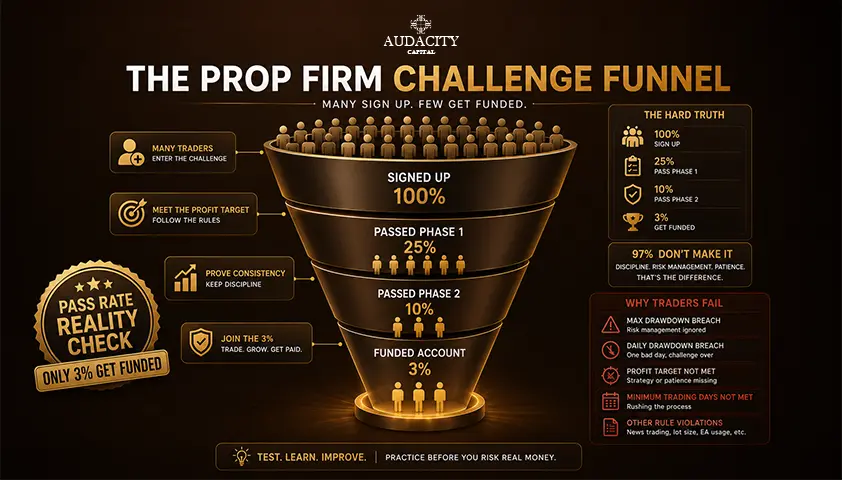
Prop Firm Pass Rate: What Percentage Actually Get Funded?
Learn the real prop firm pass rate, why estimates vary, how many traders get funded, and what the data says about payouts and repeat attempts.

10 Best Prop Trading Firms in Malaysia in 2026
Compare the 10 best prop trading firms in Malaysia for 2026, ranked on swap-free accounts, payout speed, fees, and payments that work from Malaysia.
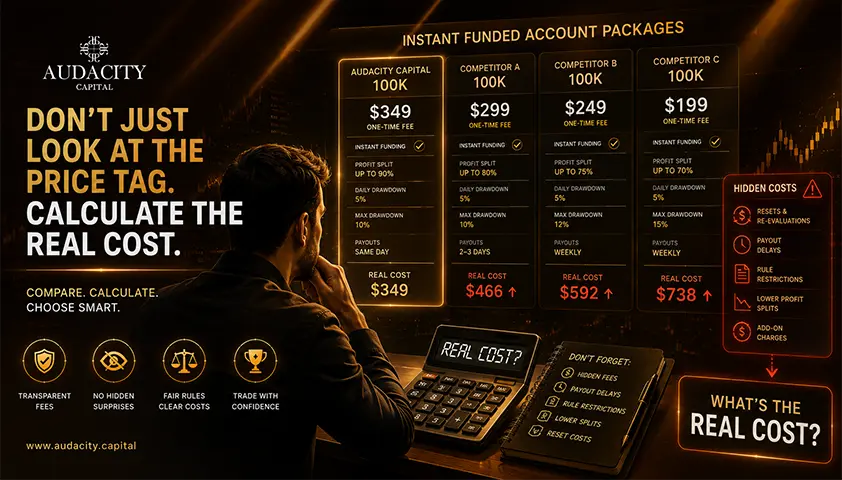
How Much Does an Instant Funded Account Cost?(2026 updated)
Sticker price tells only half the story. See what an instant funded account cost really covers, why it runs 2 to 3x a challenge, and if it's worth it.