


Averaging Down: Explained


You have probably seen averaging down described two ways, both stated with total confidence. In one place, it is what patient, long-term investors do to build a position at a better price. In another, it is the exact behavior that empties trading accounts. Neither writer is lying to you.
Both descriptions are accurate. They just describe different situations. And the thing that separates them is not conviction, discipline, or how much research you did. It is whether the person adding can afford to wait.
This article is educational only, and leveraged trading carries a substantial risk of loss.
What Averaging Down Is
Averaging down refers to the process of increasing your stake when the market has moved against you, at a lower price if it is a long trade. As a result of this, the cost basis of your position falls because you bought more at a lower price.
Your average entry price goes down and the position will need a lower price to be breakeven.
That's the part that everyone explains. Most explanations omit what follows: Two things occur simultaneously. Your breakeven price improves. Meanwhile, the total amount of money invested in the position rises.
Both effects arise out of the same action, and one cannot happen without the other. The math section will show precisely how both change simultaneously, and you’ll see how these two are related.
Three Different Things Get Called Averaging Down
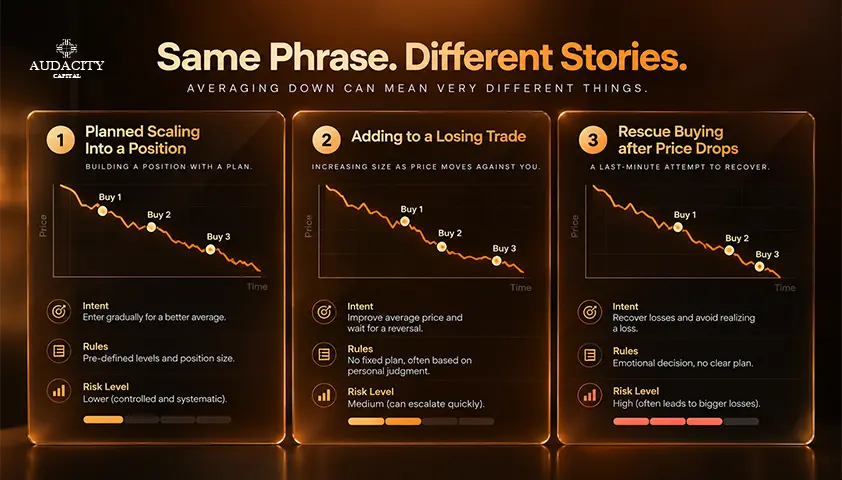
The confusion lies in the fact that there are three distinct practices with the same name. There are some very popular pages that use them interchangeably.
Even one website explains regular scheduled investing as averaging down which is quite different. Separating these things first makes everything else understandable later on.
One, dollar-cost averaging. You make a fixed investment at regular intervals, regardless of the price. The total commitment is set beforehand; the schedule does not care about price changes in an investment, and a decision to invest is made before knowing any price.
A lower average is just the consequence of this strategy, but not its goal.
Two, a planned scale-in. This can also be referred to as averaging in. You determine the total position size before you enter, and gradually fill in the position in stages at levels you planned in advance.
The total exposure is capped right from the beginning and every add is approved before the position even opens.
Three, proper averaging down. You add to a position when you think you're losing money and the size and number of adds are determined as you go. There was nothing predetermined about the addition to the trade; it was purely a response to the existing loss.
What matters is this: The first two have been determined before the loss occurs, whereas the third is a reaction to it. This is the key difference between the two, not the act itself. The remainder of this article hinges on this point.
Practice | What triggers the add | Total size | Decided when |
Dollar cost averaging | A date on the calendar | Fixed in advance | Before any price was known |
Planned scale-in | Price reaching a pre-identified level | Capped in advance | Before the position was opened |
Averaging down | The position showing a loss | Open-ended | While holding the loss |
What It Actually Does to Your Numbers
Almost every webpage about this topic starts off by mentioning the better breakeven but hides the added risk behind a qualifier somewhere at the end. They are the same thing. They belong side by side.
Start with a position in some hypothetical instrument, using round numbers. You get into the trade, and the price goes down. You add to that position once, at 10% below your original entry. The new average entry level will be below your initial entry, making your breakeven lower.
This is reality, and it does not have to be qualified. A lower breakeven is the true, valid reason for engaging in the strategy.
Now look at that same table from the opposite direction. At every price below your add, the position is losing more money than it would have been if you had never added.
You will require a smaller recovery just to break even and will lose significantly more if there is no such recovery. This is not an exception; it is the other side of the same trade.
The most significant concept discussed in this section can be defined as the cost basis illusion. It is easy to see the falling average entry as progress. Yet it is not. There were no gains realized.
Nothing was fixed. Your account remains just as impaired as ever.
Cost basis is an accounting figure that keeps track of how much has already been invested. This figure does not say anything about the level of your risk exposure or the future direction of the trade. All the relief you feel is based on the numbers alone.
Price | Single entry: open loss | After adding: open loss | Breakeven needed |
At entry | None | Not yet added | Original entry price |
10% below entry | One unit of loss | Add made here | Now lower than entry |
15% below entry | Smaller loss | Larger loss | Still lower than entry |
25% below entry | Smaller loss | Substantially larger loss | Still lower than entry |
Back to the add price | Still losing | Close to breakeven | Reached sooner |
The One Question That Settles It
No need for the checklist. There is one question that you can apply to your open position. It will take care of the rest by itself.
If you had nothing to trade right now, would you open this position, at this price and this size, today?
Answer with all four factors in place. The loophole is the dropping of the size element, which allows people to answer yes while the answer should be no.
If the answer is yes, the position you hold right now doesn't matter at all. The loss is sunk into your account; there is no need to let it affect the decision you make.
This is the sunk cost. The add is a present opportunity in its own right, and it happens to lower your average as a consequence. Fine.
In case the answer is no, it shows that the add is not an investment decision. It's a strategy to delay the time you have to realize that the first choice was incorrect. That's about as nicely put as you can say it.
If you would not open the position fresh today, you are not adding because the position is attractive. You are adding because you are trying not to be wrong.
One follow-up catches the people who say yes too fast. Has anything actually changed about why you entered, other than the price?
If the only new information is that the position is down, then you have mistaken a loss for evidence. A lower price is a fact about the market. It is not a fact about whether your original reasoning was sound.
Why the Answer Changes Completely With Leverage
Here is what almost no ranking page addresses. Most treat this as an equity investing question. But the conditions that can make averaging down survivable for a stock investor may not exist inside a leveraged account.
The investing case is genuinely different. An unleveraged holder of shares has three things working in their favor. There is no margin requirement, so nobody can force the position closed.
There is no expiry, so the holding period is whatever they decide it is. And the maximum loss is capped at the amount committed. Under those conditions, a considered thesis can outlast a long decline, and averaging down is a reasonable way to act on that view.
Remove those three conditions and the same action behaves very differently. Margin requirements can rise as position size increases, while the falling price drains your available equity.
The position can now be closed by the account rather than by you. Once that happens, your ability to wait, which was the entire premise for adding, is gone.
If you trade inside an evaluation or funded program, add one more constraint. A daily loss limit or maximum drawdown can end the account before a recovery arrives. A growing floating loss may breach that limit first.
In that setting the question is not whether your view is right. It is whether it can be right in time. Averaging down shortens the time you have while raising the size of the move you now need.
Funded programs commonly impose these limits, but the exact rules vary. Check your own rules rather than assuming.
Where Averaging Down Becomes Martingale
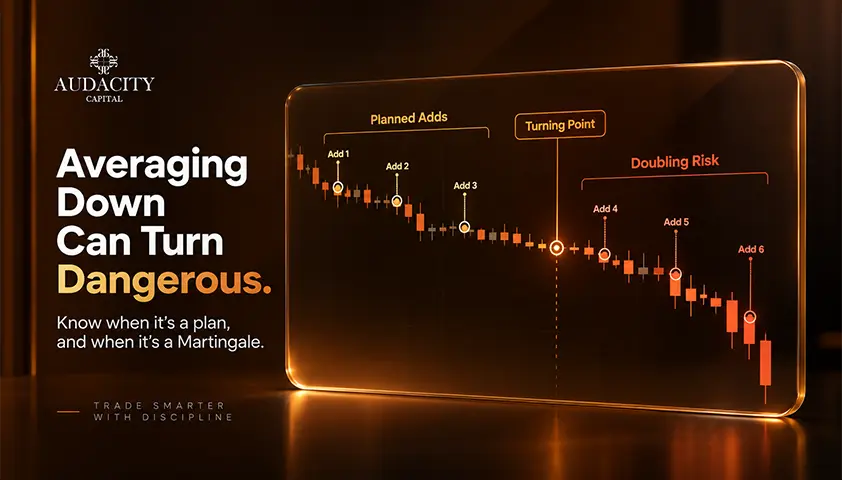
Traders often treat these two as the same thing. They are not.
Averaging down describes adding to a losing position. Martingale describes a specific sizing rule applied to that behavior. Each addition is larger than the last by a fixed multiplier, with no ceiling on the total.
Averaging down at a constant size and averaging down with escalating size behave very differently in how fast your total exposure grows, even though both add to a loser.
The key difference is the rate at which exposure grows. Escalating size removes an important constraint. There is no longer a meaningful limit on how large the position can become. Adding at a constant size still increases your exposure, but at a rate you can see coming.
We cover martingale arithmetic and why sizing cannot manufacture an edge in a separate article, so this section stops at the definition.
The Habit It Quietly Replaces
There is a second-order cost that the popular pages mention only in passing. Averaging down does not sit next to an exit plan. It takes the place of one.
A trader who keeps adding instead of exiting can turn a defined loss into a much larger exposure. They may also stop using the stop loss that was supposed to cap the damage.
Over enough positions, this can do more damage than any single trade. It erodes the habit of accepting a small, planned loss.
That habit helps keep every other position survivable. Lose it, and position sizing stops meaning much because there is no longer a floor you actually respect.
Then there is the survivorship problem, which explains why the practice looks more reliable than it is. Every well-told story about averaging down is a story where the position came back.
The ones that did not recover are not written up, retold, or turned into case studies. What you see is a record filtered by outcome. That is survivorship bias, and it makes a risky practice look like a proven one.
Conclusion
Averaging down is not right or wrong on its own. The important question is why you are adding. Was the additional position authorized by a plan you made before the loss existed, or did the loss itself trigger the decision?
Only the person holding the position knows which one it is, and once the question is asked properly, the answer usually arrives fast.
So before you add to anything currently losing, do one concrete thing. Write down your answer to the question in this article, and write down the total size you will allow the position to reach. If either answer is hard to write, you already have your answer.
One final point: averaging down depends on being able to wait. A defined loss limit removes exactly that freedom.
Audacity Capital's simulated evaluation accounts operate with a loss limit of that kind, which is worth keeping in mind as an illustration of the constraint the leverage section described.
Frequently Asked Questions
No, and the difference is whether you already hold the position. Buying a dip is opening something new at a price you find attractive, a fresh decision with no prior loss attached. Averaging down means adding to something you already own and are already losing on. That existing position contaminates the decision, because part of you is trying not to be wrong about it.
You can, and it is structurally more dangerous than doing it on a long. When you average down a long, there is a floor, because price cannot fall below zero. A losing short has no equivalent ceiling, since price can keep rising without a defined stopping point. That asymmetry means the same practice carries more open-ended risk on the short side.
The fact that you are asking is itself the warning sign. A planned scale-in already has an answer because its total size was capped in advance. Only a reactive add leaves the number open. An open number is how a small loss can turn into a position with no clear ceiling.
Adding to a losing position is not usually banned in itself, but escalating-size sizing rules commonly are. Programs differ, especially in their drawdown, margin and stop-out rules. Check your own program documentation rather than relying on a general answer.
Averaging up means adding to a position that is already profitable, which increases your exposure to something currently working rather than to something currently wrong. It carries its own trade-off, though. Each add raises your average entry, so you give back more of your gain if the move reverses.

暗号資産に規律あるリスクを適用する準備はできていますか?Audacity Capitalの新しい暗号資産商品を探索し、あなたの取引戦略を持ち込んでください。
詳細を見るニュースレター
ニュースレターに登録して最新情報を入手。
ソーシャルコミュニティに参加

関連記事

What Is BOS in Trading? A Complete Guide to Break of Structure (2026)
Learn what BOS in trading means, how Break of Structure works, how to identify bullish and bearish BOS, and how traders use it in market analysis.


Trading Burnout: Signs and Recovery
How to tell trading burnout from a losing streak, the signs worth taking seriously, what recovery actually involves, and when to speak to someone qualified.

Prop Firms With No Consistency Rule in 2026
Compare prop firms with no consistency rule. Find firms offering flexible profit requirements, trading conditions, and payout policies for traders.

PnL in Trading - What is PnL in Trading?
Learn what P&L in trading means, how to calculate it, the difference between realized and unrealized P&L, and how prop firms use P&L.