

Best Forex Trading Sessions and Times for Funded Traders



Most forex-hours articles answer one question: when does the market move?
That is not the question that actually matters to you. The better question is this: given where you live, when is the high-quality window you can realistically sit down and trade?
The market runs 24 hours a day, five days a week, but it is only truly tradable for most strategies during a few liquid windows.
Trade the quiet hours and you get flat markets, wider spreads, and poor fills. Understanding the forex trading sessions is really about matching real market activity to your own clock.
Here is the honest core. There is no magic best time to trade forex that prints money, and most traders still lose regardless of timing. The edge of timing is liquidity, which means tighter spreads, cleaner fills, and real moves.
For a funded trader, the liquid window does something extra: it protects you from the thin-liquidity slippage that can breach a daily loss or drawdown limit.
This guide keeps the session theory compact, then spends most of its weight on what you came for: your best two to three hour window in your own time zone, the times to avoid, why timing matters more on a funded account, and where Audacity Capital fits.
The forex sessions and the one window that matters most
The forex day follows the major financial centers around the clock, which gives you four broad sessions.
1. The Asian session (Sydney and Tokyo) is the quietest of the bunch. It suits range strategies and yen and Aussie pairs.
👉 Best Currency Pairs To Trade In The Forex Asia Session
👉 Best Currency Pairs To Trade In The Sydney Forex Session
2. The London session is the single heaviest session of the day, with the strongest trends and the most action in euro and pound pairs.
👉 Best Currency Pairs To Trade In The London Session
3. The New York session brings sharp reactions to US data, then tapers as the afternoon wears on.
👉 Best Currency Pairs To Trade In The New York Session
4. The London New York overlap, roughly 13:00 to 16:00 UTC (about 8am to noon in New York), is the prime window. It carries an estimated 70% of daily volume on a typical day, the tightest spreads, and the biggest moves.
There is also a smaller Tokyo-London overlap around 07:00 to 08:00 UTC that can be useful for yen and euro pairs.
Two quick definitions before the table.
- Liquidity is how easily you can get in and out at a fair price.
- Volatility is how much price is moving. Spreads are the gap between the buy and sell price, and they tighten when liquidity is high.
An overlap is simply two sessions trading at the same time, which is when liquidity and volatility peak together.
Session | Approx hours (UTC) | Approx hours (ET) | Character | Best pairs |
Asian (Sydney/Tokyo) | 23:00 to 08:00 | 18:00 to 03:00 | Quieter, range-friendly | JPY, AUD pairs |
London | 08:00 to 16:00 | 03:00 to 11:00 | Heaviest, strong trends | EUR, GBP pairs |
London-NY overlap | 13:00 to 16:00 | 08:00 to 11:00 | Peak liquidity and moves | EUR, GBP, USD pairs |
New York | 13:00 to 21:00 | 08:00 to 16:00 | Sharp on US data, then thins | USD, CAD pairs |
These times are approximate and depend on Daylight Saving Time, and the ~70% volume figure is a typical estimate, not a fixed fact. All hours are anchored in UTC so you have one stable reference point.
The best trading window by time zone
This is the part most articles skip, and it is the part that actually decides your trading week.
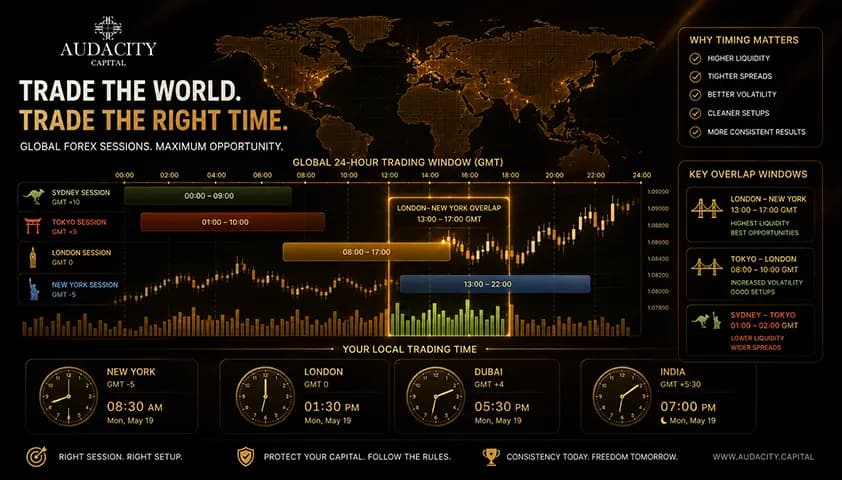
Take the prime window, the London session and especially the London New York overlap, and translate it into your local time. Your best window is where the high-liquidity hours overlap with hours you can genuinely be at the screen.
For many traders with day jobs, that is the evening, which works beautifully in some zones and badly in others.
Time zone | London session (local) | London-NY overlap (local) | Convenience |
India (IST) | from ~1:30pm | ~6:30pm to 9:30pm | Excellent for evening traders |
UK/Europe (GMT/BST) | from ~8am | ~1pm to 4pm GMT | Excellent, full daytime |
US (ET) | from ~3am | ~8am to 11am | Good, late morning |
UAE (GST) | through the afternoon | ~5pm to 8pm | Good, early evening |
All times above are standard-time approximations. Around Daylight Saving changeovers they shift by an hour, so confirm with a free session-time converter for your exact location.
India (IST)
This is the standout zone for evening traders. The London session opens around 1:30pm IST, and the high-volume overlap lands in the evening, roughly 6:30pm to 9:30pm IST on standard time.
If you work a day job and trade afterward, the single best window falls neatly into your free hours.
Note the Daylight Saving shift, and remember that during Indian afternoons the Asian session is winding down while London is opening.
United Kingdom and Europe (GMT/BST)
The most convenient zone of all. The London session is your local morning, from about 8am, and the overlap is the early-to-mid afternoon, roughly 1pm to 4pm GMT, or 2pm to 5pm BST in summer. You can trade both the London open and the overlap within normal daytime hours, which is hard to beat.
United States (ET)
US traders are well placed too. The London New York overlap is your local morning, roughly 8am to 11am ET, the most liquid window of the US trading day, with major US data landing early. After that, the New York afternoon thins out as London closes.
UAE and others (GST, AEST)
For the UAE on GST, the overlap is the early evening, roughly 5pm to 8pm, with the London session running through your afternoon.
For Australia on AEST, the big overlap falls late at night, so Australian traders often work the Asian session in their daytime instead.
The principle holds everywhere: find where deep liquidity meets the hours you can actually trade.
A final reminder. Every time above is on standard time.
Forex market hours stay constant in UTC, but your local conversion shifts around the Daylight Saving changeovers, so re-check with a converter during those weeks.
The best and worst times to trade
Now let us sharpen the when.
Best times:
- The London session and the London-New York overlap, for liquidity, tight spreads, and clean trends.
- By pair: euro and pound pairs in London and the overlap, yen and Aussie pairs in the Asian session, and the Canadian dollar around New York data.
- By day: Monday is slow as desks process the weekend, Tuesday and Wednesday are usually the strongest as data and central-bank commentary concentrate midweek, Thursday still moves, and Friday winds down.
Times to avoid:
- The thin-liquidity dead zones, especially the late New York to pre-Asian rollover around the 5pm ET handover.
- The Friday afternoon wind-down, when participation drains away.
- The Sunday open, where gap risk and wide spreads are common.
In those quiet hours, spreads widen and fills get poor.
Here is the funded-relevant point in one line: a poor fill in a dead zone can turn a normal trade into a limit breach. Day-of-week and pair behavior are typical patterns, not rules, and even the best window guarantees nothing.
For the full data and reasoning behind each day, see: Best Days To Trade Forex
Why session timing matters more on a funded account
On a personal account, a bad fill in a quiet hour is annoying. On a funded account, it can be the difference between a normal trading day and a breached limit.
Here is why timing carries more weight when you trade firm capital.
1. Thin-liquidity slippage is a breach risk.
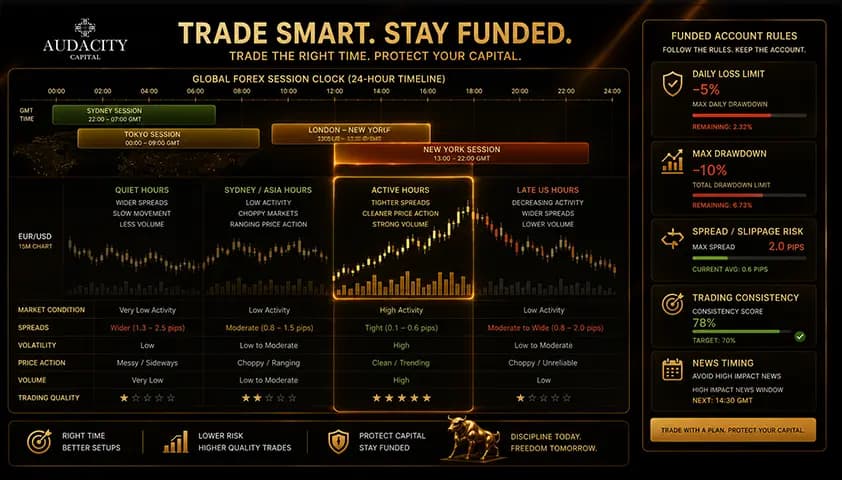
A bad fill or a sudden spread spike in a quiet hour can push a normal-sized position into your daily loss or maximum drawdown limit. The liquid window is therefore also the safer window.
2. Trade the right window, not all day.
A focused two to three hour window in the overlap is usually enough. Grinding all 24 hours mostly produces fatigue, overtrading, FOMO, and revenge trades, which is what actually damages accounts more than the market does.
3. Know when your firm trading day resets.
The daily loss limit resets at a set server time, often around the 5pm ET rollover. A session that straddles that reset is treated as two separate trading days, which changes your risk math. Always verify your firm's exact reset time before you build a routine around it.
4. Trade real liquidity, not lucky gaps.
Trading the deep liquidity of the main sessions reflects genuine market flow. As a general prop-firm principle, making most of your profit on a single illiquid news spike is the kind of behavior some firms watch for, because it looks more like a gamble than a process. Trading the liquid window keeps you on the right side of that distinction.
Trade Any Session: How Audacity Capital Fits Your Window
Here is the honest connection. Audacity Capital lets you trade forex on MT5 and DXTrade, and it allows trading across any session, including news trading and weekend holding.
That means you are free to pick the window that suits your time zone and your currency pairs rather than being boxed into set hours.
For a full breakdown of every major and minor pair, see our complete guide: The Best Forex Currency Pairs To Trade
An Indian trader can work the evening overlap, a UK trader can work the London open, and a US trader can work the late-morning window, all on the same terms.
The best window is the liquid one you can actually trade with discipline. A funded account gives you capital and structure, not an edge, and no session makes anyone profitable on its own.
What Audacity Capital adds is the flexibility to trade your real window plus clear, transparent rules to do it. If you want to put that into practice, explore the funded program and education resources and decide which path fits your routine.
FAQ
What is the best time to trade forex in India (IST)?
The high-volume London-New York overlap falls in the evening, roughly 6:30pm to 9:30pm IST on standard time, which is convenient for Indian traders with day jobs. Check the current Daylight Saving status, because the window shifts by an hour for a few weeks each year.
Which single window carries the most market activity overall?
Broadly the London-New York overlap, roughly 8am to noon New York time, because it carries the highest liquidity, the tightest spreads, and the biggest moves. The right choice still depends on your pairs and strategy, and no window guarantees a profit.
When should a funded trader stay out of the market?
During thin-liquidity hours: the late New York to pre-Asian rollover around 5pm ET, the Friday afternoon wind-down, and the Sunday open. Wide spreads and poor fills in those periods can breach your daily loss or drawdown limit on an otherwise normal trade.
Does the best window change with Daylight Saving Time?
Yes. London and New York change clocks on different dates in March and October or November, so the overlap shifts by about an hour for two to three weeks each year. Always anchor to UTC and re-check your local conversion during those weeks.
How many hours a day should a funded trader actually trade?
Often just two to three focused hours in your chosen window. Trading all day tends to cause fatigue, overtrading, and revenge trades rather than better results, and a challenge rewards quality over screen time.
Is the Asian session suitable for a funded account?
It can suit range-based strategies and yen or Aussie pairs, but it is quieter with thinner liquidity. That favors patient, smaller-size trading rather than the breakout and momentum setups that work best in the London-New York overlap.
What time is the overlap in my time zone?
On standard time it is roughly 1 to 4pm GMT, 8 to 11am ET, 5 to 8pm GST, and 6:30 to 9:30pm IST. Use a free session-time converter for your exact location and re-check around Daylight Saving changeovers.
Can trading quiet, illiquid hours get a funded account flagged?
It can raise questions, because making most of your profit on a single low-liquidity news spike can look more like gambling than trading. As a general prop-firm principle, trading the deep liquidity of the main sessions reflects genuine market flow and keeps your process clean.

暗号資産に規律あるリスクを適用する準備はできていますか?Audacity Capitalの新しい暗号資産商品を探索し、あなたの取引戦略を持ち込んでください。
詳細を見るニュースレター
ニュースレターに登録して最新情報を入手。
ソーシャルコミュニティに参加