


Equity vs Balance in Trading: Which Number Matters



You have two numbers next to each other in your account panel, and most of the time they don’t match. One of them is monitored throughout the day. The other one is the one with consequences.
The difference between the two requires just one sentence to explain, yet may lead to severe consequences. One of these figures defines when the trade is forced to be closed, and it's typically not one traders watch closely.
Equity vs Balance, Stated Plainly
Balance is what you get after you settle all accounts. The deposits, the withdrawals, and the realized profit and loss in closed positions. Nothing else touches it.
Equity is when you adjust your balance by the floating profit and loss on all your open positions in real time.
The formula can be shown in just one equation:
Equity = Balance ± floating profit and loss
Here is the part most glossary pages skip. With no positions open, the two numbers are identical. They separate only while something is live, and they converge again the second the last position closes.
There are also those platforms that include credits in your equity, as explained in the FAQ below, and should be looked at separately.
And here comes the part most glossary pages don't mention. In the absence of any open positions, both figures are identical. They diverge while there is a trade running and coincide once the last position is closed.
This is why the equity vs balance difference is so easy to miss. You will find them to be the same thing for a long period of time until an open position moves around.
That's the reason why the equity vs balance difference is so easy to miss. For a large part of the day, the two values are equal until an active position starts changing.
Balance | Equity |
Counts closed positions only | Includes open and closed positions |
Automatically updates upon the trade's closing or funds transfer | Updates continuously while a position is open |
Sits still through an open trade, however far it moves | Moves with every tick against or in your favour |
Tells you what you have actually realised | Tells you what you would have if you closed everything now |
Can't tell you of an open losing position | Cannot tell you how much of the gain is locked in |
Watch Both Numbers Through a Single Trade
Definitions don't require much mental effort to agree with. The difference between equity and balance stick comes from observing the two figures move.
Take one position on a $10,000 account. Observe the two numbers, from open to closed.
It is important to note that balance doesn't change during the trade. It only updates when the floating result is realised. As the trade occurs, equity reflects the nature of the trade.
All of this information regarding transactions with that account in that window resides in equity. The trader who focuses solely on balance sees only a stale number from before opening the transaction.
And then the loop is closed. With the position closed, the floating profit becomes realised, balance rises to match equity, and both figures are the same again until the next trade is opened.
Closing the position does not alter what you have earned. It only changes which number is reporting it.
Moment | Balance | Equity | What is happening |
Account funded, no positions open | $10,000 | $10,000 | No open position, so the two are identical |
Position opened | $10,000 | $10,000 | Opening the position does not affect either figure |
Trade goes against you | $10,000 | $9,700 | Equity reflects the $300 floating loss |
Trade recovers and moves in favour | $10,000 | $10,400 | Balance shows no change whatsoever |
Position closed at that level | $10,400 | $10,400 | The floating result is realised and the two converge |
If you are following the Trade Tab of your terminal, this is what equity and balance in MT5 are doing on every open trade you have.
Why Equity Is the Number That Can Close Your Trade For You

Margin is calculated from equity. Not balance. This concerns all margin accounts, whether it is evaluated or not.
The mechanic is straightforward. Free margin is your equity minus the margin already committed to open positions. It represents the capacity you have left to open another position or absorb an adverse move.
Margin level equals equity divided by used margin and is shown as a percentage. Both the margin call and the stop out happen when the level drops below certain thresholds.
As a result, when a provider force-closes a trade due to a margin rule, the equity is used for the calculation. Balance does not affect the margin level.
This is how it’s possible for a trader to get liquidated while having a balance that shows profits. A balance would not warn the trader because it does not change while the position remains open.
This is the simplest explanation of why equity is the figure to watch and it doesn't require any mention of prop firms. These margin calls and stop-out thresholds are different for each provider and each account type and should be referenced from the account specification.
The Asymmetry That Catches Prop Traders
In both evaluation and funding, the two figures are used to serve two different purposes, and this disparity is clearly not in favour of the trader.
Loss thresholds are often adhered to on equity. A floating loss can breach a daily loss limit in real time, even if the position recovers forty minutes later, and you may end up with either a daily loss limit or a maximum loss on an equity violation.
When measuring profit, it is often done on a closed balance. A position that is not in realised P&L positions will have no effect on the target until it is closed.
In summary: In most firms, an unrealised loss can ruin an account, but an unrealised gain will not advance it.
It is the description of how the industry normally operates but not a rule that always holds true. There are practices that vary, and some programmes calculate things differently on one or on both sides.
It is not meant to be cynical here. It is just the assumption of both rules reading the same number that brings the surprise.
Thus, before placing a trade with any programme rules, you have to clarify two issues:
- Which value the loss rules are observed against.
- Which value the profit target is measured on.
Two different questions, two different answers, both of which are described in the programme's documentation.
This knowledge will not help you to pass the evaluation. However, it can help you not to fail unnecessarily.
Where Your Balance Still Decides Things

Nothing mentioned above renders balance as an irrelevant statistic. It solves a separate problem altogether, and traders who leave after concluding that it can be disregarded have learned a wrong lesson.
Withdrawals are paid out based on the balance because unrealized profits are not actual money. The drawdown floor is usually calculated off the initial balance as well. In such a scenario, balance is what determines the position of the floor even if equity is the measure being compared against it.
And a record of closed balance over time is the only honest account of what a strategy has actually produced, since open positions can flatter or disguise a result for as long as a trader is willing to hold them.
Balance is the record. Equity is the live reading. You need both, and confusing which question each one answers is the actual error, not watching the wrong one.
What This Changes About How You Trade
Three checks. They are checks, not a strategy.
Size positions against equity, not balance. A trader calculating risk from a balance figure while carrying an open floating loss is sizing against money they do not currently have.
Watch equity intraday. Balance will confirm what happened after it is too late to act on it. On MT5 and on DXTrade both figures sit in the same panel, so this costs nothing but attention.
If you trade under programme rules, read which value each rule references and write it down. Loss rules and profit rules frequently reference different values. That answer lives in the rules documentation, not in general advice, and not in this article.
Conclusion
Balance tells you what has been realised. Equity tells you where the account stands right now, and it is central to margin calculations and many trading rules. That makes equity the figure you cannot afford to ignore while positions are open.
So open your account panel, find both figures, and if you are trading under programme rules, confirm which value each rule is written against. Two minutes of reading prevents most of the surprises described above.
As one example of why the rule definition is worth reading: Audacity Capital sets a fixed loss floor derived from the starting balance on its simulated evaluation and simulated funded account programs, so that floor does not move as the account grows.
The exact mechanics, including which value it is observed against, are published on the rules page and are worth checking directly.
Frequently Asked Questions
Check the open positions tab before assuming a platform error. The usual explanations are a credit line included in the equity figure, a pending charge that has not yet settled to balance, or a position still open that you have not noticed. On MT5 and DXTrade the open positions list will resolve this in seconds.
Free margin is your equity minus the margin currently committed to open positions. It is the amount available to open something new or to absorb an adverse move on what you already hold. Because it is calculated from equity, it falls as floating losses grow, even though nothing has been closed and your balance has not changed.
Both, depending on how your platform reports them. Swap and commission are charges applied in connection with positions, and platforms differ in whether they appear against the open position or settle directly to balance. Check how your own account reports them rather than assuming, particularly if you hold positions over multiple nights.
Credit is a non-withdrawable amount some providers add to an account. Platforms commonly include it in the equity calculation, which can make equity read higher than the money genuinely available to you. If your account carries credit, work out what your equity figure looks like without it before you use that number for anything.
Yes, in principle. A fast enough adverse move can take equity below zero and leave a negative balance once positions close. Many providers apply negative balance protection specifically to prevent this, and whether it applies to your account is stated in the account specification rather than assumed.

暗号資産に規律あるリスクを適用する準備はできていますか?Audacity Capitalの新しい暗号資産商品を探索し、あなたの取引戦略を持ち込んでください。
詳細を見るニュースレター
ニュースレターに登録して最新情報を入手。
ソーシャルコミュニティに参加

関連記事

Cross Trading — What Is Cross Trading?
Learn what cross trading is, how it works, its types, benefits and risks, and why cross-account trading is prohibited by many prop firms.


10 Best Prop Firms in Australia for 2026
Compare 10 prop firms available to Australian traders in 2026, including their challenges, drawdown rules, payouts, platforms and key differences.

ADX Indicator: How to Read Trend Strength
How the ADX indicator measures trend strength, what the 20 and 25 thresholds really mean, why platforms show different values, and how to apply it.
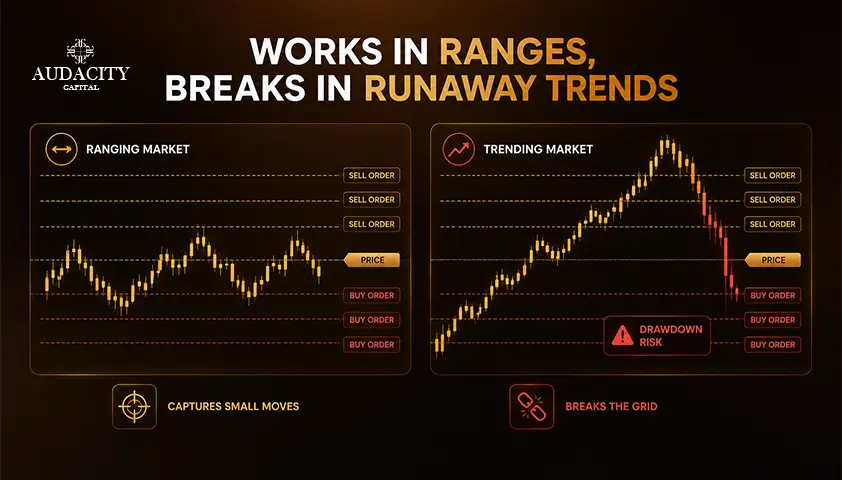
Grid Trading: How It Works and Where It Breaks
Placing orders across a range can profit from chop without predicting direction, but a trend can blow it up. See the mechanics and the failure mode.