


How to Do Scalping Trading: A Step-by-Step Guide for Beginners



Scalping trading moves at a different speed than almost every other trading style. A scalper is always trying to bank small, repeatable gains dozens of times in a single session, then get out before the market punishes hesitation.
If you ever focus on a 1-minute chart and think about how anyone reacts fast enough to profit from it, the answer is “Process”. Traders who last in this game follow the same sequence of steps on every trade, whether it's their first setup of the day or their 50th.
Here’s a detailed guide that breaks down how to do scalping trading the way consistently disciplined traders actually approach it, from picking a market through reviewing your results once the session ends.

Step 1: Choose the Right Market
You can scalp every market, but not every market rewards the effort. Before opening a single position, match your scalping trading plan to an asset class that behaves the way this style needs it to. Here’s an overview:
Forex is the classic scalping ground. Major pairs like EUR/USD, GBP/USD, and USD/JPY trade in enormous volume, continuously keeping spreads tight and price movement smooth. That tightness matters because a scalper targeting 5 to 10 pips/trade can watch half that profit disappear into entry and exit costs if the spread is wide.
Indices, including the S&P 500 or Nasdaq futures, offer strong liquidity during their market hours and trend cleanly within a session. It suits trend-following scalpers well.
Gold is an interesting middle ground. XAUUSD is liquid and volatile enough to produce frequent setups, but that volatility cuts both ways. Spreads can widen sharply during news releases, and a stop-loss that feels safe on a calm morning can get run through in seconds once volatility spikes.
Stocks work for scalping too, provided you stick to high-volume names. A thinly traded small-cap that looks like it's moving fast. However, if there aren't enough buyers and sellers on the other side of your trade, exiting at the price will be a real problem.
Crypto offers scalping around the clock with no session close. It gathers traders who can't work standard market hours. However, volatility here tends to be less predictable, and spreads on smaller coins can be brutal.
The pattern across all five is the same:
Liquidity keeps your spread tight – Volatility gives you something worth trading.
Therefore, chasing one without the other means scalping will stop being a numbers game and begin to turn into a guessing game.
Step 2: Choose the Right Timeframe
Now that the market is settled, the next big move is to decide which chart you'll actually watch. This is exactly where a lot of beginners guess wrong.
The 1-minute chart = the purest form of scalping. Every candle represents just sixty seconds of price action, which means setups appear constantly (but so does noise). Reacting to every flicker without context is how traders still learning how to do scalping end up overtrading before lunch.
The 3-minute chart filters out some of that noise, but it keeps entries reasonably tight. This chart is a fair middle ground for traders who find the 1-minute too twitchy but the 5-minute too slow for the pace they want.
The 5-minute chart is arguably the most balanced option for anyone still building consistency. 5 minutes reduces false signals compared to the 1-minute and gives each candle more meaning. It still allows enough trade frequency to make scalp trading worthwhile.
Here's what separates professionals from beginners on this step:
Professionals almost never trade off a single timeframe. They check a higher timeframe, often 15 minutes or above, purely to confirm the broader trend direction, then drop down to their execution chart to time the actual entry.
Taking a 1-minute setup that runs directly against the 15-minute trend is one of the quickest ways to turn a scalp into a loss that overstays its welcome. Match your execution timeframe to the bigger picture (and not the other way around).
Step 3: Pick a Simple Scalping Strategy
To do well at scalping, you need just one strategy that you understand well enough to execute without hesitating. It should ideally be the one that fits the market condition you're actually looking at.
Trend following works when the market is already moving in a clear direction. You enter in the direction of that move and ride the small continuation.
Breakout trading targets the moment price pushes through a well-defined level of support or resistance. It often starts with a burst of volume behind it. The appeal is speed, since a genuine breakout can deliver a fast move in your favor almost immediately.
Pullback strategies wait for price to retrace slightly against the trend before jumping back in. This offers a better entry price and a tighter, more defensible stop-loss than chasing the initial move.
Price action scalping skips indicators almost entirely and reads the raw candles, wicks, and structure on the chart to time entries and exits.
None of these approaches is inherently better than the others. For you, what should matter the most is:
- Picking one.
- Testing it on a demo account until it feels automatic.
- And most importantly, resisting the urge to switch every time you hit a rough patch.
If you want a deeper breakdown of how each of these performs in different conditions, you must read our full guide to the best scalping trading strategies.
Step 4: Prepare Your Charts
A cluttered chart will sabotage a scalp trading session quickly.
When ten indicators are fighting for space on a 1-minute candle, your brain needs an extra half-second to interpret what you're looking at, and half a second is often the difference between a good entry and a late one.
So keep the layout clean, as most experienced scalpers run with two or three indicators at most, commonly a moving average or two for trend direction and something like RSI for momentum. Anything beyond that will add clutter and not clarity.
Mark your key support and resistance levels before the session starts (and not while price is already approaching them). These levels become your reference points for entries, exits, and stop placement, and pre-marking them stops you from second-guessing a level mid-move.
Finally, pull up an economic calendar before placing a single trade. High-impact news releases, rate decisions, and employment data can widen spreads and whipsaw price in ways that make even a well-planned scalp unpredictable. Knowing what's scheduled lets you avoid trading straight into that chaos, or at least trade it with smaller size and wider expectations.
Step 5: Wait for a High-Probability Setup
Now this is where impatience creates most scalping trading losses.
Chasing a trade that doesn't fully qualify is one of the most expensive habits in this style.
A genuinely high-probability setup shows a handful of things lining up together, not just one:
- Trend alignment: The higher timeframe and your execution timeframe are pointing in the same direction, not fighting each other.
- Confirmation: Price has actually reacted at your level, whether that's a rejection wick, a break and retest, or a clean bounce, rather than just approaching it.
- Volume: There's enough participation behind the move to suggest it has follow-through, not just a thin spike that stalls immediately.
- Volatility: The market has enough movement to reach your target within your typical holding time, without being so erratic that your stop gets clipped by noise.
When two or three of these are missing, do nothing, and it will keep you within discipline. It may feel unproductive in the moment as you sit on your hands while a mediocre setup passes, but it's exactly what separates traders who last from traders who blow up an account chasing every flicker on the screen.
Step 6: Plan the Trade Before Entering
By the time you're ready to click buy or sell, the analysis part of scalping trading should already be finished. This step is about turning that analysis into a concrete plan. Here’s what you need to do:
Decide your entry point first, and be specific about it because "Somewhere around this level" isn't a plan. A precise price tied to the setup you already confirmed is important.
Set your stop-loss before you enter, not after. It should sit at the point where your original idea is proven wrong, not at a distance that simply feels comfortable. A stop placed too tight gets clipped by ordinary noise, while one placed too wide defeats the purpose of scalping in the first place.
Define your take-profit with the same precision. Scalpers generally work with modest, realistic targets, since the entire style is built around frequency.
Finally, check your risk-to-reward ratio before committing. Many experienced scalpers won't take a trade unless the potential reward is at least 1.5 times the risk, since a favorable ratio gives the strategy room to survive a normal losing streak without wiping out the gains from your winners. If the numbers don't work on paper, they are not going to show any magic once you're in the trade.
Step 7: Execute the Trade
Many traders fumble at this step because they fail to understand that “Planning” and “Execution” are two different skills.
Market orders get you in immediately at the current price, which matters when a setup is moving fast and waiting even a few seconds could mean missing the entry entirely. The trade-off is accepting whatever price is available at that instant, including a small amount of slippage.
Limit orders let you specify the exact price you want, useful when you're anticipating a pullback into a level. The risk is that price never reaches your limit, and the setup runs without you.
Whichever order type fits, execute without hesitating once your criteria are met. Scalping trading punishes indecision more than almost any other style. Stick to the plan you already built in the previous step and remember this isn't the moment to improvise.
Step 8: Manage the Trade
Once you're in a position, the temptation to fiddle with it starts almost immediately, and resisting that is its own skill.
Don't move your stop-loss further away because the trade is "about to turn around." That instinct comes from hope instead of analysis, and it's how a small, planned loss becomes a large, unplanned one.
Also, don’t over-manage in the other direction. Constantly adjusting your take-profit or watching every tick with your finger hovering over the close button adds stress without adding an edge.
The goal is simple: Exit according to the plan you set in Step 6, whether that means hitting your target, hitting your stop, or closing at a predetermined time if neither has happened yet. A position still open well past its intended window has usually stopped being a scalp and turned into an accidental, undersized swing trade.
Step 9: Review Every Trade
The trade isn't finished when the position closes. For anyone serious about how to do scalping trading long-term, the review is where the actual improvement happens.
Take a screenshot of your chart at entry and exit, and keep it alongside the trade. A month from now, remembering exactly what a setup looked like is nearly impossible, but a screenshot removes the guesswork.
Keep a trading journal, even a simple spreadsheet, logging the market, timeframe, strategy, entry, exit, and outcome for every trade. Because scalping produces so many trades, patterns in your journal show up faster than they would in a swing trading log, but only if you're recording every entry, including what worked and what didn’t.
Go back through your mistakes honestly. Did you enter before confirmation showed up? Did you move a stop-loss out of fear? Naming the specific error is far more useful than a vague sense that today was rough.
Track your win rate alongside your average risk-to-reward, since a 40% win rate can still be profitable with the right ratio, while a 70% win rate can quietly lose money if the losers are too large. Those lessons compound over weeks, and that compounding, not any single trade, is what builds a durable edge.
Building a Scalping Routine
Talent can be one factor adding to how you manage scalp trading, but consistency and a routine remove decisions you shouldn't be making mid-session.
Before the market opens → Review the day's news and economic calendar, mark the key levels you'll be watching, and check current volatility so you know what kind of session to expect.
During trading → Wait patiently for setups that meet your checklist, follow it on every trade without exception, and watch your trade count so you don't slide into overtrading once a session gets slow or a loss stings.
After trading → Journal every trade while it's still fresh, analyze whatever mistakes showed up, and review your overall performance rather than fixating on any single winner or loser.
For some effectiveness, do all three every session, until the sequence stops feeling like a checklist and starts feeling like how you naturally trade.
Common Beginner Mistakes
As a trader, you may understand how to do scalp trading in theory but can still fall into a handful of predictable traps.
- Trading without a plan. Entering on a feeling and not a confirmed setup is the fastest route to inconsistent results.
- Overtrading. More trades ≠ more profit, but it just means more spread paid and more chances of a bad decision.
- Ignoring spreads. Once realistic costs are factored in, a strategy that looks profitable on paper can quietly lose money.
- Entering too late. Jumping in after a move has already run reduces your reward and often puts your stop closer to price than your plan intended.
- Chasing momentum. Reacting to a big candle after it's already happened usually invites latecomers right before the move reverses.
- Trading during unsuitable conditions. The false signals a normal checklist would otherwise filter out; the thin, choppy, low-volume periods will produce them.
- Risking too much on one trade. A single oversized loss can undo the progress of dozens of small, disciplined wins.
Every one of these is avoidable, and almost none requires more skill to fix – yet more discipline is a non-negotiable.
Essential Tools for Scalping
With the right setup, you cannot turn a bad strategy profitable, but it makes executing a good one far easier once you already know how to do scalp trading with some consistency.
A fast execution platform matters more here than in any other style, since a few seconds of lag between clicking and getting filled can turn a well-timed entry into a late, worse one.
An economic calendar should be checked before every session, so you know when volatility is likely to spike for reasons that have nothing to do with your technical setup.
A trading journal, whether a dedicated app or a plain spreadsheet, turns a string of trades into usable data instead of a blur of wins and losses you can't learn from.
A watchlist keeps you focused on a small number of markets you actually understand well, rather than jumping between unfamiliar charts hoping one produces a setup.
A risk calculator removes the mental math from position sizing, so you're not doing arithmetic under pressure while a setup develops in real time.
None of these tools replace a strategy, but they remove friction, so the strategy you've already chosen gets executed the way you designed it, trade after trade.
Who Should (and Shouldn't) Try Scalping?
Scalping isn't a better or worse style than swing trading or long-term investing, but it's simply a different fit for a different kind of person.
It may be suitable for:
- If you are an active trader who genuinely enjoys being at the screen for focused stretches and not occasionally.
- If you are a disciplined trader who can follow a checklist even when a trade isn't going your way.
- Surely, if you can make fast decisions and comfortably action a setup within seconds without deliberating.
Someone who works a flexible schedule, can dedicate an uninterrupted hour or two to a single market, and doesn't mind the intensity of frequent decisions is generally a good candidate.
But someone still figuring out how to do scalp trading profitably should treat the first few weeks as pure practice.
It is less suitable for:
- If you are amongst those who cannot monitor markets closely, since a scalp left unattended can run well past its stop before anyone notices.
- If you are uncomfortable with rapid decision-making, since hesitation costs more here than in slower styles.
- People seeking a low-maintenance style, since scalping is, almost by definition, high-maintenance.
Someone juggling back-to-back meetings and only able to glance at charts once or twice a day will likely find more success in swing trading or longer-term investing, where a missed hour rarely changes the outcome of a trade.
Scalping Trading Checklist
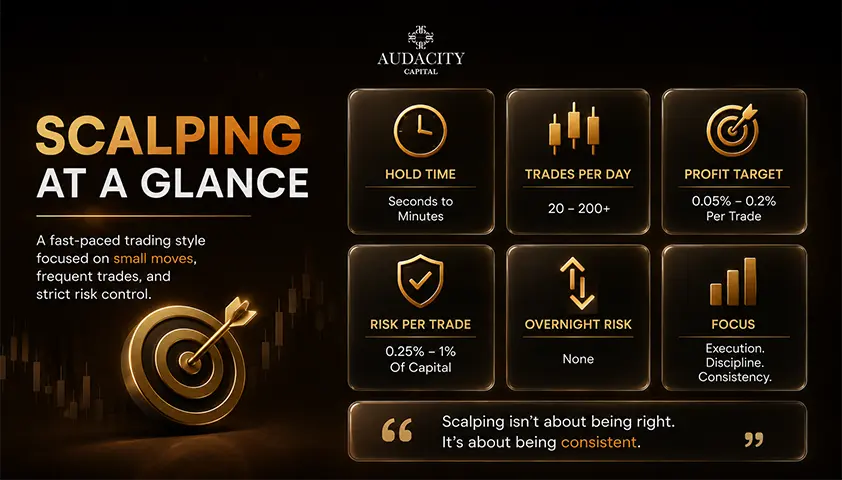
Print this or pin it next to your monitor. This checklist isn’t a guarantee for a winning trade, but it will reliably keep you from taking the kind you'd regret in hindsight.
Before entering a trade:
- Trend confirmed
- Key level identified
- Entry trigger present
- Stop-loss placed
- Position size calculated
- Risk acceptable
- News checked
After the trade:
- Outcome recorded
- Screenshot saved
- Rules followed?
- Improvement noted
If you're still building the fundamentals, our What Is Scalping Trading? A Beginner's Guide walks through the core concepts this checklist assumes you already understand, which makes it a useful stop before your next live session.
Conclusion
In the end, scalping trading rewards preparation and discipline far more than it rewards raw prediction skill. The traders who last are the ones who choose a market, respect their timeframe, wait for setups that genuinely qualify, and manage trades according to a plan instead of a mood.
None of the nine steps above is complicated in isolation. What's difficult is doing all of them, in order, on every trade, especially the ones where you'd rather skip a step and jump straight to clicking buy.
Before risking real capital, practice this entire process on a demo account until it feels automatic. Once you've refined a single approach and can execute it without hesitating, you'll have a genuinely usable answer to how to do scalping trading, not just a theoretical one.
Frequently Asked Questions
It can be, but the learning curve is steeper than it looks from the outside. Most beginners underestimate how much spread and commission eat into thin profit targets until they actually track it.
There's no fixed number, but risking only a small percentage of capital per trade, often around 0.5 to 1%, matters more than account size itself. A trader risking 1% of a modest account while following strict rules will typically outlast someone risking a larger share of a bigger account without the same discipline.
There's no universal number, and forcing a specific count is itself a common mistake. The right amount is however many genuinely qualify under your checklist on a given day, which might be three trades during a quiet session and considerably more during an active one.
Not universally. Most retail forex and CFD brokers permit it, but a few restrict or discourage it, particularly on account types with wider spreads built in specifically to make high-frequency trading less appealing.

暗号資産に規律あるリスクを適用する準備はできていますか?Audacity Capitalの新しい暗号資産商品を探索し、あなたの取引戦略を持ち込んでください。
詳細を見るニュースレター
ニュースレターに登録して最新情報を入手。
ソーシャルコミュニティに参加