



Trading Psychology for Funded Traders: Pressure, Fear and Revenge Trading


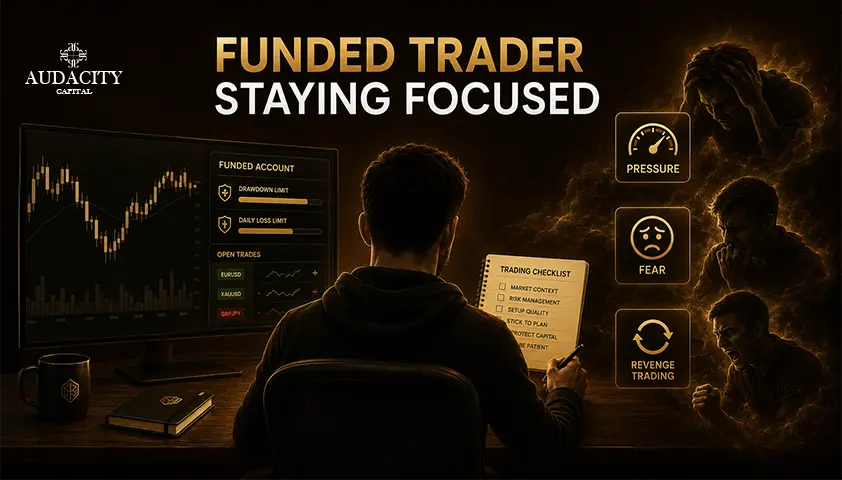
You can have a clean and a tested and profitable strategy and still lose money on account after account. The problem is not whether or not you'll generate revenue. It is a test of the ability to follow a process when under pressure.
The truth that most traders find out the hard way: The majority of funded accounts are lost due to trading psychology, not strategy.
You understand the pattern; You're trading well for three weeks, then take a normal loss, then size up to get it back and break your limit on day 19.
The good thing about all this is that the people who get funding do not necessarily have better emotions than yours, but they have better systems for managing their emotions.
This shows you that this is a skill which you can develop. This guide looks at why funded trading is difficult, why funded trading accounts fail, the emotional cycle of trading, systems to correct the problem, and one honest opinion on when it becomes more than just a bad day.
Why trading psychology hits funded traders harder
Trading someone else’s money through rules is much more serious than trading your own money; it is not because of some kind of psychological weakness, it is because of the pressures that are imposed on you because of the funded arrangement.
1. Loss feels permanent. Exceed the maximum drawdown setting, the minimum amount that your account can safely drop below before closing, and the account is lost. No further deposits can help restore it.
2. The charge exerts pressure. You have already paid to be here, and each time you lose can seem like you are wasting the money you have already spent.
3. The rules deprive you of any backdoors. There's no way to wait it out quietly or to "average down" to recover the position. The guardrails keep you on a process.
4. The target plus a deadline forces the clock. A profit target with a time frame sneaks in the idea of being goal-oriented, essentially overrides your trading plan.
5. A trailing drawdown creates the feeling of being chased. If your loss limit moves along with your equity, you're never really able to relax.
6. The payout anticipation creates the urge to trade out of fear. Approaching a payout, the fear of losing your profits may become stronger than the need for more.
There is one very simple explanation of why smart individuals continue adjusting stops and doubling their losing trades. This sort of stress activates the brain's threat response, which may change the decision process from a rational, planning part of the brain to the reactive, emotional part.
This is a general statement and is not being used as a trading-specific statistic.
The point is pragmatic – the aim is to deal with this reality rather than trying to switch it off. The company's drawdown and loss limits are not set to trap you. They're safety barriers to both protecting the account and the mindset.
The psychological traps that blow funded accounts
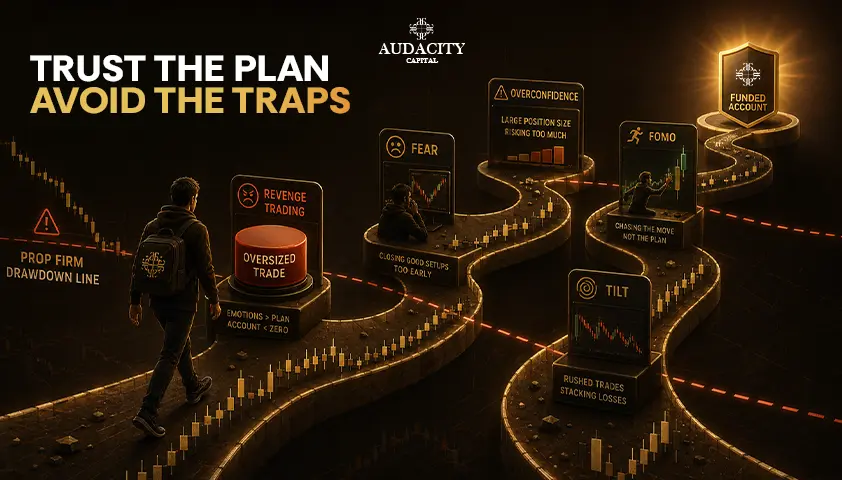
These are the named enemies. They're the emotional patterns that lead to the end of accounts, the first line of defense is awareness.
A fact that links them all is that accounts do not typically die after the first loss, they die after what the trader does next.
Here are some traps at a glance
Trap | What triggers it | What it makes you do | The fix |
Revenge trading | A stop-out you wish to remove | Oversize, chase, break limits | Close the platform for 30 minutes after a loss |
Fear | Risk of breaching or giving back gains | Hesitate, cut winners and freeze | Pre-set risk, so that the outcome is capped. |
FOMO | A big move you missed | Buy late at a low cost | Only trade setups that meet your checklist |
Overconfidence | A winning streak | Oversize, ignore stops | Maintain size constant for all streaks |
Tilt | A violation or large loss | Trade recklessly | Stop and step away until calm |
1. Revenge trading (the number 1 account-killer)
Revenge trading is the desire to make up for a loss as soon as possible, which results in overtrading, rash entries and rule violations. Here is the honest truth.
The funded trader reaches the daily loss limit and quits. The one that cannot get funded hits the daily limit but takes another position since “this time it’s going to be different.”
It is never different. Accounts get killed by the next trades after the loss, and not by the loss itself.
2. Fear (of breaching, of losing, of giving back)
Fear has many faces. The fear of failing to pass the test leads to doubt and second-guessing and you will fail to enter into valid setups and will trade scared money.
Loss aversion, the feeling of a loss being higher than joy of an equivalent win, leads to cutting winners early.
Fear when reaching the daily limit causes premature exit from working trades. Fear of giving up the profits close to the target either freezes you or causes erratic trading behavior to ensure passing.
Here’s the reframe that works: in prop trading, fear is usually not the fear of losing money but the fear of losing control.
3. FOMO (fear of missing out)
The fear of missing out (FOMO) is the urge to press for a move that has already occurred. You observe a big run on a pair that you haven't traded, your brain says there's still room, you buy at the worst price and the trade turns around and hits your stop.
FOMO is purely an emotional reaction, not a trade. It is particularly costly due to the time pressure of the challenge.
4. Overconfidence after wins
Winning streaks are just as harmful as those of losing ones. Overconfidence results in improper position sizing, lack of stops and deviating from the strategy that made you successful in the first place. True confidence derives from consistently implementing your strategy and not from a hot streak.
5. Tilt (the umbrella destructive state)
Tilt is the emotional overload that sets in after a rule is broken, or a tremendous loss is sustained. Rational decision making fails and more and more risk-taking behavior emerges. It's the most destructive state in prop trading; it's where revenge trading and oversizing happens.
The only way to solve it is to pause and take a breath until you feel you're calm
The emotional arc of a funded account
Your emotions are not random. They go through predictable stages during an evaluation and in a funded account, and if you can recognize the stage you're in, you can take the appropriate countermeasure before it costs you.
Early confidence. Things are going great and the account is smooth. The risk of this stage is complacency and gradual oversizing. The remedy is to slow down and proceed with the good run as if it were the norm and not proof to push.
Building up the pressure as the target approaches. As the profit target comes into view, goal-oriented thinking starts overriding the plan. The solution is to reduce the sizes of the trades and extend the trading routine so that it would not affect your performance.
Fear following a loss or near a limit. Losses, the daily limit or the target itself can make you hesitate, exit prematurely or erratic locking-in. The remedy is to turn to your checklist and act according to your trading rules.
Tilt after a violation or an enormous loss. This is when accounts expire. The only countermeasure that works in this state is to get away completely.
Post-funding drift. Once you pass, the stress of passing goes away and discipline subtly fades. The solution is easy and harsh: treat the funded account in exactly the same way you treat the evaluation – same process, same constraints, same checklist.
Match the countermeasure to the stage and you will no longer be fighting your emotions blindly.
How to build discipline under pressure (systems beat willpower)
__webp__orig.webp)
Under stress, willpower breaks down. Pre-built systems do not. This is the fundamental rule of prop firm trading psychology: the funded traders did not force their way through with sheer willpower, they created systems and followed them.
Here is the playbook.
1. Pre-set your risk.
Apply position sizing as an emotional shield. Knowing that you cannot lose more than a certain fixed percentage with each trade and each day will strip the element of risk that causes fear.
Risk management is not only about capital protection, it's also about emotional protection.
2. Set a personal limit stricter than the firm's.
End your day’s trades on a loss that comfortably stays within the daily limits set by your firm. That buffer will save you and give you time to get away before you get overrun with emotion.
3. Build circuit breakers.
Set up an inviolable rule of shutting down the platform for 30 min following each loss and exiting the session following the second consecutive losing trade.
Revenge trading lives in the gap between a loss and the next trading impulse. Close the gap by switching off the screen.
4. Utilize a trade checklist.
Before each trade, go through the checklist to ensure that all conditions are met. It will help you resist making impulsive decisions.
5. Emotion tag Journaling.
Label each trade as calm, anxious, frustrated or revenge. With time the trends will be revealed as your revenge trades will turn out to be less profitable than the calm ones. It helps transform generic tips into statistics.
6. Perform pre-trade and post-trade procedures.
Plan and review your plan prior to the session. Journal and reflect on whether you followed your process or not after.
7. See losses as business costs.
The storekeeper does not panic when paying rent. Losses within your risk parameters are a cost of doing business and not a judgment on you. Separate your self-value from your performance, because a loss trade doesn't mean that you are a poor trader.
8. Support the basics.
If the market gets too high, take a few deep breaths or a quick break. Ensure that you are having a decent sleep, some exercises and an accountability partner. Singles trading generally tend to amplify bad patterns.
Your one-page discipline system
- Risk per trade and per day fixed and small, before the session.
- A daily personal stop within the bounds of the company.
- Platform closed for 30 minutes after any loss.
- Session over after two losses in a row.
- Checklist to read before each entry.
- Each trade is documented including an emotional tag.
- Same routine for the funded account as the evaluation.
There are no sure-fire fixes among these. Trading psychology is not a "switch," it is a practice and there is no technique that can beat the math of the market.
The role of systems is keeping your decision making process clean when you are under pressure to let your edge have a chance to work.
When it's more than a bad day
There is a point to be aware of, which most pages overlook.
A bad day you learn from is part of the business. A pattern is something else. When you cannot stop yourself, when you chase the losing trades to make them up, when you hide your trading, when you trade the money you cannot afford to lose or feel distressed – that is not a bad day.
Named plainly and without shame: Revenge trading, making up for losses, and being unable to quit are traits similar to compulsive or problem gambling.
The funded structure can feed that loop. A paid fee, a deadline, and the urge to win it back are exactly the ingredients that pull someone back to the screen when they should be away from it.
Warning signs to watch for:
- You simply cannot stop even when you promised yourself that you would.
- You continue trading to get even rather than execute a strategy.
- You trade funds you cannot risk losing.
- You keep your trading hidden from those who are close to you.
- Your trading affects your sleep, finances, relationships, or well-being in general
In case any of the above is true, the right thing to do would be to step back rather than to fight. Contact someone for assistance.
Note: This is not medical or psychological advice, and a qualified professional should be consulted for genuine concerns. There is no shame in stopping. No funded account is worth your wellbeing.
How Audacity Capital's Structure Protects Your Mindset
Discipline is built on structure. Audacity Capital's clear, transparent risk limits act as guardrails for both the account and the mindset, because a known daily loss and maximum loss are exactly what prevents the panic spiral that leads to revenge trading.

Trade with Audacity Capital
Login in to access your trader dashboardWhen the worst case is already defined, there is less for fear to grab onto.
There is one more thing worth naming honestly for trading psychology for funded traders: with no consistency rule, the requirement some firms impose to keep your daily results within a narrow band, you carry one less source of pressure that can distort otherwise good decisions. Fewer artificial constraints means more room to trade your plan calmly.
A funded account is capital and structure, not an edge and not a guarantee. It will not make anyone profitable on its own and it does not guarantee a pass.
What it gives you is a clear, simulated environment with honest rules to build your discipline on. If that is the structure you want to practice trading under pressure within, explore Audacity Capital's funded programs and education resources.
Learn more about our latest guide Introduction To The Psychology Of Day Trading
FAQ
Because the funded structure adds pressures your own account never had: hard rules that can end the account, a fee you paid, and a target with a deadline. Losses feel permanent, so every decision gets amplified by the fear of failing. The strategy is usually fine. The environment is what changes your behavior.
Treat the urge to size up after a loss as your signal to do the opposite, reduce size or stop entirely. Set a hard rule to close the platform for 30 minutes after any loss and quit for the day after two. Revenge trades happen in the gap between a loss and the next click, so the fix is to physically leave the screen and close that gap.
That is fear of giving back gains. The closer you are to passing or to a payout, the more your brain shifts from trading your plan to protecting the scoreboard. That shift causes premature exits and missed setups. The countermeasure is to shrink size near the target and keep following your checklist rather than the finish line.
For most traders who already have a workable edge, yes. Challenges are usually lost to emotional decisions like revenge trading and oversizing rather than to the strategy itself. This is not a guarantee that emotional control makes you profitable, because most traders still lose, but it removes the self-inflicted damage that ends accounts.
Keep treating the funded account exactly like the evaluation. Same pre-market routine, same checklist, same risk limits. Discipline tends to loosen once the pressure of passing is gone, and post-funding drift is a real account-killer. Consistency in your process matters more after you pass, not less.
Tilt is emotional flooding after a loss or rule violation that overrides rational decisions. It is the state inside which most reckless trading happens. The fastest recovery is to stop trading immediately, step away from the screen, and not return until you are genuinely calm. There is no clever trade that gets you out of tilt, only distance from the market.
Yes, because tagging each trade with your emotional state reveals patterns over time, such as your revenge trades losing far more often than your calm ones. That turns abstract advice into concrete numbers you can act on. For the full method, see our dedicated trading journal guide.
It can. A paid fee, a deadline, and the urge to win losses back can feed a compulsive loop. If you find you cannot stop, are chasing losses to get even, or it is causing real distress, step back and consider professional support. This is not a diagnosis and not medical advice, just an honest signpost to take seriously.

暗号資産に規律あるリスクを適用する準備はできていますか?Audacity Capitalの新しい暗号資産商品を探索し、あなたの取引戦略を持ち込んでください。
詳細を見るニュースレター
ニュースレターに登録して最新情報を入手。
ソーシャルコミュニティに参加

関連記事

The First 30 Days: What New Traders Should Focus On (And Ignore)

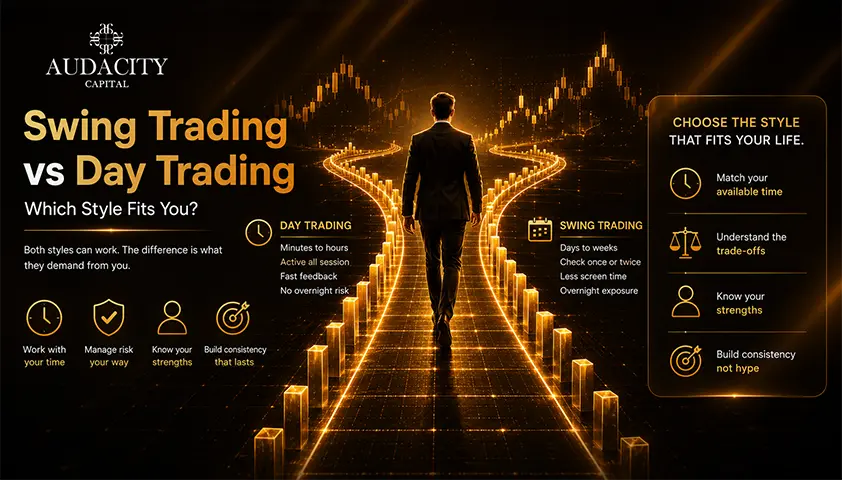
Swing Trading vs Day Trading: Which Is Right for You?
One style costs you your afternoons. The other costs you your sleep. Here is how swing trading vs day trading really compare, and how to pick.

What Is A Black Swan Event in Trading & Finance?
Learn what a black swan event is in trading and finance, with real examples, market impact, and strategies to manage risk during extreme events.
__webp__orig.webp)
From Demo To Live: When Are You Ready To Go Live?